National Unity Day, or Rashtriya Ekta Diwas, is observed in India every year on October 31 to mark the birth anniversary of Sardar Vallabhbhai Patel. India started the observance in 2014 to honour his role in uniting over 560 princely states. The 2026 edition marked his 151st birth anniversary.
What Is National Unity Day and Why Is It Celebrated on October 31?
National Unity Day is the national observance held in India on October 31 to honour the birth anniversary of Sardar Vallabhbhai Patel and his work for national integration. India observes it as Rashtriya Ekta Diwas and Ekta Diwas. The day reminds citizens to protect the unity, integrity and security of the country.
The Government of India announced the observance in 2014. The first celebration took place on 31 October 2014. The Ministry of Home Affairs is the nodal authority for the national observance and issues yearly directions to central offices, public sector units and state governments.
The date was chosen because Patel was born on 31 October 1875. The year 2025 marked his 150th birth anniversary, which was observed with a year long commemoration. The year 2026 marked his 151st birth anniversary. On 31 October 2015, during the Ekta Diwas function, the Prime Minister announced Ek Bharat Shreshtha Bharat. The programme creates structured cultural links between paired states and Union Territories and promotes interaction through language, art and youth exchange.
Who Was Sardar Vallabhbhai Patel?
Sardar Vallabhbhai Patel was a freedom movement leader, the first Deputy Prime Minister of independent India and the first Home Minister. He is known as the Iron Man of India for his firm role in uniting the country after Partition. His birth anniversary is observed as National Unity Day.
Patel was born on 31 October 1875 in Nadiad in present day Gujarat. His family belonged to Karamsad in the present Anand district. His father was Jhaverbhai Patel and his mother was Ladba. He trained as a lawyer and qualified as a barrister in England. After his return, he built a successful legal practice in Godhra, Borsad and Ahmedabad.
From Kheda to Bardoli: How Vallabhbhai Became Sardar
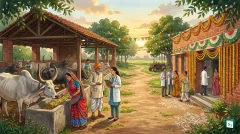
Patel entered public life under the influence of Mahatma Gandhi. Gandhi chose him as deputy commander for the Kheda Satyagraha in 1918, a peasant protest in Gujarat against tax collection despite crop failure. The campaign succeeded and made Patel a trusted organiser.
In 1924, Patel became President of the Ahmedabad Municipal Board. He improved drainage, sanitation, cleanliness and water supply in the city. His main national breakthrough came with the Bardoli Satyagraha in 1928. Patel led farmers in Bardoli against a sharp rise in land tax. The British government finally accepted a settlement and returned seized land. People honoured him with the title Sardar, which means leader or chief.
He later became President of the Indian National Congress at the Karachi session in 1931. He played a central role in the Quit India Movement of 1942 and was imprisoned in Ahmednagar Fort from 1942 to 1945.
How Patel Integrated More Than 560 Princely States
At Independence, India had two types of territory. There were 17 provinces of British India and more than 560 princely states. These states covered nearly two fifths of the land area. Under the Indian Independence Act, 1947, British paramountcy ended. Each ruler could join India, join Pakistan or claim independence. Without quick action, the new country would have had gaps across its map.
The government set up the States Department on 5 July 1947. Patel took charge as its Minister and V. P. Menon served as Secretary. They asked rulers to sign an Instrument of Accession. Under it, a ruler gave the Government of India control over only three subjects, defence, external affairs and communications. A Standstill Agreement kept railways, posts and other shared services running while full merger was worked out. By 15 August 1947, almost every state inside Indian territory had acceded.
The next stage was full integration. Small states merged with nearby provinces. Others were grouped into new unions such as Saurashtra, Rajasthan, Madhya Bharat, PEPSU (Patiala and East Punjab States Union) and Travancore-Cochin. Some difficult cases needed firm action:
- Junagadh: The Nawab announced accession to Pakistan against the wishes of most people. India arranged a plebiscite in February 1948. Voters chose India by a large margin.
- Hyderabad: The Nizam resisted merger. India carried out a police action codenamed Operation Polo in September 1948. The state then joined India.
- Kashmir: After attack from Pakistan in October 1947, Maharaja Hari Singh signed the Instrument of Accession and sought Indian help.
- Travancore, Jodhpur and Bhopal: Patel combined talks, appeals to patriotism and pressure to bring them into India.
Patel died on 15 December 1950. He is also remembered as the creator of the All India Services. He called them the steel frame of India that would protect unity and administrative continuity. The Indian Administrative Service and the Indian Police Service trace their modern form to his effort.
How National Unity Day Is Celebrated Across India
Schools, colleges, government offices, public sector units, police forces and youth groups take part in the observance across the country. The main national function is held at Ekta Nagar in Narmada district of Gujarat. Local programmes stress that unity in diversity keeps the country strong and secure.
Run for Unity and the National Unity Pledge
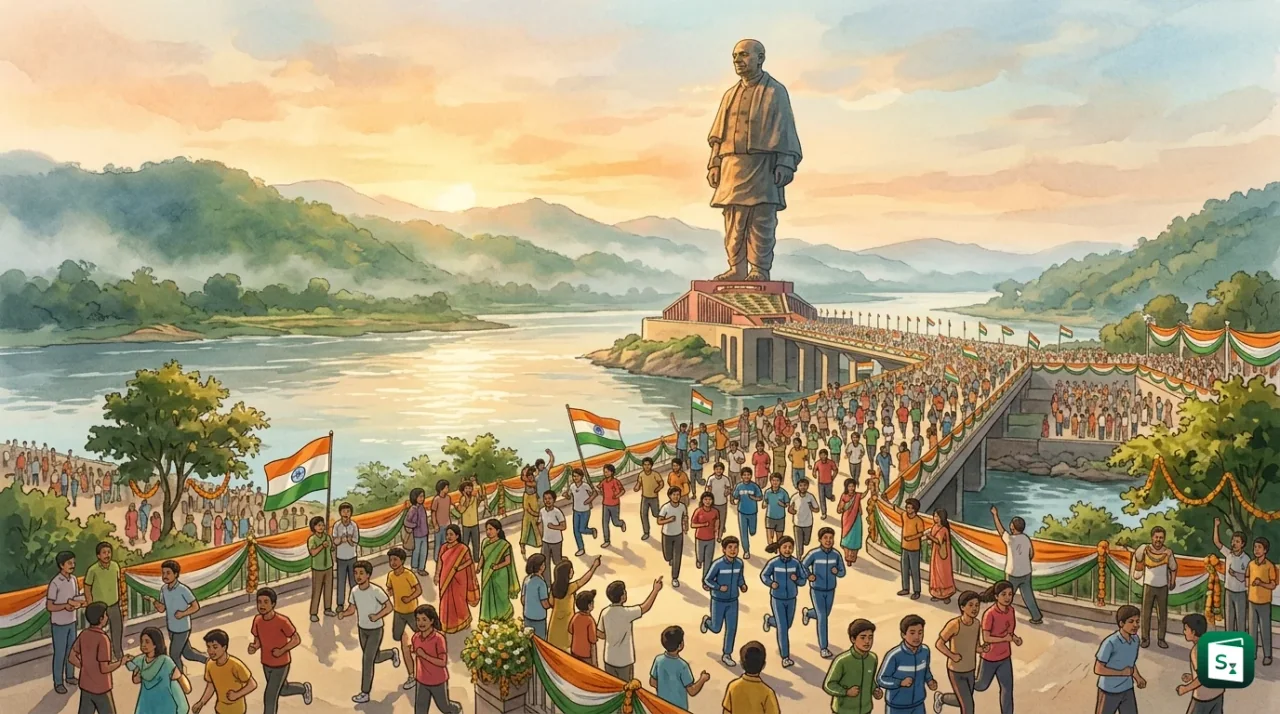
The Run for Unity is a short public run organised in capitals, district towns and villages. Students, National Cadet Corps (NCC) cadets, National Service Scheme (NSS) volunteers, athletes and citizens take part. The first run in Delhi ran from Vijay Chowk to India Gate. In recent years the Delhi run starts from the Major Dhyan Chand National Stadium. In 2024 the Home Minister flagged off the Delhi run. In 2026 runs were held across the country on the morning of October 31.
Offices and schools also hold a pledge ceremony. In the National Unity Pledge, participants promise to preserve the unity, integrity and security of the nation and to spread the message among fellow citizens. They take the pledge in the spirit of the national unification made possible by Patel. They also promise to contribute to the internal security of the country. The pledge is read in English and Hindi, and states also use regional languages.
Other common activities include march pasts by police and Home Guards, debates, quizzes, essay contests, speeches, drawing events, seminars and cultural shows on unity and Patel’s life.
Ekta Diwas Parade at Ekta Nagar in Gujarat
The central event is the Ekta Diwas Parade at Ekta Nagar, earlier known as Kevadia. The Prime Minister offers floral tribute at the Statue of Unity, administers the unity pledge and takes the salute. Central Armed Police Forces such as the Border Security Force (BSF), Central Reserve Police Force (CRPF), Central Industrial Security Force (CISF), Indo-Tibetan Border Police (ITBP) and Sashastra Seema Bal (SSB) march with state police contingents, the NCC and bands. Recent parades have included daredevil motorcycle shows, camel and horse contingents, dog squads with Indian breeds, pipe bands and an Indian Air Force flypast.
| Parade Element | What It Shows |
|---|---|
| Marching contingents | Discipline and readiness of police and central forces |
| Tableaux | Cultural heritage of states and Union Territories |
| Cultural programme | Classical and folk dances of India |
| Special displays | Dog squads, motorcycle stunts, martial arts, school bands |
The 2025 parade marked the 150th birth anniversary and used the theme Unity in Diversity. It featured ten tableaux and a cultural show by 900 artists. A commemorative coin and postal stamp were also released.
The 2026 parade was held in the evening at Ekta Nagar. Its highlights were the theme of a Naxal free India and 150 years of Vande Mataram. About 2,000 artists from 126 districts once affected by Left Wing Extremism presented a theatre performance directed by the National School of Drama. Fifteen tableaux carried ideas linked to Vande Mataram. About 5,000 artists from different states living in Gujarat presented regional dances under Ek Bharat Shreshtha Bharat. Development projects worth over ₹400 crore for Ekta Nagar were inaugurated around the same visit.
What Is the Statue of Unity in Gujarat?
The Statue of Unity is the memorial to Sardar Patel and the tallest statue in the world. It stands in Gujarat on Sadhu Bet island in the Narmada river at Ekta Nagar in Narmada district. It faces the Sardar Sarovar Dam and stands between the Satpura and Vindhya ranges, about 100 kilometres southeast of Vadodara.
The statue is 182 metres tall, which equals 597 feet. The height matches the number of seats in the Gujarat Legislative Assembly. With its base, the total structure is 240 metres tall. A viewing gallery at 153 metres can hold about 200 visitors at a time and offers a view of the dam, reservoir and hills. The statue was designed by sculptor Ram V. Sutar. It was built by Larsen and Toubro. The project was announced in 2010 by the then Chief Minister of Gujarat. Construction started in October 2013. The Prime Minister dedicated it to the nation on 31 October 2018, Patel’s 143rd birth anniversary.
The statue shows Patel in a dhoti and shawl in a walking pose. Engineers used steel framing, reinforced concrete and bronze cladding. Two tuned mass dampers of 250 tonnes each keep it stable. It can withstand winds up to 180 kilometres per hour and earthquakes up to 6.5 magnitude. As part of public participation, farmers donated used iron tools for the project. A museum and exhibition hall at the base explain Patel’s life and the construction method.
The site has become a major tourist centre. It recorded nearly 2.9 million visitors in its first year and crossed 15 million cumulative visitors within five years. It is listed among the 8 Wonders of the Shanghai Cooperation Organisation. For many visitors, the statue links the memory of Patel’s integration work with the present message of Rashtriya Ekta Diwas.
Key Takeaways
- National Unity Day, or Rashtriya Ekta Diwas, is observed every year on 31 October, the birth anniversary of Sardar Vallabhbhai Patel.
- India started the observance in 2014 to honour Patel’s role in integrating over 560 princely states after Independence.
- Patel, born on 31 October 1875 in Nadiad, Gujarat, earned the title Sardar after the Bardoli Satyagraha of 1928 and served as India’s first Deputy Prime Minister and Home Minister.
- Celebrations include the Run for Unity, the National Unity Pledge and the Ekta Diwas Parade at Ekta Nagar in Gujarat.
- The Statue of Unity in Gujarat is 182 metres (597 feet) tall, the tallest statue in the world, and was dedicated on 31 October 2018.