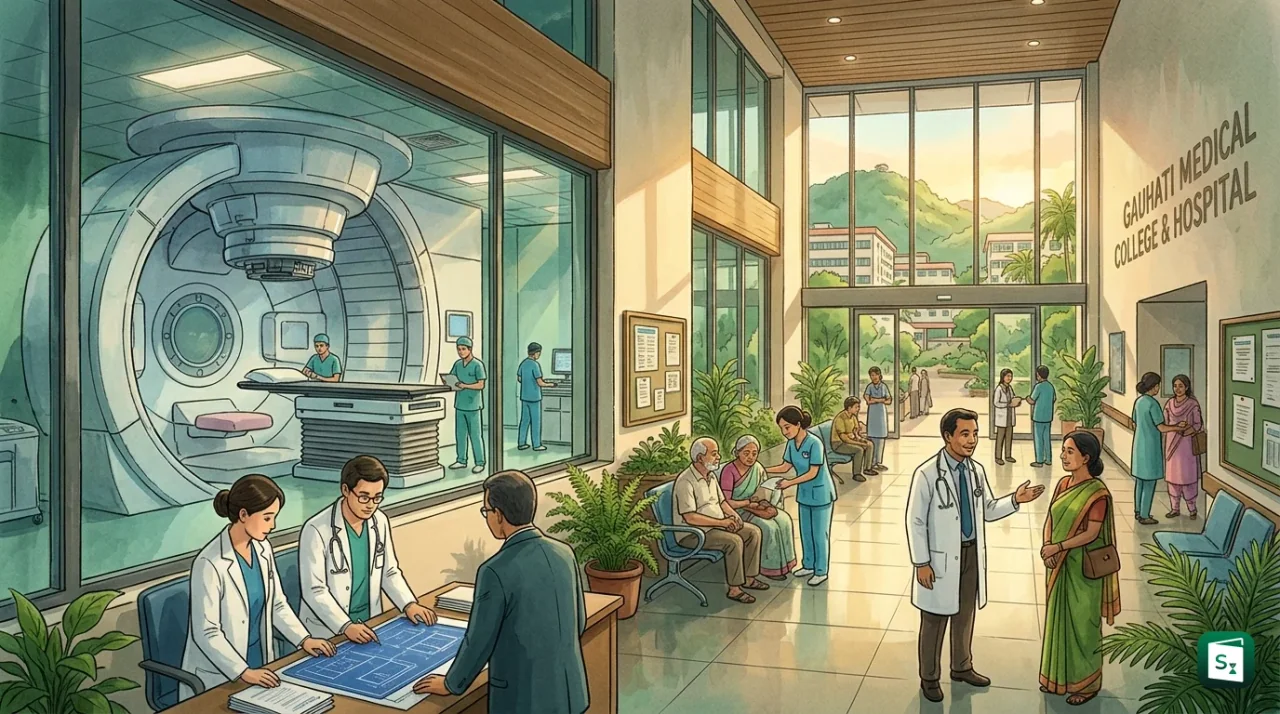
On 31 October 2026, the Assam government signed a contract with IBA Particle Therapy India Pvt Ltd, the Indian arm of Belgium-based Ion Beam Applications (IBA), to set up a proton beam therapy centre at the Gauhati Medical College and Hospital (GMCH) in Guwahati. The ₹600 crore project is expected to be ready within three years. It will be the third proton therapy facility in India and the first to be run by a state government, bringing one of the most precise cancer treatments into the public health system.
What Is Proton Therapy?
Proton therapy, also called proton beam therapy or proton radiation therapy, is a type of external radiation treatment that uses protons to destroy cancer cells. Protons are positively charged particles found in the nucleus of an atom. In this treatment, a particle accelerator speeds up protons and directs them as a narrow beam into the tumour, where they damage the DNA of cancer cells and stop them from growing.
In standard X-ray radiation, the beam passes through the body and gives radiation both before and after the tumour. Proton therapy works differently. Doctors tune the energy of the proton beam so that most of the energy is released exactly inside the tumour and almost no dose goes beyond it. This sharp peak of energy release is called the Bragg peak. Because of this property, proton therapy can hit the tumour with a high dose while giving a much lower dose to nearby healthy organs.
Proton therapy does not replace surgery or chemotherapy. The Assam government noted that it is especially valuable for children and for tumours close to sensitive parts like the brain, spinal cord and eye. In children, healthy tissues are still growing, so limiting extra radiation lowers the risk of growth problems and second cancers later in life.
How Does Proton Therapy Work?
The proton beam therapy machine creates protons from hydrogen atoms, speeds them up in an accelerator such as a cyclotron or synchrotron, and guides them through magnets to the treatment room. The patient lies on a robotic couch while a rotating frame called a gantry moves around the body to send the beam from the best angle. Each beam lasts only one to two minutes, and the patient feels no pain during the session.
Modern centres in India use pencil beam scanning and Intensity Modulated Proton Therapy (IMPT). In this method, a thin pencil-sized proton beam paints the tumour spot by spot and layer by layer. The energy is changed for each layer so that the Bragg peak falls at different depths. Together, these layers form a spread out Bragg peak that covers the full three dimensional shape of the tumour.
Treatment is usually given in daily sittings over several weeks, similar to standard radiation. Before treatment starts, doctors make a custom plan using CT and MRI scans, fix the body position with masks or supports, and verify the position with imaging. Centres with young child patients also keep anaesthesia support ready, because small children must stay perfectly still during each sitting.
What Assam and IBA Agreed To Build at GMCH Guwahati
The Assam government signed the agreement with IBA Particle Therapy India Pvt Ltd on 31 October 2026 at Lok Sewa Bhawan in Dispur. Ion Beam Applications (IBA), founded in 1986 as a spin off of the Catholic University of Louvain and headquartered in Louvain-la-Neuve, Belgium, is the world leader in particle accelerator technology for proton therapy. Chief Minister Himanta Biswa Sarma and Health Minister Ashok Singhal attended the signing.
The centre will come up at Gauhati Medical College and Hospital (GMCH), the largest state-run teaching hospital in Assam, located in Guwahati. IBA will supply its compact single room system called Proteus ONE. The contract also includes building work, installation and a multi year operations and maintenance package. The first patient treatment is expected by the end of 2029.
| Project element | Detail |
|---|---|
| Location | GMCH campus, Guwahati, under the Health and Family Welfare Department, Assam |
| Technology | Proteus ONE compact proton system with pencil beam scanning and IMPT |
| Total cost | ₹600 crore, including machine, building and training |
| Funding | ₹315 crore World Bank loan and ₹285 crore from the state budget |
| Programme | Assam State Secondary Healthcare Initiative for Service Delivery Transformation (ASSIST), run by the Assam Health Infrastructure Development and Management Society |
| Timeline | Cabinet approval on 30 August 2026, contract on 31 October 2026, completion in about three years |
The ASSIST project is a World Bank supported programme approved in 2023 with a loan of about $251 million to strengthen secondary hospitals in Assam. The proton centre is being built as a special high end component of this programme. The state has said IBA will train doctors, medical physicists and technicians, and that clinical teams will also work with the Tata Memorial Centre in Mumbai during the early phase.
Proton Beam Therapy in India: Where the New Centre Fits
The Assam government has described the GMCH facility as the third proton beam therapy centre in India and the first in the public health sector to be owned by a state government. This wording needs a small clarification. India already has two working centres. The Apollo Proton Cancer Centre in Chennai, opened in January 2019, is fully private. The National Hadron Beam Therapy Facility at the Advanced Centre for Treatment, Research and Education in Cancer in Kharghar, Navi Mumbai, run by the Tata Memorial Centre, was dedicated to the nation in May 2023 and started treating patients in August 2023. The Tata centre is a central public facility under the Department of Atomic Energy. The GMCH centre will therefore be the third overall and the first run by a state government.
| Centre | City | Sector | Status |
|---|---|---|---|
| Apollo Proton Cancer Centre | Chennai, Tamil Nadu | Private | Working since 2019, treated more than 2,500 patients from 147 countries |
| Tata Memorial Centre, ACTREC | Kharghar, Navi Mumbai, Maharashtra | Central public (Department of Atomic Energy) | Working since 2023, crossed 1,000 patients by June 2026, about 60 percent treated at subsidised rates and nearly 30 percent free of cost |
| GMCH Proton Therapy Centre | Guwahati, Assam | State public (Government of Assam) | Contract signed October 2026, treatment expected by end of 2029 |
In private hospitals in India, one course of proton treatment can cost ₹20 lakh to ₹50 lakh. In the United States, the same treatment can cost $150,000 to $200,000. The Assam government has said it will keep charges at GMCH as low as possible because the capital cost is shared with World Bank support. Globally, there are about 110 to 130 proton centres, with the largest networks in the United States, Germany, Japan and the United Kingdom.
How Proton Therapy Differs From Standard Radiation and Chemotherapy
Is proton therapy better than standard radiation? For tumours next to critical organs, the answer is often yes, because proton therapy leaves far less exit dose beyond the tumour. Standard photon radiation uses X-rays that enter with high energy, pass through the tumour and continue to healthy tissue behind it. Proton beams release only a small entry dose, deposit most energy at the Bragg peak inside the tumour, and then stop. This lowers the total radiation load on the body.
Is proton therapy the same as chemotherapy? No. Chemotherapy uses drugs that travel through the blood to the whole body, while proton therapy is a local treatment aimed only at the tumour area. Chemotherapy remains the main option when cancer has spread widely. Proton therapy is used when doctors want very tight local control without harming nearby organs, for example in brain tumours, skull base tumours, spinal tumours, eye tumours and head and neck cancers, and in selected cancers of the lung, liver, breast, oesophagus and prostate.
Proton therapy is not painless because of the machine, but because radiation itself is painless, and the beam sitting is short. Common side effects still include tiredness and skin redness in the treated area, but damage to distant organs is lower than with photons. The main limits are cost and size. A proton unit needs a large accelerator, thick shielding walls and trained physicists, so each system costs €35 million to €45 million for the machine alone. That is why India has only two working centres for a projected need of more than 100,000 eligible patients by 2040.
Why the Centre Matters for Assam and the Northeast
The Northeast has one of the highest cancer burdens in India. Data from the Indian Council of Medical Research National Centre for Disease Informatics and Research show that Aizawl district in Mizoram recorded an age adjusted incidence rate of 269.4 per 100,000 men, the highest in the country. Kamrup Urban district, which includes Guwahati, has a lifetime risk of one in four men and one in six women developing cancer. Tobacco related cancers make up 49.3 percent of male cancers in the region.
Assam is building a wider cancer network around the new centre. Under the Assam Cancer Care Foundation, a partnership of the state government and the Tata Trusts, 17 cancer hospitals are planned across the state. Twelve are already working. The State Cancer Institute at GMCH, with 350 beds, already offers radiation, chemotherapy, robotic surgery, nuclear medicine and bone marrow transplant services.
For patients, the gain is access. At present, families from the Northeast must travel to Chennai or Mumbai for proton treatment and pay up to ₹50 lakh in private hospitals. A state-run centre at GMCH will allow treatment closer to home at public hospital rates. The state also expects training, research in medical physics and radiation oncology, and medical tourism from neighbouring states and nearby countries once the centre opens.
Key Takeaways
- The Assam government signed a contract with IBA Particle Therapy India on 31 October 2026 to build a proton therapy centre at GMCH Guwahati.
- The project costs ₹600 crore, with ₹315 crore as a World Bank loan under ASSIST and ₹285 crore from the state budget.
- The GMCH centre will be India’s third proton therapy facility and the first run by a state government, with treatment expected by end of 2029.
- Proton therapy uses the Bragg peak to release most radiation inside the tumour and stop, sparing nearby healthy tissue.
- Existing centres are the Apollo Proton Cancer Centre, Chennai (2019) in the private sector and the Tata Memorial Centre, ACTREC, Navi Mumbai (2023) in the central public sector.