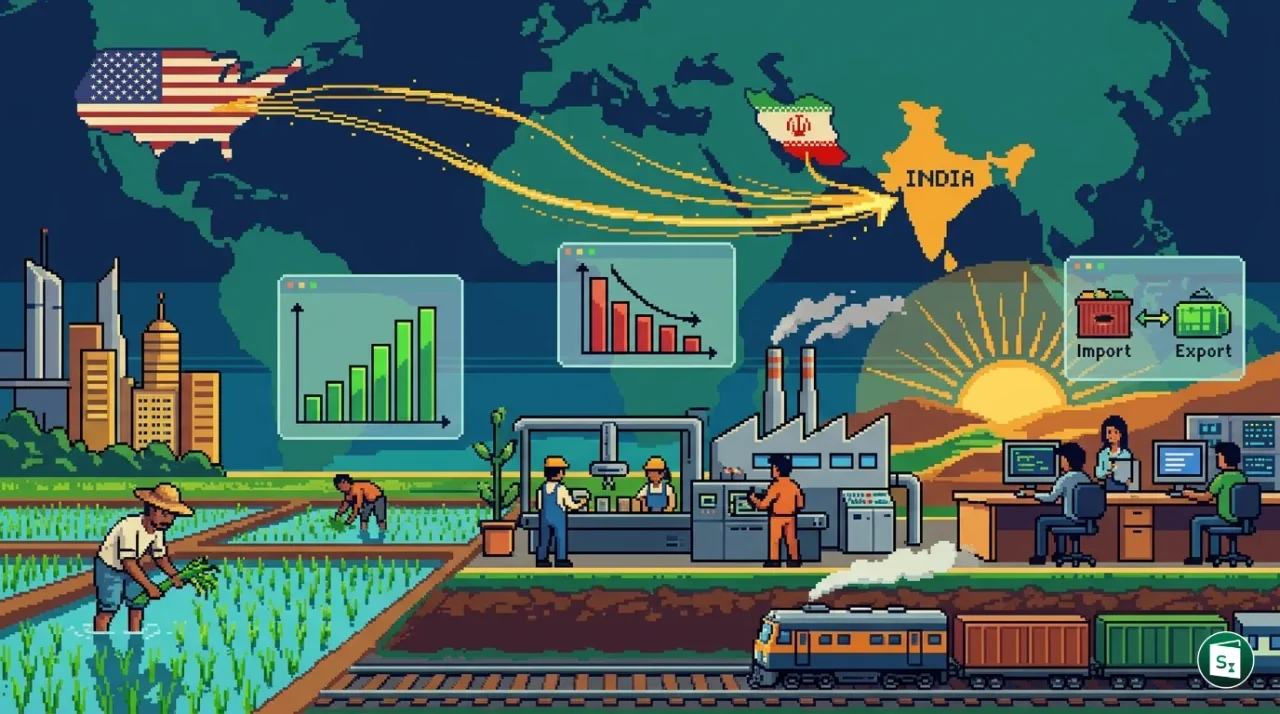
Global investment bank Goldman Sachs has raised India’s real GDP growth forecast for calendar year 2026 to 6.8%, up 30 basis points from its earlier estimate of 6.5%, following the US-Iran peace deal that triggered a sharp correction in global crude oil prices. The bank also revised its FY27 growth projection upward by 40 basis points to 6.5% while lowering its retail inflation forecast for the current year to 4.4% and trimming the current account deficit estimate to 1.1% of GDP. The across-the-board upgrade, detailed in a report titled “India: Improved Macro Outlook after the USA-Iran Deal”, reflects the significant improvement in India’s macroeconomic environment as lower energy costs ease inflationary pressures, reduce the import bill and strengthen external balances.
Goldman Sachs and Its Revised India Outlook
Goldman Sachs is one of the world’s largest investment banks, founded in 1869 by Marcus Goldman and headquartered at 200 West Street in New York City. The firm is a globally recognised financial institution with a significant presence in India, regularly publishing research on the country’s economic trajectory. The latest report was authored by Goldman Sachs economists Santanu Sengupta and Arjun Varma.
The report presents a sharply improved outlook across three key macroeconomic indicators:
| Indicator | Previous Forecast | Revised Forecast | Change |
|---|---|---|---|
| Real GDP Growth (CY26) | 6.5% | 6.8% | +30 bps |
| Real GDP Growth (FY27) | 6.1% | 6.5% | +40 bps |
| Headline CPI Inflation (CY26) | 4.6% | 4.4% | -20 bps |
| Current Account Deficit (CY26) | 1.3% of GDP | 1.1% of GDP | -20 bps |
| Balance of Payments (CY26) | 0.6% surplus | 0.7% surplus | +10 bps |
The revisions are anchored in a significant downward adjustment to the bank’s crude oil price assumptions. Goldman Sachs now expects Brent crude to average USD 82 per barrel in the second half of CY26, down from its earlier estimate of USD 92 per barrel. For CY27, the projection has been reduced to USD 75 per barrel from USD 80 per barrel. This correction in oil prices is the direct result of the US-Iran peace agreement, which has eased supply disruptions and lowered geopolitical risk premiums in global energy markets.
How the US-Iran Deal Transformed India’s Economic Outlook
The US-Iran war, which began in late February 2026, severely disrupted global energy markets by effectively closing the Strait of Hormuz, a narrow waterway between Iran and Oman that handles roughly one-fifth of the world’s oil consumption. For India, the impact was particularly acute. The country depends on West Asia for about 50% of its crude oil imports, 70% of its LPG supplies and nearly 90% of its LNG imports. With over 88% of its crude oil requirements met through imports, India is one of the most oil-sensitive major economies in the world.
During the conflict, Brent crude prices surged to around USD 120 per barrel at their peak, up from below USD 70 before hostilities began. Shipping through the Gulf was disrupted, insurance premiums skyrocketed, and Indian refiners were forced to source supplies from more distant and costlier markets. The government had to ration natural gas supplies to certain industries to protect households and priority sectors.
The US-Iran peace agreement, announced in mid-June 2026, reversed this situation. The reopening of the Strait of Hormuz restored the free flow of tanker traffic through the Gulf, and Brent crude prices fell sharply to around USD 83 per barrel. For India, every sustained USD 1 per barrel decline in oil prices reduces the annual import bill by roughly USD 2 billion. Goldman Sachs has accordingly revised its oil import forecast for India downward to about USD 215 billion for CY26 from an earlier USD 220 billion, while raising its remittance inflow projection to USD 140 billion on the back of stronger-than-expected inflows from the Gulf region.
The report noted that the peace deal removed a key tail risk for India’s macro trajectory by triggering a correction in global crude prices and easing supply constraints that had weighed on investment activity. Lower oil prices have also reduced the risk of additional fuel price hikes, taking pressure off household budgets and containing inflation expectations.
India’s Resilience During the Crisis
One of the key reasons Goldman Sachs upgraded its outlook was the underlying strength of the Indian economy even during the height of the conflict. India’s real GDP grew at 7.8% year-on-year in Q1 CY26 (January to March 2026), about 50 basis points above the bank’s own forecast. This growth was driven by resilient investment activity and robust expansion in the services sector.
The report highlighted that the Indian economy remained resilient through the Middle East shock because fiscal and quasi-fiscal measures absorbed much of the increase in energy costs. The government limited the pass-through of higher crude prices to consumers by adjusting excise duties and allowing state-owned oil marketing companies to absorb part of the cost. This helped consumption hold up through March and April, even as investment activity softened due to supply chain disruptions.
The strong Q1 performance added to the momentum from earlier quarters. India’s GDP had grown 7.4% in Q4 FY25 (October to December 2025) and continued to show traction through the early months of 2026. The broad-based nature of this growth, led by both investment and services, gave Goldman Sachs confidence that the economy had sufficient underlying momentum to benefit disproportionately from the post-deal easing of energy prices.
The report also noted that lower crude prices would now support a recovery in investment activity, which had softened during the conflict due to supply disruptions. With energy costs declining and supply chains normalising, the conditions for a pickup in capital spending have improved considerably.
The Broader Implications
The improved macro outlook has implications beyond headline growth numbers. On inflation, Goldman Sachs lowered its headline CPI forecast for CY26 to 4.4% from 4.6% and its FY27 forecast to 4.9% from 5.1%. Lower crude prices have substantially reduced the risk of further increases in petrol and diesel prices and eased cost pressures on petrochemical products. Core goods inflation for CY26 has been revised down to 3.2% from 3.5%, reflecting these benefits.
On the fiscal front, the correction in global commodity prices extends beyond crude oil. The sharp fall in global urea prices, together with lower oil benchmarks, is expected to reduce the government’s subsidy burden. The report noted that lower fertiliser prices should reduce upside risk to the fertiliser subsidy bill and, together with lower oil prices, help ease near-term fiscal pressures. This is significant because it provides the government with additional fiscal space at a time when the economy needs sustained public capital expenditure.
On the external sector, the improvement is particularly striking. India’s current account deficit for CY26 is now projected at just 1.1% of GDP, down sharply from the war-period estimate of 2.0%. The bank expects India to record a balance of payments surplus of 0.7% of GDP, supported by a reduced oil import bill and stronger remittance inflows from the Gulf. This marks a meaningful improvement in India’s external vulnerability profile.
However, the report also flagged near-term risks. Weather-related uncertainties, including early monsoon weakness and the likelihood of El Nino conditions, could impact agricultural output and rural demand. The lagged impact of earlier fuel price increases may weigh on household consumption in the second and third quarters of 2026. Despite these headwinds, Goldman Sachs expects lower crude prices and improving investment activity to drive economic momentum in the second half of the year.
The upgrade from Goldman Sachs is one of the most significant endorsements of India’s economic resilience in recent months. It reflects a view that India is structurally better positioned to navigate global shocks than in previous episodes, with lower oil intensity, improved energy efficiency and stronger macroeconomic fundamentals providing a more durable foundation for growth.
Key Takeaways
- Goldman Sachs raised India’s CY26 real GDP growth forecast to 6.8% from 6.5%, citing lower oil prices after the US-Iran peace deal.
- India’s FY27 GDP growth forecast was raised by 40 basis points to 6.5%.
- The report lowered India’s CY26 headline CPI inflation forecast to 4.4% and reduced the current account deficit projection to 1.1% of GDP.
- Goldman Sachs, founded in 1869 by Marcus Goldman, is headquartered at 200 West Street, New York City.
- India posted a 7.8% GDP growth in Q1 CY26, about 50 basis points above Goldman Sachs’ earlier forecast, driven by investment and services.
- The Strait of Hormuz, handling roughly one-fifth of global oil trade, was effectively closed during the conflict, pushing Brent crude above USD 120 per barrel.