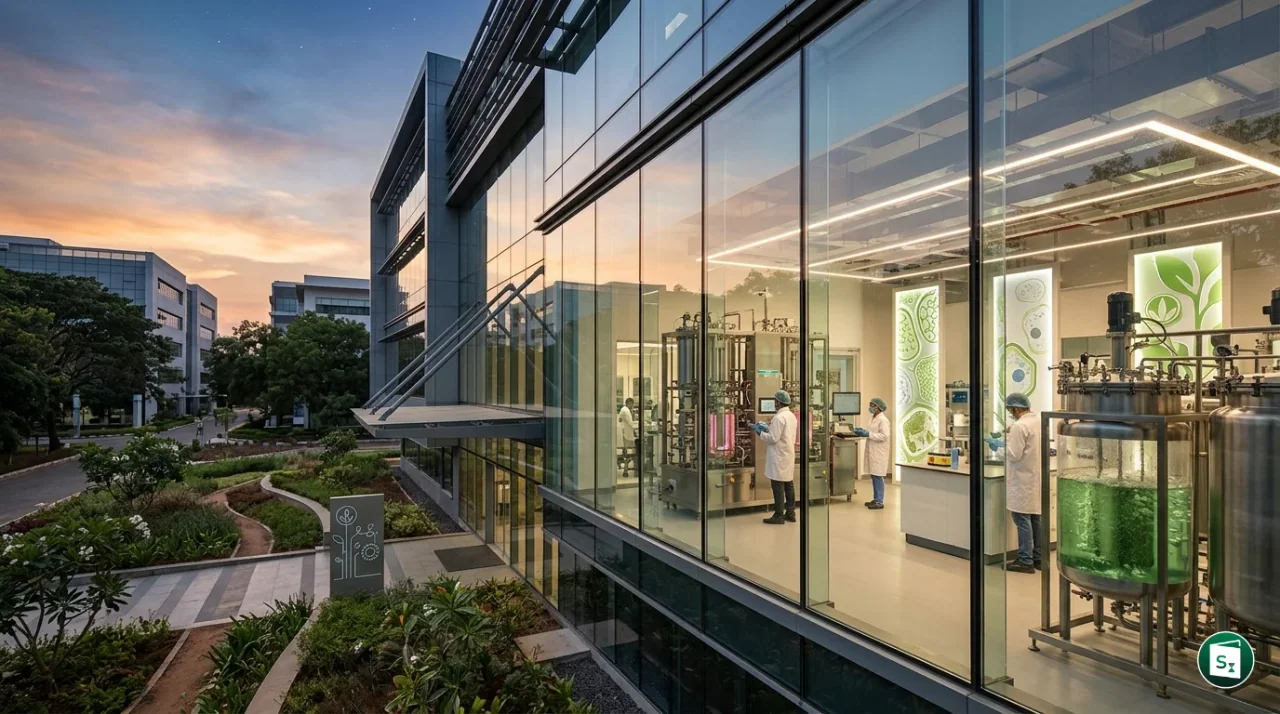
The Indian Institute of Technology Madras and Herbalife International India have inaugurated the country’s first dedicated Centre of Excellence on Plant Cell Fermentation Technology at the IIT Madras Research Park. Inaugurated on 22 June 2026, this facility is designed to bridge the gap between laboratory research and industrial-scale production of plant-derived ingredients using advanced fermentation techniques. The centre marks a significant step towards positioning India as a global hub for sustainable biomanufacturing of herbal biomass, enriched extracts, and high-value phytochemicals for health and wellness products.
What Is Plant Cell Fermentation Technology?
Plant Cell Fermentation (PCF) is a biotechnology process that grows plant cells in controlled laboratory conditions using bioreactors, rather than harvesting whole plants from farms or forests. A small sample of plant tissue is taken and placed in a nutrient-rich liquid medium inside sterilised stainless steel tanks, where the cells multiply and produce the same bioactive compounds they would in nature. The technology allows year-round production of high-value plant-derived molecules without being affected by seasons, climate, pests, or soil quality.
This method offers several advantages over traditional agriculture. It eliminates the need for large land areas, avoids pesticides and heavy metal contamination, and ensures consistent quality and purity of the final product. PCF is particularly valuable for producing phytochemicals (bioactive compounds from plants) such as those used in medicines, nutraceuticals, cosmetics, and functional foods. The technology is also non-GMO, using viable plant cell suspensions without genetic modification.
Globally, PCF has been successfully applied to produce high-value compounds such as paclitaxel, a cancer drug originally derived from the Pacific yew tree. Phyton Biotech, a global leader in this field, operates the world’s largest plant cell fermentation facility with over 200,000 litres of capacity in Germany and Canada. India has now entered this space with the Herbalife-IIT Madras CoE.
About the Centre of Excellence
The Herbalife-IIT Madras Centre of Excellence is located at the IIT Madras Research Park (IITMRP) , India’s first university-based research park established in 2010. Spread across 11.42 acres with over 1.2 million square feet of workspace, the Research Park houses more than 70 R&D partners and 200 incubated startups. The CoE will operate from a dedicated facility equipped with customised plant cell bioreactors, advanced analytical platforms, metabolomics systems, and pilot-scale processing units.
The centre has three core research objectives: enabling sustainable and scalable production of herbal biomass, developing enriched herbal extracts, and producing high-value phytochemicals for health and wellness applications. It integrates advanced upstream cultivation systems (where cells are grown) with downstream processing technologies (where compounds are extracted and purified) and metabolomics platforms (which analyse the chemical profile of the products).
Beyond research, the CoE aims to promote technology transfer, foster innovation and entrepreneurship, and build skilled manpower in this emerging domain. It will facilitate industry partnerships, support start-up creation through spin-offs, conduct training programmes, and encourage intellectual property generation. The centre is expected to catalyse both national and international academia-industry R&D collaborations in plant cell fermentation.
| Aspect | Details |
|---|---|
| Location | IIT Madras Research Park, Chennai |
| Inauguration Date | 22 June 2026 |
| Funding | Herbalife India’s CSR programme |
| Key Facilities | Bioreactors, metabolomics platforms, pilot-scale processing |
| Focus Areas | Herbal biomass, enriched extracts, phytochemicals |
| Head of Centre | Prof. Smita Srivastava |
Key People and Institutional Partners
The inauguration ceremony brought together several prominent figures from science, academia, and industry. Dr. N. Kalaiselvi, Director General of the Council of Scientific and Industrial Research (CSIR) and Secretary of the Department of Scientific and Industrial Research (DSIR) , attended as the Chief Guest. Dr. Kalaiselvi, the first woman to head CSIR since its establishment in 1942, is an electrochemical scientist known for her work on battery materials. CSIR, headquartered in New Delhi, operates 37 laboratories across India and is among the largest publicly funded R&D organisations in the world.
Prof. V. Kamakoti, Director of IIT Madras, was also present. IIT Madras, founded in 1959 as the third Indian Institute of Technology, is located in Chennai across a 620-acre campus. It has been ranked No. 1 in the NIRF ‘Overall’ category for five consecutive years and is recognised as an Institute of Eminence.
Shri Virendra R. Tiwari, Chairperson of the National Biodiversity Authority (NBA) , served as the Guest of Honour. The NBA is a statutory body established in 2003 under the Biological Diversity Act, 2002, with its headquarters in Chennai. It operates under the Ministry of Environment, Forest and Climate Change.
Mr. Ajay Khanna, Managing Director of Herbalife International India, represented the company. Prof. Smita Srivastava heads the Centre of Excellence, and Prof. Ashwin Mahalingam, Dean of Alumni and Corporate Relations at IIT Madras, played a key role in the partnership.
Background of the Herbalife-IIT Madras Collaboration
This Centre of Excellence is the second phase of a partnership that began in February 2025, when Herbalife India established the Herbalife-IITM Plant Cell Fermentation Technology Lab at the IIT Madras campus. That initial lab, also funded through Herbalife’s CSR programme, focused on developing sustainable solutions for high-quality herbal raw materials and phytochemicals. The success of Phase 1 led to the expanded Phase 2 collaboration, resulting in this full-scale Centre of Excellence.
Herbalife Ltd. is an American multinational health and wellness company founded in 1980 by Mark R. Hughes. Headquartered in Los Angeles, California, the company operates in over 90 countries and reported net sales of approximately $5 billion in 2024. Herbalife India, its Indian subsidiary with offices in Bengaluru, has been operating in the country for over two decades. The company’s products include weight management supplements, protein shakes, targeted nutrition, and sports nutrition.
IIT Madras has a strong track record of industry-academia partnerships. The IIT Madras Research Park, established in 2010, was conceived by industry-active faculty who recognised the need for structured collaboration between academia and industry. It has since become a model for university-based research parks in India, housing R&D centres of major companies including Saint-Gobain, Pfizer, Tata Steel, Renault Nissan, and Caterpillar.
Significance and Strategic Importance
The establishment of this CoE is significant for several reasons. First, it directly aligns with India’s BioE3 Policy (Biotechnology for Economy, Environment and Employment), approved by the Union Cabinet in August 2024. The policy, spearheaded by the Department of Biotechnology (DBT) , aims to foster high-performance biomanufacturing across six thematic sectors including functional foods, smart proteins, and bio-based chemicals. India’s bioeconomy is projected to reach $300 billion by 2030, and initiatives like this CoE contribute directly to that target.
Second, the centre supports the Atmanirbhar Bharat vision by reducing India’s dependence on imported herbal ingredients and phytochemicals. India has a rich tradition of herbal medicine through Ayurveda, but much of the raw material for modern nutraceuticals is either imported or sourced through unsustainable wild harvesting. Plant cell fermentation offers a way to produce these compounds domestically with consistent quality and at scale.
Third, the centre addresses sustainability concerns in the herbal products industry. Traditional farming of medicinal plants is vulnerable to climate change, seasonal fluctuations, pests, and land constraints. Some medicinal plant species are also endangered due to over-harvesting from the wild. PCF technology provides a controlled, climate-resilient alternative that can produce these compounds without any environmental footprint from agriculture.
The centre also has a strong skill development component. By training students and researchers in advanced bioprocessing, metabolomics, and bioreactor operations, it will help build a workforce for India’s growing biomanufacturing sector. The facility is expected to generate intellectual property, support start-ups, and create new opportunities for technology transfer to industry.
Key Takeaways
- The Herbalife-IIT Madras Centre of Excellence on Plant Cell Fermentation Technology, India’s first dedicated facility of its kind, was inaugurated on 22 June 2026 at the IIT Madras Research Park.
- Plant Cell Fermentation (PCF) is a non-GMO biotechnology process that grows plant cells in bioreactors to produce high-value phytochemicals without traditional farming.
- The centre is funded through Herbalife India’s CSR programme and represents Phase 2 of their collaboration with IIT Madras, following a lab established in February 2025.
- IIT Madras, founded in 1959, is an Institute of National Importance and has been ranked No. 1 in NIRF for five consecutive years.
- The initiative aligns with India’s BioE3 Policy (approved August 2024) and the Atmanirbhar Bharat vision for self-reliance in biomanufacturing.
- Dr. N. Kalaiselvi, the first woman Director General of CSIR (established 1942), was the Chief Guest at the inauguration.