The NITI Aayog launched the “Roadmap for Building India as a Leading Bioeconomy Powerhouse by 2035” at the National Media Centre in New Delhi, setting a bold vision for the country’s biotechnology-led growth. The roadmap targets scaling India’s bioeconomy from its current $195.3 billion to $691 billion by 2035 and further to $2.6 trillion by 2047, while creating over 30 million high-value jobs. Union Minister of State for Science and Technology Dr. Jitendra Singh inaugurated the roadmap, which was developed by the NITI Frontier Tech Hub (NITI-FTH) in consultation with the Department of Biotechnology (DBT).
India’s Bioeconomy: A Decade of Growth
India’s bioeconomy has seen remarkable expansion over the past decade. From a modest $10 billion in 2014, it grew to $165.7 billion in 2024 and reached $195.3 billion in 2025, recording an 18% year-on-year growth. The sector now contributes 4.8% to the national GDP.
The country ranks 12th globally in biotechnology and 3rd in the Asia-Pacific region. India is also the world’s largest vaccine manufacturer and has one of the fastest-growing biotech startup ecosystems. More than five sub-sectors of the bioeconomy now generate over $1 billion each month. This strong foundation, built over a decade, provides the launching pad for the ambitious targets set by the roadmap.
The NITI Aayog was established on January 1, 2015, replacing the erstwhile Planning Commission. It serves as the premier policy think tank of the Government of India, providing directional and strategic input on key policy matters. The Department of Biotechnology (DBT), established in 1986, operates under the Ministry of Science and Technology and has been the nodal agency driving India’s biotechnology agenda.
Ambitious Targets Set for 2035 and 2047
The roadmap lays out a three-phase growth trajectory for India’s bioeconomy:
| Phase | Target Year | Target Value | Key Focus |
|---|---|---|---|
| Short-term | 2030 | $300 billion | Consolidation and scaling of existing strengths |
| Medium-term | 2035 | $691 billion | India among top 3 global biotech powers |
| Long-term | 2047 | $2.6 trillion | Viksit Bharat vision through bio-led growth |
Achieving the $691 billion target by 2035 would require the bioeconomy to grow at a sustained rate, building on the momentum of the BioE3 Policy (Biotechnology for Economy, Environment and Employment), which was approved by the Union Cabinet in August 2024. The BioE3 Policy is India’s first dedicated policy framework for fostering high-performance biomanufacturing and positions biotechnology as a strategic lever for sustainable economic growth.
Six National BioMissions
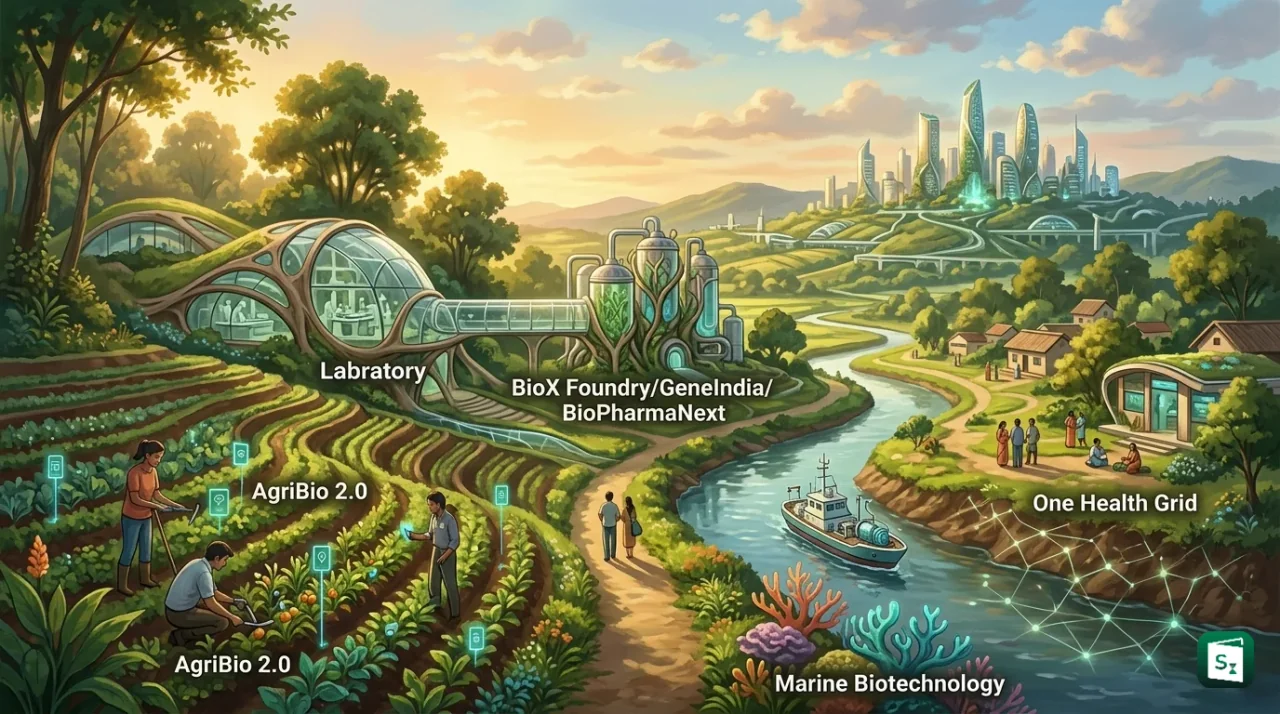
At the heart of the roadmap are six National BioMissions, designed as focused execution platforms to convert India’s scientific strengths into scalable national capabilities. Each mission targets a specific domain within the bioeconomy:
| Mission | Focus Area | Key Objectives |
|---|---|---|
| GeneIndia | Genomic healthcare | Affordable gene and cell therapies, precision medicine, expanded genomic diagnostics |
| AgriBio 2.0 | Agricultural biotechnology | Climate-resilient gene-edited crops, biofertilisers, biological crop protection |
| BioX Foundry | Synthetic biology | Commercialisation of synthetic biology innovations, bio-based manufacturing platforms |
| One Health Grid | Disease surveillance | Integrated infectious disease monitoring, antimicrobial resistance (AMR) tracking, human-animal-environment health integration |
| Marine Biotechnology | Blue bioeconomy | Seaweed cultivation expansion, marine bio-products, sustainable ocean resources |
| BioPharmaNext | Next-generation biopharma | Biologics, biosimilars, AI-enabled drug discovery, vaccine innovation |
GeneIndia
This mission aims to democratise access to advanced genomic healthcare. It focuses on developing affordable gene and cell therapies for diseases that currently have limited treatment options. The mission builds on the foundation of the Genome India Project, which has generated rich datasets on India’s genetic diversity.
AgriBio 2.0
Building on the success of India’s agricultural biotechnology sector, this mission targets the development of climate-resilient crops using gene-editing technologies. It also promotes bio-based inputs such as biofertilisers and biopesticides to reduce dependency on chemical alternatives and support sustainable agriculture.
BioX Foundry
The BioX Foundry is designed to become India’s flagship platform for synthetic biology. It will support the commercialisation of bio-designed products across multiple sectors, including chemicals, materials, and fuels, using AI-driven Design-Build-Test-Learn platforms.
One Health Grid
This mission adopts the One Health approach, recognising the interconnection between human health, animal health, and the environment. It will establish an integrated surveillance system for infectious diseases and antimicrobial resistance, using AI-assisted epidemiological tools.
Marine Biotechnology
India’s long coastline of over 7,500 km offers vast potential for the blue bioeconomy. This mission focuses on expanding seaweed cultivation, developing marine bio-products, and creating sustainable livelihood opportunities for coastal communities.
BioPharmaNext
India is already the world’s largest vaccine manufacturer. BioPharmaNext aims to build on this strength by establishing the country as a global hub for biologics, biosimilars, and next-generation therapeutics. It emphasises AI-enabled drug discovery and advanced biomanufacturing capabilities.
A ₹50,000 Crore BioEconomy Growth Fund
A central financial recommendation of the roadmap is the creation of a BioEconomy Growth Fund of ₹50,000 crore for the 2026-2035 period. This fund will be carved out from the existing ₹1 lakh crore Research, Development and Innovation (RDI) Framework.
The RDI Scheme was launched on November 3, 2025, by Prime Minister Narendra Modi. It provides long-term financing and refinancing with long tenors at low or nil interest rates to spur private sector investment in research and innovation. The scheme is administered through the Anusandhan National Research Foundation (ANRF) .
The BioEconomy Growth Fund is designed to bridge the “valley of death” in biotechnology, where promising lab-scale innovations struggle to secure capital for commercial-scale production. The fund will support:
- Viability Gap Funding (VGF) for biotech infrastructure projects
- Shared biomanufacturing facilities accessible to startups and SMEs
- Emerging sectors such as advanced therapeutics, synthetic biology, fermentation technologies, diagnostics, and biomaterials
- Blended finance and equity-risk instruments to attract private capital
The roadmap also recommends a dedicated Production Linked Incentive (PLI) Scheme for domestic biomanufacturing to reduce import dependence and enhance global competitiveness.
Institutional and Regulatory Reforms
To ensure effective implementation, the roadmap proposes several new institutional mechanisms:
- Empowered Committee on National BioMissions for inter-ministerial coordination and oversight
- National BioData Council to govern biological and health data, ensuring ethical use and interoperability
- BioEconomy Investment and Policy Forum to align public and private investment strategies
- BioIP and Innovation Evaluation Agency for biotechnology intellectual property valuation and commercialisation
On the regulatory front, the roadmap recommends fast-track approval pathways for gene therapies, synthetic biology products, and AI-designed drugs. It also calls for modernisation of the Central Drugs Standard Control Organisation (CDSCO) to keep pace with emerging biotech innovations.
A key infrastructure proposal is the development of five integrated bio-innovation clusters with shared manufacturing facilities and high-performance computing capabilities. These clusters will be linked to the National Supercomputing Mission to provide computational biology resources for researchers and startups across the country.
The roadmap also emphasises the convergence of AI and biology. It highlights the need for computational biology, digital twins, biosensor networks, robotics, and automated biofoundries to accelerate discovery cycles and reduce costs.
The Way Forward
The roadmap recognises biotechnology as strategic national infrastructure, similar to how digital public infrastructure and energy systems are treated. Its success will depend on coordinated execution across multiple ministries, sustained public-private partnerships, and the ability to move from policy documents to on-ground impact.
Key priorities in the near term include operationalising the BioEconomy Growth Fund, launching the six National BioMissions with measurable outcomes, expanding bio-innovation clusters, and building a globally competitive biotechnology workforce. The proposals align with broader national priorities such as Atmanirbhar Bharat, Make in India, Startup India, and the Viksit Bharat 2047 vision.
If implemented effectively, the roadmap has the potential to transform biotechnology from a high-potential sector into a primary engine of India’s economic growth, health security, food security, climate resilience, and technology leadership in the coming decades.
Key Takeaways
- The NITI Aayog launched the “Roadmap for Building India as a Leading Bioeconomy Powerhouse by 2035” on 16 July 2026 at the National Media Centre, New Delhi.
- The roadmap targets scaling India’s bioeconomy to $691 billion by 2035 and $2.6 trillion by 2047, creating over 30 million jobs.
- It proposes six National BioMissions: GeneIndia, AgriBio 2.0, BioX Foundry, One Health Grid, Marine Biotechnology, and BioPharmaNext.
- A BioEconomy Growth Fund of ₹50,000 crore (2026-2035) is proposed, to be carved from the existing ₹1 lakh crore RDI Framework.
- India’s bioeconomy grew from $10 billion in 2014 to $195.3 billion in 2025, contributing 4.8% to GDP.
- The NITI Frontier Tech Hub (NITI-FTH) developed the roadmap in consultation with the Department of Biotechnology (DBT) , which was established in 1986.
- The roadmap builds on the BioE3 Policy, approved by the Union Cabinet in August 2024, India’s first policy for high-performance biomanufacturing.