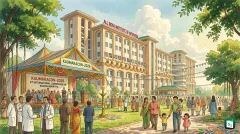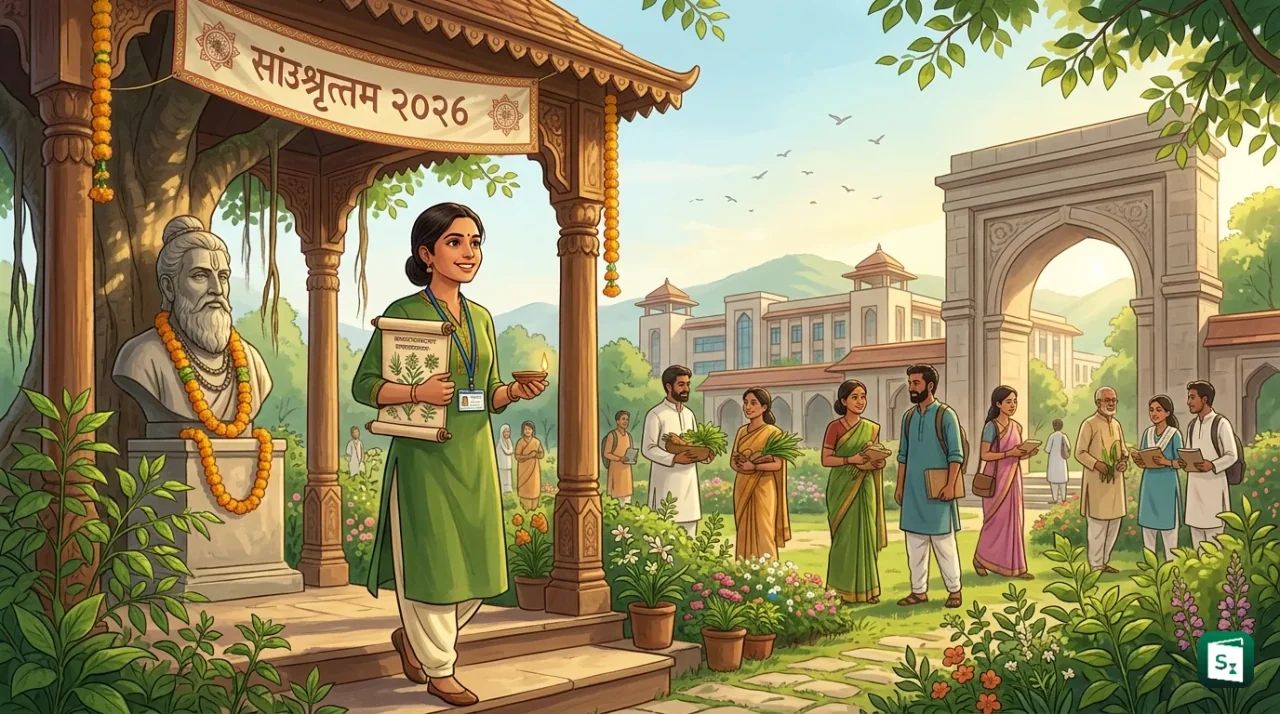
President Droupadi Murmu inaugurated Saushrutam 2026, a three-day international seminar on Ayurvedic surgery, at the All India Institute of Ayurveda (AIIA) in New Delhi on 15 July 2026, held on the occasion of Sushruta Jayanti. The seminar, organised by the Ministry of Ayush, brought together surgeons, researchers, and policymakers from nine countries to discuss evidence-based Ayurvedic surgery and its integration with modern surgical sciences. During the event, the President also released a study by the National Commission for Indian System of Medicine (NCISM) on the professional careers of women Ayurveda graduates and inaugurated an AI-enabled 3 Tesla High-Field MRI facility at AIIA.
What Is Saushrutam 2026?
Saushrutam 2026 was a three-day international seminar on Ayurvedic surgery (Shalya Tantra) held from 15 to 17 July 2026 at the All India Institute of Ayurveda in New Delhi. The event was preceded by a one-day pre-conference workshop on 14 July 2026. The seminar was organised on the occasion of Sushruta Jayanti, the birth anniversary of Acharya Sushruta, the ancient Indian physician and surgeon regarded as the Father of Surgery.
The seminar featured live surgical demonstrations including robotic-assisted surgeries, laparoscopic procedures, wound reconstruction, and minimally invasive interventions. Experts from nine countries, including Thailand, Israel, Austria, the United Kingdom, Sri Lanka, Indonesia, Nepal, Greece, and India, participated in the event. More than 30 eminent national experts, including Padma Shri awardees, along with faculty from premier institutions such as AIIA, IMS-BHU, National Institute of Ayurveda (NIA) Jaipur, ITRA Jamnagar, AIIMS, SGPGI Lucknow, and Sir Ganga Ram Hospital, contributed to the scientific sessions.
On the concluding day, AIIA also renewed its Memorandum of Understanding (MoU) with IIT Delhi for another five years, reaffirming the commitment of both institutions toward collaborative research and innovation in Ayurveda and technology.
Who Was Acharya Sushruta?
Acharya Sushruta was an ancient Indian physician and surgeon who lived around the 6th century BCE, traditionally believed to have been born in Kanyakubja (modern Kannauj, Uttar Pradesh) and later active in Varanasi. He is globally recognised as the Father of Surgery for his pioneering contributions to surgical science.
Sushruta authored the Sushruta Samhita, one of the most important surviving ancient treatises on medicine and a foundational text of Ayurveda. The text describes:
| Aspect | Details |
|---|---|
| Surgical procedures | Over 300 different types, including rhinoplasty, cataract surgery, lithotomy, and tumour removal |
| Surgical instruments | Around 120 different instruments, including knives, forceps, scissors, and probes |
| Classification of surgery | Eight categories, including excision, incision, scarification, puncturing, and probing |
| Wound management | 60 types of upkarma (therapeutic procedures) for wound treatment |
| Illnesses described | Over 1,120 medical conditions |
Sushruta’s most famous contribution is rhinoplasty (reconstructive nose surgery), which he performed using a forehead flap technique. This method, described in the Sushruta Samhita, remained unknown to Western medicine until it was reported in the 18th century in the Gentleman’s Magazine in London. In July 2026, a bronze statue of Sushruta was unveiled at the Royal College of Surgeons of Edinburgh, recognising his enduring global legacy.
The Sushruta Samhita also details anatomy, embryology, toxicology, paediatrics, and therapeutics. It remains one of the oldest and most comprehensive surgical treatises in the world.
Key Events at the Inaugural Session
The inaugural session of Saushrutam 2026 saw several important developments.
AI-Enabled 3 Tesla MRI Facility
The President inaugurated an AI-powered 3 Tesla High-Field MRI facility at AIIA, marking a significant step in integrating modern diagnostic technology with Ayurvedic patient care. A 3 Tesla MRI is a high-field magnetic resonance imaging system that produces clearer and more detailed images than conventional lower-field MRI machines. The integration of artificial intelligence into the system enhances diagnostic accuracy and efficiency.
NCISM Study on Women Ayurveda Graduates
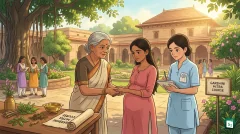
President Murmu released a study titled “Assessment of the Professional Life of Women Ayurveda Graduates: An Observational and Exploratory Study” conducted by the National Commission for Indian System of Medicine (NCISM). The study examined the career trajectories of women who graduate in Ayurveda.
The President noted that while women’s enrolment in Ayurveda colleges has increased steadily, many do not remain in professional practice. She expressed hope that the report’s recommendations would help increase women’s participation in the field of Ayurvedic medicine and called for policy support and institutional mechanisms to enable women to build long-term careers.
President’s Address: Blend Tradition with Science
In her address, President Murmu urged young Ayurveda students and researchers to follow the path shown by Acharya Sushruta and remain committed to medical ethics and compassionate patient care. She called for the integration of traditional Ayurvedic knowledge with modern diagnostics, advanced technologies, and clinical research to strengthen Ayurveda’s global credibility.
The President emphasised the importance of biodiversity conservation for ensuring the sustainable availability of medicinal plants, describing environmental protection as integral to the future of Ayurveda. She also highlighted that the Government of India has worked to establish Ayurveda and Yoga on the global stage and is making efforts to validate the ancient tradition of surgery through scientific benchmarks.
Ayurvedic Surgery and Its Modern Relevance
Ayurvedic surgery, known as Shalya Tantra, is one of the eight branches of Ayurveda. While Ayurveda is often associated primarily with herbal medicine and wellness therapies, Saushrutam 2026 sought to highlight its deep-rooted surgical tradition.
Current Status of Ayurvedic Surgery
The Union Minister of State for Ayush, Prataprao Jadhav, stated that specially trained postgraduate Ayurveda students are now permitted to perform 58 types of surgeries, including 39 general surgeries and 19 eye, ENT, and dental surgeries. These practitioners complete MS (Shalya Tantra) and MS (Shalakya Tantra) programmes, after which they are legally authorised to perform a defined range of surgical procedures under NCISM regulations since 2020.
AIIA’s Growing Footprint
The All India Institute of Ayurveda was established on 10 October 2015 as an apex autonomous body under the Ministry of Ayush. It is located in Sarita Vihar, New Delhi, and functions as a centre of excellence for Ayurveda, offering postgraduate and doctoral courses, clinical research, and patient care. The institute records 1,500 to 2,000 outpatients daily, with annual OPD attendance crossing four lakh patients.
AIIA was conceived following a declaration by then Prime Minister Atal Bihari Vajpayee in May 2000 to establish a state-of-the-art National Ayurveda Hospital. The institute was formally dedicated to the nation by Prime Minister Narendra Modi in October 2017. In the Union Budget 2026-27, the government announced the establishment of three new AIIA institutions across the country.
The Ministry of Ayush
The Ministry of Ayush was formed on 9 November 2014 with a vision to revive and promote India’s traditional systems of medicine, including Ayurveda, Yoga, Unani, Siddha, Sowa-Rigpa, and Homeopathy. It was elevated from a department under the Ministry of Health and Family Welfare to a full-fledged ministry.
National Commission for Indian System of Medicine
The National Commission for Indian System of Medicine (NCISM) is a statutory and regulatory body of 29 members formed by the Government of India under the NCISM Act, 2020. It replaced the Central Council of Indian Medicine (CCIM), which was established under the Indian Medicine Central Council Act, 1970. The NCISM is headquartered in New Delhi and operates under the Ministry of Ayush. Its responsibilities include framing policies for institutions engaged in Indian System of Medicine, regulation of medical professionals, and assessment of healthcare infrastructure.
Key Takeaways
- President Droupadi Murmu inaugurated Saushrutam 2026, a three-day international seminar on Ayurvedic surgery, at AIIA New Delhi on 15 July 2026 on the occasion of Sushruta Jayanti.
- The seminar featured experts from nine countries and included live demonstrations of robotic, laparoscopic, and reconstructive surgeries.
- The President released an NCISM study on the professional careers of women Ayurveda graduates and inaugurated an AI-enabled 3 Tesla MRI facility at AIIA.
- AIIA renewed its MoU with IIT Delhi for another five years to advance collaborative research in Ayurveda and technology.
- The Sushruta Samhita, authored by Acharya Sushruta, describes over 300 surgical procedures, 120 surgical instruments, and 1,120 illnesses, making it one of the world’s oldest surgical treatises.
- The Ministry of Ayush was established on 9 November 2014, and the NCISM was formed under the NCISM Act, 2020, replacing the Central Council of Indian Medicine.