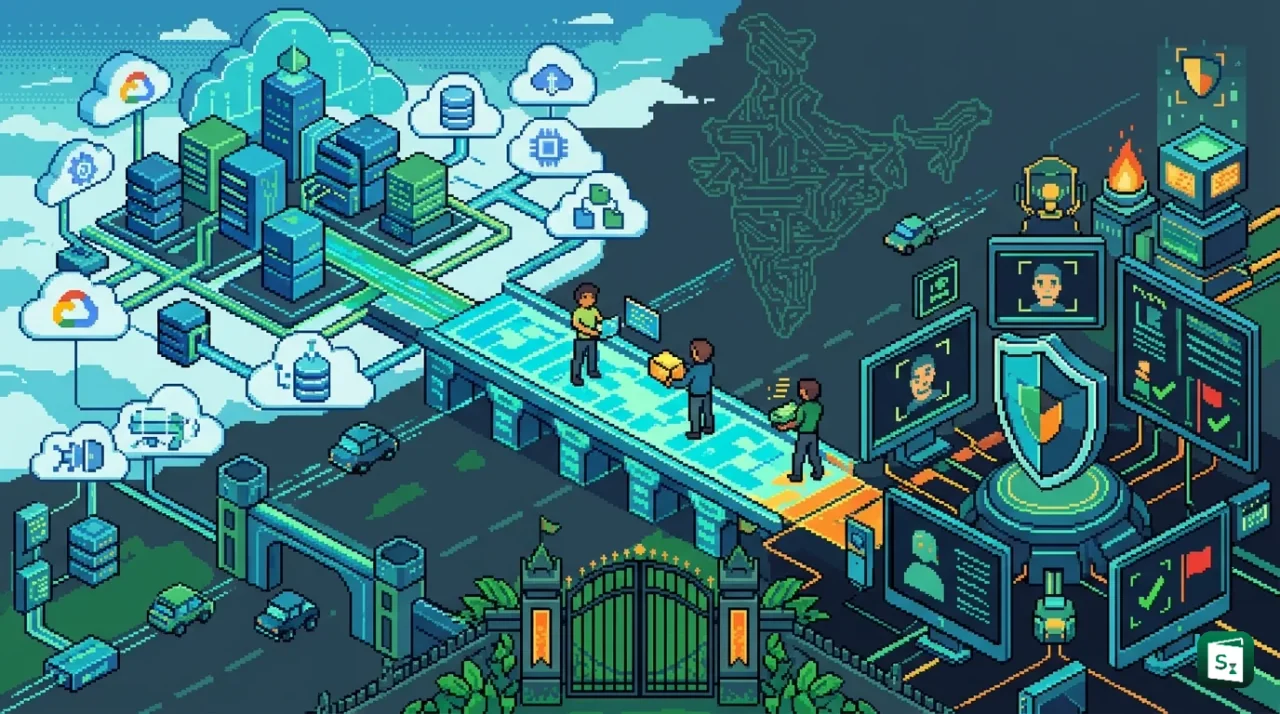
pi-labs, a Pune-based Indian AI startup focused on cyber forensics and deepfake detection, has entered into a strategic collaboration with Google Cloud to deliver secure, scalable, and mission-ready AI solutions for India. The partnership combines pi-labs’ indigenous AI capabilities with Google’s Distributed Cloud infrastructure to serve public sector organisations, critical enterprise infrastructure, and government institutions. This collaboration marks a significant step towards building sovereign AI systems that align with India’s vision of digital self-reliance.
Who Is pi-labs?
pi-labs was founded in 2023 by Ankush Tiwari (CEO), Abhijeet Zilpelwar (CTO), and Dr Raghu Sesha Iyengar (Chief Scientist). The company is headquartered in Pune, Maharashtra. It develops AI-powered cyber forensics, cybersecurity, and intelligence solutions with a strong focus on deepfake detection and digital evidence verification.
Its flagship product, Authentify, is an AI-driven deepfake detection engine that identifies synthetically generated content across video, audio, and images. According to the company, it has the largest deployment of deepfake detection solutions in Indian law enforcement agencies (LEAs). The product suite also includes pi-scout, a unified data lake and analytics platform for digital investigations, and pi-sense, an advanced video analytics platform for tamper-proof evidence verification.
pi-labs has been recognised as part of NASSCOM’s DeepTech League of 10 under its Emerge 50 Awards. It is also supported by the NVIDIA Inception partnership programme and is empanelled as a Dell OEM Partner. The company holds six global patents and has published eight research papers, including two in IEEE journals.
The startup serves law enforcement agencies at both central and state levels, as well as enterprises in the BFSI (Banking, Financial Services, and Insurance) sector. Its clients use Authentify for verifying video KYC, preventing impersonation fraud, and authenticating digital evidence in legal proceedings.
The Google Cloud Partnership
Under this collaboration, pi-labs will leverage Google Distributed Cloud (GDC) Tactical Appliance to deploy its AI solutions. GDC is an on-premise, air-gapped version of Google’s public cloud that can operate in complete isolation from the internet. It is designed for organisations that handle sensitive data and require strict regulatory compliance, data sovereignty, and operational continuity even in disconnected environments.
pi-labs will host its indigenous AI models on this infrastructure to deliver solutions such as:
- Secure threat detection for government networks and critical infrastructure
- Regional language processing using AI models trained on Indian languages
- Assistive security analytics for law enforcement investigations
- Deepfake and misinformation detection at scale
The partnership is specifically aimed at India’s public sector. Ashish Wattal, Country Director for Public Sector at Google Cloud India, described this synergy as an enabler for organisations to safely implement technology at scale, reinforcing India’s pursuit of “Functional Sovereignty.” Ankush Tiwari, CEO of pi-labs, emphasised that the collaboration brings together solutions that understand India’s languages, legal frameworks, and operational realities with Google’s secure infrastructure.
The Rising Deepfake Threat in India
The partnership comes at a time when deepfake-driven cyber attacks are escalating rapidly across the world. According to the Thales 2026 Data Threat Report, conducted by S&P Global 451 Research, 65% of organisations in India reported experiencing deepfake-driven attacks. The same report found that 64% of Indian organisations rank AI-enabled attacks as their top data security risk.
Deepfakes are AI-generated video, audio, or images that convincingly mimic real people. In India, these have been used for:
| Threat Type | Example |
|---|---|
| Financial Fraud | Impersonating executives to authorise fake fund transfers |
| Video KYC Bypass | Mimicking legitimate customers to access banking services |
| Election Misinformation | Spreading fake videos of political leaders |
| Extortion and Blackmail | Creating non-consensual synthetic content |
India’s digital public infrastructure, including Aadhaar, UPI, and video KYC systems, is particularly vulnerable to deepfake abuse. The country’s CERT-In (Indian Computer Emergency Response Team) handled over 29.44 lakh cyber incidents in 2025, issuing 1,530 alerts across sectors.
Sovereign AI and Functional Sovereignty
A key theme of this partnership is the concept of Functional Sovereignty, meaning India must develop and control its own AI capabilities rather than rely entirely on foreign-built systems. Google Cloud’s Distributed Cloud appliance allows pi-labs to run AI workloads on Indian soil with complete data isolation, meeting the strictest compliance and security requirements.
This approach aligns with the Union Cabinet-approved IndiaAI Mission, launched in March 2024 under the Ministry of Electronics and Information Technology (MeitY) . The mission aims to build a comprehensive AI ecosystem in India by democratising computing access, improving data quality, and fostering indigenous AI innovation. pi-labs’ partnership with Google Cloud directly supports this national objective by providing Indian-built AI models deployed on infrastructure that respects data residency.
The concept of sovereign AI has gained urgency as governments worldwide recognise that AI systems trained on foreign data may not reflect local languages, cultural contexts, or legal frameworks. pi-labs’ models, built specifically for Indian languages and governance workflows, address this gap.
The Bigger Picture: India’s AI Ecosystem
The pi-labs and Google Cloud partnership is part of a larger trend of global technology companies investing in India’s AI ecosystem. In October 2025, Google announced plans to build its first AI hub in India, pledging an investment of around $15 billion over five years. At Google I/O Connect India 2026 in Bengaluru, the company announced new sovereign AI capabilities for Indian enterprises, including tools for mission-critical workloads.
For pi-labs, this partnership provides enterprise-grade cloud infrastructure that would be difficult for a bootstrapped startup to build on its own. For Google Cloud, it opens a channel into India’s sensitive government and law enforcement AI needs, a market where foreign cloud providers have traditionally faced barriers due to data sovereignty concerns.
The collaboration also positions pi-labs for international expansion. The company is already running pilot projects in the Middle East and Africa and has participated in major security conferences such as GISEC in the Gulf region. With Google Cloud’s global reach, pi-labs could extend its sovereign AI model to other nations facing similar deepfake and cybersecurity challenges.
Key Takeaways
- pi-labs, a Pune-based deep tech startup founded in 2023 by Ankush Tiwari, Abhijeet Zilpelwar, and Dr Raghu Sesha Iyengar, has partnered with Google Cloud to deliver mission-ready AI solutions for India.
- The partnership uses Google Distributed Cloud Tactical Appliance, an air-gapped on-premise infrastructure, to deploy pi-labs’ indigenous AI models for public sector and government use.
- 65% of organisations in India have experienced deepfake-driven attacks, according to the Thales 2026 Data Threat Report, highlighting the urgent need for indigenous detection tools.
- pi-labs’ flagship product Authentify is the most widely deployed deepfake detection solution among Indian law enforcement agencies.
- The company is recognised under NASSCOM’s DeepTech League of 10, holds six global patents, and is supported by the NVIDIA Inception programme and Dell OEM Partnership.
- The partnership supports India’s vision of Functional Sovereignty and aligns with the IndiaAI Mission approved by the Union Cabinet in March 2024.