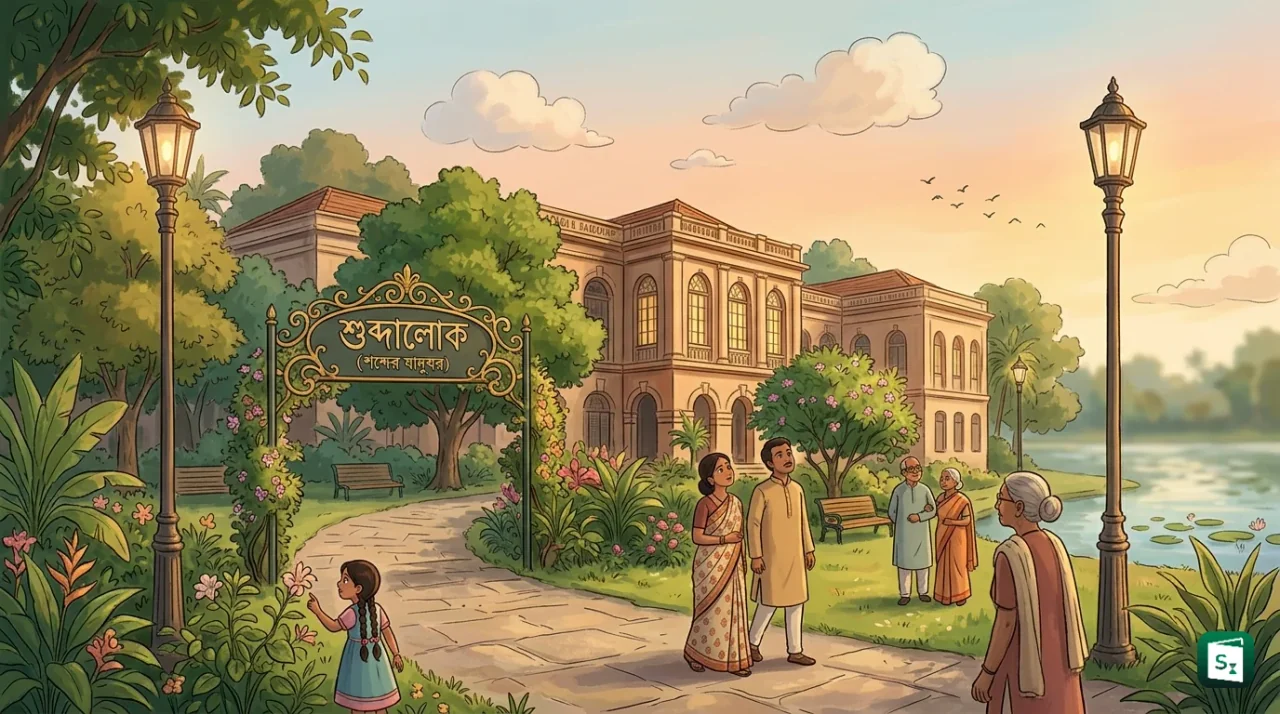
Union Home Minister Amit Shah inaugurated Shabdalok (The Museum of Word), India’s first immersive language museum, at the National Library campus in Kolkata on July 19, 2026. Developed by the National Library under the Ministry of Culture, the museum was built at a cost of ₹41 crore and showcases nearly 380 languages through interactive, technology-driven exhibits. The museum is housed within the historic Belvedere House and aims to present language as a living entity that has shaped India’s civilisation and culture.
What Is Shabdalok (Museum of Word)?
Shabdalok, meaning “The Museum of Word”, is India’s first immersive language museum dedicated to celebrating the country’s unparalleled linguistic heritage. Unlike a conventional museum with static displays, Shabdalok uses cutting-edge immersive technologies including AI, augmented reality (AR), virtual reality (VR), holograms, motion-sensor technology, and gesture-reading sensors to bring India’s oral and written literary traditions to life. Acoustically designed hallways and interactive installations further enhance the visitor experience.
The museum showcases nearly 380 languages, encompassing the 121 languages recorded in the Census of India 2011 while also recognising several historical languages that are no longer in everyday use. It celebrates India’s 22 constitutionally recognised languages under the Eighth Schedule of the Constitution and traces their journey from oral traditions and ancient manuscripts to printed works and modern electronic texts.
The project is being implemented in phases. Phase I, which covers approximately 2,282 square metres of exhibition space on the first floor at a cost of ₹15 crore, was inaugurated in July 2026. Subsequent phases will include additional galleries on the ground floor, a Souvenir Shop and Cafe, and a facade projection mapping programme. Entry to the museum is free for all visitors until August 15, 2026, and it remains open from 10:00 AM to 6:00 PM on all days except Mondays.
Nine Thematic Galleries: A Journey Through India’s Languages
Visitors to Shabdalok embark on an engaging journey through nine thematic galleries, each exploring a different facet of India’s linguistic and cultural evolution.
| Gallery | Focus Area |
|---|---|
| First Word | Origins of speech and the earliest symbols from the Indus-Saraswati Civilisation, including the revived Gunjala Gondi script |
| My Mother Tongue | India’s 22 scheduled languages and the emotional bond between people and their native languages |
| Navrasa | The nine emotions (rasas) as expressed through Indian literature and performing arts |
| Journey of Languages | Evolution of speech, scripts, literature, and communication across millennia |
| Honouring the Legends | Contributions of eminent poets, writers, philosophers, and scholars who enriched India’s literary traditions |
| Oral Traditions | India’s vibrant oral heritage, including folk songs, storytelling, and oral epics |
| Performing Traditions | Relationship between language and India’s diverse performing arts such as theatre, dance, and music |
| Global Dialogue | Historical and contemporary linguistic exchanges between India and the wider world |
| Public Library Movement | The vital role of public libraries in preserving, disseminating, and democratising knowledge |
Together, these galleries present a compelling account of India’s linguistic evolution, beginning with the earliest symbols of the Indus-Saraswati Civilisation and tracing the development of speech and scripts across thousands of years. One of the key attractions allows visitors to trace how the pronunciation, meaning, and usage of words have changed over centuries.
The Historic Setting: National Library and Belvedere House
The choice of location for Shabdalok is deeply symbolic. The museum is housed within Belvedere House, a historic mansion on the campus of the National Library of India in Alipore, Kolkata. Belvedere House was originally built in the 1760s by Mir Jafar, the eighth Nawab of Bengal, and was later given to Warren Hastings, the first Governor General of Bengal.
The National Library of India, which now occupies the Belvedere Estate, has its origins in the Calcutta Public Library established on March 21, 1836 by prominent figures including Prince Dwarkanath Tagore and Pyari Chand Mitra. After independence, the Imperial Library (Change of Name) Act in 1948 led to the creation of the National Library, which was formally opened to the public on February 1, 1953 by Maulana Abul Kalam Azad, independent India’s first Education Minister.
The National Library functions under the Ministry of Culture and is the country’s largest library, serving as a repository of India’s intellectual heritage with a vast collection of books, manuscripts, and rare documents. Locating the Museum of Word within this setting creates a unique synergy between the preservation of books and manuscripts and the living traditions of language, literature, and knowledge.
India’s Linguistic Diversity in Context
India is one of the most linguistically diverse countries in the world. The Eighth Schedule of the Constitution currently recognises 22 languages: Assamese, Bengali, Bodo, Dogri, Gujarati, Hindi, Kannada, Kashmiri, Konkani, Maithili, Malayalam, Manipuri, Marathi, Nepali, Odia, Punjabi, Sanskrit, Santali, Sindhi, Tamil, Telugu, and Urdu. Notably, the Constitution does not designate any language as the national language of India; Hindi in Devanagari script is the official language of the Union, alongside English for official purposes.
Beyond these 22 scheduled languages, India is home to hundreds of other languages and dialects. The Census of India 2011 recorded 121 languages and 270 mother tongues across the country. In addition, India recognises 11 classical languages: Tamil (2004), Sanskrit (2005), Kannada (2008), Telugu (2008), Malayalam (2013), Odia (2014), and five more added in 2024 including Marathi, Pali, Prakrit, Assamese, and Bengali. These classical languages meet specific criteria of antiquity, independent literary tradition, and historical value.
At the inauguration, Amit Shah emphasised five principles for preserving and promoting Indian languages. He said education should begin in the mother tongue, all Indian languages should be digitally empowered and made AI-enabled, and libraries and museums should reach young people through outreach initiatives instead of remaining confined to physical buildings. He also urged students to learn at least one Indian language besides their mother tongue to better appreciate the country’s cultural diversity.
Key Takeaways
- Shabdalok (The Museum of Word), India’s first immersive language museum, was inaugurated at the National Library campus in Kolkata by Union Home Minister Amit Shah on July 19, 2026.
- The museum was developed by the National Library under the Ministry of Culture at a total cost of ₹41 crore, with Phase I covering 2,282 square metres at ₹15 crore.
- The museum features nine thematic galleries including First Word, My Mother Tongue, Navrasa, Journey of Languages, and others, using AI, AR/VR, holograms, and motion-sensor technology.
- Shabdalok showcases nearly 380 languages, covering all 121 languages recorded in the Census of India 2011 and 22 languages under the Eighth Schedule of the Constitution.
- The museum is housed in Belvedere House, an 18th-century mansion on the National Library campus, which traces its origins to the Calcutta Public Library established in 1836.
- Entry to the museum is free for all visitors until August 15, 2026, with operating hours from 10:00 AM to 6:00 PM (closed on Mondays).