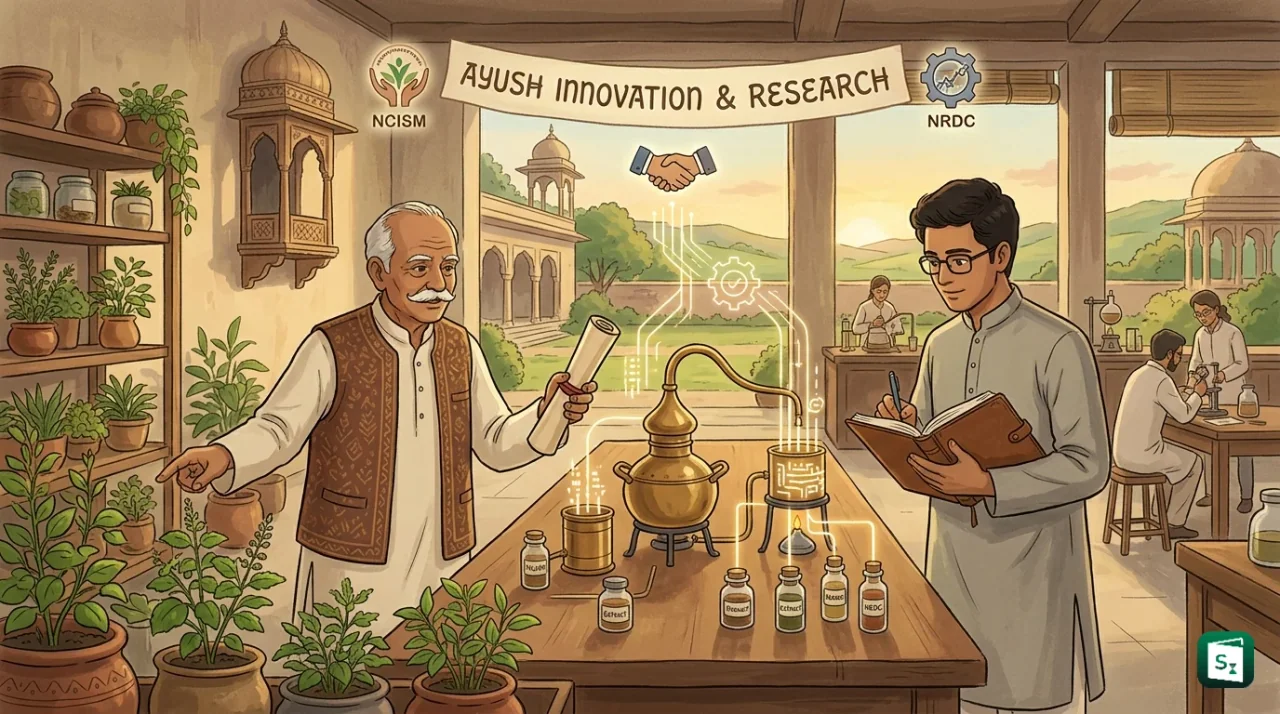
The National Research Development Corporation (NRDC) and the National Commission for Indian System of Medicine (NCISM) have signed a Memorandum of Understanding to promote innovation, intellectual property management, technology transfer, and the commercialisation of research outcomes in the Indian System of Medicine. The agreement brings together India’s premier technology transfer organisation and the statutory regulator for traditional medicine systems to create an institutional bridge between research labs and the marketplace. This partnership is expected to help transform academic and clinical research in Ayurveda, Unani, Siddha, and Sowa-Rigpa into commercially deployable healthcare solutions.
What Is NRDC?
The National Research Development Corporation (NRDC) was established in 1953 by the Government of India with the primary mandate of promoting, developing, and commercialising technologies and know-how originating from national R&D institutions and universities. It is fully owned by the Government of India and registered under Section 8 of the Companies Act, 2013.
NRDC operates under the administrative control of the Department of Scientific and Industrial Research (DSIR), which falls under the Ministry of Science and Technology. Its headquarters is in New Delhi.
Over seven decades, NRDC has concluded more than 5,100 technology transfer agreements with Indian industries. Some of its notable licensed technologies include Indelible Ink (used in elections), Infant Food, Artificial Heart Valve, and crop-specific foliar micronutrient formulations. It also runs two major technology promotional programmes: the Program for Inspiring Inventors and Innovators (PIII) and the Program for Development of Technologies for Commercialization (PDTC).
What Is NCISM?
The National Commission for Indian System of Medicine (NCISM) is a statutory and regulatory body consisting of 29 members. It was created under the NCISM Act, 2020, which was notified on 20 September 2020 and came fully into force on 11 June 2021. It replaced the Central Council of Indian Medicine (CCIM), which had functioned since 1971 under the Indian Medicine Central Council Act, 1970.
NCISM operates under the Ministry of Ayush and is headquartered in New Delhi. Its current Chairperson is Dr. Maneesha Kothekar.
The commission governs four streams of traditional medicine collectively known as AUSS: Ayurveda, Unani (Greco-Arabic medicine), Siddha (Tamil Nadu’s classical medicine system), and Sowa-Rigpa (traditional medicine of Ladakh and Himalayan regions). Homoeopathy and Yoga are not under NCISM; they are regulated by separate bodies.
NCISM functions through four Autonomous Boards. The Board of Ayurveda handles matters related to Ayurveda education and standards. The Board of Unani, Siddha and Sowa-Rigpa (BUSSR) covers the other three traditional systems. The Medical Assessment and Rating Board for Indian System of Medicine (MARB-ISM) is responsible for inspecting and rating colleges. The Medical Ethics and Registration Board for Indian System of Medicine (MERB-ISM) maintains the National Register of practitioners and handles ethical complaints.
What Does the MoU Cover?
The MoU was exchanged between Cmde. Amit Rastogi (Retd.), Chairman and Managing Director of NRDC, and Dr. Maneesha Kothekar, Chairperson of NCISM. Senior officials from both organisations, including the presidents of the Board of Ayurveda and BUSSR, were present at the signing.
Under the agreement, NRDC will extend its full range of expertise in intellectual property protection, patent and trademark facilitation, technology assessment, valuation, licensing, and technology transfer to institutions regulated by NCISM. It will also provide mentoring to innovators, facilitate incubation support, promote industry-sponsored research, and help institutions develop effective IP management practices and commercialisation strategies.
NCISM, in turn, will facilitate engagement between NRDC and its regulated institutions, Research, Innovation and Entrepreneurship Development (RIED) Cells, and registered medical practitioners across the country. Institution-specific technical, commercial, and financial engagements will be handled directly between NRDC and the respective institution or innovator.
The partnership will support a wide range of activities: identification and protection of intellectual property, patent and trademark filing, innovation mentoring, entrepreneurship development, institutional IP policy formulation, capacity-building programmes, innovation awareness campaigns, ideathons, hackathons, technology showcases, industry interactions, and dissemination of research success stories.
Why This Partnership Matters
The Indian System of Medicine represents centuries of accumulated knowledge, but much of this knowledge has remained outside the formal commercial innovation ecosystem. Research institutions and practitioners in fields like Ayurveda and Unani often develop valuable formulations, diagnostic methods, and therapeutic approaches that never reach the market due to lack of IP awareness, technical assessment, or industry connections.
This collaboration directly addresses that gap. NRDC’s track record of more than 5,100 technology transfers across diverse sectors since 1953 positions it well to evaluate traditional medicine innovations for commercial readiness and guide them through the patenting and licensing process.
From a policy perspective, the MoU aligns with the government’s broader push under Aatmanirbhar Bharat to build a self-reliant healthcare ecosystem rooted in India’s traditional knowledge systems. It also supports the Ministry of Ayush’s ongoing efforts to integrate evidence-based traditional medicine into mainstream healthcare while protecting indigenous intellectual property from misappropriation.
The partnership also builds on recent initiatives such as the PRANA (Protecting Rights and Novelties in AYUSH) conference, organised jointly by NCISM, AICTE, and the Ministry of Education’s Innovation Cell, which aimed to help ISM innovators explore patents, startups, and technology transfer.
Key Takeaways
- The National Research Development Corporation (NRDC) was established in 1953 under the Ministry of Science and Technology and has concluded over 5,100 technology transfer agreements.
- The National Commission for Indian System of Medicine (NCISM) is a statutory body formed under the NCISM Act, 2020, replacing the Central Council of Indian Medicine.
- NCISM operates under the Ministry of Ayush and governs four systems: Ayurveda, Unani, Siddha, and Sowa-Rigpa (AUSS).
- The MoU covers IP management, patent facilitation, technology assessment, licensing, incubation support, and commercialisation of research across NCISM-regulated institutions.
- NRDC will provide mentoring, industry linkage, and IP policy formulation support, while NCISM will connect its RIED Cells and registered practitioners to the partnership.
- The agreement supports the government’s Aatmanirbhar Bharat vision by building a self-reliant, innovation-driven healthcare ecosystem rooted in traditional medicine.