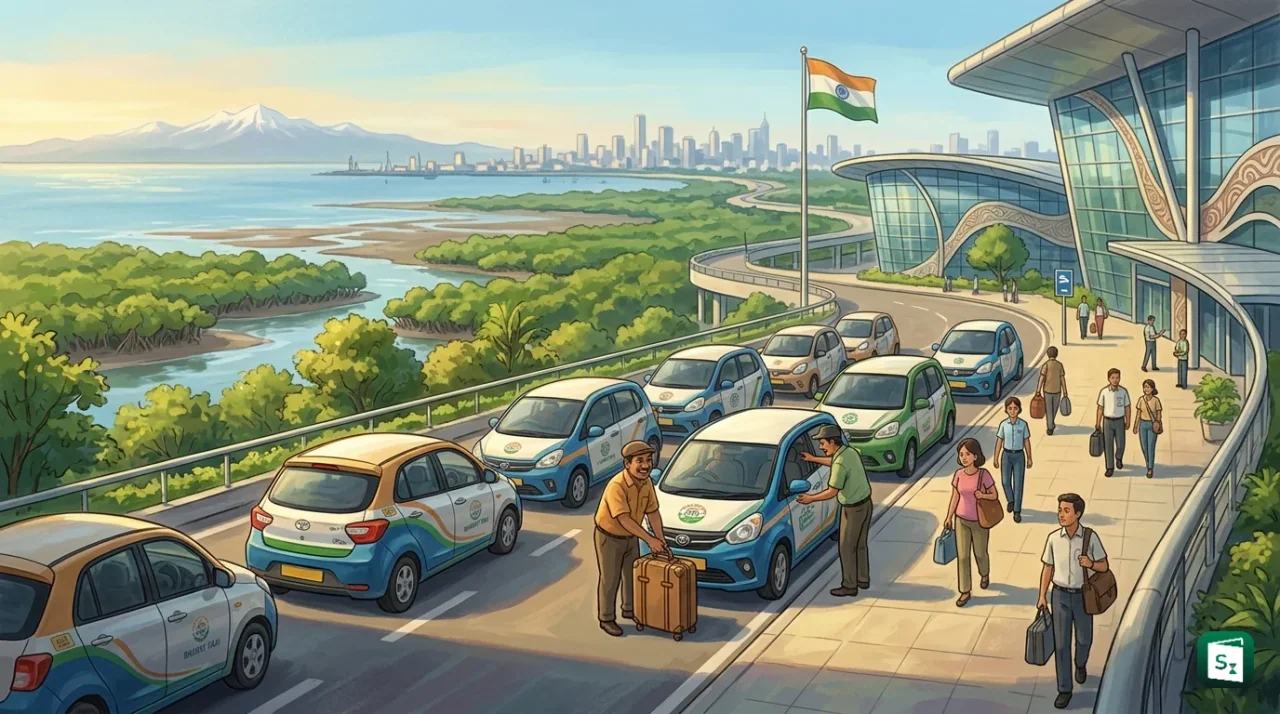
Maharashtra Chief Minister Devendra Fadnavis launched the Bharat Taxi service at the Navi Mumbai International Airport on July 23, 2026, marking the entry of a cooperative-based ride-hailing platform into the state. Unlike private aggregators that operate on commission-based models, Bharat Taxi treats its drivers as co-owners and members of a cooperative society, with zero surge pricing and direct profit sharing. The service is positioned as a government-backed alternative to foreign-funded platforms such as Ola and Uber.
What Is Bharat Taxi?
Bharat Taxi is India’s first cooperative-owned digital mobility platform, managed by Sahakar Taxi Cooperative Limited, a multi-state cooperative society registered under the Multi-State Cooperative Societies Act, 2002 on June 6, 2025. It was nationally launched on February 5, 2026 by Union Home Minister and Cooperation Minister Amit Shah in Delhi.
The platform operates a single mobile application that offers three types of services: four-wheeler cabs, autorickshaws, and two-wheeler bike taxis. Drivers on the platform are called sarathis (charioteers), reflecting their position as owners rather than employees. The core principle of the service is “sarathi hi malik” (the driver is the owner).
Sahakar Taxi Cooperative Limited is promoted by the National Cooperative Development Corporation (NCDC) and backed by seven leading cooperative institutions: Amul (GCMMF), NAFED, NABARD, IFFCO, KRIBHCO, NDDB, and National Cooperative Export Limited (NCEL). Its authorized share capital is ₹300 crore, with ₹80 crore already committed by the promoting cooperatives.
The Cooperative Model: How It Works
The fundamental difference between Bharat Taxi and conventional ride-hailing platforms lies in its ownership structure. In private aggregator models, the platform company takes a commission (typically 20-30%) from each ride fare, while the driver bears the operational costs. Bharat Taxi eliminates this intermediary.
Drivers who join the platform become members of the cooperative society and receive membership shares. Every ride fare (except a nominal service fee for platform maintenance) goes directly to the driver. When the cooperative earns profits, these are distributed back to driver-members as dividends. This model is inspired by the Amul cooperative model, where milk producers own the brand and share its profits.
The platform follows a zero-commission and surge-free pricing model. The Cooperation Department of the Maharashtra government oversees all financial transactions, ensuring transparency. Drivers also receive personal accident insurance cover of ₹5 lakh and are not bound by exclusivity clauses, meaning they can work on other platforms simultaneously.
Fare Structure and Key Features
At the Maharashtra launch, Fadnavis announced that Bharat Taxi fares would be aligned with the traditional black-and-yellow meter taxi rates in Mumbai. Passengers pay ₹31 for the first 1.5 kilometres and ₹21 for every subsequent kilometre. Fares are capped and do not rise during peak demand periods, festivals, or heavy monsoon weather, addressing one of the most common complaints against private aggregators.
| Feature | Bharat Taxi | Private Aggregators (Ola/Uber) |
|---|---|---|
| Pricing Model | Fixed, surge-free | Dynamic surge pricing (up to 3-4x) |
| Driver Commission | Zero commission | 20-30% per ride |
| Driver Status | Co-owner/member of cooperative | Contractor/employee |
| Profit Distribution | Dividends to driver-members | Retained by platform |
| Exclusivity | No exclusivity clause | Often restricted |
| Insurance | ₹5 lakh accident cover | Varies |
In its first phase in Maharashtra, 600 taxis were affiliated with the service in the Mumbai Metropolitan Region (MMR). The government plans to scale this to more than 1,000 units shortly before expanding to Pune and other cities across the state.
Last-Mile Connectivity and Civic Partnerships
A significant development at the launch was the signing of a Memorandum of Understanding (MoU) between the Brihanmumbai Municipal Corporation (BMC) and Sahakar Taxi Cooperative Limited. Under this agreement, Bharat Taxi will strengthen last-mile connectivity across Mumbai by integrating its app-based transport services with railway stations, Metro stations, and bus terminals.
The partnership allows Bharat Taxi to use civic spaces for pick-up and drop-off points, creating a seamless transition for commuters between public transport and their final destinations. This aligns with the concept of Mobility as a Service (MaaS), where multiple transport modes are integrated into a single accessible platform.
A similar MoU was signed with the Ahmedabad Municipal Corporation in June 2026, demonstrating a pattern of city-level partnerships that Bharat Taxi is adopting nationwide. The service also signed an agreement with the Late D. B. Patil Cooperative Transport Society near the Navi Mumbai Airport, which is expected to create employment opportunities for an estimated 3,000 to 4,000 local youth.
National Expansion and Driver Impact
Since its national launch in February 2026, Bharat Taxi has expanded rapidly. As of July 2026, the platform has enrolled over 8 lakh drivers across the country and has been downloaded by more than 35 lakh users. It is facilitating nearly 11,000 rides daily. A total of ₹77 crore has been transferred directly into drivers’ bank accounts without any intermediary deductions.
The service was first launched in Delhi-NCR and Gujarat (Ahmedabad, Surat, Gandhinagar) before arriving in Maharashtra. The government has set a target of expanding to more than 500 cities and towns across India within two years. The platform also features an SOS integration with police authorities for passenger safety, and over 10,000 drivers have received training in digital literacy and soft skills to maintain service quality.
Union Minister of State for Cooperation and Civil Aviation Murlidhar Mohol, who was present at the Maharashtra launch, noted that nearly 40,000 new cooperative societies have been registered nationwide against a target of 2 lakh, and the Centre is investing around ₹3,000 crore in the computerisation of Primary Agricultural Credit Societies (PACS) to strengthen grassroots cooperative institutions.
The Bigger Picture: Ministry of Cooperation and Sahakar se Samriddhi
Bharat Taxi is a flagship initiative of the Ministry of Cooperation, which was created as a separate Union ministry on July 6, 2021. Before its creation, cooperative affairs were handled by the Ministry of Agriculture. The ministry’s vision is encapsulated in the motto “Sahakar se Samriddhi” (Prosperity through Cooperation), a concept championed by Prime Minister Narendra Modi.
The ministry works to provide a separate administrative, legal, and policy framework for strengthening the cooperative movement in India, which has historically been dominated by agriculture, dairy (Amul), and banking sectors. Bharat Taxi represents the first major expansion of the cooperative model into the digital mobility sector, marking a new phase in the cooperative movement’s evolution.
The initiative also aligns with the government’s broader push for Atmanirbhar Bharat (self-reliant India) by offering an indigenous alternative to foreign-funded ride-hailing platforms that dominate India’s urban transport market. The Multi-State Cooperative Societies Act, 2002 provides the legal framework for societies like Sahakar Taxi to operate across state boundaries.
Key Takeaways
- Maharashtra CM Devendra Fadnavis launched Bharat Taxi at the Navi Mumbai International Airport on July 23, 2026.
- Bharat Taxi is operated by Sahakar Taxi Cooperative Limited, a multi-state cooperative society registered on June 6, 2025 under the Multi-State Cooperative Societies Act, 2002.
- The service follows a zero-commission and surge-free pricing model. Fares are ₹31 for the first 1.5 km and ₹21 per km thereafter.
- The platform has enrolled over 8 lakh drivers nationwide, with ₹77 crore transferred directly to their accounts.
- BMC signed an MoU with Bharat Taxi to strengthen last-mile connectivity with Mumbai’s railway stations, Metro stations, and bus terminals.
- Bharat Taxi is an initiative of the Ministry of Cooperation (established July 2021), guided by the vision of “Sahakar se Samriddhi”.