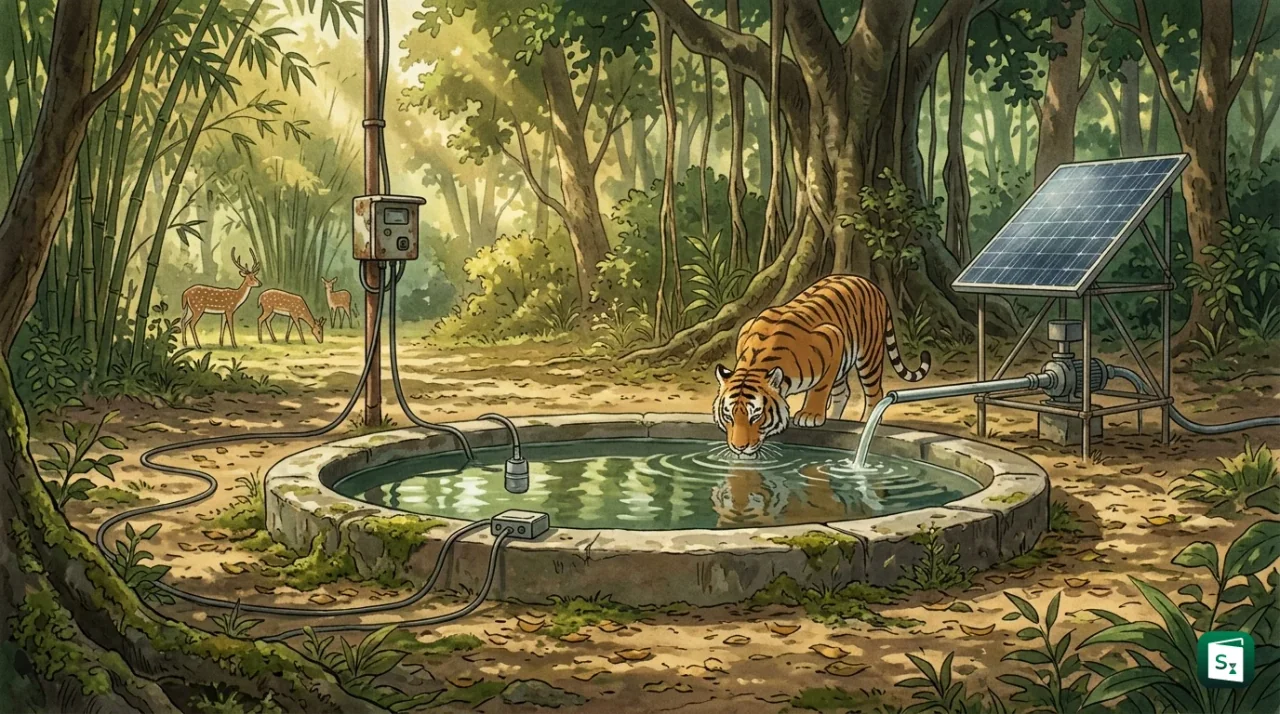
The Tadoba-Andhari Tiger Reserve in Chandrapur district of Maharashtra has started a pilot sensor based water management system to automate its wildlife waterholes. The system uses a water level sensor, a controller and a relay to switch waterhole pumps on and off by itself. The move aims to stop overflow, save groundwater and ensure steady drinking water for animals through the harsh summer.
Where Is Tadoba National Park
The Tadoba-Andhari Tiger Reserve is located in Chandrapur district in eastern Maharashtra, about 45 kilometres from Chandrapur town and around 140 kilometres from Nagpur. The reserve lies in the Vidarbha region and includes Tadoba National Park and the Andhari Wildlife Sanctuary.
Tadoba is Maharashtra’s oldest and largest national park. The name Tadoba comes from Taru or Tadoba, a local tribal god worshipped by Gond communities in the region. Andhari refers to the Andhari River that flows through the forest. A shrine to Taru near Tadoba Lake is still visited by local people, especially during the annual fair in December and January.
Tadoba National Park was first notified in 1955 with an area of 116.55 sq km. The Andhari Wildlife Sanctuary, covering 508.85 sq km, was notified in 1986. The two were merged in 1995 to form the Tadoba-Andhari Tiger Reserve. The Maharashtra Forest Department manages the reserve through a Field Director based at Chandrapur.
| Unit of Tadoba-Andhari Tiger Reserve | Area |
|---|---|
| Tadoba National Park (core, since 1955) | 116.55 sq km |
| Andhari Wildlife Sanctuary (core, since 1986) | 508.85 sq km |
| Total core or Critical Tiger Habitat | 625.40 sq km |
| Buffer zone around the core | 1,101.77 sq km |
| Total tiger reserve area | 1,727.17 sq km |
The core was declared as Critical Tiger Habitat in 2007 under Section 38V of the Wildlife (Protection) Act, 1972. This law is India’s main law for protecting wild animals and protected areas. The buffer zone, which includes 106 villages and mixed forest and farm land, was notified in 2010. Perennial water bodies in the landscape include Tadoba Lake, Kolsa Lake, the Andhari River and the Irai reservoir on the edge of the forest.
How Many Tigers Live in Tadoba
The Tadoba-Andhari Tiger Reserve holds more than 80 tigers inside the reserve and about 200 tigers in the larger Tadoba landscape including adjoining forest divisions (as of October 2026). The landscape covers forests of Chandrapur, Bramhapuri and Central Chanda and links to other protected areas in central India.
Tadoba is one of the best places in India to see the Bengal tiger, which is India’s national animal. The open forest and regular monitoring make sightings more likely here than in many dense forests. Along with tigers, the reserve supports leopards, sloth bears, wild dogs, sambar, chital, wild pigs and mugger crocodiles in Tadoba Lake.
Tadoba functions as a source population under Project Tiger. Project Tiger is a Centrally Sponsored Scheme of the Ministry of Environment, Forest and Climate Change, launched in 1973 with nine reserves. It now supports 58 tiger reserves across 18 states, covering about 84,500 sq km. The National Tiger Conservation Authority (NTCA), a statutory body set up in 2005 under the Wildlife (Protection) Act, 1972, approves tiger conservation plans and conducts the All India Tiger Estimation every four years.
Maharashtra has six tiger reserves. Tadoba is among the most productive for tiger breeding and dispersal. Young tigers from Tadoba have moved to forests like Navegaon-Nagzira, Umred-Karhandla, Tipeshwar, Bor and Pench, and even to Kawal and Indravati further away.
| Tiger Reserve in Maharashtra | Year Formed |
|---|---|
| Melghat | 1973-74 |
| Tadoba-Andhari | 1993-94 |
| Pench Maharashtra | 1998-99 |
| Sahyadri | 2009-10 |
| Navegaon-Nagzira | 2013-14 |
| Bor | 2014 |
As per the All India Tiger Estimation, Maharashtra had 444 tigers in 2022, up from 312 in 2018 and 103 in 2006. The state holds one of the largest tiger populations in the country. Continuous Phase IV camera trap monitoring in Tadoba, done with the Wildlife Institute of India, tracks tigers, co-predators and prey each year.
What Is the New Water Management System
The new water management system in Tadoba is a pilot automatic device that keeps wildlife waterholes filled to a fixed level without manual pumping. The Tadoba-Andhari Tiger Reserve management describes the system as the first sensor based waterhole control tried in Indian wildlife management.
A water management system in this context means the full arrangement for supplying, storing and controlling water for animals. In Tadoba it includes natural sources, artificial waterholes, borewells, solar pumps, pipelines and now sensors and controllers. The goal is simple. Keep clean water available near animals while wasting as little groundwater as possible.
The reserve has about 130 natural water sources and 350 artificial waterholes. Many artificial waterholes depend on groundwater pumped by solar powered pumps. The pumps run from sunrise to sunset. In summer, when natural streams dry up, these waterholes become the main drinking points for tigers, leopards, deer and birds.
| Component of the New System | Role |
|---|---|
| Water level sensor | Senses the water level inside the waterhole |
| Controller | Reads the sensor signal and decides when to act |
| Relay | Acts as an electric switch that starts or stops the pump |
| Waterhole pump, mostly solar powered | Lifts groundwater or stored water into the waterhole |
The Field Director of Tadoba-Andhari Tiger Reserve announced the pilot in October 2026. The system is installed on selected waterholes first. Performance during peak summer and drought spells will decide wider use.
How Does the Water Sensor Work
A water sensor is a small electronic device that detects the presence or height of water and sends an electric signal. In Tadoba, the sensor sits at a fixed height in the waterhole and continuously reports whether water has fallen below or risen above set limits.
The working logic is direct. When the water level falls below the lower limit, the controller closes the relay and the pump starts. Water flows into the waterhole. When the level reaches the upper limit, the controller opens the relay and the pump stops. This on and off cycle repeats through the day without a person standing at the site.
This matters because solar pumps do not stop by themselves. As long as sunlight is available, a solar pump keeps lifting water. Without control, the waterhole overflows after it is full. Overflow looks harmless but it drains groundwater, makes the surrounding soil soggy and wastes clean energy. A small part of the overflow helps animals that like wallowing, such as wild pigs and sloth bears. But uncontrolled flow for hours is pure waste.
Manual control is difficult in a tiger reserve. Staff must walk or drive to remote waterholes, often in extreme heat and in areas with tiger and leopard movement. Forgetting to switch off a pump, or reaching late, means hours of extra pumping. The sensor unit removes this risk. It cuts the need for daily visits, lowers staff exposure to dangerous wildlife encounters and keeps water levels steady for shy animals that drink at fixed times.
Why Water Management Matters in Tadoba
Water management is important in Tadoba because summer heat dries most natural streams while animal demand for water peaks in the same months. The Tadoba-Andhari Tiger Reserve must therefore store and supply water across a large dry deciduous forest without depleting groundwater or disturbing animals.
Chandrapur is a hot and drought prone district. Day temperatures in April and May often cross 45 degrees Celsius. During this period, tigers, leopards, wild dogs and herbivores gather around the remaining waterholes. Crowding at a few water points raises stress, disease risk and conflict. A wider and more reliable network of waterholes spreads animals evenly and improves breeding success.
The reserve has worked to reduce tanker dependence. In the intense heat last summer, Tadoba managers reported that no water tankers were needed to fill waterholes. Solar pumping and careful maintenance kept levels stable. The new sensor system builds on this result. It aims to save the groundwater that solar pumps would otherwise pump in excess, and to keep supply steady even if drought conditions return.
Tadoba managers have also divided the core area into grids to map water gaps. Each grid is being checked for natural and artificial sources. The plan is to provide at least one dependable waterhole in every grid. This exercise is expected to be completed within 2026. Better spacing means a tigress with cubs, a herd of chital or a pack of wild dogs will not have to travel far for water. Shorter travel saves energy and lowers road crossings and encounters with people.
In the larger picture, the pilot links technology with habitat care. If sensor control proves durable in dust, heat and wildlife movement, the same low cost model can help other tiger reserves in central India that face the same mix of solar pumps, hard summers and wide forest beats.
Key Takeaways
- The Tadoba-Andhari Tiger Reserve in Chandrapur, Maharashtra launched a pilot sensor based water management system in October 2026.
- The system uses a water level sensor, controller and relay to start the pump when water falls low and stop it at the upper limit.
- Tadoba manages about 130 natural sources and 350 artificial waterholes, many fed by solar powered pumps.
- The reserve covers 1,727.17 sq km, with a 625.40 sq km core formed by merging Tadoba National Park (1955) and Andhari Wildlife Sanctuary (1986) in 1995.
- Tadoba holds more than 80 tigers inside the reserve and about 200 tigers in the larger landscape (as of October 2026).
- Project Tiger, launched in 1973, now supports 58 tiger reserves, with Maharashtra holding 444 tigers in 2022.