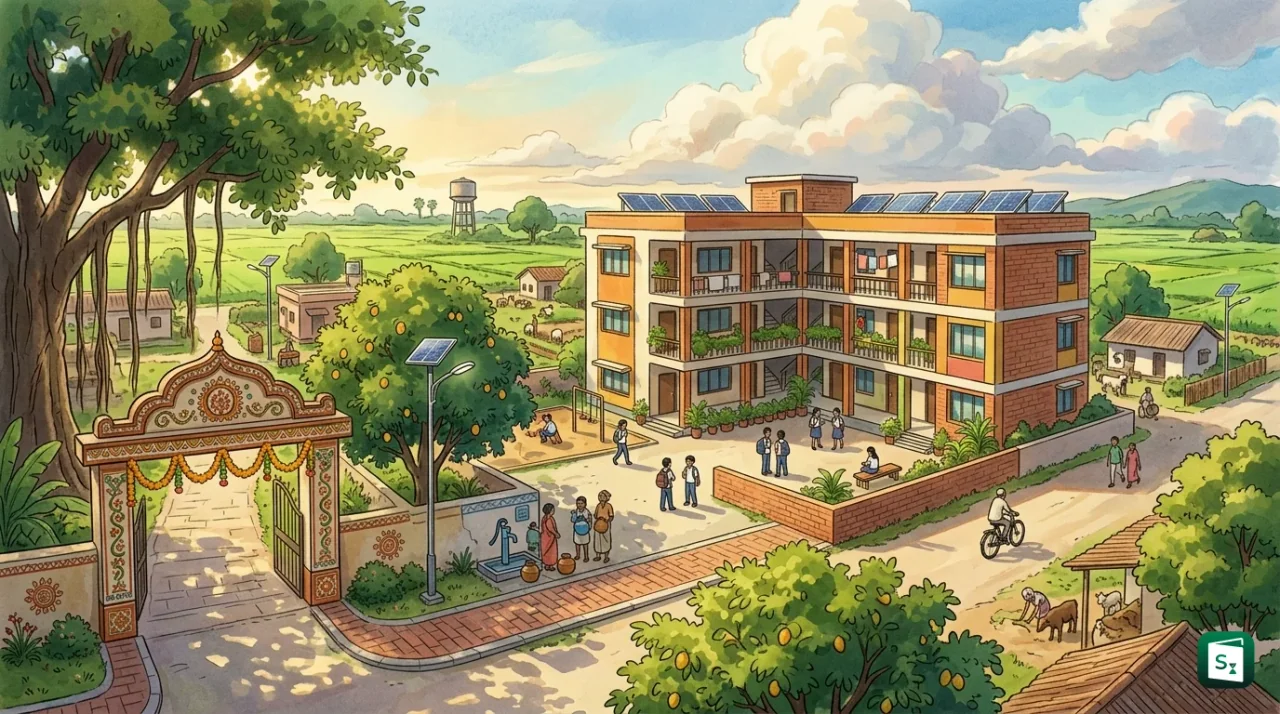
The Ministry of Social Justice and Empowerment has reported that 18,093 villages have been declared Adarsh Grams under the Pradhan Mantri Anusuchit Jaati Abhyuday Yojana (PM-AJAY), with the scheme now covering more than 47,200 villages across the country. The Ministry has released over ₹1,730 crore directly to States under the scheme’s Grants-in-Aid component between 2021-22 and 2025-26, while 785 student hostels have been completed as of September 2026. These numbers place PM-AJAY at the centre of India’s effort to close long-standing development gaps in Scheduled Caste-majority villages.
What Is the PM-AJAY Scheme?
The Pradhan Mantri Anusuchit Jaati Abhyuday Yojana (PM-AJAY) is a 100 per cent centrally sponsored scheme launched in 2021-22 by the Ministry of Social Justice and Empowerment to improve livelihoods, village infrastructure and education for Scheduled Caste communities. It works through three components: Adarsh Gram, Grants-in-Aid and Hostels.
The Department of Social Justice and Empowerment runs the scheme. Its stated objectives are to reduce poverty among Scheduled Caste communities through skill development and income-generating activities, to improve socio-economic indicators in Scheduled Caste-dominated villages, and to raise literacy and school enrolment by providing residential facilities. The scheme is designed as a convergence platform, which means it tries to pool resources from other Central and State programmes rather than work in isolation.
Three Merged Schemes Behind PM-AJAY
PM-AJAY is a merger of three older centrally sponsored schemes that shared similar goals. Bringing them under one umbrella was meant to reduce administrative duplication and create a single framework for planning, funding and monitoring.
| Merged Scheme | Original Focus | Period |
|---|---|---|
| Pradhan Mantri Adarsh Gram Yojana (PMAGY) | Integrated development of villages with a majority Scheduled Caste population | 2009-10 to 2021-22 |
| Special Central Assistance to Scheduled Castes Sub Plan (SCA to SCSP) | Additive grants to States for Scheduled Caste welfare projects | 1980 to 2021-22 |
| Babu Jagjivan Ram Chhatrawas Yojana (BJRCY) | Construction and repair of hostels for Scheduled Caste students | Pre-2021-22 |
The Adarsh Gram component carries forward the village-development work of PMAGY. The Grants-in-Aid component absorbs the old SCA to SCSP structure, while the hostel component continues the work of BJRCY. BJRCY was named after Babu Jagjivan Ram, a former Deputy Prime Minister and a prominent Scheduled Caste leader.
PM-AJAY and PM-JAY Are Not the Same
The two names sound almost identical, but they belong to different ministries and serve completely different purposes. PM-JAY is the Pradhan Mantri Jan Arogya Yojana, the health assurance scheme under Ayushman Bharat, which provides hospitalisation cover. PM-AJAY is a social justice scheme focused on villages, livelihoods and student hostels.
| Feature | PM-AJAY | PM-JAY |
|---|---|---|
| Full form | Pradhan Mantri Anusuchit Jaati Abhyuday Yojana | Pradhan Mantri Jan Arogya Yojana |
| Nodal Ministry | Ministry of Social Justice and Empowerment | Ministry of Health and Family Welfare |
| Core Purpose | Village development, livelihood support and hostels for Scheduled Caste communities | Health assurance and hospitalisation cover for eligible families |
| Flagship Umbrella | Standalone centrally sponsored scheme | A core component of Ayushman Bharat |
What Did the Latest Ministry Data Show?
The Ministry’s latest progress report, released in the run-up to the October announcement, shows improvement across all three components. The Adarsh Gram numbers are the most closely watched because they measure how many villages have actually completed the journey from selection to formal declaration.
| Metric | Latest Figure | Reference Point |
|---|---|---|
| Villages declared Adarsh Grams | 18,093 | 8 September 2026 |
| Villages covered under the Adarsh Gram component | 47,243 | September 2026 |
| Citizens covered in these villages | Over 47.79 lakh | September 2026 |
| Development works completed | 46,944 | September 2026 |
| Village Development Plans prepared | 27,032 | September 2026 |
| Grants-in-Aid released to States | Over ₹1,730 crore | FY 2021-22 to 2025-26 |
| Livelihood and skilling beneficiaries | Over 2.5 lakh | FY 2021-22 to 2025-26 |
| Student hostels completed | 785 | September 2026 |
The declaration count has moved quickly. In July 2026, the Ministry reported 16,759 Adarsh Grams; by early September, the figure had reached 18,093. That is an increase of more than 1,300 villages in about two months, which suggests that States are clearing pending verification and self-declaration checks at a faster pace.
The wider financial picture also matters. The Ministry has released ₹4,276.62 crore under PM-AJAY across all components since 2021-22, covering 30 States and Union Territories. Of this, ₹1,100.09 crore was released in 2025-26 alone. States reported utilisation of ₹3,185.07 crore for infrastructure, livelihoods and educational support.
How Does the Adarsh Gram Component Work?
An Adarsh Gram is a Scheduled Caste-majority village that has been assessed against 50 socio-economic indicators and has scored at least 70 out of 100, besides being Open Defecation Free. The State Government formally declares the status after verification, which is why selection and declaration are two different milestones.
The component follows a survey-first approach. Officials first establish a baseline for each village, then prepare a Village Development Plan that lists the gaps and the works needed to close them. Some gaps are filled by existing Central and State schemes through convergence, while the remaining ones are funded from PM-AJAY’s gap-filling allocation. Progress is uploaded on the PMAGY portal, which now sits inside the wider PM-AJAY digital system.
Fifty Indicators Across Ten Domains
The assessment covers ten development domains. Together they give a rounded picture of village life rather than focusing only on roads or buildings.
| Domain | Broad Focus |
|---|---|
| Drinking Water and Sanitation | Sustainable water sources, household taps, toilets, drains and waste disposal |
| Education | Attendance at primary, middle, secondary and higher secondary levels, plus scholarship coverage |
| Health and Nutrition | Health protection cover, ambulance access, anaemia among pregnant women, institutional deliveries |
| Social Security | Coverage under pension and social assistance programmes |
| Rural Roads and Housing | Road connectivity and housing adequacy |
| Electricity and Clean Fuel | Household electrification and access to clean cooking fuel |
| Agricultural Practices | Soil health cards, organic farming and watershed management |
| Financial Inclusion | Aadhaar coverage, bank accounts and access to credit |
| Digitization | Internet connectivity, Common Service Centres and digital literacy |
| Livelihood and Skill Development | Skilling, bank-linked loans and membership of self-help groups |
How a Village Becomes an Adarsh Gram
The process runs through distinct stages, and each stage has a paper trail that can be checked.
| Stage | What Happens |
|---|---|
| Selection | Villages with at least 40 per cent Scheduled Caste population and a total population of 500 or more are identified in descending order of Scheduled Caste population |
| Baseline survey | A need assessment survey records the status of all 50 indicators |
| Village Development Plan | A plan is prepared, usually covering a five-year horizon, listing the works required |
| Convergence and gap funding | Existing schemes are pooled; PM-AJAY funds cover activities that no other scheme supports |
| Assessment and declaration | A village scoring 70 or above and certified Open Defecation Free is declared an Adarsh Gram by the State |
States have also been directed to verify the self-declaration submitted for Adarsh Gram status. This verification step matters because a declaration changes how the village is presented in national data, and weak checks can inflate the count.
Who Is Eligible for Benefits?
Under the Grants-in-Aid component, priority goes to Scheduled Caste individuals and families with an annual income of ₹2.50 lakh or less. Members of Scheduled Caste-majority groups are also eligible. For infrastructure work, the unit of eligibility is the village rather than the household, and the threshold is the 40 per cent population share mentioned above.
Grants-in-Aid and Hostels: The Other Two Pillars
Adarsh Gram gets most of the public attention, but the scheme’s livelihood and education work runs through the other two components. Both are designed to reach Scheduled Caste families directly, either through skilling and income projects or through residential facilities for students.
Grants-in-Aid for Livelihoods
The Grants-in-Aid component gives money to States and districts for projects that raise incomes and improve social indicators. The projects include skill training, small livelihood enterprises, related infrastructure and residential schools where needed. Between 2021-22 and 2025-26, the Centre released more than ₹1,730 crore directly to States under this head, supporting over 2.5 lakh individual and group beneficiaries.
The allocation is not divided equally. It takes into account the Scheduled Caste population of a State and the ratio of the State’s Scheduled Caste Sub Plan to its Annual Plan, compared with the Scheduled Caste share of the population. In simple terms, States with a larger Scheduled Caste population and a weaker relative flow of sub-plan funds receive more weight.
Student Hostels for Scheduled Caste Students
The hostel component supports the construction and repair of hostels for Scheduled Caste students, with a clear focus on reducing dropout rates, especially among girls. As of September 2026, 785 student hostels have been completed. For 2026-27, the Centre has allocated ₹61.46 crore for two hostel projects, one for girls and one for boys, with room for 264 students.
The scheme’s guidelines go beyond bricks and beds. Girls’ hostels are required to have lady wardens and security personnel round the clock. Hostels are also expected to provide in-house coaching, medical care, health camps, IT education, sports coaching and barrier-free access for students with disabilities. During the five years from 2021-22 to 2025-26, 90 hostels were sanctioned, benefiting 10,649 Scheduled Caste students, with ₹198.50 crore released for construction.
How Is PM-AJAY Funded and Monitored?
PM-AJAY is a 100 per cent centrally funded scheme. States and Union Territories can add their own resources if they want to expand coverage, but the core funding comes from the Centre. The money is divided across the three components under a fixed allocation framework.
| Allocation Head | Share of Scheme Funds |
|---|---|
| Gap-filling activities in selected Adarsh Gram villages | Up to 50 per cent |
| Technical Support Groups and Project Implementation Units at Central, State and district levels | Up to 5 per cent |
| Construction and repair of hostels for Central institutions | Up to 2 per cent |
| Grants-in-Aid for district and State-level projects | Remaining funds |
Once an infrastructure project is completed, its upkeep and operation become the responsibility of the State Government or the implementing agency. The hostel component also allows Central assistance for maintenance, which recognises that a building without upkeep quickly loses its value.
Digital Monitoring Through the PM-AJAY Portal
The Ministry launched the PM-AJAY Portal and the AJAY mobile application on 26 May 2026. The platforms replace paper-based surveys and plan preparation with digital workflows. Field teams can conduct door-to-door surveys offline, generate Village Development Plans against the 50 indicators and upload geo-tagged, time-stamped photographs at different stages of construction.
For administrators, the portal provides national, State and district dashboards and links fund releases to milestones. The system covers all three components, so a hostel proposal, a livelihood project and an Adarsh Gram plan can be tracked on the same platform. The stated aim is faster processing, fewer missing files and a clear audit trail.
From PMAGY to PM-AJAY: The Policy Journey
The Adarsh Gram idea did not begin in 2021. It grew out of a longer effort to direct Plan funds toward villages where Scheduled Caste families formed a large share of the population. The merger in 2021-22 consolidated that experience into a single scheme.
Constitutional and Planning Roots
Article 46 of the Constitution, a Directive Principle of State Policy, directs the State to promote with special care the educational and economic interests of the weaker sections of society, particularly Scheduled Castes and Scheduled Tribes, and to protect them from social injustice and exploitation. Article 335 adds that the claims of Scheduled Castes and Scheduled Tribes to government services must be considered while maintaining the efficiency of administration.
The planning mechanism built on these provisions was the Scheduled Caste Sub Plan (SCSP), originally introduced as the Special Component Plan in 1979-80. The idea was to earmark a share of State Plan outlays in proportion to the Scheduled Caste population, so that benefits flowed to these communities across sectors rather than through welfare departments alone. The Special Central Assistance to SCSP, started in 1980, provided additional Central funds to States as a catalyst for these plans.
How PMAGY Evolved
PMAGY was announced in the 2009-10 Union Budget and began as a pilot covering 1,000 villages in five States: Assam, Bihar, Himachal Pradesh, Rajasthan and Tamil Nadu. It was later expanded in phases.
| Period | Expansion |
|---|---|
| 2009-10 | Pilot in 1,000 villages across five States, with gap-filling assistance of ₹20 lakh per village |
| 2014-15 | Phase I added 1,500 villages across 11 States |
| 2018-19 onwards | Coverage widened to eligible villages in all districts, selected in descending order of Scheduled Caste population |
| 2021-22 | PMAGY merged with SCA to SCSP and BJRCY to form PM-AJAY |
This history explains why the scheme’s data often mixes old and new vocabulary. Officials still refer to the PMAGY portal, even though the programme is now PM-AJAY, because the village-level survey and declaration system was built on that platform.
Why the Scheme Matters
Scheduled Castes make up about 16.6 per cent of India’s population, and a large share of them live in rural areas. PM-AJAY’s significance lies in its area-based approach. Instead of treating welfare as a set of separate individual benefits, it assesses an entire village and then works to close gaps in water, sanitation, education, health, housing, electricity, finance and skills.
The convergence model is the scheme’s real strength. A village does not have to wait for a single programme to fund every need. Jal Jeevan Mission can support water connections, PMAY-Gramin can support housing, Ayushman Bharat can support health cover, and PM-AJAY can fill the remaining gaps. The Village Development Plan is meant to coordinate these separate streams.
An independent evaluation by the Development Monitoring and Evaluation Office (DMEO) of NITI Aayog found that PM-AJAY is aligned with national development priorities and has improved access to basic infrastructure, electricity, banking, institutional healthcare, education and livelihood opportunities. The evaluation covered all three components across multiple States.
The data also reveals uneven performance. Tamil Nadu has declared 2,915 Adarsh Grams from 3,113 selected villages, and Karnataka has declared 1,530 from 2,185. In contrast, Bihar and West Bengal have selected 3,021 and 8,045 villages respectively, but the portal shows no declarations from either State yet. Uttar Pradesh has declared 2,234 out of 12,426 selected villages, while Punjab has declared 253 out of 3,763. These differences point to varying State capacity in completing works, compiling evidence and clearing verification.
Verification is another area of concern. Adarsh Gram status begins with a self-declaration, and the Ministry has instructed States and Union Territories to validate those claims. Without strong third-party checks, the headline number can run ahead of the actual quality of infrastructure on the ground.
What Lies Ahead?
The Department of Social Justice and Empowerment has proposed continuing PM-AJAY from 2026-27 to 2030-31 with an enhanced financial outlay. The plan is to expand coverage, deepen livelihood interventions and strengthen infrastructure in Scheduled Caste-dominated villages. Until the new phase is approved, the scheme continues under its existing framework.
Several tasks will shape the next phase. The most immediate is clearing the gap between selected villages and declared Adarsh Grams. More than 47,200 villages are covered, but only 18,093 have been declared, which leaves a large pipeline of pending works and verification.
The quality of hostels and their upkeep also needs attention. Completion numbers matter, but so do functioning amenities, safety arrangements and maintenance funding. Alongside this, data integrity remains central. A credible Adarsh Gram count depends on consistent surveys, geo-tagged evidence and State-level checks rather than self-reported progress alone.
For now, the scheme’s direction is clear. It is moving from paper-based planning to digital dashboards, from isolated works to convergence, and from village selection to measurable saturation of socio-economic indicators. How well States convert that framework into functioning water systems, classrooms, hostels and livelihoods will decide whether the Adarsh Gram label becomes a lasting marker of development or remains a statistical milestone.
Key Takeaways
- PM-AJAY is a 100 per cent centrally sponsored scheme launched in 2021-22 and implemented by the Ministry of Social Justice and Empowerment.
- The scheme merged three older programmes: Pradhan Mantri Adarsh Gram Yojana, Special Central Assistance to Scheduled Castes Sub Plan and Babu Jagjivan Ram Chhatrawas Yojana.
- A total of 18,093 villages had been declared Adarsh Grams as of 8 September 2026, while the Adarsh Gram component covered 47,243 villages and over 47.79 lakh citizens.
- A village is assessed on 50 socio-economic indicators across 10 domains and must score at least 70 out of 100 and be Open Defecation Free to be declared an Adarsh Gram.
- Over ₹1,730 crore was released to States under the Grants-in-Aid component from 2021-22 to 2025-26, supporting more than 2.5 lakh beneficiaries.
- As of September 2026, 785 student hostels had been completed, and ₹61.46 crore was allocated for 2026-27 for two hostel projects accommodating 264 students.
- The PM-AJAY Portal and AJAY mobile application were launched on 26 May 2026 to digitise surveys, Village Development Plans and milestone-linked fund flows.