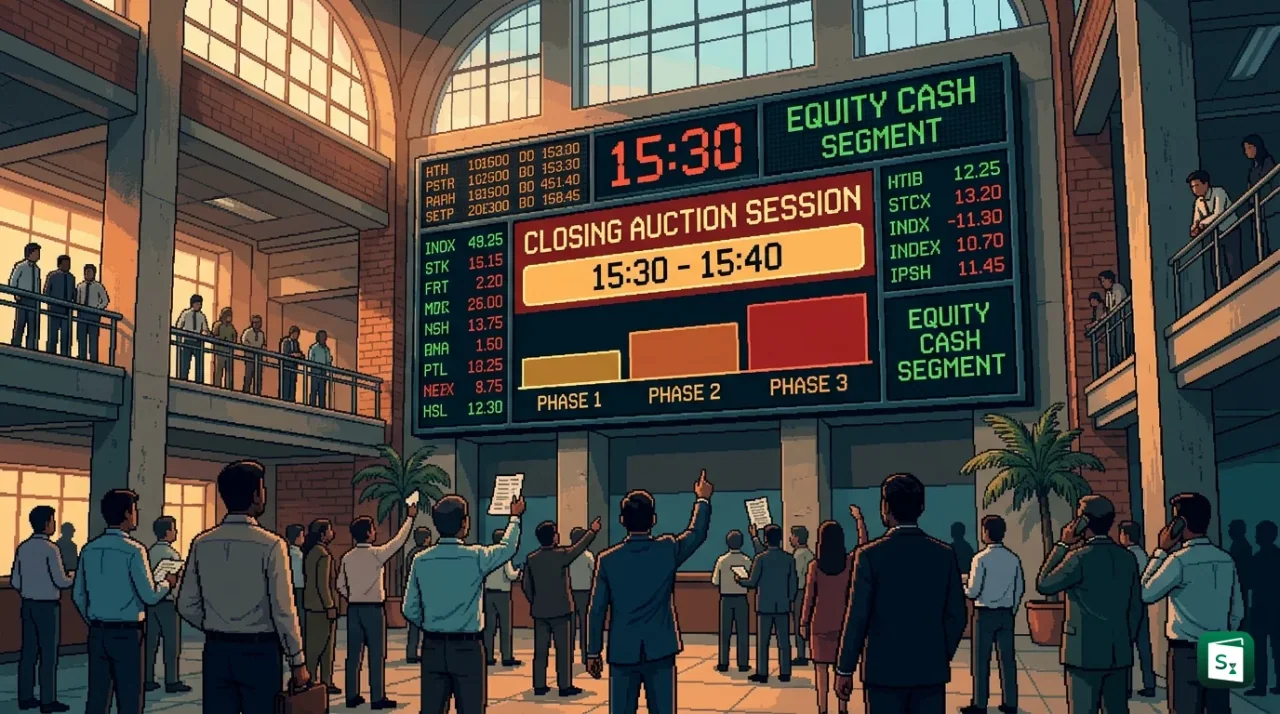
SEBI has overhauled the Closing Auction Session (CAS) that sets the official closing price for equity cash market stocks with derivatives contracts. From December 7, 2026, the auction will run for 10 minutes, from 3:30 PM to 3:40 PM, in three phases, replacing the earlier 3:15 PM to 3:35 PM window. The revision follows complaints of thin participation and sharp expiry-day swings, and it also restores the volume-weighted average price method for settling expiring derivatives.
What Is the Closing Auction Session (CAS)?
CAS stands for Closing Auction Session, a dedicated end-of-day auction in which a stock exchange collects buy and sell orders for a stock and matches them at one equilibrium price. That single price becomes the official closing price of the security for the trading day.
CAS currently applies only to stocks in the equity cash segment on which derivative contracts are available, generally called F&O stocks. About 208 such stocks were covered when the framework was rolled out on August 3, 2026, and the list has since grown to about 213. All other listed stocks still use the older method, where the closing price is the volume-weighted average price (VWAP) of trades in the final 30 minutes of continuous trading.
A VWAP is simply the average price of a stock weighted by the number of shares traded at each price. If a stock trades heavily at higher prices near the close, its VWAP rises; if most trades happen at lower prices, it falls.
The closing price is not a cosmetic number. It is used to calculate the net asset value (NAV) of mutual funds, to compute benchmark indices such as the Nifty 50 and the Sensex, to settle derivatives contracts on expiry, and to fix reference prices for open offers, delisting and buybacks. A small distortion in the close can therefore travel through the entire financial system.
The National Stock Exchange (NSE), established in 1992, and the Bombay Stock Exchange (BSE), founded in 1875 and Asia’s oldest exchange, run separate auction order books. Their auction prices can differ, which is why the Nifty and the Sensex can occasionally close at different percentage changes on the same day.
Why SEBI Replaced VWAP With a Closing Auction
Before August 2026, the closing price of every stock was the VWAP of trades executed in the last 30 minutes of continuous trading, between 3:00 PM and 3:30 PM. That method had a structural weakness. A large institutional order placed in the final minutes could push prices sharply, and the resulting close reflected the path of trading rather than a collective consensus at the bell.
The Securities and Exchange Board of India (SEBI), the apex regulator for India’s securities market, introduced CAS through a circular dated January 16, 2026. SEBI was set up in 1988 as a non-statutory body and received statutory powers through the SEBI Act, 1992. It is headquartered in Mumbai.
SEBI’s stated rationale was that an auction pools all closing interest into one order book. That allows a single price to emerge where the maximum quantity of buy and sell orders can be matched. The regulator argued this gives a fairer and more transparent close, improves execution for large orders and gives all categories of investors equal access to the closing price.
The closing price is also the benchmark for passive funds and exchange-traded funds (ETFs), which need to trade close to the official close to track their indices. A predictable auction helps them execute large rebalancing trades without distorting the market through the last half hour.
| Feature | VWAP method (before August 2026) | Closing Auction Session |
|---|---|---|
| Basis of closing price | Average price of trades in the final 30 minutes | Single equilibrium price from pooled buy and sell orders |
| Treatment of large orders | Impact spread across the closing window | Impact concentrated in one auction |
| Price band | Regular market price bands | Price band around a reference price |
| Closing time | Fixed at 3:30 PM | Random closure within a defined window |
The shift followed two rounds of public consultation, in December 2024 and August 2025, along with deliberations in SEBI’s Secondary Market Advisory Committee (SMAC). The framework went live on August 3, 2026, initially for derivative-linked stocks.
New CAS Timings: The Three Phases From 3:30 PM to 3:40 PM
From December 7, 2026, the auction will be a 10-minute session from 3:30 PM to 3:40 PM, divided into three phases. The first minute sets the reference price, the next five minutes accept both limit and market orders, and the final four minutes accept only limit orders before a random close between 3:38 PM and 3:40 PM.
| Phase | Time | What Happens |
|---|---|---|
| Phase 1 | 3:30 PM to 3:31 PM | Reference price is calculated from the continuous trading session and the exchange moves from continuous trading to the auction |
| Phase 2 | 3:31 PM to 3:36 PM | Limit orders and market orders can be placed, modified or cancelled |
| Phase 3 | 3:36 PM to 3:40 PM | Only limit orders can be placed; market orders cannot be modified or cancelled; order entry closes randomly between 3:38 PM and 3:40 PM |
After the order window shuts, the exchange matches orders using the auction algorithm and publishes the closing price and executed quantity as soon as possible. The random closure is deliberate. If traders knew the exact closing second, they could wait until the last moment and place a large order to nudge the price, a practice known as marking the close.
The revision also changes the rhythm of the trading day for F&O stocks. Continuous trading in these stocks will now continue until 3:30 PM, instead of stopping at 3:15 PM as it did under the original framework. The auction then takes over for ten minutes. The cash market post-close session will run from 3:50 PM to 4:00 PM, where trades are executed at the closing price of the security.
How the Closing Price Is Discovered
The auction cannot start from thin air. Every stock needs a reference price, which is the VWAP of trades in the final 15 minutes of continuous trading, between 3:15 PM and 3:30 PM. If a stock did not trade in that window, its last traded price during the day is used. If it did not trade at all, the previous day’s closing price becomes the reference, adjusted for corporate actions such as splits or bonuses.
Orders can be placed only within plus or minus 3% of the reference price. This band prevents the auction from producing a closing price far removed from the market’s recent trading range. Only limit orders and market orders are allowed. New iceberg orders, which hide the true order size by splitting a large order into smaller chunks, are barred. Stop-loss orders are also not permitted.
Analogy · The Single-Price Market Expand analogy
Imagine a vegetable market where every buyer and seller shouts a price at once. The auctioneer picks the one price at which the largest number of deals can be completed. Everyone who agrees to trade at that price gets served, and that becomes the day’s official rate.
The exchange then calculates the equilibrium price, the level at which the maximum number of shares can be bought and sold. If several prices meet that test, the exchange applies a clear set of tie-breakers.
| Situation | Rule for the closing price |
|---|---|
| One price allows the maximum executable volume | That price becomes the closing price |
| Several prices allow the same maximum volume | The price with the smallest unmatched order quantity is chosen |
| The unmatched quantity is also equal | The price closest to the reference price is chosen |
| The reference price is exactly midway between the two closest prices | The reference price itself is used |
| No equilibrium price can be found | The reference price becomes the closing price |
During the auction, exchanges display an indicative equilibrium price (IEP). This is an estimate based on the orders in the book at that moment. It changes as new orders arrive or existing orders are modified or cancelled, and it is not an executed trade. Traders often confuse the IEP with the final closing price, a problem that became central to the volatility seen in the early months of CAS.
Order execution follows a fixed priority. Market orders are matched first with other market orders on a time basis. Any remaining market orders are matched with limit orders on a price-time basis. The remaining limit orders are then matched with each other on price-time priority.
What Changes for Derivatives and Expiry-Day Settlement
The most consequential change is not the timing of the auction but the price used to settle derivatives on expiry day. SEBI has delinked the settlement price from the auction close and restored the VWAP of the final 30 minutes of continuous trading, between 3:00 PM and 3:30 PM.
For expiring index derivatives, the settlement price will be based on the index value calculated from the VWAP of its constituent stocks during that 30-minute window. For expiring stock derivatives, clearing corporations will use the VWAP of the underlying stock across all stock exchanges over the same period. Exchanges will publish indicative index and stock VWAP values in real time during the window so that traders can track the likely settlement price.
This reverses the original design. When CAS was introduced, the closing price discovered in the auction was also used to settle expiring derivatives. That link magnified the impact of a thin auction, because a handful of orders could move the closing price and, through it, the settlement value of options contracts worth thousands of crores.
The trading hours for derivatives have been aligned with the longer cash session. Index derivatives will trade until 3:45 PM on normal days. On expiry days, contracts expiring that day will stop trading at 3:30 PM, while the rest continue until 3:45 PM. Stock derivatives will trade until 3:45 PM on all days, including expiry days.
| Segment | Normal trading day | Expiry day |
|---|---|---|
| Cash market for CAS stocks | Continuous trading until 3:30 PM, then CAS from 3:30 PM to 3:40 PM | Same |
| Index derivatives | Until 3:45 PM | Expiring contracts stop at 3:30 PM; other contracts until 3:45 PM |
| Stock derivatives | Until 3:45 PM | Until 3:45 PM |
| Cash market post-close session | 3:50 PM to 4:00 PM | 3:50 PM to 4:00 PM |
For contracts that trade until 3:45 PM, the five-minute gap between the end of the auction at 3:40 PM and the derivatives close gives traders a short window to adjust positions after the official closing price is known. Before this revision, derivatives continued until 3:40 PM while the auction itself ran until 3:35 PM, leaving a much tighter adjustment window.
Why SEBI Revised the Framework
The original framework ran into trouble from its first day. On August 3, 2026, the Nifty 50 jumped nearly 200 points in the final minutes of the auction and closed 1.6% higher at 24,774.30, while the Sensex rose only 0.7% to 78,639.03. The divergence was not caused by a sudden change in market sentiment. It was the result of thin participation in the new auction.
Thin Liquidity and Sharp Swings
Data from the first session showed that the median auction participation across eligible stocks was just 1.7%, compared with a median of 16.3% during the conventional closing window in the preceding month. With few buyers and sellers in the auction book, a small number of large orders could move the equilibrium price sharply.
The problem recurred on expiry days. On September 3, 2026, the Sensex fell about 2,100 points within minutes during the auction before recovering most of the loss. On September 8, 2026, the Nifty’s indicative close dropped as much as 1.8% during the auction, triggering a sharp spike in put option premiums. Option buyers and sellers faced unexpected settlement and margin obligations because the auction price, not a broader trading average, decided the value of their contracts.
The Sensex Manipulation Case
The regulator’s surveillance also detected attempts to influence the auction. On August 13, 2026, a weekly Sensex expiry day, SEBI’s systems flagged sudden spikes in the Sensex indicative price across three short windows lasting a total of 42 seconds.
In an interim order, SEBI found that Copthall Mauritius Investment, a JPMorgan-owned entity, placed aggressive buy orders at or near the 3% upper price band across most Sensex constituents. These orders accounted for 85% to 99% of buy order value during the spikes and were largely cancelled after the index moved. SEBI estimated the wrongful gain at ₹2.96 crore.
Separately, Mansi Share and Stock Broking placed sell orders worth ₹145.65 crore across a few Sensex stocks and cancelled them within three seconds. The cancellation caused the Sensex indicative price to jump by 232.96 points, indicating that the sell orders had been artificially suppressing the index. SEBI estimated a wrongful gain of ₹71.64 lakh.
The two entities faced a combined penalty of ₹3.7 crore and a ban on market participation. It was the first enforcement action of its kind under the CAS framework. Such conduct is covered by the SEBI (Prohibition of Fraudulent and Unfair Trade Practices) Regulations, 2003, which bar manipulative and deceptive devices in the securities market.
Consultation and Review
SEBI issued a consultation paper on September 12, 2026, seeking public comments on the auction timings, the transition of pending orders and the settlement methodology for derivatives. The paper received more than 20,000 comments. After analysing them, along with recommendations from the SMAC and discussions with stock exchanges, SEBI issued the revised circular on October 15, 2026.
How India’s CAS Compares With Global Closing Auctions
Closing auctions are not an Indian experiment. Most major equity markets use some form of auction to set the official closing price, but the design differs.
The United States follows an on-close model. The New York Stock Exchange and Nasdaq accept market-on-close and limit-on-close orders throughout the day, alongside continuous trading, and publish information on order imbalances before the close. Europe and much of Asia-Pacific use a separate call auction after continuous trading ends. The London Stock Exchange introduced its closing call auction on May 30, 2000, with a five-minute order collection window.
| Market | Model | Key Feature |
|---|---|---|
| United States (NYSE, Nasdaq) | On-close facility | Auction orders run parallel to continuous trading; imbalance data published before the close |
| United Kingdom (LSE) | Separate closing call auction | Order collection after continuous trading, followed by a single clearing price |
| Hong Kong | Closing call auction | Introduced in 2008, suspended after manipulation concerns and relaunched in 2016 with stronger safeguards |
| India (NSE, BSE) | Separate closing call auction | Random closure, 3% price band, indicative equilibrium price and a one-minute transition |
India’s model is closest to the European and Asian call auction design, with two distinct features. The first is the random closure of the order window, which makes it harder to time a last-second order. The second is the 3% price band, which caps how far the auction price can move from the reference price.
Hong Kong’s experience is a useful warning. Its first closing auction was suspended in 2009, less than a year after launch, after regulators suspected widespread price manipulation. The relaunched version in 2016 added design features to deter manipulation, including a shorter auction window and price limits. India’s own revision follows a similar learning curve.
What the Overhaul Means for Investors and Market Participants
The revised framework changes the end-of-day routine for anyone who trades or values Indian equities.
For Mutual Funds and ETFs
Mutual funds value their portfolios using the official closing price, so the auction directly affects NAV. In the weeks after CAS began, several fund houses limited the size of trades routed through the auction because a sharp swing could leave a scheme buying or selling far from the prevailing market price. The longer continuous session, which will run until 3:30 PM from December 7, gives them more time to execute large orders in the regular market before the auction starts.
The restoration of VWAP-based derivatives settlement also reduces the valuation mismatch that hurt arbitrage funds. These funds hold a stock in the cash market and an offsetting short futures position. When the cash leg was valued at an auction price and the futures leg at a VWAP, the two ends of the same trade could diverge on paper, causing sudden NAV jumps or dips that did not reflect the actual strategy.
For Traders and Brokers
Traders in F&O stocks must note that continuous trading will end at 3:30 PM from December 7, not 3:15 PM. Any order placed after that goes into the auction. From February 8, 2027, limit orders pending at the end of continuous trading will generally be carried into the auction if their prices fall within the applicable band. Stop-loss orders will not be carried forward, and new stop-loss or iceberg orders cannot be placed during the auction.
The new rules also affect brokers and exchanges, whose revenue depends on derivatives volumes. In the first month of CAS, options premium turnover fell as traders stayed away from the uncertain close. The revised framework aims to bring participation back by making expiry-day settlement more predictable and by reducing the gap between the cash and derivatives sessions.
For long-term investors, the change is less visible but still relevant. A more reliable closing price improves the accuracy of index funds, ETFs and mutual fund NAVs, all of which use the close as a benchmark.
The Road Ahead
Most of the revised framework takes effect on December 7, 2026. The provisions governing the transition of unexecuted limit and iceberg orders from continuous trading into the auction will apply from February 8, 2027, giving exchanges and brokers more time to upgrade their systems.
SEBI has asked stock exchanges and clearing corporations to amend their standard operating procedures in consultation with the regulator within seven days of the circular and to put the necessary systems in place. The actual test will come in the weeks after December 7, when the market adjusts to a later close, a shorter auction and a different settlement price for derivatives.
The stakes are large. The stocks covered by CAS account for a substantial share of India’s passive investment universe. According to exchange estimates, assets under management linked to CAS-eligible stocks stood at about ₹10.11 trillion, or roughly 67% of total passive AUM. Any change in how their closing prices are set affects index funds, ETFs, arbitrage schemes and retail investors who hold them.
SEBI Chairperson Tuhin Kanta Pandey (as of October 2026) has said the closing auction is here to stay and that the regulator will act firmly against manipulation. The revised design reflects that balancing act: keep the auction, but make it harder to distort and less disruptive for derivatives.
The deeper challenge remains liquidity. A closing auction works best when many participants compete at the close. India’s auction is still dominated by institutions, while arbitrageurs and retail traders remain cautious. A vibrant stock lending and borrowing market, better awareness of auction mechanics and smoother coordination between the cash and derivatives segments will decide whether the closing bell becomes more reliable, or simply differently volatile.
Key Takeaways
- SEBI’s revised Closing Auction Session will run from 3:30 PM to 3:40 PM on all trading days from December 7, 2026, replacing the earlier 3:15 PM to 3:35 PM window.
- The 10-minute auction has three phases: a one-minute reference price calculation from 3:30 PM to 3:31 PM, a five-minute window for limit and market orders until 3:36 PM, and a four-minute limit-only window that closes randomly between 3:38 PM and 3:40 PM.
- The reference price is the volume-weighted average price of the stock in the final 15 minutes of continuous trading, and orders are allowed within plus or minus 3% of this price.
- CAS currently covers only F&O stocks, about 213 securities as of September 2026; other stocks continue to use the 30-minute VWAP method.
- Expiring derivatives will be settled using the VWAP of the final 30 minutes of continuous trading, between 3:00 PM and 3:30 PM, delinking settlement from the auction closing price.
- On expiry days, expiring index derivatives stop trading at 3:30 PM, while stock derivatives continue until 3:45 PM.
- The rules for carrying unexecuted limit and iceberg orders from continuous trading into CAS will take effect on February 8, 2027.
- SEBI’s first CAS manipulation order, passed after the August 13, 2026 Sensex expiry, imposed a combined penalty of ₹3.7 crore on Copthall Mauritius Investment and Mansi Share and Stock Broking.