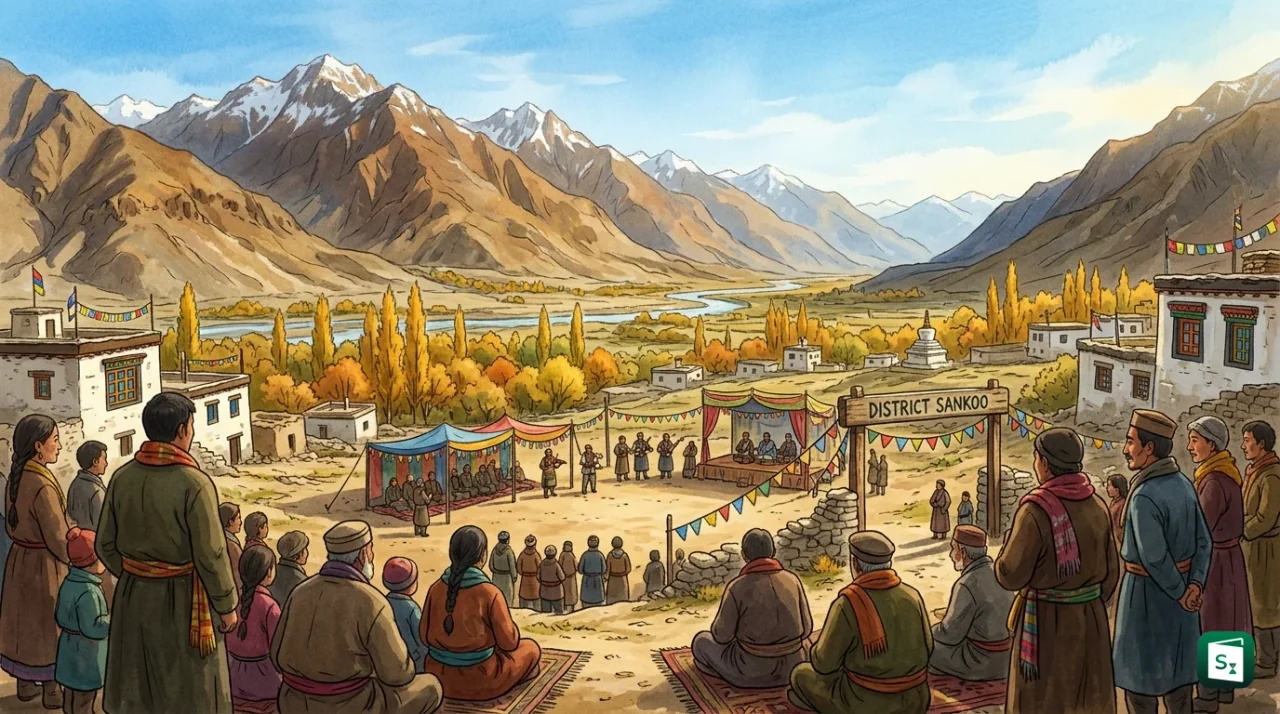
Lieutenant Governor Vinai Kumar Saxena announced Sankoo as the 8th district of Ladakh on 16 October 2026 during a visit to Sankoo town. The new district has been carved out of Kargil district, with Sankoo town as its headquarters. It fulfils a long pending demand and takes Ladakh from two districts in 2019 to eight districts in less than six months in 2026.
How Many Districts Are There in Ladakh in 2026?
Ladakh has eight districts in 2026. Leh and Kargil were the original two districts. Five new districts, Sham, Nubra, Changthang, Zanskar and Drass, were notified on 27 April 2026. Sankoo, carved out of Kargil, was notified on 16 October 2026 as the eighth district.
The count has changed quickly in recent years. Ladakh became a separate Union Territory on 31 October 2019 with only Leh and Kargil as districts. The Ministry of Home Affairs approved five new districts on 26 August 2024 to bring administration closer to remote settlements. The Ladakh administration issued the formal notification through S.O. 180 on 27 April 2026, which raised the total to seven.
Sankoo is the latest addition. The Revenue Department issued Notification S.O. 284 on 16 October 2026 under Section 5 of the Jammu and Kashmir Land Revenue Act, 1996, as applicable to Ladakh. The notification came into force from its publication in the Official Gazette and redefined the limits of Kargil district.
| District | Headquarters | Carved Out Of | Notified On |
|---|---|---|---|
| Leh | Leh | Original district | Existing since 1979 |
| Kargil | Kargil | Original district | Existing since 1979 |
| Sham | Khaltse | Leh | 27 April 2026 |
| Nubra | Diskit | Leh | 27 April 2026 |
| Changthang | Nyoma | Leh | 27 April 2026 |
| Zanskar | Padum | Kargil | 27 April 2026 |
| Drass | Drass-Ranbirpura | Kargil | 27 April 2026 |
| Sankoo | Sankoo | Kargil | 16 October 2026 |
What Is Sankoo and Where Is It Located?
Sankoo is a town and administrative centre in the Suru Valley of western Ladakh, located about 42 km south of Kargil town. The Suru River, which is a tributary of the Indus River, flows north through a broad bowl shaped valley at Sankoo and is joined by the Lingber Lungpa stream. The lower valley below 3,000 metres is among the most fertile parts of Ladakh, with two crops a year, willow and poplar plantations, and barley fields watered by heavy winter snowmelt.
Sankoo tehsil had a population of 40,548 in the 2011 Census. Most residents belong to Purgi communities of Tibetan descent and speak the Purgi language. Nearly the entire population follows Shia Islam, with historic links to Baltistani preachers who arrived from the 16th century onward. The area also preserves older Buddhist heritage, including the seven metre tall Maitreya rock carving near Kartse and the shrine of Sayed Mir Hashim at Karpo Kharon.
The demand for district status is old. In February 2020, about 3,000 people gathered in Sankoo under the banner of Youth Sankoo, with support from religious bodies such as Anjuman-e-Sahib Zaman and political groups, seeking a separate district for Sankoo and Zanskar. Residents argued that heavy snow cuts off far villages from Kargil town in winter and forces long travel for basic services. The Lieutenant Governor acknowledged the role of Anjuman-e-Sahib Zaman, its chief patron Syed Mohammad Razvi, chairman Sheikh Sadiq Balaghi, Kargil hill council chief Dr Jaffer Akhoon, Ladakh MP Haneefa Jan and former Leh council chief Tashi Gyalson in pursuing the demand.
Ladakh District Map and the New Administrative Framework
The Ladakh district map now shows three districts in the west centre around Kargil, namely Kargil, Drass and Sankoo, plus Zanskar in the south west. It shows Leh in the centre east, with Sham in the west of Leh, Nubra in the north and Changthang in the south east along the border with China. This layout reflects how the two large original districts were split to shorten administrative distances in a Union Territory that covers 59,146 sq km with a sparse population of about 2.74 lakh as per the 2011 Census.
The new Sankoo district comprises four tehsils, which are the basic revenue administrative units below the district. These are Sankoo, GM Pore, TSG and Taisuru, along with their revenue villages. The jurisdiction of Kargil district has been reduced to exclude these tehsils and villages. Till separate orders are issued for sub divisions, niabats and patwar circles, the existing revenue setup will continue.
Along with Sankoo, the administration announced five new tehsils to deepen outreach. These are Aryan Valley in Sham district, Sodh in Kargil district, Phey in Zanskar district, Thasgam in Drass district and Hemya in Changthang district. A tehsil brings land records, certificates and welfare services closer to villages, so new tehsils reduce the need for residents to travel often more than 100 km to the district headquarters in harsh terrain.
The larger reorganisation follows the same logic. After the April 2026 notification, Leh district retained 44 revenue villages, while Nubra got 30, Changthang 24 and Sham 27. Kargil retained 80 villages before the Sankoo split, while Zanskar got 26 and Drass 19. The administration has started building District Collectorate complexes at Khaltse, Diskit, Nyoma, Padum and Drass, and recruitment for gazetted and non gazetted posts has been taken up to staff the new offices.
Kargil District and Its Bifurcation
Kargil is the parent district of Sankoo. It is one of the remotest districts in India, covering high valleys that remain cut off from the rest of the country in winter when the Zoji La pass closes. Much of the present district was once known as Purig, ruled by local chiefs and later by Ladakhi kings. In 1834, Dogra general Zorawar Singh, acting for Maharaja Gulab Singh of Jammu, entered Ladakh through Suru Valley and met resistance near Sankoo before annexing the region.
Kargil in Which State or Union Territory Is It Located?
Kargil is in the Union Territory of Ladakh in northern India. Ladakh was formed on 31 October 2019 by the Jammu and Kashmir Reorganisation Act, 2019. Kargil is the western of the two original districts of Ladakh. It shares borders with Pakistan administered areas and the Kashmir Valley.
Kargil town is the joint headquarters of the district administration with Leh for the Union Territory setup at the field level. The district has four sub divisions, which are Drass, Zanskar, Sankoo and Shakar Chiktan. With the creation of Zanskar, Drass and now Sankoo as separate districts, the older large Kargil district has been divided into four smaller administrative units. This reduces travel for people in Suru Valley who earlier depended entirely on Kargil town, about 42 km to the north, for district level work.
What Is Ladakh?
Ladakh is a Union Territory in northern India between the Karakoram and the Himalaya. It was formed on 31 October 2019 after the division of Jammu and Kashmir. It is a high altitude cold desert with Leh and Kargil as its main towns.
Ladakh is a Union Territory without Legislature. It is administered by a Lieutenant Governor appointed by the President under Article 239 of the Constitution. Vinai Kumar Saxena is the Lieutenant Governor (as of October 2026). Leh functions as the main administrative headquarters, where the UT Secretariat and the Lieutenant Governor’s office are located. The official languages notified for Ladakh are Bhoti, Urdu, Purgi, Hindi and English.
Ladakh is famous for high mountain passes, glacial lakes and Buddhist monasteries. Pangong Tso, Nubra Valley, Khardung La, Hemis Monastery and the Zanskar range draw visitors from across India and abroad. The region is also known for Pashmina wool from Changpa herders, sea buckthorn production, apricots and wood carving. Strategically, Ladakh shares long borders with Pakistan and China, so the Indian Army maintains a large presence, especially in eastern Ladakh and the Siachen region.
Many local groups have demanded constitutional safeguards for land, jobs and culture, including extension of the Sixth Schedule and full statehood. The Sixth Schedule of the Constitution provides autonomous councils with powers over land and local laws in certain tribal areas. Ladakh already has hill councils under a separate law, but the demand for stronger protection continues alongside the creation of new districts.
Separate Hill Council for Sankoo
The Ladakh Autonomous Hill Development Council (LAHDC) is an elected body that plans development and manages local affairs in a district. Councils were first formed in Leh in 1995 and in Kargil in 2003 under the LAHDC Act, 1997. Their powers are broadly similar to those under the Sixth Schedule and cover areas such as land use, education, health and rural works. A 2018 amendment gave the councils greater funds and control.
The administration has notified a separate LAHDC for Sankoo, so the new district will have its own council like other districts. Elections for the new council will be held later. The existing Kargil council’s area will shrink to exclude villages now placed in Sankoo, Zanskar and Drass.
The move is linked to a wider legal change. President Droupadi Murmu promulgated the LAHDC (Amendment) Regulation, 2026, which Lieutenant Governor Saxena notified with effect from 19 October 2026. The regulation paves the way for councils in all eight districts. It rationalises elected seats from a fixed 26 to a range of 7 to 24 seats based on size, provides for nomination of four members from women and unrepresented communities, and gives the State Election Commission the power to conduct polls. The word Governor in the Act has been replaced with Administrator, which means the Administrator of Ladakh appointed under Article 239.
Key Takeaways
- Sankoo was notified as the 8th district of Ladakh on 16 October 2026 with Sankoo town as headquarters.
- The district comprises four tehsils, Sankoo, GM Pore, TSG and Taisuru, carved out of Kargil district under Notification S.O. 284.
- Ladakh now has eight districts: Leh, Kargil, Sham, Nubra, Changthang, Zanskar, Drass and Sankoo.
- Five districts were notified earlier on 27 April 2026 after approval by the Ministry of Home Affairs in August 2024.
- A separate LAHDC for Sankoo has been notified, and the LAHDC Amendment Regulation, 2026 allows councils in all eight districts with 7 to 24 elected seats.