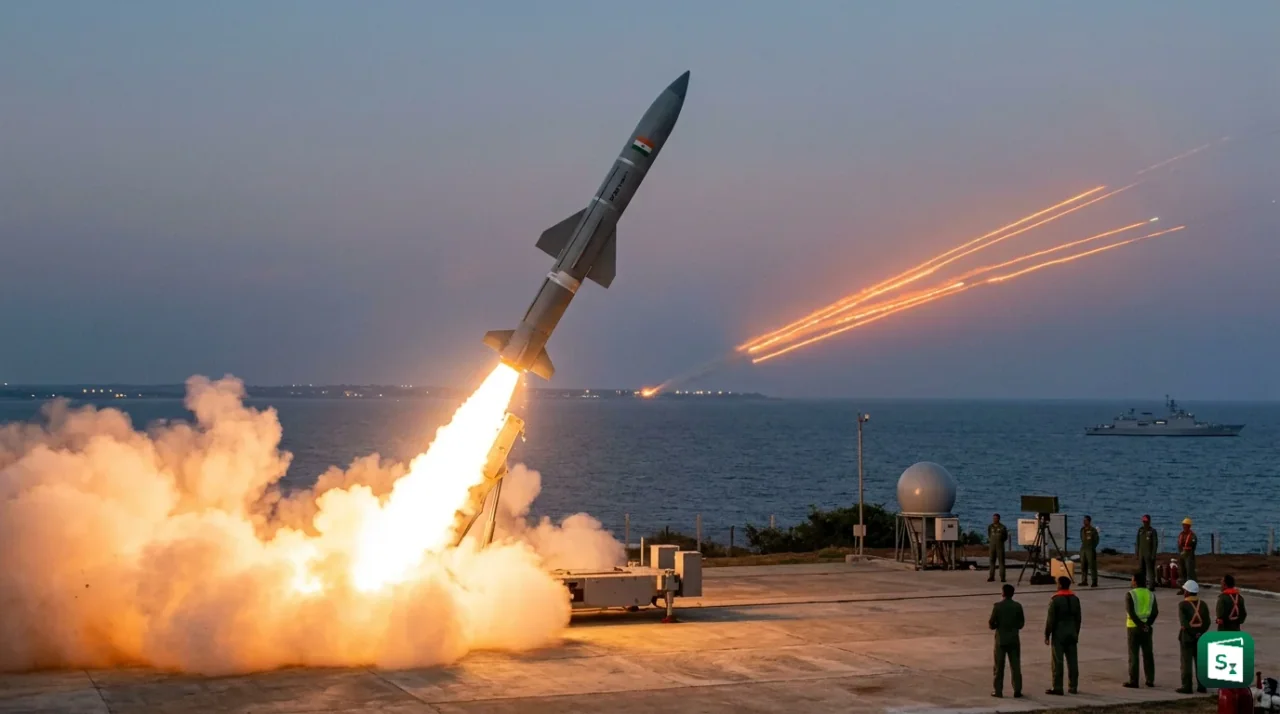
The Defence Research and Development Organisation achieved two major milestones in indigenous defence technology. It successfully conducted the maiden flight-test of the Kusha Long-Range Surface-to-Air Missile (LRSAM) from the APJ Abdul Kalam Island off the Odisha coast, and separately delivered India’s first indigenous expendable turbojet engine of the 350 kg thrust class. Both breakthroughs mark significant progress in India’s drive toward self-reliance in critical military technologies.
What Is Project Kusha?
Project Kusha, also called the Extended Range Air Defence System (ERADS), is a DRDO programme to develop a mobile long-range surface-to-air missile system for the Indian Air Force and Indian Navy. The project was cleared by the Cabinet Committee on Security in May 2022, and the Ministry of Defence granted Acceptance of Necessity in September 2023 for five squadrons at a cost of ₹21,700 crore.
The system is designed to fill the gap between the existing Medium-Range SAM (MR-SAM) with an 80 km range and the S-400 system acquired from Russia, which can engage targets up to 400 km. Once fully operational, Kusha will form the backbone of a layered air defence network, capable of engaging fighter aircraft, cruise missiles, drones, and stealth jets across extended ranges and altitudes.
The missile was test-fired from Launch Complex IV (LC-IV) of the Integrated Test Range (ITR) at APJ Abdul Kalam Island. This island, formerly known as Wheeler Island, was renamed in 2015 after former President Dr APJ Abdul Kalam and houses India’s primary missile testing facility off the Odisha coast in the Bay of Bengal.
Three Variants of the Kusha System
Project Kusha includes three interceptor variants that share the same kill vehicle but use different boosters to achieve varying ranges:
| Variant | Range | Primary Targets |
|---|---|---|
| M1 | 120-150 km | Fighter aircraft, cruise missiles, drones |
| M2 | 250 km | Stealth fighters, cruise missiles, large aircraft |
| M3 | 350-400 km | AWACS, large enemy aircraft, high-value aerial assets |
The missile travels at speeds of up to Mach 5.5 and uses a hybrid radio-frequency and infrared guidance system with datalink support. It carries a fragmentation warhead with both optical proximity fuze and hit-to-kill capability. The system will be mounted on Transporter Erector Launchers (TEL) and supported by 3D long-range surveillance radars and multi-function fire-control radars.
Each squadron is planned to have eight launchers carrying twelve missiles each, supported by two long-range observation radars. The Indian Air Force has ordered five squadrons, with plans to expand to ten. The naval version of the missile is also under development to counter anti-ship ballistic missiles.
Strategic Significance of the Kusha Test
The maiden flight-test of the Kusha missile demonstrated the baseline propulsion performance, aerodynamic stability, structural integrity, and integrated guidance logic of the system. The missile successfully intercepted an electronic target simulating a high-speed, high-altitude aerial threat, validating its design parameters.
Kusha is often compared to Russia’s S-400 Triumf system, which India has been inducting in phases under a ₹35,000 crore deal signed in 2018. However, Kusha differs from the S-400 in one key respect: it is not designed primarily to intercept ballistic missiles. While the S-400 has limited ballistic missile defence capability, Kusha is optimised for engaging aerodynamic targets such as aircraft, cruise missiles, stealth fighters, and drones. India’s ballistic missile defence needs will be met by a separate two-phase BMD programme, which has already validated Phase-I interceptors for the 2,000 km class and Phase-II interceptors for the 5,000 km class.
The Kusha missile system is also a key component of Mission Sudarshan Chakra, a larger initiative announced by Prime Minister Narendra Modi to develop a comprehensive, multi-layered air defence shield for the country by 2035. The system will integrate with the Integrated Air Command and Control System (IACCS), a fully automated air defence network that combines military and civilian radars to provide networked situational awareness.
| Aspect | Details |
|---|---|
| Project approval | May 2022 (Cabinet Committee on Security) |
| AoN for 5 squadrons | September 2023 |
| Cost per 5 squadrons | ₹21,700 crore |
| Expected induction | 2028-2030 |
| System integrators | Bharat Electronics, Bharat Dynamics Limited |
India’s First Indigenous Expendable Turbojet Engine
In a separate but equally significant achievement, DRDO has developed India’s first indigenous expendable turbojet engine in the 350 kg thrust class. The engine was designed by the Gas Turbine Research Establishment (GTRE), a Bengaluru-based laboratory of DRDO, and manufactured by Azad Engineering of Hyderabad. The engine was successfully delivered to GTRE on 22 July 2026.
GTRE, established in 1959 and brought under DRDO in 1961, is India’s primary laboratory for aero gas-turbine research and development. It is located in Bengaluru, Karnataka. The lab has previously developed engines such as the GTX-35VS Kaveri turbofan, the Manik small turbofan engine for cruise missiles, and the Kaveri Marine Gas Turbine for the Indian Navy.
Azad Engineering, headquartered in Hyderabad, is a precision engineering firm that manufactures mission-critical components for the aerospace, defence, energy, and oil and gas sectors. The company was selected by GTRE as a single-source industry partner for the Advanced Turbo Gas Generator (ATGG) programme in May 2024, under which this expendable turbojet engine was developed.
The engine was formally handed over by Azad Engineering CEO Rakesh Chopdar to Distinguished Scientist and Director General (Aeronautical Systems) Dr K. Rajalakshmi Menon and Outstanding Scientist and Director of GTRE Dr S.V. Ramanamurty.
Applications of the Turbojet Engine
An expendable turbojet engine is designed for single-use applications where the engine is not recovered after flight. The 350 kg thrust class engine is well-suited for powering:
- Cruise missiles, including the NASM-MR (Naval Anti-Ship Missile-Medium Range)
- Long-range loitering munitions and combat drones
- Decoy drones that simulate aircraft signatures to saturate enemy air defences
- Anti-ship missiles for the Indian Navy
Jet engine technology is mastered by only a handful of countries and is regarded as one of the most complex engineering disciplines, requiring exceptional precision, advanced metallurgy, and stringent manufacturing standards. The successful development of this engine demonstrates the growing technological maturity of India’s private defence manufacturing ecosystem.
DRDO Chairman Rajesh Kumar Singh described the achievement as a historic milestone for the country’s aerospace and defence ecosystem, highlighting the successful partnership between a DRDO laboratory and a private industry partner.
The Road Ahead
Both developments are expected to move toward induction and production. For Project Kusha, further developmental trials will be conducted before the system enters service with the Indian Air Force, with induction of the three variants expected between 2028 and 2030. Bharat Electronics and Bharat Dynamics Limited are expanding their manufacturing infrastructure to produce 300-400 missiles per year by 2032.
For the turbojet engine, the ATGG programme will move into production phase, with the engine set to power India’s next-generation cruise missiles and unmanned systems. The partnership between GTRE and Azad Engineering is expected to serve as a model for future collaboration between DRDO labs and the private sector under the Atmanirbhar Bharat initiative.
Key Takeaways
- The Kusha Long-Range Surface-to-Air Missile, also called the Extended Range Air Defence System (ERADS), is being developed under Project Kusha by DRDO for the Indian Air Force and Indian Navy.
- The missile has three variants: M1 (120-150 km range), M2 (250 km range), and M3 (350-400 km range), all with a top speed of Mach 5.5.
- The maiden flight-test was conducted from APJ Abdul Kalam Island (formerly Wheeler Island) off the Odisha coast, which houses the Integrated Test Range.
- DRDO’s GTRE, established in 1959 and based in Bengaluru, designed the first indigenous expendable turbojet engine of 350 kg thrust class.
- The engine was manufactured and delivered by Azad Engineering of Hyderabad on 22 July 2026 under the Advanced Turbo Gas Generator (ATGG) programme.
- The turbojet engine will power cruise missiles, loitering munitions, and anti-ship missiles, reducing import dependence in critical propulsion technology.