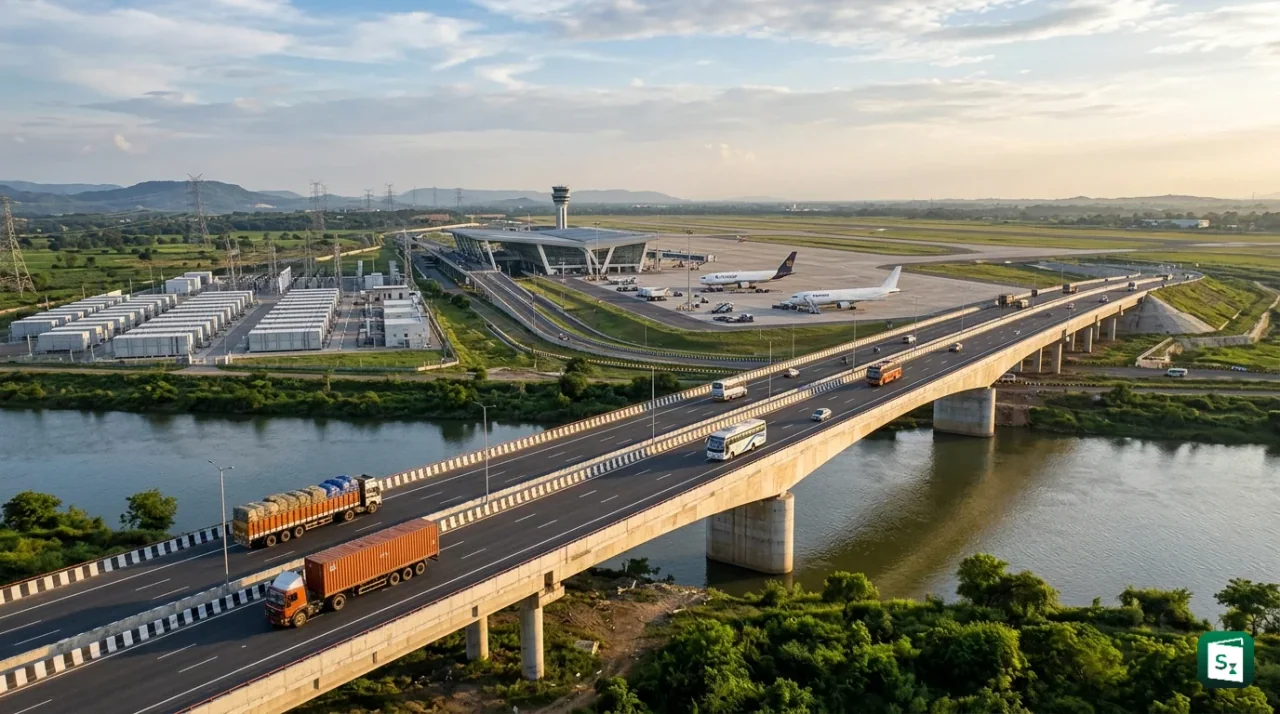
The Ministry of Statistics and Programme Implementation (MoSPI) has released the latest quarterly update of its PAIMANA performance dashboard, expanding the indicator set from 121 to 165 with 44 newly added metrics across India’s critical infrastructure sectors. The update captures remarkable momentum in civil aviation cargo, record highway construction, surging digital toll collections, and a projected tenfold increase in energy storage capacity, offering a data-driven snapshot of the country’s infrastructure transformation.
What Is the PAIMANA Dashboard?
PAIMANA stands for Project Assessment, Infrastructure Monitoring and Analytics for Nation-building. It is a web-based performance dashboard launched by MoSPI on 16 April 2026, replacing the earlier OCMS-2006 (Online Computerized Monitoring System) that had been in use for nearly two decades. The dashboard was built on the principle of “one data, one entry” and is integrated with the Integrated Project Monitoring Portal of the Department for Promotion of Industry and Internal Trade (DPIIT) through APIs, enabling automatic data flow from central ministries.
The dashboard monitors infrastructure performance across multiple sectors using indicators grouped under five dimensions: Accessibility, Quality, Fiscal Cost and Revenue, Utilization, and Affordability. This multidimensional framework marks a significant shift from the earlier output-focused approach, which measured only production and growth rates, to a holistic evaluation that captures how widely infrastructure is available, how reliably it performs, and how economically accessible it is to citizens.
How the Dashboard Measures Infrastructure Performance
The latest quarterly update, released in July 2026, added 44 new indicators to the dashboard, bringing the total to 165. These indicators are distributed across major infrastructure sub-sectors, with some of the largest allocations in civil aviation, ports and shipping, and roads. The dashboard now covers performance data across all key infrastructure domains, moving beyond the original set of 116 indicators that were available at its launch.
| Infrastructure Sub-Sector | Number of Indicators (Current) |
|---|---|
| Civil Aviation | 29 |
| Roads, Transport and Highways | 9 |
| Power and Energy | 13 |
| Ports, Shipping and Waterways | 49 |
| Telecommunications | 7 |
| Railways | 9 |
| Others (newly added) | 49 |
The dashboard is updated on a quarterly basis, with each release incorporating the latest data submitted by the respective ministries and departments. The July 2026 update, in particular, introduced indicators related to energy storage capacity, aerodrome expansion, cargo throughput, and electronic toll transactions, reflecting the government’s growing emphasis on tracking infrastructure quality and outcomes rather than just outputs.
Civil Aviation: Cargo Boom and Airport Expansion
The civil aviation sector posted extraordinary numbers in the latest dashboard update. A total of 98,920 tonnes of cargo was transported in April 2026, recording a staggering 115% year-on-year increase. This surge reflects the rapid expansion of India’s air cargo ecosystem, driven by the growth of e-commerce, pharmaceutical logistics, and perishable goods exports. The Economic Survey 2025-26 had earlier noted that India’s air cargo volumes grew from 2.53 million metric tonnes in FY15 to 3.72 million metric tonnes in FY25, and this momentum has clearly accelerated.
The dashboard also highlighted the remarkable expansion of India’s airport network. The number of aerodromes in the country has increased from 81 in 2014 to 165 at present, more than doubling in just over a decade. This growth has been driven by the UDAN (Ude Desh ka Aam Naagrik) regional connectivity scheme, launched in 2016 under the Ministry of Civil Aviation, which aims to make air travel affordable and accessible to smaller towns. The scheme has operationalized dozens of underserved and unserved airports, contributing directly to this expansion.
Roads and Highways: Record Construction and Digital Tolling
The Road, Transport and Highways sector reported that 9,360 km of National Highways (NHs) were constructed during FY26 (2025-26). This continues the trend of sustained highway expansion under the Ministry of Road Transport and Highways (MoRTH), driven by flagship programmes such as Bharatmala Pariyojana, which was launched in 2017 with a target of building about 34,800 km of highways at an estimated cost of over ₹5.35 lakh crore. Bharatmala focuses on optimizing the efficiency of freight and passenger movement across the country by bridging critical infrastructure gaps.
On the digital payments front, electronic toll collection transactions reached ₹88 crore up to May 2026, registering a 39.7% year-on-year growth. This surge is driven by the widespread adoption of FASTag, an electronic toll collection system based on Radio Frequency Identification (RFID) technology, which was mandated by the government for all vehicles from January 2021. FASTag is issued by the National Payments Corporation of India (NPCI) through the National Electronic Toll Collection (NETC) system and allows vehicles to pass through toll plazas without stopping for cash payments.
The growth in digital tolling aligns with the government’s broader push toward a barrier-less, distance-based toll collection system. In December 2025, the Union Minister for Road Transport and Highways announced plans to implement a fully automated electronic toll collection system nationwide within a year, eliminating physical toll plazas and using AI-based number plate recognition technology.
Power Sector: A Tenfold Surge in Energy Storage Needs
One of the most significant data points in the latest PAIMANA update relates to the power sector. Storage requirements are projected to increase more than tenfold, rising from 87 GWh in 2027-28 to 888 GWh by 2035-36. This projection, aligned with reports from the India Energy Storage Alliance (IESA), underscores the critical role that energy storage will play in India’s transition to a renewable energy-dominated grid.
The Composition of Storage Capacity
The projected 888 GWh storage capacity will be met through two main technologies:
- Battery Energy Storage Systems (BESS) are expected to contribute about 80 GW of capacity by 2035-36. BESS involves large-scale lithium-ion or advanced chemistry battery banks that can store electricity from solar and wind farms and discharge it when needed. These systems are particularly valuable for managing the intra-day variability of solar power, which generates electricity only during daylight hours.
- Pumped Storage Plants (PSPs) are projected to add 94 GW of capacity. PSPs work by pumping water from a lower reservoir to an upper reservoir during periods of low electricity demand and releasing it through turbines to generate power during peak hours. This is a mature technology that India has used for decades, with projects such as the Tehri Pumped Storage Plant in Uttarakhand and the Pinnapuram PSP in Andhra Pradesh.
India’s current installed battery storage capacity stands at roughly 1 GWh, meaning the country will need to scale its storage infrastructure nearly 900 times over the next decade. This massive requirement is driven by India’s ambitious renewable energy targets: the country aims to achieve 500 GW of non-fossil fuel energy capacity by 2030 and net zero emissions by 2070, as announced by the Prime Minister at COP26 in 2021.
Why Energy Storage Matters
The intermittency of renewable sources such as solar and wind poses a challenge to grid stability. Solar farms generate power only when the sun is shining, and wind turbines only when the wind is blowing. Energy storage bridges this gap by storing surplus renewable electricity during periods of high generation and releasing it during periods of low generation or high demand. Without adequate storage, India’s ambitious renewable energy targets risk being underutilized, and grid operators would struggle to maintain the delicate balance between supply and demand.
The government has recognized this challenge and has introduced several policy measures to promote energy storage, including the Production Linked Incentive (PLI) scheme for Advanced Chemistry Cell (ACC) battery manufacturing, which was approved in 2021 with a budget of ₹18,100 crore to build a domestic manufacturing capacity of 50 GWh of ACC batteries. Additionally, the Ministry of Power has notified the Energy Storage Obligation (ESO) framework, which mandates that a certain percentage of electricity from renewable sources must be paired with storage capacity, similar to the earlier Renewable Purchase Obligation (RPO).
Key Takeaways
- The PAIMANA dashboard, launched by MoSPI in April 2026, has expanded to 165 indicators with the addition of 44 new metrics in its latest quarterly update.
- India transported 98,920 tonnes of air cargo in April 2026, registering a 115% year-on-year growth, while the number of aerodromes doubled from 81 in 2014 to 165 currently.
- A total of 9,360 km of National Highways was constructed during FY26, and electronic toll collection through FASTag grew 39.7% year-on-year to ₹88 crore up to May 2026.
- India’s energy storage requirement is projected to surge from 87 GWh in 2027-28 to 888 GWh by 2035-36, a more than tenfold increase driven by renewable energy integration.
- The storage capacity will comprise 80 GW from Battery Energy Storage Systems (BESS) and 94 GW from Pumped Storage Plants (PSPs).
- The PLI scheme for Advanced Chemistry Cell batteries, approved in 2021 with an outlay of ₹18,100 crore, aims to build 50 GWh of domestic ACC manufacturing capacity to support India’s storage goals.