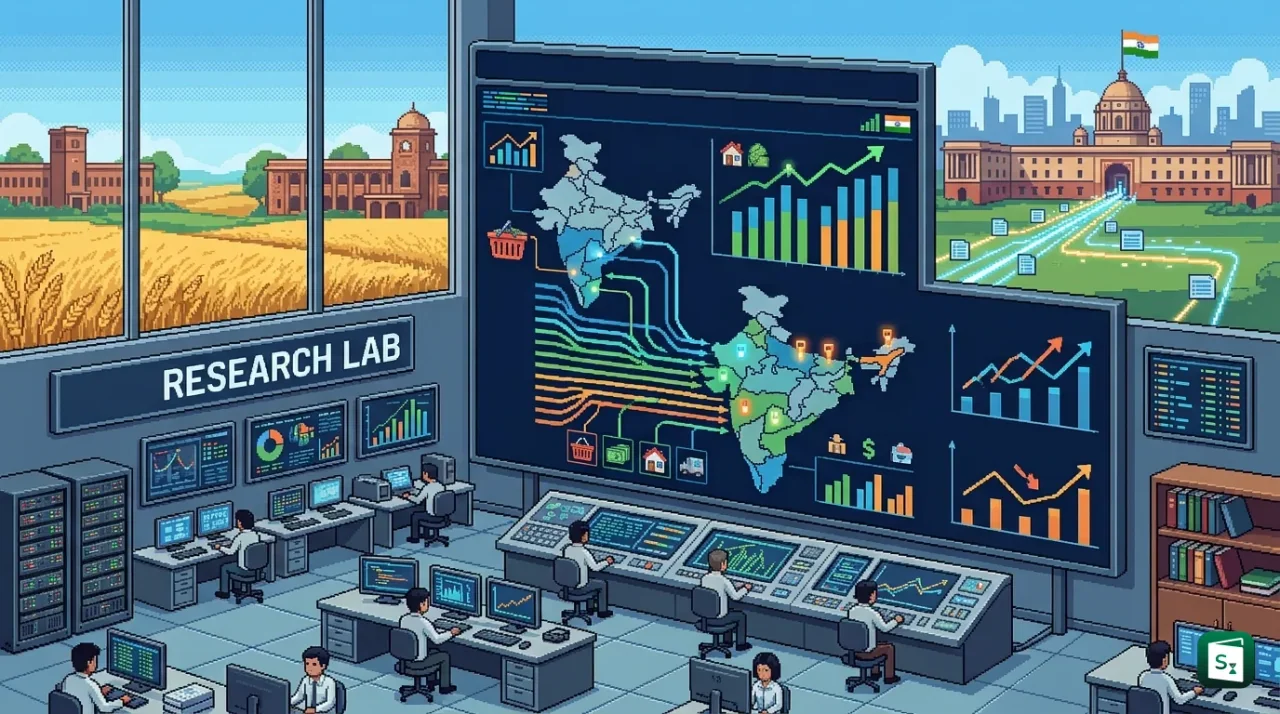
The Ministry of Statistics and Programme Implementation (MoSPI) signed a Memorandum of Understanding with the Thapar Institute of Engineering and Technology (TIET), Patiala on 31 August 2026 to develop a Predictive and Analytical Framework for Monthly Consumption Expenditures in India. The study will use data from the Household Consumption Expenditure Survey (HCES) to estimate and analyse Monthly Per Capita Consumption Expenditure (MPCE) at national and state levels. At a time when private consumption drives more than three fifths of India’s GDP, the framework aims to give policymakers faster, more reliable insights between survey rounds.
What Is Consumption Expenditure and Why Is Monthly Data Important?
Consumption expenditure is the total money spent by households or government on goods and services for final use. Household consumption expenditure covers spending by families on food, housing, transport, health, education and durable goods, while government final consumption expenditure covers spending by government on public services. Together with investment and net exports, it forms a core part of Gross Domestic Product (GDP), and its household component is tracked as Private Final Consumption Expenditure (PFCE) in national accounts.
Tracking this spending on a monthly basis matters because India’s economy is consumption led. According to the Economic Survey 2025-26, the share of PFCE in GDP rose to 61.5 percent in FY26, the highest since 2011-12, and real GDP growth for FY26 was estimated at 7.4 percent. Monthly Per Capita Consumption Expenditure (MPCE), which means the average monthly spending per person, is the standard measure derived from household surveys to understand living standards, poverty and inequality. It is also a key input for updating the Consumer Price Index (CPI), which measures inflation, and for weighting GDP estimates.
The challenge is that large household expenditure surveys are periodic and field intensive. A predictive framework can fill the gap by providing model based monthly estimates, helping government track demand, calibrate welfare delivery and improve price statistics without waiting for the next full survey round.
Consumption Expenditure Formula in Simple Terms
In basic macroeconomics taught at school level, total consumption expenditure is often linked to income through a simple relation where consumption depends on autonomous spending plus a proportion of disposable income. In national accounts, household spending is summed across all items to arrive at MPCE, which is calculated by dividing a household’s total monthly spending by its size. The framework under the new MoU will refine such aggregation using statistical modelling and predictive analytics rather than relying only on direct survey totals.
What Was Signed Between MoSPI and Thapar Institute?
The MoU was signed on 31 August 2026 in New Delhi between MoSPI and TIET, Patiala. It was signed by Prof. Padmakumar Nair, Vice Chancellor of TIET, and Shri R. Rajesh, Additional Director General, Capacity Development Division, MoSPI. The ceremony was attended by Dr. Saurabh Garg, Secretary, MoSPI, along with Dr. Chandramani Sharma, Additional Director General, Coordination and Quality Control Division, and Dr. Sourav Chakrabortty, Deputy Director General, Research and Analysis Division, MoSPI.
Under the agreement, TIET will undertake a dedicated research study to build a Predictive and Analytical Framework for Monthly Consumption Expenditures. The project is described as part of MoSPI’s wider push to collaborate with academic institutions and to expand the use of artificial intelligence (AI) and data science in official statistics. TIET will leverage its research capacity, including the Thapar School of Advanced AI and Data Science established in collaboration with NVIDIA, to design estimation models, pattern detection tools and analytical dashboards.
The core deliverable is a framework that can generate monthly estimates of consumption expenditure, identify household consumption patterns across states and social groups, and provide evidence for poverty and inequality analysis. This is especially useful because full scale HCES data, while comprehensive, is released periodically and cannot by itself offer high frequency signals for fast moving policy needs.
Understanding the Household Consumption Expenditure Survey and MPCE
The Household Consumption Expenditure Survey (HCES) is India’s primary source of data on how households spend. It is conducted by the National Statistical Office (NSO), the statistics wing of MoSPI, through the National Sample Survey Office (NSSO) network using multistage stratified sampling. Villages and urban blocks are selected as first stage units and households as ultimate stage units, with households grouped by land possessed in rural areas and car ownership in urban areas to ensure representation across economic classes.
The two most recent rounds after the pandemic were HCES 2022-23 and HCES 2023-24. The 2023-24 survey, held from August 2023 to July 2024, covered 2,61,953 households (1,54,357 rural and 1,07,596 urban) across all States and Union Territories. A detailed factsheet was released in December 2024 and the full report in June 2024.
| Survey Round | Sample Households | Average MPCE Rural | Average MPCE Urban | Urban-Rural Gap as percent of Rural MPCE |
|---|---|---|---|---|
| 2011-12 (68th Round) | Large national sample | ₹1,430 | ₹2,630 | 83.9% |
| 2022-23 | About 2.6 lakh households | ₹3,773 (₹3,860 with imputation) | ₹6,459 (₹6,521 with imputation) | About 71% |
| 2023-24 | 2,61,953 households | ₹4,122 (₹4,247 with imputation) | ₹6,996 (₹7,078 with imputation) | About 70% |
MPCE without imputation excludes the value of items received free through welfare programmes, while figures with imputation include them. The survey also showed a fall in consumption inequality, with the Gini coefficient declining to 0.237 in rural and 0.284 in urban India in 2023-24 from 0.266 and 0.314 a year earlier. State patterns varied widely. Sikkim recorded the highest MPCE at ₹9,377 rural and ₹13,927 urban, while Chhattisgarh had the lowest at ₹2,739 rural and ₹4,927 urban. Among non-food items, spending was highest on conveyance, clothing, bedding and footwear, and miscellaneous goods, while among food items, beverages, refreshments and processed food led the share.
This data feeds directly into poverty measurement, the base year revision for GDP and CPI, and welfare targeting. The new predictive framework will build on this database, using unit level HCES records to model monthly movements rather than just annual snapshots.
How Will the Predictive and Analytical Framework Work?
An analytical framework is a structured approach to examine data and draw conclusions, while a predictive framework adds models that forecast future values based on past patterns. In this MoU, the two are combined. The analytical part will break down consumption by sector, state, social group and item group to reveal patterns, while the predictive part will use statistical and AI methods to estimate MPCE for months when no fresh survey is available.
The work will involve three practical steps. First, researchers will harmonise HCES microdata on quantities and values of consumption for hundreds of items, grouped into food and non-food categories across questionnaires on household characteristics, food and perishables, and durable goods. Second, they will train models that link expenditure levels to correlates such as prices, seasons, geography and household traits, validating them against the observed monthly panels of HCES 2023-24, which was spread over ten overlapping three month panels from August 2023 to July 2024. Third, they will build tools to generate national and state level MPCE estimates monthly, with error measures such as relative standard errors for reliability checks.
The use of AI and machine learning in official statistics is not new globally but its application to consumption estimation is growing in India. Models can detect seasonality in food spending, shifts from food to non-food as incomes rise, and divergent trends between rural and urban areas. For government, monthly signals mean earlier detection of demand slowdowns, better calibration of inflation monitoring and more timely inputs for Private Final Consumption Expenditure estimation within GDP.
Consumption Expenditure Components Covered
The framework is expected to analyse spending across major groups that HCES already tracks, such as cereals, pulses, milk, vegetables, beverages, education, health, transport, rent and durable goods. By keeping the same item classification, the new monthly estimates will remain comparable with official HCES reports and the National Accounts Statistics compiled by MoSPI.
MoSPI and TIET: Institutional Profiles
What is MoSPI? The Ministry of Statistics and Programme Implementation is the nodal ministry for official statistics and programme monitoring in India. It came into existence as an independent ministry on 15 October 1999 after the merger of the Department of Statistics and the Department of Programme Implementation. It is headquartered in New Delhi and is headed by a Union Minister, currently Rao Inderjit Singh as Minister of State (Independent Charge), with the Secretary as the administrative head. MoSPI has two wings. The Statistics Wing, now called the National Statistical Office (NSO), includes the Central Statistical Office (CSO), the National Sample Survey Office (NSSO) and the Computer Centre, while the Programme Implementation Wing monitors the Twenty Point Programme, infrastructure projects costing above prescribed thresholds, and the Members of Parliament Local Area Development Scheme (MPLADS).
MoSPI’s core functions include compiling National Accounts Statistics for GDP and GVA, conducting the Annual Survey of Industries (ASI), running large sample surveys on employment, consumption, health and education, and publishing price statistics such as the Consumer Price Index (CPI). It also nurtures the Indian Statistical Institute (ISI), declared an institute of national importance under the ISI Act, 1959, and steers the National Statistical Commission, set up in 2006 as the apex advisory body on statistical matters.
What is Thapar Institute? The Thapar Institute of Engineering and Technology (TIET), formerly Thapar University, is a deemed to be university located in Patiala, Punjab. It was established in 1956 through a collaboration between the then State of PEPSU (Patiala and East Punjab States Union), the Central Government and the Patiala Technical Education Trust (PTET) founded by industrialist Lala Karam Chand Thapar. The trust deed was signed on 9 April 1956. The campus spans 250 acres and the institute is accredited with NAAC A++ grade. It is known for engineering and interdisciplinary research and houses the Thapar School of Advanced AI and Data Science. Its Vice Chancellor is Prof. Padmakumar Nair.
Together, the collaboration reflects a model where government data and academic expertise combine to strengthen evidence based policymaking, a trend seen in other MoSPI partnerships with research institutions.
Why This Framework Matters for the Economy and Policy
The size of household spending makes its measurement central to economic management. With PFCE at 61.5 percent of GDP, even small shifts in consumption affect overall growth, inflation expectations and tax revenues. Monthly estimates can help government and the Reserve Bank of India track demand momentum, assess the impact of low inflation and wage conditions, and anticipate turns in rural demand after a good crop season.
Second, consumption data underpins poverty and inequality analysis. As no official poverty line has been updated since the methodology based on 2011-12, HCES provides the base for any new estimation. A monthly analytical lens that shows spending of the bottom 5 to 10 percent of the population, who saw the highest MPCE growth in 2023-24, can improve targeting of subsidies and welfare delivery, including the valuation of free grains, uniforms and other transfers that are imputed separately in HCES.
Third, timely consumption indicators support the revision of base years for CPI, GDP and Index of Industrial Production (IIP), which rely on updated spending weights. MoSPI, which also releases GDP estimates, CPI and IIP data, benefits from more frequent expenditure signals that reduce reliance on interpolation between survey years. For states, state level MPCE estimates can inform regional policy, especially where the urban rural gap remains high, such as in Meghalaya, Jharkhand and Chhattisgarh, compared with low gap states like Kerala.
The Way Forward
The MoU sets the research direction, but the final value will depend on model accuracy, transparency and access. Successful implementation will require rigorous validation of predictive models against future HCES rounds, clear documentation of methodology and sampling errors, and open availability of anonymised insights for researchers while protecting respondent confidentiality.
If the framework proves robust, it could be extended to link consumption with other MoSPI datasets such as the Periodic Labour Force Survey (PLFS) and Time Use Survey, and to inform India’s broader data modernization agenda that includes the use of technology for faster collection and dissemination. For now, the partnership signals a step toward high frequency, AI enabled official statistics, aligning household level evidence with the needs of a consumption driven economy.
Key Takeaways
- MoSPI and Thapar Institute of Engineering and Technology (TIET), Patiala signed an MoU on 31 August 2026 to develop a Predictive and Analytical Framework for Monthly Consumption Expenditures.
- The framework will use Household Consumption Expenditure Survey (HCES) data to estimate Monthly Per Capita Consumption Expenditure (MPCE) at national and state levels.
- HCES 2023-24 covered 2,61,953 households and found average MPCE of ₹4,122 in rural and ₹6,996 in urban India without imputation.
- The Economic Survey 2025-26 placed Private Final Consumption Expenditure at 61.5 percent of GDP in FY26, the highest since 2011-12, with GDP growth estimated at 7.4 percent.
- MoSPI, which became an independent ministry on 15 October 1999, is headquartered in New Delhi and includes the National Statistical Office with CSO and NSSO.
- TIET, established in 1956 on a 250 acre campus in Patiala, is a NAAC A++ deemed to be university known for AI and data science research.