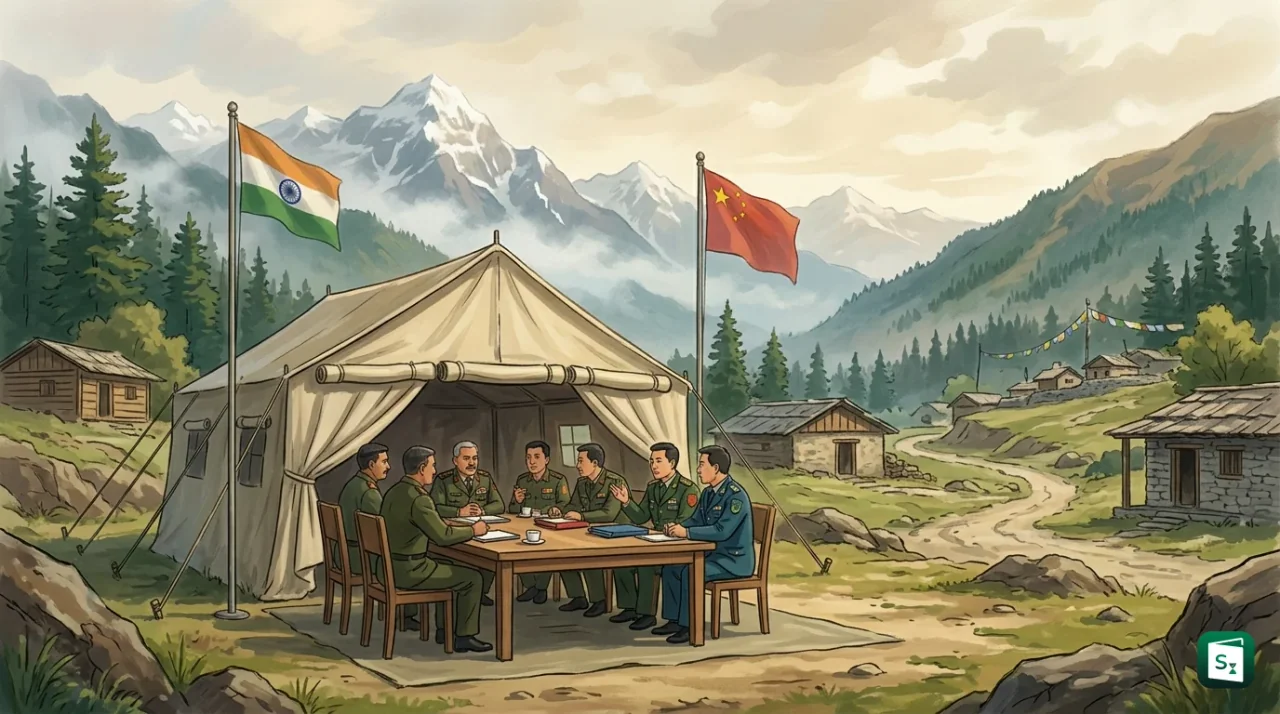
India and China held their inaugural Corps Commander-level military talks in Arunachal Pradesh on 6 September 2026 at the Wacha-Damai Border Personnel Meeting (BPM) point near Kibithu in Anjaw district. The Indian delegation was led by Lt Gen Girish Kalia, commander of the Rangapahar-based 3 Corps (Spear Corps), meeting his Chinese counterpart on the Indian side of the Line of Actual Control (LAC). This is the first time the senior military dialogue mechanism, long used in Ladakh, has been extended to the Eastern Sector of the India-China border, amid renewed attention on border management and recent reports of activity near Taksing in Upper Subansiri.
What Happened at Wacha-Damai?
The meeting took place on Sunday, 6 September 2026, at the Wacha-Damai BPM point on the Indian side of the LAC, north of Kibithu in Anjaw district of Arunachal Pradesh. According to official sources, the Indian side fielded a 12-member delegation led by Lt Gen Girish Kalia, and included an Inspector General of the Indo-Tibetan Border Police (ITBP), which guards the frontier alongside the Army. The Chinese side was represented by the corps-level commander responsible for the corresponding area in the Tibet Autonomous Region.
The talks focused on maintaining peace and tranquillity along the LAC in the Eastern Sector and addressing local issues where the two sides have different perceptions of the line. No official joint statement announcing a disengagement agreement or troop reduction was issued, and the Army did not release a formal press note, which is common for sensitive border engagements. Sources indicated that the discussion was aimed at preventing escalation and improving direct communication at a higher military level.
The timing is notable. The engagement came just days after the 25th round of Special Representatives (SR) talks held in Beijing on 25 August 2026 between National Security Adviser Ajit Doval and Chinese Foreign Minister Wang Yi, and about a week before the 18th BRICS Summit scheduled in New Delhi from 11 to 13 September 2026, where Chinese President Xi Jinping is expected to attend. Reports in the preceding weeks had pointed to increased Chinese activity around Taksing in Upper Subansiri district, and to several lower-level meetings between local commanders to manage friction, which set the context for elevating dialogue to corps commander level.
What Is the Line of Actual Control and How Is It Divided?
The Line of Actual Control (LAC) is the notional line that separates areas under Indian control from areas under Chinese control along the disputed India-China boundary. It is not a legally demarcated international border, and the two countries have different perceptions of its alignment in many places. The term was first used by Chinese Premier Zhou Enlai in a 1959 letter to Prime Minister Jawaharlal Nehru, and it gained legal recognition in the 1993 Agreement on Maintenance of Peace and Tranquillity and the 1996 Agreement on Confidence Building Measures, which both asked the two sides not to overstep the LAC.
India considers the LAC to be about 3,488 km long, while China refers to a shorter length. For practical management, the LAC is divided into three sectors:
| Sector | Indian States / UTs Covered | Chinese Side | Key Feature |
|---|---|---|---|
| Western Sector | Ladakh | Xinjiang and Tibet Autonomous Region | Covers Aksai Chin, site of the 2020 Galwan and eastern Ladakh standoffs. Perception differences are largest here. |
| Middle Sector | Uttarakhand and Himachal Pradesh | Tibet Autonomous Region | Least disputed segment, though alignment at Barahoti remains contested. |
| Eastern Sector | Arunachal Pradesh and Sikkim | Tibet Autonomous Region | Largely follows the McMahon Line of 1914, but China claims the whole of Arunachal Pradesh as Zangnan or South Tibet. |
The Eastern Sector in Arunachal Pradesh stretches for about 1,126 km to 1,140 km. India and China do not share a mutually agreed map of the LAC in several stretches, so patrols up to their respective claim lines sometimes lead to face-offs. This is why local perceptions and ground-level protocols matter so much for peace.
How Is the LAC Different from the LOC and the McMahon Line?
Three terms are often confused but they mean very different things. The LAC is the working military control line between India and China, not delineated on a jointly signed map and not demarcated on the ground. The Line of Control (LOC) is the military control line between India and Pakistan in the former princely state of Jammu and Kashmir. It emerged from the 1948 ceasefire line and was formally designated as the LOC after the Simla Agreement of 1972, with a map signed by the Directors General of Military Operations of both armies, giving it legal sanctity.
The McMahon Line is a separate historical boundary. It was drawn at the Simla Convention of 1914 between representatives of British India, Tibet and China. The line, named after Sir Henry McMahon, then Foreign Secretary of British India, runs for about 890 km from Bhutan to the Isu Razi Pass on the Myanmar border along the Himalayan crest. British India and Tibet signed the map on 24-25 March 1914, but China repudiated the Convention, arguing Tibet was not sovereign. Independent India inherited the line and administers territory south of it as Arunachal Pradesh, while China rejects its legal validity but has stated in 1959 that the LAC in the east largely coincides with the so-called McMahon Line. Areas such as Longju, Asaphila, Sumdorong Chu, Yangtse and Taksing are among the points of differing perception in this sector.
What Are Border Personnel Meeting Points and Corps Commander-Level Talks?
A Border Personnel Meeting (BPM) point is a designated location on the LAC where the Indian Army and the People’s Liberation Army (PLA) of China meet for structured dialogue. Meetings are of two types, ceremonial meetings on national days and national festivals to build trust, and practical flag meetings to resolve local incidents quickly. The Border Defence Cooperation Agreement (BDCA) signed in October 2013 during Prime Minister Manmohan Singh’s visit to Beijing provided the formal framework for expanding BPM sites, hotlines and communication links.
There are five formal BPM points, established between 2013 and 2015:
| BPM Point | Location | State / UT on Indian Side | Formal Opening |
|---|---|---|---|
| Daulat Beg Oldi (DBO) - Tianwendian (TWD) | Karakoram area, northern Ladakh | Ladakh | August 2015 |
| Spanggur Gap (Chushul-Moldo) | Near Rezang La, eastern Ladakh | Ladakh | 2013-2014 |
| Nathu La | Sikkim | Sikkim | 2013-2014 |
| Bum La Pass | Near Tawang | Arunachal Pradesh | 2013-2014 |
| Kibithu-Wacha / Wacha-Damai (Walong-Kaho sector) | North of Kibithu, Anjaw district | Arunachal Pradesh | May 2015 (first informal meeting in November 2006) |
Wacha-Damai, often called Wacha, is India’s easternmost BPM point. It lies north of the village of Kibithu, close to Kaho, which is India’s last village on the LAC where the Lohit River enters India from Tibet. An ITBP post sits north of Kaho. The point was formalised after Prime Minister Narendra Modi’s visit to China in May 2015, when both sides agreed to add new meeting venues. The 6 September 2026 engagement was the first Corps Commander-level interaction at Wacha since the point became operational.
A Corps Commander is a Lieutenant General who commands a corps, a large formation comprising multiple divisions, typically 20,000 to 45,000 troops. In the Indian Army, a corps looks after a broad operational area and is junior to an Army Commander but senior to a Division Commander. A Corps Commander-level talk, also called Senior Highest Military Commander Meeting (SHMC), is therefore a high-level dialogue. Unlike a local commander or Brigadier-level flag meeting that handles an immediate face-off, a corps commander can discuss sector-wide issues, deployment patterns, patrolling norms and measures to prevent escalation. Until now, such senior talks were concentrated at Chushul-Moldo in eastern Ladakh, especially after the Galwan Valley clashes of June 2020, where over 20 Indian soldiers and an undisclosed number of Chinese personnel were killed. Extending the same format to Wacha-Damai creates a senior channel for the east.
Who Leads the Spear Corps and Why Does Kibithu Matter?
The Spear Corps and Lt Gen Girish Kalia
The 3 Corps, also known as the Spear Corps, is headquartered at Rangapahar Military Station near Dimapur in Nagaland. It operates under the Army’s Eastern Command, which is headquartered at Fort William in Kolkata. The corps was raised on 4 February 1985 by Lt Gen Joginder Singh Bakshi, MVC, to coordinate counter-insurgency and conventional operations across the northeast.
Today the Spear Corps is responsible for large parts of the LAC in central and eastern Arunachal Pradesh, as well as internal security in Nagaland and Manipur. The other formation guarding Arunachal is the 4 Corps (Gajraj Corps) based at Tezpur in Assam, which looks after the western part of the state including the Tawang and Kameng sectors. The 33 Corps (Trishakti Corps) at Sukna covers Sikkim, and the 17 Corps (Brahmastra Corps) at Panagarh is India’s dedicated Mountain Strike Corps for the east.
The Indian delegation at Wacha-Damai was led by Lt Gen Girish Kalia, who assumed command of the Spear Corps on 1 May 2026, succeeding Lt Gen Abhijit S. Pendharkar. Commissioned into the Madras Regiment, Kalia is a decorated officer with the Ati Vishisht Seva Medal (AVSM) and Vishisht Seva Medal (VSM). His appointment placed him directly in charge of the sector where Kibithu lies, which is why his role in the inaugural eastern dialogue is of operational significance.
Kibithu, Anjaw and the Easternmost Frontier
Kibithu, also spelled Kibithoo, is a village in Anjaw district of Arunachal Pradesh. It sits at an elevation of about 1,240 metres on the banks of the Lohit River, a tributary of the Brahmaputra that flows north to south from Tibet into India. Kibithu is considered one of India’s easternmost permanently populated places and is often described as India’s first village when viewed from the east.
Key geographic facts make the location sensitive. Kibithu lies about 15 km south of the LAC at Kaho, about 70 km north of the district headquarters at Hawai, and about 40 km west of Diphu Pass near the India-China-Myanmar tri-junction. The nearest air connectivity is at the Walong Advanced Landing Ground, about 20 km to the south. Anjaw district itself, with Hawai as its headquarters, shares borders with both China to the north and Myanmar to the east, making it a strategic frontier district. The Wacha-Damai BPM point, located north of Kibithu, is therefore not just a meeting hut but a frontline interface at the extreme eastern end of the LAC where Indian and Chinese perceptions most visibly overlap.
Why Is an Eastern Sector Dialogue Significant Now?
Until this meeting, Corps Commander-level talks were almost entirely associated with the Western Sector in eastern Ladakh. After the Galwan clashes of June 2020 and the prolonged standoff at multiple friction points such as Pangong Tso, Galwan Valley, Gogra-Hot Springs and Depsang Plains, India and China held more than 20 rounds of corps commander talks at Chushul-Moldo. Those talks helped in phased disengagement at several points but left broader issues of de-escalation and patrolling rights unresolved.
The east had been managed through lower-level instruments, local commander meetings, Brigade-level flag meetings and BPM interactions at Bum La and Kibithu. While effective for minor incidents, these channels lacked the authority to address sector-wide patterns. Reports of Chinese construction, patrolling activity and perceived transgressions around Taksing in Upper Subansiri, as well as older friction points like Yangtse near Tawang where a clash occurred in December 2022, highlighted the need for a higher forum.
That gap was addressed at the 25th SR talks in Beijing. On 25 August 2026, Ajit Doval and Wang Yi, who serve as the Special Representatives on the Boundary Question since the mechanism was created in 2003, agreed on an eight-point outcome and consensus. Among the points was the decision to add two more locations for Senior Highest Military Commander meetings to improve border management. One of the new venues is now in the Eastern Sector under 3 Corps responsibility, which materialised as the Wacha-Damai meeting on 6 September, and another is expected in the Middle Sector. The talks also agreed to strengthen hotline links between military headquarters and to sustain cooperation on trans-border rivers, Kailash Manasarovar Yatra through Nathu La, and border trade via three passes.
For India, which administers Arunachal Pradesh as an integral state, elevating dialogue in the east also has a political signal. Arunachal Pradesh, with a population of about 1.5 million and capital at Itanagar, is claimed by China as South Tibet. Regular senior-level contact at a designated BPM point reinforces India’s administrative and military presence while offering both sides a structured way to clarify intentions. For China, the same channel helps manage risks as it builds infrastructure on its side of the Tibetan plateau. The fact that the meeting occurred days before the BRICS Summit shows both sides preferred to stabilise the border narrative ahead of a high-profile diplomatic gathering.
The Way Forward for Border Management
The Wacha-Damai meeting does not by itself resolve the boundary dispute. No map exchange, disengagement schedule or boundary package settlement was announced. The Special Representatives mechanism will continue to work toward a political settlement based on the Political Parameters and Guiding Principles agreed in 2005, which envisage a fair, reasonable and mutually acceptable solution. The 26th round of SR talks is scheduled to be held in India in 2027.
In the near term, the value of an Eastern Sector corps commander channel lies in three practical areas. First, it provides faster escalation control. When local patrols overlap in zones of differing perception, a call to a corps commander can prevent a minor face-off from turning into a prolonged standoff. Second, it allows regular review of existing agreements, including the 1993, 1996, 2005 and 2013 agreements on peace, confidence building and border defence cooperation, to ensure both sides honour patrolling protocols and prior understandings. Third, it creates consistency across sectors. With senior channels now available in both the western and eastern stretches, and a new one planned for the middle sector, border management becomes less Ladakh-centric and more comprehensive.
The challenge will be continuity. Single meetings do not erase differing claim lines or infrastructure asymmetry. Sustained engagement, proper use of the proposed hotlines, and verification of commitments on the ground will determine whether the Wacha-Damai opening becomes a durable pillar or a one-time signal. For now, the move broadens India’s crisis-management toolkit along the entire LAC and marks a shift from reactive flag meetings to proactive senior dialogue in the sensitive eastern Himalayas.
Key Takeaways
- India and China held their first Corps Commander-level talks in the Eastern Sector on 6 September 2026 at the Wacha-Damai BPM point near Kibithu in Anjaw district, Arunachal Pradesh.
- The Indian delegation was led by Lt Gen Girish Kalia, commander of the 3 Corps (Spear Corps) headquartered at Rangapahar near Dimapur, Nagaland, under the Eastern Command.
- Wacha-Damai is India’s easternmost Border Personnel Meeting point, formalised in May 2015 after an informal start in November 2006, located north of Kibithu near Kaho on the Lohit River.
- The Line of Actual Control (LAC) spans about 3,488 km as per India, divided into Western (Ladakh), Middle (Uttarakhand and Himachal Pradesh) and Eastern (Arunachal Pradesh and Sikkim) sectors, and is distinct from the LOC with Pakistan and the 890 km McMahon Line of 1914.
- There are five formal BPM points: Daulat Beg Oldi, Spanggur Gap (Chushul-Moldo), Nathu La, Bum La and Kibithu-Wacha, created under the Border Defence Cooperation Agreement of October 2013.
- The meeting followed the 25th Special Representatives talks in Beijing on 25 August 2026 between Ajit Doval and Wang Yi, where both sides agreed on eight points of consensus, including two additional SHMC venues and stronger hotline mechanisms, with the 26th SR round scheduled in India in 2027.