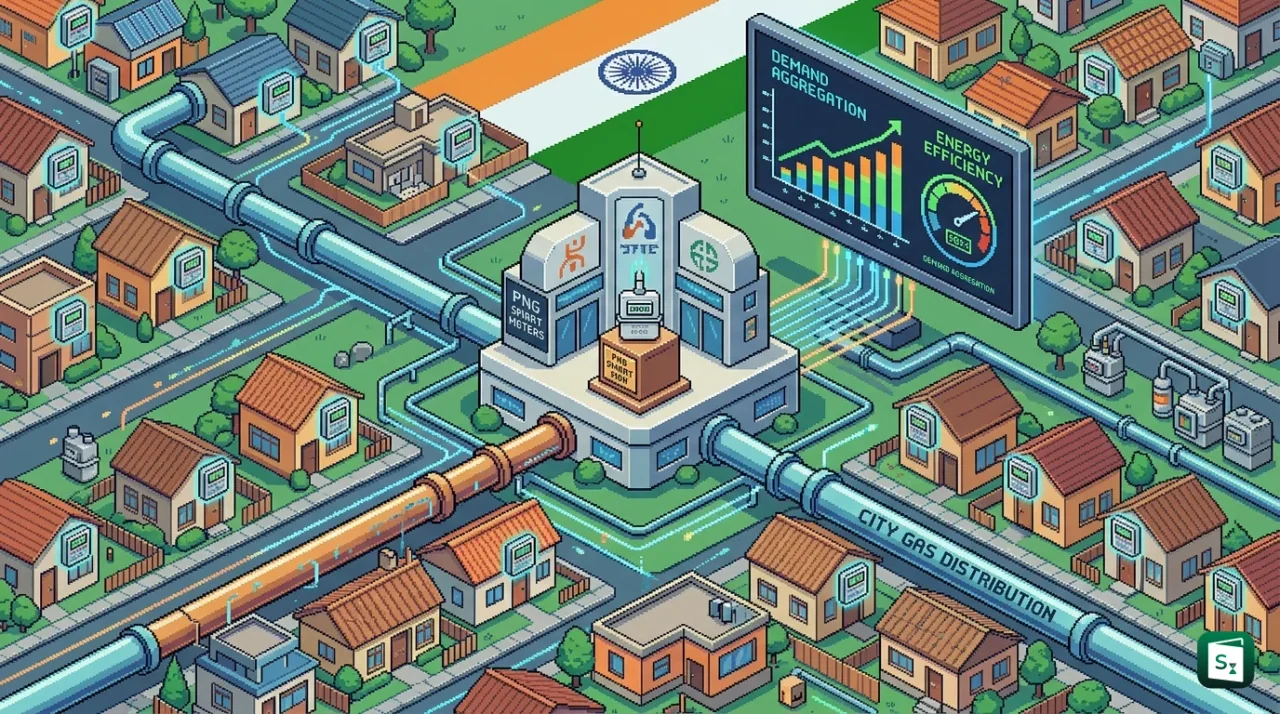
The Petroleum and Natural Gas Regulatory Board (PNGRB) signed a Memorandum of Understanding with Energy Efficiency Services Limited (EESL) on 28 August 2026 to accelerate the rollout of smart domestic Piped Natural Gas (PNG) meters across India. The pact focuses on demand aggregation and large-scale deployment of Advanced Metering Infrastructure (AMI) in the City Gas Distribution (CGD) sector. It aims to replace manual meter reading with a digital, consumer-centric and safety-enabled gas metering ecosystem.
What Does the PNGRB-EESL MoU Cover?
The Memorandum of Understanding was signed by Anjan Kumar Mishra, Secretary of PNGRB, and Akhilesh Kumar Dixit, Chief Executive Officer of EESL. It creates a structured ecosystem to speed up the adoption of smart domestic PNG meters by bringing together CGD entities, technology providers, manufacturers, system integrators and other stakeholders.
Under the MoU, PNGRB will support the initiative from the regulatory and sectoral side. It will share information on standards, certification, regulatory developments, conformity assessment and inspection for smart domestic PNG metering, and will facilitate stakeholder consultations and interactions.
EESL will handle demand aggregation for domestic PNG smart meters and use its industry expertise, technical capability and stakeholder network to coordinate among CGD entities and the smart metering ecosystem. It will carry out market assessments, technical evaluations and explore competitive procurement, price discovery and suitable models for supply, installation, operation and maintenance of smart domestic PNG meters. The collaboration is designed to promote standardisation, interoperability, innovation and efficient implementation, while making the PNG system more transparent and secure.
The next generation meters envisaged under the pact include digital monitoring, tamper alerts, leak detection, remote operations and cybersecurity safeguards, moving the household gas supply from periodic manual reading to continuous digital oversight.
What Is PNGRB and How Does It Regulate City Gas Distribution?
PNGRB stands for the Petroleum and Natural Gas Regulatory Board. It is a statutory body constituted under the Petroleum and Natural Gas Regulatory Board Act, 2006, which was notified on 31 March 2006. It functions under the Ministry of Petroleum and Natural Gas and is headquartered in New Delhi. The Chairperson as of 2026 is Anil Kumar Jain.
The Board regulates the downstream petroleum and natural gas sector. This covers refining, processing, storage, transportation, distribution, marketing and sale of petroleum, petroleum products and natural gas, but it excludes the production of crude oil and natural gas. Its core mandate is to protect consumer interests, ensure uninterrupted and adequate supply across the country, promote competitive markets and prevent restrictive trade practices.
In the downstream segment, two of its most visible roles are relevant for everyday consumers. The first is authorisation of City Gas Distribution (CGD) networks. No entity can lay, build, operate or expand a CGD network in a specified Geographical Area (GA) without PNGRB authorisation. The Board invites competitive bids, selects entities in a transparent manner and grants exclusivity for a defined period. The second is regulation of natural gas pipelines and tariffs. It declares pipelines as common carrier or contract carrier, frames the pipeline access code, regulates transportation tariffs for common carriers and contract carriers, lays down technical standards and safety standards including the Technical Standards and Specifications including Safety Standards for City Gas Distribution (T4S) Regulations and monitors compliance through conformity assessment and inspection.
An important distinction is whether PNGRB is a government or private body. It is a statutory regulatory board created by Parliament, not a Public Sector Undertaking (PSU) and not a private company. It derives all its powers from the 2006 Act.
Rapid Expansion of the CGD Network and Pipeline Grid
The need for smart metering is directly linked to how fast the CGD network has grown. Until 2014, only 57 Geographical Areas were authorised for CGD. Through successive bidding rounds, that number has risen sharply. By 2023-2024, after the 11th CGD Bidding Round, about 300 GAs were authorised, covering roughly 88 percent of geographical area and 98 percent of population.
The 12th CGD Bidding Round, launched on 12 October 2023 and concluded in March 2024, offered 7 to 8 GAs covering the five North Eastern states of Arunachal Pradesh, Meghalaya, Manipur, Nagaland and Sikkim plus the Union Territories of Jammu and Kashmir and Ladakh. With this round, the Board achieved 100 percent mainland coverage (except islands) for CGD authorisation, with 307 GAs now authorised in total. The anticipated investment for the 12th round alone was estimated at around ₹35,500 crore to ₹41,000 crore, with potential to generate significant employment.
On the pipeline side, PNGRB has authorised more than 33,500 km of natural gas trunk pipelines, of which about 25,000 km are operational. This grid links production fields and LNG import terminals to city gate stations. The Household PNG segment (often called domestic PNG) and Compressed Natural Gas (CNG) for transport are the two main retail products of the CGD network, along with commercial and industrial PNG. Rapid growth in connections has made the old manual, postpaid billing model harder to manage, which sets the context for the smart meter push.
What Is EESL and Why Was It Chosen for Demand Aggregation?
EESL stands for Energy Efficiency Services Limited. It is a Joint Venture of four Central Public Sector Undertakings under the Ministry of Power, namely NTPC Limited, Power Finance Corporation Limited, REC Limited and POWERGRID Corporation of India Limited. It was set up on 10 December 2009 under the Companies Act, 1956 and received its certificate for commencement of business on 11 February 2010. It is registered as a public limited company with its registered office in New Delhi and corporate office in Noida, Uttar Pradesh. Each founding promoter initially held a 25 percent equity stake.
EESL is described as a Super Energy Service Company (ESCO). It implements the market activities of the National Mission for Enhanced Energy Efficiency (NMEEE), one of the eight missions under the National Action Plan on Climate Change. Unlike a traditional trader or manufacturer, it does not rely on subsidies for its core operations. Instead, it uses an annuity-based and demand aggregation business model.
Demand aggregation means pooling the combined requirement of many buyers to procure equipment in bulk at a lower price through competitive and transparent bidding. This was the method that allowed EESL to bring down the price of LED bulbs under the UJALA (Unnat Jyoti by Affordable LEDs for All) scheme launched in 2015, where it distributed more than 36.8 crore LED bulbs, tube lights and fans, and to implement the Street Lighting National Programme (SLNP). The savings are passed on to consumers or utilities, while EESL recovers its investment over time through energy savings.
The same approach was applied to smart electricity metering through the Smart Meter National Programme (SMNP). Under SMNP, EESL has installed more than 44.5 lakh smart electricity meters across Uttar Pradesh, Haryana, Bihar, Delhi, Rajasthan and the Andaman and Nicobar Islands, and is responsible for their operation and maintenance for 8 to 10 years along with a web-based monitoring system. It has also acted as the Advanced Metering Infrastructure Service Provider (AMISP) in several states, managing 3.25 million smart meters in Bihar alone on a prepaid model with GPRS-based communication.
For the PNG sector, this track record matters. CGD entities individually face high upfront costs for smart gas meters, which cost about 5 to 9 times more than conventional diaphragm meters. By aggregating demand across multiple CGD companies, EESL can invite standardised technical specifications, drive price discovery through bulk tenders, ensure interoperability, and offer supply, installation, operation and maintenance models that a single city utility could not achieve alone.
What Are Smart Domestic PNG Meters and Advanced Metering Infrastructure?
Piped Natural Gas (PNG) is natural gas, composed mainly of methane, supplied to households through an underground polyethylene pipeline network from the city gas distribution grid. Unlike Liquefied Petroleum Gas (LPG), which is a mixture of propane and butane stored in cylinders under pressure, PNG flows continuously at low pressure, about 21 millibars, and is billed through a meter, much like electricity or water. PNG is lighter than air and disperses upward if it leaks, which is a safety advantage over LPG that settles near the ground.
A smart meter is a digital gas metering device that records consumption at short intervals, usually every 15 to 60 minutes, and communicates the data automatically without a manual visit. A smart domestic PNG meter adds communication, data logging and control features to the conventional volumetric measurement.
The product that is likely to be deployed first is the smart diaphragm gas meter. It keeps the same positive displacement principle as the conventional diaphragm meter, where gas alternately fills and empties flexible diaphragm chambers and the movement is converted into a volume reading. The smart version adds magnetic or optical sensors, an electronic module, a battery, a communication module and a shut-off valve. Other technologies exist, such as thermal mass flow meters and ultrasonic meters, which have no moving parts and can be more accurate, but they currently cost more and are less suited for an initial nationwide rollout. A committee report on smart domestic PNG metering in April 2026 concluded that smart diaphragm meters offer the most feasible and cost effective balance of accuracy, reliability and domestic manufacturing availability for large-scale adoption.
Advanced Metering Infrastructure (AMI) is the complete system that makes smart metering work. It is the fixed, two-way communication network that connects smart meters to the utility back-end. It has four main parts. First, smart meters at homes that measure gas flow and detect tamper or abnormal conditions. Second, the communication network using radio frequency, cellular GPRS or Narrow Band Internet of Things that carries data to and from the meter. Third, the Head-End System (HES) that collects, validates and forwards meter data. Fourth, the Meter Data Management System (MDMS) and billing and customer information systems that store historical usage, flag anomalies, generate bills and feed analytics.
In a manual or even in a one-way Automated Meter Reading (AMR) system, a worker must walk or drive by to collect data and cannot send commands back to the meter. In AMI, data moves automatically at set intervals, and the utility can also send instructions to the meter remotely.
How Does a Smart Gas Meter Work?
The working sequence is straightforward and continuous. First, the meter measures gas volume as it passes through the diaphragm chambers and sensors convert the mechanical movement into a digital volume. Next, the electronics log the reading with a time stamp and store interval data, event logs and tamper flags. Then, at pre-set intervals, often once or a few times per day to save battery, the communication module transmits the data to the Head-End System. After that, the Head-End System validates the data and passes it to the MDMS for billing, energy audit and tamper analysis. Finally, if the system detects a leak, tamper attempt, unusually high flow or a prepaid balance of zero, it can trigger an alert and remotely close the in-built valve to stop gas supply.
Because accurate billing and safety depend on this chain, the PNGRB-EESL collaboration also stresses standardisation, certification, conformity assessment and secure data exchange to ensure meters from different makers work reliably on the same network.
Piped Natural Gas vs LPG: How Do They Compare?
Many households compare Piped Natural Gas (PNG) with Liquefied Petroleum Gas (LPG) when deciding on cooking fuel. Both are clean fuels, but their supply chain, cost structure and safety profile differ.
| Feature | Piped Natural Gas (PNG) | Liquefied Petroleum Gas (LPG) |
|---|---|---|
| Full form and composition | Piped Natural Gas, mainly methane | Liquefied Petroleum Gas, mainly propane and butane |
| How it reaches home | Continuous supply through underground CGD pipeline network from city gate station to kitchen meter | Stored in cylinders, bottled at plants and delivered by trucks and dealers |
| Billing | Metered monthly billing for actual consumption, like electricity, can be prepaid or postpaid | Pay per cylinder refill, requires booking and replacement when empty |
| Pressure and handling | Low pressure at about 21 millibars, no storage at home, no need to book | High pressure in cylinder, must store, handle and return cylinder |
| Safety behaviour | Lighter than air, disperses upward on leakage, supports remote shut-off and leak alerts in smart meters | Heavier than air, settles near ground, higher accumulation risk in poorly ventilated kitchens |
| Cost | Usually 30 to 40 percent cheaper per unit in cities where pipeline exists, no transport and dealer margins | Price linked to crude and imported LPG, plus bottling and transport costs, about 60 percent of LPG demand is imported |
| Availability | Limited to urban and semi-urban areas with CGD pipelines, about 1.36 crore to 1.62 crore domestic PNG connections in 2024 to 2026 | Nationwide, more than 33.2 crore LPG connections including Pradhan Mantri Ujjwala Yojana (PMUY) beneficiaries |
| Supply resilience | Buffered by gas in pipelines and terminal storage, treated as priority sector with 100 percent allocation under recent supply orders | More exposed to logistics and Strait of Hormuz disruptions through tanker, terminal, bottling and delivery chain |
The comparison explains why the government is pushing PNG in pipeline-covered cities while LPG remains essential for rural areas where pipelines do not yet reach. PNGRB has projected that PNG connections could rise to 12.63 crore by 2034 if the network is fully built, but even then LPG will continue to serve a large share of households.
Why Smart Metering Matters for Households, Companies and Safety
The move to smart domestic PNG meters is driven by practical problems that have grown with the CGD expansion.
For households, the most direct gain is accurate and transparent billing. Instead of estimated or delayed manual bills, consumers get real-time consumption information and digital access to usage data through a display or app. The prepaid option, recommended by the April 2026 committee on smart domestic PNG metering, allows families to pay before use, much like recharging a mobile phone. The meter shows credit balance and estimated days remaining, so users can budget and control expenditure and avoid bill shocks. Daily, weekly and monthly information also reduces disputes.
For safety, smart meters bring features that conventional mechanical meters cannot offer. These include remote monitoring, abnormal flow detection, tamper alerts and automatic remote shut-off of gas supply if a leak, tamper or very low balance is detected. Logs for events such as tilt, magnet interference or valve operation help the utility spot theft or faults quickly. As gas networks become digitally connected, the pact also builds in cybersecurity safeguards such as secure communication and protected data exchange to prevent unauthorised access.
For CGD entities, commercial benefits are significant. Industry interactions cited in the 2026 roadmap noted that under the postpaid system, a large share of domestic consumers default or pay late, forcing companies to spend heavily on manual billing, meter reading, recovery visits and disconnection and reconnection. Smart prepaid metering helps eliminate bad debts, strengthen revenue protection, cut operational expenditure and improve cash flow because gas is paid for in advance. Automated reading also reduces the need for staff to visit homes and allows remote connect and disconnect.
The challenge is cost and ecosystem readiness. A smart meter still costs 5 to 9 times more than a conventional diaphragm meter, and prepaid success needs a vending infrastructure for easy recharge, clear consumer communication and robust battery optimisation. To extend battery life, smart gas meters transmit data in a controlled way, typically a few times per day, rather than continuously. This balance between real-time visibility and battery life is part of the technical assessment that EESL will carry out.
The Way Forward for Smart PNG Metering in India
The MoU is the start of a longer implementation chain rather than a one-time purchase. Based on the Roadmap for Implementation of Smart Domestic PNG Metering prepared by a PNGRB-constituted committee in April 2026, the likely path has four elements.
First, regulatory alignment. The committee recommended that six months after notification of relevant changes in the T4S Regulations for CGD networks, all new domestic PNG connections must be equipped with prepaid smart meters. This avoids retrofitting later and ensures every new consumer starts with real-time monitoring.
Second, phased replacement of existing conventional meters. A four-phase plan has been proposed, with Phase I in FY 2026-27 covering 5 percent of billed connections, and priority to billed connections in the first two phases to address revenue leakage first. The exact share for later phases will be tied to manufacturing capacity and cost trends.
Third, industrial and manufacturing support. The committee suggested production-linked incentive (PLI) support for smart meter makers to scale domestic production of smart diaphragm meters, reduce costs through bulk procurement and ensure quality and interoperability across CGD entities. EESL’s demand aggregation and competitive procurement will test price points for a sustainable annuity model.
Fourth, integration with the wider gas-based economy push. India’s share of natural gas in the primary energy mix is about 5.78 to 6.2 percent and the government aims to raise it to 15 percent by 2030, with natural gas consumption targeted to grow from about 185 MMSCMD to 500 MMSCMD by 2030. PNGRB’s unified pipeline tariff reform is meant to make gas affordable even in far-flung areas, while the authorised pipeline length and 307 GAs provide the physical base. Combining natural gas with hydrogen blending or compressed biogas blending is also being explored for the future.
In institutional terms, PNGRB provides regulatory guidance, standardisation, certification and stakeholder coordination, while EESL provides demand aggregation, technical evaluation, procurement strategy and implementation support. Together, they seek a consumer-centric, technology-enabled and future-ready CGD ecosystem where billing is automatic, safety is proactive and data is secure.
Key Takeaways
- PNGRB and EESL signed an MoU on 28 August 2026, signed by Anjan Kumar Mishra and Akhilesh Kumar Dixit, to drive demand aggregation and large-scale deployment of smart domestic PNG meters with Advanced Metering Infrastructure across the CGD sector.
- PNGRB is a statutory body under the PNGRB Act, 2006 (notified on 31 March 2006), headquartered in New Delhi under the Ministry of Petroleum and Natural Gas, which authorises 307 Geographical Areas for City Gas Distribution.
- EESL was set up on 10 December 2009 as a Joint Venture of NTPC, PFC, REC and POWERGRID under the Ministry of Power, and has already deployed over 44.5 lakh smart electricity meters as a Super ESCO using a bulk procurement demand aggregation model.
- Smart diaphragm PNG meters have been identified as the most feasible option for initial rollout, offering automated reading, real-time monitoring, prepaid billing, tamper alerts, leak detection and remote shut-off with secure two-way AMI communication.
- More than 33,500 km of natural gas pipelines have been authorised with about 25,000 km operational, supporting India’s target to raise natural gas share to 15 percent of the primary energy mix by 2030 and to grow consumption from 185 MMSCMD to 500 MMSCMD.