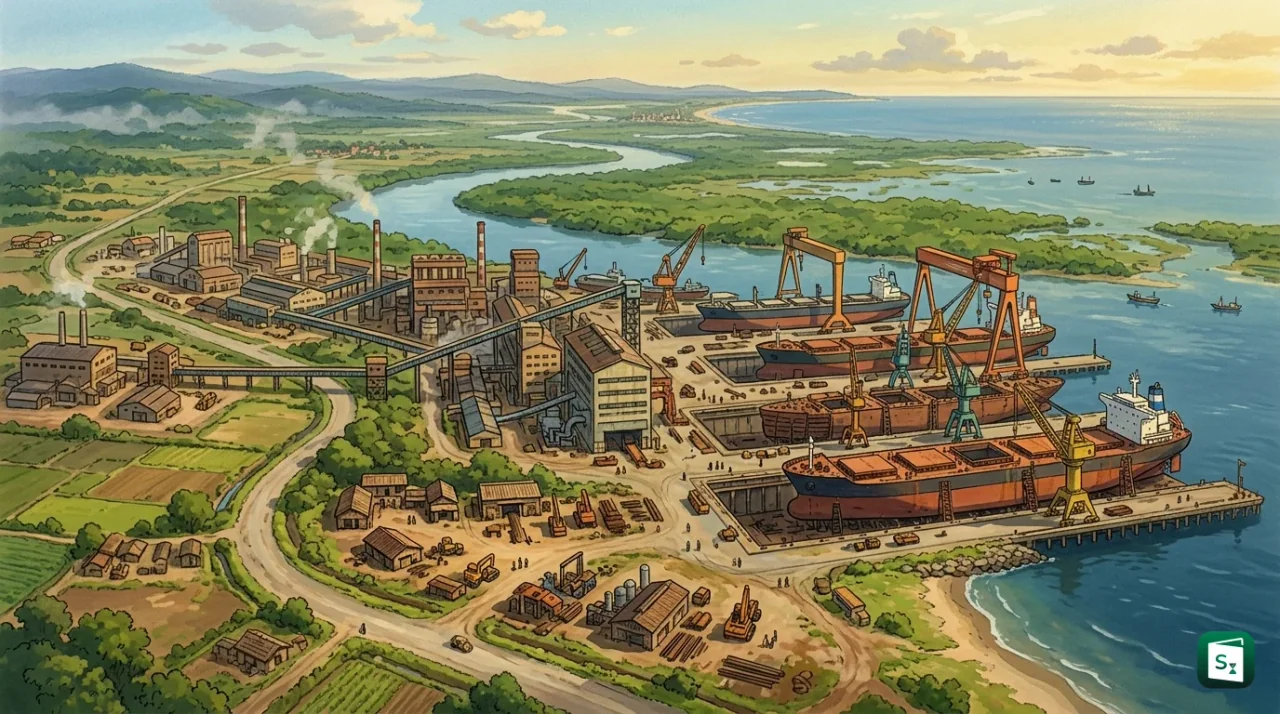
The National Shipbuilding and Heavy Industries Park Odisha Ltd has received in-principle approval to build a ₹24,700 crore shipbuilding and heavy industries cluster on the northern bank of the Mahanadi in Kendrapara, Odisha. The approval, granted under the Shipbuilding Development Scheme of the Ministry of Ports, Shipping and Waterways, clears the first formal step for the state’s first mega shipbuilding hub. To be developed through a joint Special Purpose Vehicle of the Odisha Maritime Board and Paradip Port Authority, the Odisha shipbuilding cluster in Kendrapara is planned as a greenfield integrated ecosystem for shipbuilding, ship repair and heavy engineering.
What Is a Shipbuilding Cluster and Why Does It Matter?
Shipbuilding is the design, construction and outfitting of ships and large marine vessels. It is classified as a heavy engineering and manufacturing industry because it involves large-scale steel fabrication, heavy machinery, precision engineering and long production cycles. A shipbuilding cluster is a geographically concentrated ecosystem where one or more large shipyards operate alongside shared common infrastructure and a network of ancillary industries.
Unlike a stand-alone shipyard, a cluster brings together everything needed to build and repair ships in one place. This includes breakwaters and harbour basins, dredged navigational channels, fabrication shops, engine manufacturing, steel processing, electrical and navigation equipment units, and common facilities such as barges and floating cranes. It also includes internal roads, power and water supply, training centres and research and development facilities.
The cluster model is important for three reasons. First, it lowers cost through shared infrastructure, so each shipbuilder does not have to build its own breakwater or channel. Second, it creates a strong supply chain, as suppliers of steel plates, pipes, paints and fittings locate close to the yard. Third, it creates jobs at scale. Studies cited under the national shipbuilding package note an employment multiplier of 6.4, which means every direct job in a shipyard supports more than six indirect jobs in supporting industries. Globally, this model helped countries such as South Korea and China to dominate shipbuilding, accounting for about 95 percent of new orders by tonnage in 2024.
Odisha’s ₹24,700 Crore Kendrapara Project Gets In-Principle Nod
The in-principle approval for the Kendrapara cluster was granted after NSHIPOL submitted its application on 30 July 2026. The proposal was examined under the guidelines of the Shipbuilding Development Scheme (SbDS) and recommended by the sixth meeting of the Inter-Ministerial Group for Shipbuilding (IMGB) under the National Shipbuilding Mission, held on 10 August 2026. The competent authority thereafter granted the approval, which was publicly confirmed on 31 August and 1 September 2026.
It is important to note that in-principle approval is not final approval. It allows the project to move to detailed planning and land-related steps, but final approval will require a Detailed Project Report (DPR), firm commitment from an anchor shipyard, and all major statutory clearances.
Location, Capacity and Scale
The cluster is proposed as a greenfield mega shipbuilding cluster, which means it will be built on a largely undeveloped site with new infrastructure. Key features include:
The site is on the northern bank of the Mahanadi river, directly opposite the IFFCO plant at Paradip in Kendrapara district. This location places it close to Paradip Port, one of India’s 12 major ports, and gives it riverfront access to the Bay of Bengal. The project area is estimated at 2,000 to 2,500 acres with a dedicated waterfront of about 2 to 2.5 km. The plan envisages one or more large shipyards with a combined capacity of around 1.2 million Gross Tonnage (GT) per year. Gross Tonnage is a measure of a ship’s overall internal volume and is the standard unit for shipbuilding capacity.
Along with shipbuilding, the park will include facilities for ship repair, marine engineering and heavy industries. Ancillary units for engine assembly, steel fabrication, marine equipment and navigation systems are planned, together with common infrastructure such as administrative blocks, skill development centres and research facilities.
Who Is Implementing the Project? The NSHIPOL Special Purpose Vehicle
The project is being implemented by the National Shipbuilding and Heavy Industries Park Odisha Ltd (NSHIPOL). NSHIPOL itself is a Special Purpose Vehicle (SPV), which is a dedicated company created to carry out a specific project.
The SPV has been formed jointly by the Odisha Maritime Board (OMB) and the Paradip Port Authority (PPA). This 50:50 Centre-State partnership model is the standard structure prescribed under the SbDS for greenfield clusters. The OMB, established under the Odisha Maritime Board Act, 2020 and functioning under the state Commerce and Transport Department, acts as the single-window agency for development of non-major ports and inland waterways in Odisha. The PPA, which administers Paradip Port, is one of India’s major ports located at the confluence of the Mahanadi and the Bay of Bengal. The port was founded through the efforts of former Chief Minister Biju Patnaik, its foundation stone was laid by Prime Minister Jawaharlal Nehru on 3 January 1962, and it was declared the eighth major port of India on 18 April 1966 and the first major port on the east coast commissioned after independence. Today it serves a vast hinterland covering Odisha, Jharkhand, Chhattisgarh and parts of West Bengal, Bihar and Madhya Pradesh.
Paradip Port Authority Chairperson P. L. Haranadh described the approval as an important milestone that can strengthen shipbuilding capability, attract investment, create employment and promote ancillary industries in the region. Preliminary surveys have already been reported in villages such as Badatubi, Sanatubi and Nipania to assess land and infrastructure needs.
Understanding the Shipbuilding Development Scheme (SbDS)
The Shipbuilding Development Scheme (SbDS) is the central government’s main scheme to create new capacity and make Indian shipyards more competitive. It is part of a comprehensive maritime package of ₹69,725 crore approved by the Union Cabinet on 24 September 2025 to strengthen shipbuilding, financing and skilling.
The package has four pillars and three major financial components:
| Component | Outlay | Purpose |
|---|---|---|
| Shipbuilding Financial Assistance Scheme (SBFAS) | ₹24,736 crore | Financial help to Indian yards to offset cost disadvantage against foreign yards |
| Maritime Development Fund (MDF) | ₹25,000 crore | Long-term financing for shipping and shipbuilding, with a Maritime Investment Fund of ₹20,000 crore and an Interest Incentivisation Fund of ₹5,000 crore |
| Shipbuilding Development Scheme (SbDS) | ₹19,989 crore | Capacity creation through greenfield clusters, brownfield expansion and credit risk cover |
The SbDS aims to raise India’s shipbuilding output from the current about 0.07 million GT to 4.5 million GT per year by around 2037, in line with the Maritime India Vision 2030 and the Maritime Amrit Kaal Vision 2047 (MAKV 2047). The guidelines for the scheme were issued on 26 December 2025 and it is valid for proposals approved between 24 September 2025 and 31 March 2036.
How the Scheme Works for Greenfield Clusters
Greenfield clusters are large new manufacturing zones built with plug-and-play infrastructure. Under the SbDS, three to four greenfield clusters are planned across the country, with only one cluster per state.
For an approved greenfield cluster, the scheme provides 100 percent capital assistance in the form of a grant for eligible items. The eligible items include breakwaters, tide-independent basins, channel and basin development, land reclamation, area grading, Regional Shipbuilding Capability Development Centres, common maritime assets such as barges and floating cranes, and internal infrastructure including roads, power and water supply. Preparation cost of the DPR is also eligible for clusters that have received in-principle approval.
The cluster is developed by an SPV formed between a central port authority and the state maritime board, which is responsible for planning, financing and developing the common infrastructure. Land for the cluster is transferred to the SPV by the state government. The common infrastructure is then leased to private anchor shipyards on a 60-year lease, which pay an annual lease or concession fee.
The guidelines set clear conditions for final approval and release of funds. The SPV must secure at least 90 percent of the required land, obtain all major statutory approvals including environmental clearance and Coastal Regulation Zone (CRZ) permissions, and secure a firm investment commitment from at least one anchor shipyard through a binding agreement. At least one anchor yard must have a design capacity of at least 0.5 million GT per year, to be achieved within 10 years of commissioning. The overall cluster capacity target is about 1.2 million GT per year.
Funds are released in milestones. The assistance is disbursed in four tranches (20 percent, 30 percent, 30 percent and 20 percent) linked to physical progress, utilisation certificates and verification by an independent project management agency. The Directorate General of Shipping (DGS) and the Sagarmala Finance Corporation Ltd (SMFCL) act as implementing agencies, while the National Shipbuilding Mission (NSbM) and its Inter-Ministerial Governing Board are the nodal bodies for approval and oversight. A separate credit risk coverage component under SbDS also provides government-backed insurance for pre-shipment, post-shipment and vendor-default risks to make Indian yards more bankable.
For brownfield yards, which are existing shipyards seeking expansion, the scheme offers 25 percent capital assistance for items such as dry docks, shiplifts, fabrication facilities and automation. This helps older yards modernise without building a new site.
Why Kendrapara? Strategic Edge and Odisha’s Maritime Legacy
Kendrapara was chosen for both economic and geographic reasons.
Resource and logistics advantage. The Mahanadi river location gives the cluster direct riverfront and sea access while staying close to Paradip Port, which already has an artificial harbour with breakwaters, a dredged approach channel and the ability to handle large vessels. Paradip’s hinterland provides ready access to steel, coal and other bulk raw materials from Odisha’s mineral-rich interior and from Jharkhand and Chhattisgarh. An established road and rail network, plus existing maritime logistics, reduces the cost of moving heavy plates and equipment.
District profile. Kendrapara district was carved out of Cuttack district on 1 April 1993 and covers 2,644 square kilometres. It lies in the delta formed by the Mahanadi and Brahmani rivers and is bounded by the Bay of Bengal in the east, Bhadrak in the north, Jagatsinghpur in the south, Cuttack in the west and Jajpur in the northwest. The district is known for the Bhitarkanika Mangroves and Bhitarkanika National Park, which is India’s second largest mangrove ecosystem after the Sundarbans, as well as Gahirmatha Beach, the world’s largest nesting site for Olive Ridley turtles, and the Baladevjew Temple at Ichhapur. This coastal geography makes it naturally suited for port-led development.
Historical maritime identity. Odisha, known in ancient times as Kalinga, has a seafaring history of more than 2,000 years. Merchants called Sadhabas sailed in fleets known as Boitas to trade with Sri Lanka, Burma, Malaya, Bali, Java and Sumatra. The tradition is still celebrated every year on Kartik Purnima as Boita Bandana and Bali Jatra, especially on the banks of the Mahanadi at Cuttack. The Bay of Bengal was once called the Kalinga Sea, and sculptures at Konark and records of Kalinga settlements in Southeast Asia point to this long maritime link. Building a modern shipbuilding park in this region therefore connects a historic identity with a contemporary industrial goal.
Policy alignment. The location was already identified in Odisha’s Economic Survey as the site for a national mega shipbuilding cluster. The NITI Aayog Economic Plan for the Bhubaneswar-Cuttack-Puri-Paradip Economic Region also proposed developing the Mahanadi riverine belt into a leading shipbuilding and ship-repair hub for large and short-sea vessels, with ideas for a design and innovation centre for green vessel technology, a skill academy and ancillary manufacturing for engines and navigation systems.
Together, these factors give Kendrapara a mix of waterfront availability, raw material proximity, port connectivity and historical narrative that few other sites can match. The project, if completed, would shift Odisha’s maritime economy from being largely a bulk cargo and mineral export hub centred on Paradip to a centre for ship construction, repair, marine engineering and ancillary manufacturing.
India’s Bigger Shipbuilding Push: From Less Than 1 Percent to Top Five by 2047
India’s shipbuilding sector today handles nearly 95 percent of India’s trade by volume and about 70 percent by value by sea, yet the country builds less than 1 percent of the world’s ships. India ranks around 18th to 22nd globally and has an annual capacity of about 0.07 million GT, compared with China at about 39 million GT, South Korea at about 20 million GT and Japan at about 9 million GT. Together, those three countries account for more than 90 to 95 percent of global output, with China alone holding about 54.5 percent, South Korea about 28 percent and Japan about 12 percent in recent years. The global shipbuilding market is valued at about $150 to $200 billion annually.
This dependence has a direct cost. India paid about $75 billion in sea freight to foreign vessels in 2023, an amount close to the defence budget. Expanding domestic capacity is therefore seen as a matter of economic security, supply chain resilience and energy transport, besides industrial growth.
The national response is framed by two visions. The Maritime India Vision 2030 (MIV 2030) aims to place India among the top 10 shipbuilding nations by 2030 with about 5 percent global market share. The Maritime Amrit Kaal Vision 2047 (MAKV 2047) aims to make India one of the top 5 shipbuilding nations by 2047, raise the maritime sector’s share of GDP from about 4 percent to 12 percent, expand port capacity from about 2,500 million tonnes per annum to 10,000 million tonnes, and create 35 to 40 million additional jobs. Other targets include expanding India’s merchant fleet to 100 million GT, building 10 world-class shipyards, and ensuring at least 30 percent of the fleet uses clean fuels such as LNG, methanol and hydrogen by 2047.
The Kendrapara cluster is one piece of this national map. Under SbDS, in-principle approval has already been granted to several greenfield clusters across coastal states.
| Greenfield Shipbuilding Cluster | Location | Estimated Area | Waterfront |
|---|---|---|---|
| Kuchhadi | Porbandar, Gujarat | About 2,000 acres | About 2.7 km |
| Dighi | Maharashtra | About 2,000 acres | About 3 km |
| Dugarajapatnam | Tirupati, Andhra Pradesh | About 3,488 acres | About 2.1 km |
| Kendrapara | Odisha | About 2,000 to 2,500 acres | About 2 to 2.5 km |
| Thoothukudi | Tamil Nadu | About 2,050 acres | About 2.4 km |
In Andhra Pradesh, the National Shipbuilding and Heavy Industries Park Andhra Pradesh Ltd (NSHIPAP), formed by Visakhapatnam Port Authority and the Andhra Pradesh Maritime Board, received in-principle approval in May 2026 for the Dugarajapatnam cluster at an indicative cost of ₹29,254 crore. In Gujarat, the cluster at Kuchhadi includes an additional ₹3,300 crore of common infrastructure investment and is backed by the state’s Shipbuilding and Repair Policy 2026. In Tamil Nadu, the first such SPV, NSHIP Tamil Nadu, was formed by the V. O. Chidambaram Port Authority and SIPCOT. These examples show that each cluster follows the same plug-and-play, anchor-yard model, but the Kendrapara project, at ₹24,700 crore and 1.2 million GT, is among the largest in terms of investment and capacity.
What Happens Next and The Way Forward
In-principle approval is only the first gate. For final approval under the SbDS, NSHIPOL must now prepare a Detailed Project Report with a globally reputed agency experienced in shipyard construction, secure firm financial and investment commitments from anchor shipyard operators, and obtain all statutory clearances. These include environmental clearance, Coastal Regulation Zone permissions and any required port and shoreline approvals. The SPV must also show that at least 90 percent of the land is secured on a long-term lease or title basis.
Once the National Shipbuilding Mission through its Inter-Ministerial Governing Board grants final approval, site development will begin. Common infrastructure will be built by the SPV using the central grant, while anchor yards will invest in their own yard-specific equipment and operations on a commercial basis. Progress will be monitored by an Independent Evaluation Agency and an Independent Project Management Agency, with funds released only after verified physical milestones and utilisation certificates.
If executed well, the cluster can generate significant benefits for Odisha. It is expected to attract private investment, create thousands of direct and indirect jobs, and build a local base for engine manufacturing, steel fabrication, electrical systems and marine services. It will also support skill development through dedicated training centres and help India reduce reliance on foreign yards for commercial vessels, naval support ships and green vessels. Proposals in the NITI Aayog plan to add a green shipbuilding and design innovation centre could align the park with global demand for low-emission vessels powered by green fuels.
Challenges remain. Land assembly across 2,000 plus acres, environmental sensitivity near Bhitarkanika, the need to mobilise large anchor investors, and timely completion of dredging and breakwater works will all require close coordination between the Centre and the state. However, the SbDS framework, with its milestone-based grants and 60-year lease model, is designed to reduce upfront risk for investors and keep the project accountable to clear deliverables.
Key Takeaways
- National Shipbuilding and Heavy Industries Park Odisha Ltd (NSHIPOL) received in-principle approval for a ₹24,700 crore shipbuilding and heavy industries cluster in Kendrapara, Odisha on the northern bank of the Mahanadi opposite IFFCO, Paradip.
- The approval was granted under the Shipbuilding Development Scheme (SbDS) of the Ministry of Ports, Shipping and Waterways (MoPSW) after the sixth meeting of the Inter-Ministerial Group for Shipbuilding on 10 August 2026, following an application on 30 July 2026.
- The project will be implemented by an SPV of Odisha Maritime Board (OMB) and Paradip Port Authority (PPA) and is planned with 2,000 to 2,500 acres, 2 to 2.5 km waterfront and 1.2 million GT annual capacity.
- The SbDS is part of the ₹69,725 crore maritime package approved on 24 September 2025 and has an outlay of ₹19,989 crore, offering 100 percent grant for greenfield clusters and 25 percent for brownfield expansion, valid till 31 March 2036.
- India today accounts for less than 1 percent of global shipbuilding with about 0.07 million GT, and aims to reach the top 10 by 2030 and top 5 by 2047 under Maritime India Vision 2030 and Maritime Amrit Kaal Vision 2047.
- Five greenfield clusters have received in-principle approval at Kuchhadi (Gujarat), Dighi (Maharashtra), Dugarajapatnam (Andhra Pradesh), Kendrapara (Odisha) and Thoothukudi (Tamil Nadu), each targeting about 1.2 million GT and an anchor yard of at least 0.5 million GT within 10 years.