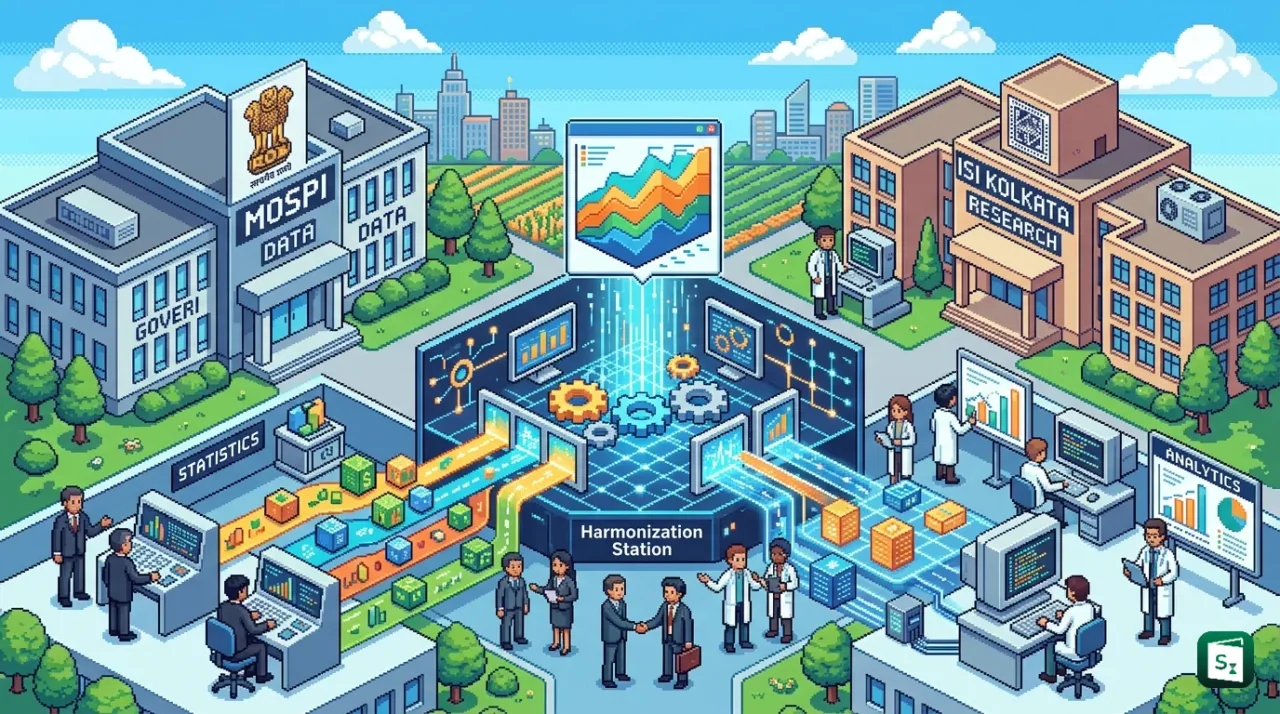
The Ministry of Statistics and Programme Implementation (MoSPI) has signed two Memorandums of Understanding (MoUs) with the Institute of Data Engineering, Analytics and Science Foundation (IDEAS) at the Indian Statistical Institute (ISI), Kolkata to conduct research studies. The collaboration is designed to examine in depth the various statistical series released by MoSPI and to harmonise them with other data sources. The move is part of a broader drive to modernise India’s statistical system by linking academic research with official statistics.
What the Two MoUs Cover
The first MoU focuses on taking a deep dive into the statistical products that MoSPI publishes, such as national accounts, price indices, and survey-based estimates. Researchers under this agreement will scrutinise the methodologies, data sources, and computation methods behind these releases to find ways to improve their accuracy and reliability.
The second MoU centres on data harmonisation, which means aligning statistics generated from different sources so that they use the same definitions, classifications, and standards. MoSPI already relies on more than 300 data sources for computing the Gross Domestic Product (GDP), including administrative records such as Goods and Services Tax (GST) data and Public Financial Management System (PFMS) records. The new research will help stitch these diverse datasets together in a statistically sound way.
Together, the agreements are expected to produce research papers, methodological notes, and tools that MoSPI can use in its routine statistical production. The partnership also gives ISI’s researchers access to real, high-value datasets, which supports teaching and applied research at the institute.
MoSPI and the Data Innovation Lab
This agreement is part of a wider effort by MoSPI to modernise India’s statistical system. The ministry runs the Data Innovation Lab (DIL), set up in July 2024 under the Data Informatics and Innovation Division (DIID) of the National Statistical Office. The lab acts as a hub where academic institutions, researchers, and government bodies collaborate on problems in official statistics.
The DIL is built on three pillars: a Research Network, Innovation, and Student Outreach. Through this network, MoSPI approaches reputed institutions, including IITs and IIMs, and signs non-commercial MoUs to bring their expertise into statistical research. By January 2026, MoSPI had signed 17 MoUs with various institutions under this initiative. The two new pacts with IDEAS Foundation add to this growing research ecosystem.
The ministry has also built a supportive digital infrastructure. The e-Sankhyiki portal, launched on National Statistics Day 2024 (29 June 2024), serves as India’s one-stop platform for official statistics and now hosts more than 136 million records across 21 statistical products. In February 2026, MoSPI added a Model Context Protocol (MCP) server to the portal, which lets users and AI tools query official datasets directly.
Who Is IDEAS Foundation?
The Institute of Data Engineering, Analytics and Science Foundation (IDEAS) is a Technology Innovation Hub (TIH) set up at ISI Kolkata under the National Mission on Interdisciplinary Cyber-Physical Systems (NM-ICPS). The mission, launched in December 2018 by the Department of Science and Technology (DST), was approved by the Union Cabinet at a total outlay of ₹3,660 crore for five years. It has established 25 Technology Innovation Hubs across the country, each focused on a specific advanced technology area.
IDEAS specialises in data science, big data analytics, and data curation. It works on statistical methods, machine learning, and large-scale data processing, and builds tools for industry and government. It also incubates technology startups and runs skill development programmes. Its focus on handling, cleaning, and analysing large datasets makes it a natural research partner for a ministry that manages India’s official statistics.
About the Indian Statistical Institute
The Indian Statistical Institute (ISI) was founded by Professor Prasanta Chandra Mahalanobis on 17 December 1931 in Kolkata. It was declared an Institute of National Importance by Parliament through the Indian Statistical Institute Act, 1959. Its headquarters is in Kolkata, with centres in Delhi, Bengaluru, Chennai, Hyderabad, and Tezpur.
ISI functions under MoSPI and has shaped India’s statistical system since independence. It designed the National Sample Survey (NSS) in 1950, which later became the basis of the National Sample Survey Office (NSSO). It also publishes Sankhya, one of the oldest statistical journals in India. Mahalanobis, its founder, later served as the architect of India’s Second Five-Year Plan. ISI remains a premier institution for research and education in statistics, mathematics, and computer science.
Why Data Harmonisation Matters
Data harmonisation is one of the biggest challenges facing India’s statistical system today. India collects data through surveys, censuses, and the administrative records of government departments. These sources often use different definitions, classifications, and reference periods, which makes it hard to compare or combine them.
For example, the definition of a kutcha or pucca housing structure used in different surveys once differed, and this was only recently harmonised with the approval of the National Statistical Commission. Such mismatches can lead to inconsistent estimates and erode public trust in official numbers. Research under the new MoUs is expected to help resolve these kinds of definitional and methodological differences.
Five Pillars of the Harmonisation Framework
Following the 5th National Conference of Chief Secretaries held in December 2025, MoSPI built a data harmonisation framework for States and Union Territories based on five pillars:
| Pillar | Purpose |
|---|---|
| Metadata compilation | Documenting how each dataset is collected and defined |
| Data quality assessment | Evaluating the reliability of each source |
| Uniform classifications | Using the same codes and categories across datasets |
| Unique identifiers | Linking records from different systems to the same entity |
| Resolution of definitional divergences | Settling conflicting definitions between sources |
The ministry has also released a Practitioner’s Handbook on Harmonisation of Data Sets to guide state statistical agencies. The research collaboration with IDEAS Foundation is expected to feed directly into these harmonisation efforts with analytical rigour and data engineering support.
Significance of the Collaboration
This partnership connects the government’s statistical machinery with one of the world’s leading statistical research institutions. ISI’s theoretical expertise in statistics, combined with IDEAS’s practical skills in data engineering and machine learning, gives MoSPI access to advanced analytical methods for improving its products.
The collaboration also supports India’s broader agenda of evidence-based policy. When GDP, inflation, and employment figures rest on harmonised and cross-verified data, planners can make more informed decisions. Reliable statistics also help international investors and agencies assess the Indian economy with confidence.
Broader Context
The move fits into a wider modernisation push by MoSPI. In 2026, the ministry released new base-year series for GDP (base year 2022-23, released 27 February 2026) and the Index of Industrial Production (IIP) (released 28 May 2026). It is also developing a new Index of Services Production and planning to use administrative datasets, including GST records, more extensively.
At the same time, the Indian Statistical Institute Bill, 2026, introduced in the Lok Sabha on 3 August 2026, proposes to convert ISI from a registered society into a statutory body corporate, with the President of India as the Visitor. The Bill has drawn criticism from faculty and opposition members over concerns about institutional autonomy. Even so, the ministry has continued to deepen its research ties with the institute through agreements like the ones with IDEAS Foundation.
The Way Forward
The research studies under the two MoUs are expected to yield practical outputs that MoSPI can adopt in its statistical production cycle. Areas likely to benefit include survey methodology, handling of administrative data, machine-readable classifications, and the use of artificial intelligence in data processing.
With more such partnerships planned through the Data Innovation Lab, MoSPI appears committed to building a statistical system that is faster, more accurate, and better connected with the wider data ecosystem. The collaboration with IDEAS Foundation marks another step in that direction, using academic research to strengthen the credibility of India’s official numbers.
Key Takeaways
- MoSPI has signed two MoUs with the IDEAS Foundation at ISI Kolkata to undertake research studies on official statistics and data harmonisation.
- The Institute of Data Engineering, Analytics and Science Foundation (IDEAS) is a Technology Innovation Hub set up under the National Mission on Interdisciplinary Cyber-Physical Systems (NM-ICPS), launched by the Department of Science and Technology (DST) in December 2018.
- The Indian Statistical Institute (ISI), founded by P. C. Mahalanobis in 1931, was declared an Institute of National Importance under the ISI Act, 1959, and is headquartered in Kolkata.
- MoSPI’s Data Innovation Lab, set up in July 2024, had signed 17 MoUs with institutions by January 2026.
- The e-Sankhyiki portal, launched on 29 June 2024, hosts 21 statistical products and more than 136 million records.
- MoSPI uses more than 300 data sources for computing GDP, including administrative records from GST and PFMS.