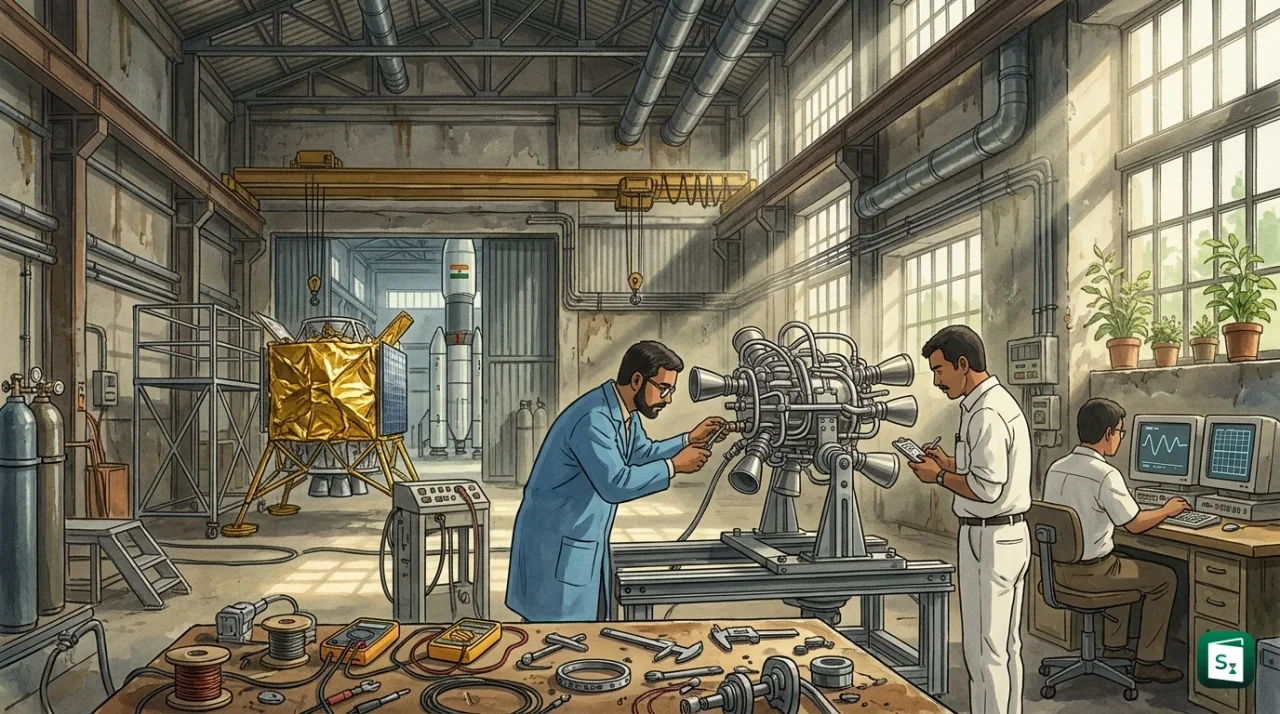
The Technology Development Board has signed an agreement with Manastu Space Technologies Pvt Ltd to provide ₹116 crore under the Research Development and Innovation (RDI) Fund. The total project cost is ₹277.63 crore for a scalable, integrated green propulsion system for satellites and launch vehicles. The system will cover a wide thrust range from 5 mN to 300 N and move from advanced validation toward full space deployment.
What Is the Technology Development Board?
The Technology Development Board (TDB) is a statutory body under the Department of Science and Technology (DST) that funds the commercial use of home grown technology in India. TDB, which stands for Technology Development Board, was set up on 1 September 1996 under the Technology Development Board Act, 1995. The Act received presidential assent on 16 December 1995 and created the first government body whose sole aim is to take the fruits of Indian research to the market.
The Board is chaired by the Secretary, DST in an ex officio capacity. Its members include the Secretaries of Expenditure, Industrial Policy and Promotion, Scientific and Industrial Research, Defence Research and Development Organisation and Rural Development, along with four nominated experts and the Secretary of TDB as Member Secretary. In total, the Board has 11 members. Its money comes from the Fund for Technology Development and Application, which is built from the cess collected under the Research and Development Cess Act, 1986 on payments for imported technology, plus recoveries and investment income.
TDB supports Indian companies and research agencies that develop Indian technology or adapt imported technology for wider use in India. It provides soft loans at 5% simple interest per year, equity support up to 25% of the approved project cost, and grants in rare cases of national importance. A loan usually covers up to 50% of the project cost, is paid in parts linked to technical milestones, and carries a one year pause on repayment after project completion. The usual project period is up to three years, and the Board charges no processing or commitment fee.
What Is the RDI Fund in India?
The Research Development and Innovation (RDI) Fund is a ₹1 lakh crore national fund that gives low cost, long term money to private companies for research in sunrise and strategic sectors. The Union Cabinet approved the RDI Scheme on 1 July 2025. The Prime Minister launched the fund on 3 November 2025 at ESTIC 2025. The Department of Science and Technology is the nodal ministry, and the money is held in a Special Purpose Fund inside the Anusandhan National Research Foundation (ANRF).
ANRF, which stands for Anusandhan National Research Foundation, is India’s apex research body set up through the ANRF Act, 2023. Its Governing Board is chaired by the Prime Minister and gives overall direction to the RDI Scheme. The fund uses a two level system. At the first level, the Special Purpose Fund keeps the corpus. At the second level, designated Second Level Fund Managers pass money to companies. The Technology Development Board and the Biotechnology Industry Research Assistance Council (BIRAC) were named as the first two such managers. BIRAC, which stands for Biotechnology Industry Research Assistance Council, was set up in 2012 under DST to support biotech startups and industry.
The scheme will run for six years, with ₹20,000 crore marked for FY 2025-26. It supports projects at Technology Readiness Level (TRL) 4 and above. TRL is a scale from 1 to 9 that shows how mature a technology is. TRL 4 means the technology is proven in a laboratory. TRL 9 means it is proven in real use. Support is mainly in the form of long term loans at low or nil interest, with tenures up to 15 years including moratorium. Equity support is possible for startups. The scheme does not give grants. Funding can cover up to 50% of the total project cost, with the company bringing the balance. Financing is collateral free, with no need for personal or corporate guarantees.
| Feature of RDI Fund | Approved Detail |
|---|---|
| Total corpus | ₹1 lakh crore over six years |
| Launch | Approved 1 July 2025, launched 3 November 2025 |
| Custodian | Special Purpose Fund under ANRF |
| Nodal ministry | Department of Science and Technology |
| First Second Level Fund Managers | TDB and BIRAC, calls opened in February 2026 |
| Eligible maturity | TRL 4 and above |
| Instrument | Low cost loan, equity for startups, Optionally Convertible Debt |
| Interest and tenure | Around 2 to 4%, up to 15 years with moratorium |
The priority sectors include energy security and transition, climate action, quantum technologies, robotics, artificial intelligence for agriculture, health and education, biotechnology, space, digital economy, and other areas linked to self reliance. The fund was created because India’s research spending is low. India’s Gross Expenditure on R&D is about 0.64% of GDP, with the private sector contributing only about 35 to 36%. In leading innovation economies, private firms contribute more than 70%. The RDI Fund aims to close this gap by giving patient capital for high risk, deep tech work.
The ₹116 Crore Agreement: What Exactly Happened?
The Technology Development Board signed the agreement with Manastu Space Technologies Private Limited of Navi Mumbai, Maharashtra on 26 October 2026. The Board will provide ₹116 crore as RDI Fund support for a project with a total cost of ₹277.63 crore. The money will flow as Optionally Convertible Debt (OCD). OCD is a loan that can stay as a loan or be converted into company shares at a later date as per agreed terms. This structure gives a startup long term money without immediate pressure to dilute ownership.
The project falls under the Deep Technology sector, with Space Technology as the sub sector. Its goal is to build a scalable, integrated green propulsion system that works across a thrust class from 5 mN (millinewton) to 300 N (newton). Thrust is the push that moves a spacecraft. One newton is the force needed to accelerate a one kilogram mass by one metre per second squared. A millinewton is one thousandth of a newton. The low end of this range suits tiny CubeSats that need gentle nudges for pointing and collision avoidance. The high end suits larger satellites, orbital transfer vehicles and upper stages of launch vehicles that need strong pushes for orbit raising.
The programme will take the technology from TRL 6 to TRL 9. TRL 6 means a prototype has been tested in a relevant environment. TRL 9 means the final system is proven through actual missions. Manastu Space has already fired its system in space. The new funding will pay for further engineering, system integration, ground testing, qualification and flight validation. The work covers propulsion engines, propellant feed systems and an ultra high temperature ceramic catalyst for reliable ignition in harsh conditions.
This is one of the early large tickets cleared under the first TDB call of the RDI Fund. The first TDB call, opened on 4 February 2026, invited proposals at TRL 4 and above. By July 2026, the government had sanctioned ₹1,000 crore each to TDB and BIRAC under the scheme, with ₹500 crore already released to TDB. TDB had approved 22 projects with a combined cost of ₹4,744 crore and RDI support of ₹2,192 crore. BIRAC had shortlisted 8 projects worth ₹390.35 crore. The Manastu Space project is part of this pipeline and shows how the fund is being used to move Indian deep tech from demonstration to deployment.
What Is Green Propulsion and How Does Satellite Propulsion Work?
Green propulsion is a satellite propulsion method that uses propellants which are less toxic, safer to handle and less harmful to the environment than conventional hydrazine fuels while giving similar or better performance. A green propulsion system includes the propellant tank, feed lines, thruster engine and catalyst that together produce controlled thrust for movement in space. A green propellant is the low toxicity chemical fuel that powers such a system.
Satellites use propulsion for orbit raising, station keeping, pointing, collision avoidance and safe disposal at mission end. Station keeping means making small corrections to stay in the assigned orbit. Most satellites have used chemical propulsion so far. In a chemical thruster, a fuel reacts and releases hot gases through a nozzle. The gases push out in one direction and the satellite moves in the opposite direction. Electric propulsion works in a different way. It uses solar power to ionise a gas and push the ions out at very high speed. Electric systems give gentle thrust for a long time and save fuel, but they need continuous power and act slowly. Chemical systems give quick, strong thrust and are better for fast moves.
For decades, the standard chemical fuel has been hydrazine and its variants such as monomethyl hydrazine (MMH) and unsymmetrical dimethyl hydrazine (UDMH). Hydrazine gives reliable performance and can be stored for years. The thrust of typical hydrazine thrusters ranges from 0.1 N to 200 N. The problem is safety. Hydrazine is highly toxic and cancer causing. Its vapour needs full body protection suits, called SCAPE suits, during filling on the ground. Handling is slow and costly.
Why Hydrogen Peroxide Instead of Hydrazine?
Manastu Space uses a proprietary propellant named MS-289. MS-289 is a blend of about 53% hydrogen peroxide and 12% ethanol with stabilisers in deionised water. Hydrogen peroxide is a clear liquid used in diluted form in homes and hospitals. In high strength form with additives, it can act as a green monopropellant. A monopropellant is a single liquid that produces hot gases when passed over a catalyst, without needing a separate oxidiser.
The claimed gains are practical. Ground teams can load MS-289 without SCAPE suits and with minimal protective gear. That cuts time, cost and risk at the launch centre. The company reports a specific impulse of more than 250 seconds for its thruster. Specific impulse is a measure of fuel efficiency. A higher number means more push per kilogram of fuel. The system is also designed to be dense and compact, so a small tank can hold enough energy for the mission.
| Feature | Hydrazine System | Manastu MS-289 Green System |
|---|---|---|
| Main chemistry | Hydrazine, MMH, UDMH | Hydrogen peroxide with alcohol and additives |
| Toxicity | Highly toxic and cancer causing | Low toxicity, safer handling |
| Ground handling | Needs SCAPE suits, long process | No SCAPE suits, minimal protective gear |
| Operating temperature | Around 900 degrees Celsius | Higher, needs ceramic catalyst |
| Efficiency | Proven, standard benchmark | Claimed more than 250 seconds specific impulse |
Globally, two mature green fuels are ASCENT (AF-M315E), developed in the United States and based on hydroxylammonium nitrate, and LMP-103S, developed in Sweden and based on ammonium dinitramide. Both have flown on more than 25 satellites and give higher density impulse than hydrazine. Density impulse is thrust per unit volume of fuel. A higher value means a smaller tank can do the same job. India’s own space agency has also worked on green fuels based on ammonium dinitramide, hydrogen peroxide and hydroxylammonium nitrate, plus electric propulsion for GSAT class satellites.
Manastu Space Technologies: Company Profile and Technology Base
Manastu Space Technologies Private Limited is a Navi Mumbai based space startup that builds green propulsion for satellites, orbital transfer vehicles and upper stages of launch vehicles. The founders are Tushar Jadhav, Chief Executive Officer, and Ashtesh Kumar, Chief Technology Officer. Both are alumni of the Indian Institute of Technology Bombay. Jadhav earlier worked as a scientist with the Defence Research and Development Organisation (DRDO) on jet engines and led the student satellite Pratham, which flew on PSLV-C35 on 26 September 2016 from Sriharikota. Kumar led onboard computer work for the same mission. The company was founded in 2017 and is located in the TTC industrial area at Pawne, Turbhe, Navi Mumbai.
Manastu Space has built a product family around the same fuel. Sharanga is a tiny thruster of 1 to 10 mN for CubeSats of 3U to 10U size for orbit phasing and de orbit. Vyom 2U is a compact unit of 1.1 N with a total impulse of 1,700 Newton seconds for small satellites. iBooster offers 0.5 N and 1 N versions with 20,000 Newton seconds for satellites of 100 to 500 kg for orbit raising and station keeping. GP-LAM is a 300 N liquid apogee module for upper stages, orbital transfer vehicles and geostationary satellites. An apogee module is a motor that fires to place a satellite into its final high orbit.
The technology has a clear flight record. The company handed over its iBooster system to DRDO on 11 December 2024. Its Vyom 2U unit flew on the PSLV-C60 POEM-4 platform on 30 December 2024 and fired first on 31 December 2024. POEM, which stands for PSLV Orbital Experimental Module, is an Indian Space Research Organisation (ISRO) platform that lets startups test equipment using the spent fourth stage of the PSLV rocket. ISRO, headquartered in Bengaluru and set up in 1969, is India’s national space agency (as of October 2026). The Vyom 2U firing tilted the platform by 24 degrees, fired for more than 620 seconds across 23 cycles over 71 days, and completed over 1,150 orbits. In April 2025, the company confirmed more than 700 seconds of firing with over 20 restarts.
On the same day as the TDB announcement, Manastu Space signed a memorandum of understanding with Axelspace Corporation of Japan on 26 October 2026. The two firms will study integration of the green system into an Axelspace spacecraft and explore an in orbit test using the AxelLiner Laboratory. AxelLiner Laboratory, started in full scale in 2024, offers paid flight chances to prove components in real space conditions and gain flight heritage. Flight heritage means a proven record of working in orbit, which buyers ask for before placing commercial orders. The Japan pact is at the study stage and is not yet a confirmed launch contract.
Significance for India’s Space Economy and Way Forward
The Technology Development Board agreement matters because propulsion is a choke point in the space value chain. India builds rockets and satellites at competitive cost, but high end thrusters, catalysts and storable propellants have often come from abroad. A home grown system that spans CubeSats to upper stages can cut import dependence, shorten supply chains and keep more mission value inside India. Safer fuels also lower launch centre costs and allow faster integration, which helps both government missions and private constellations.
The timing fits the wider opening of India’s space sector. The Indian National Space Promotion and Authorisation Centre (IN-SPACe), set up in 2020 and headquartered in Ahmedabad, now allows private firms to use ISRO facilities such as POEM for testing. Manastu Space has already used this route. The next step is commercial scale. The company must prove long life, repeat restarts and stable performance across the full 5 mN to 300 N range, secure supply of high purity hydrogen peroxide, and build service networks for mission design, fuel loading and de orbit support.
For the RDI Fund, the project will be a test of the loan plus conversion model. Success would show that concessional debt can carry Indian deep tech from prototype to market without giving early grants. The outcome to watch is clear. Movement from TRL 6 to TRL 9, fresh flight heritage on Indian and foreign platforms, and confirmed commercial orders will decide whether green propulsion becomes a standard option for future Indian satellites and launch vehicles.
Key Takeaways
- The Technology Development Board signed an agreement on 26 October 2026 to give ₹116 crore to Manastu Space Technologies Pvt Ltd under the RDI Fund.
- The total project cost is ₹277.63 crore for a scalable green propulsion system covering 5 mN to 300 N thrust for satellites and launch vehicles.
- The project aims to advance the technology from TRL 6 to TRL 9 with funding as Optionally Convertible Debt.
- The RDI Fund has a corpus of ₹1 lakh crore, was approved on 1 July 2025, and is anchored in a Special Purpose Fund under ANRF with DST as nodal ministry.
- The Technology Development Board was set up on 1 September 1996 under the Technology Development Board Act, 1995 as a statutory body of DST.
- Manastu Space’s MS-289 propellant is a hydrogen peroxide based green fuel first tested in space on ISRO’s POEM-4 in December 2024.