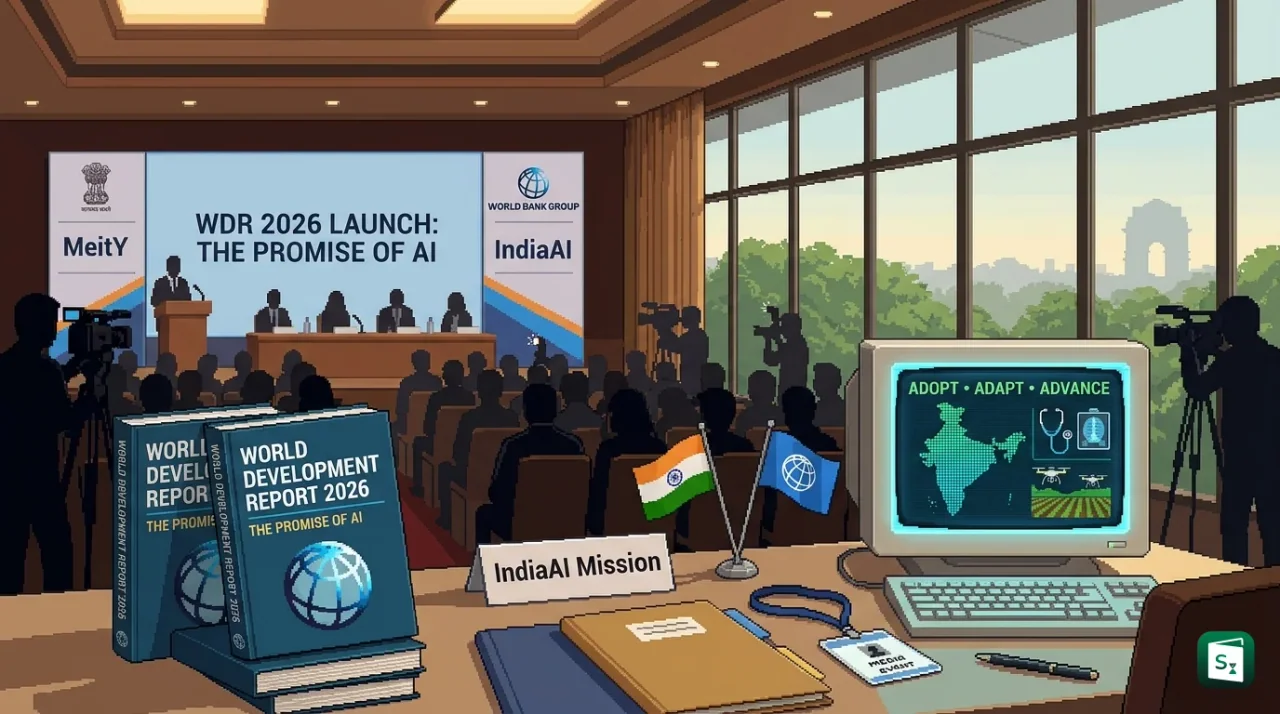
Union Minister Ashwini Vaishnaw launched the World Bank Group’s World Development Report 2026, titled The Promise of Artificial Intelligence, in New Delhi on 8 October 2026. The India launch was jointly hosted by the IndiaAI Mission under the Ministry of Electronics and Information Technology (MeitY) and the World Bank Group. The report argues that developing economies can achieve in a decade what might otherwise take a century if they close gaps in power, connectivity, skills and institutions.
What Is the World Development Report and Who Publishes It?
The World Development Report is the flagship annual publication of the World Bank Group that examines one major development theme each year for policymakers, researchers and governments across low and middle income countries. The World Bank Group publishes the report from its headquarters in Washington, D.C. in the United States.
The World Development Report (WDR) has appeared every year since 1978. Each edition picks a central question for development policy. Past themes include Digital Dividends in 2016, Data for Better Lives in 2021 and the 2025 edition on growth. The 2026 edition focuses on artificial intelligence as a general purpose technology, which means a technology that spreads across many sectors like electricity or the internet once did.
The World Bank traces its origin to the Bretton Woods Conference of 1944 and began operations in 1946. The World Bank Group today consists of five bodies working for poverty reduction and shared prosperity on a livable planet. The World Bank Group President is Ajay Banga (as of October 2026), who took charge on 2 June 2023 for a five year term. The Group has 189 member countries and staff in more than 130 locations.
What Happened at the New Delhi Launch?
The World Bank Group released the World Development Report 2026 globally on 4 August 2026 in Washington. The India launch took place on 8 October 2026 at The Oberoi, New Delhi. The IndiaAI Mission under the Ministry of Electronics and Information Technology (MeitY), which handles electronics, IT and digital policy in India, hosted the event in collaboration with the World Bank Group.
Ashwini Vaishnaw, Union Minister for Electronics and Information Technology, Railways, and Information and Broadcasting, delivered the keynote address and formally presented the report. The Minister stressed India’s approach of democratising technology so that citizens, enterprises and institutions across the country can use artificial intelligence (AI), which refers to computer systems that can learn, reason and solve problems.
The programme opened with remarks by Sudeep Srivastava, Chief Operating Officer of the IndiaAI Mission, and Somik Lall, Director of Strategy for Development Economics in the World Bank Group. Michael Kremer, Chief Economist and Senior Vice President of the World Bank Group, gave a lecture on moving from AI pilots to scale in India. Gaurav Nayyar, Director of the World Development Report 2026, presented the key findings. Special remarks came from Neelkanth Mishra, Executive Director in the World Bank Group, and S. Krishnan, Secretary of MeitY.
A high level panel on Making AI Work for Development in India discussed adoption challenges, local adaptation and risk controls. The panel included technology leaders from Sarvam AI, Wadhwani AI, BharatGen and the EkStep Foundation, and was moderated by CNBC-TV18 Managing Editor Shereen Bhan. The session concluded that India must move from isolated pilots to evidence based scale up with better data, affordable compute and clear institutional rules.
What Is the Adopt, Adapt and Advance Approach?
The Adopt, Adapt and Advance approach is the World Development Report 2026 framework that asks developing countries to first use existing AI tools, then customise them to local needs, and only later invest in building advanced models and infrastructure. It prioritises affordable solutions over costly frontier races.
Adopt means using AI tools that already exist. A small clinic can use an approved screening app. A school can use a tutoring assistant. This step needs no large data centre. It needs reliable electricity, internet and basic digital skills.
Adapt means changing those tools for local language, local data and local problems. The report says this is where most gains lie. Open models can be tuned on Indian crop, health or education data. Local language datasets, affordable access to computing power and skilled workers make adaptation possible. Governments can help by opening quality public data and testing what works.
Advance means building deeper capability over time. This includes research talent, semiconductor supply, data centres and indigenous foundation models, which are large AI systems trained on vast data that others can build upon. The report warns that this stage is expensive and out of reach for most developing countries in the near term. Countries should enter it selectively and avoid dependence on any single supplier.
The World Development Report 2026 tells governments to act in three roles. As enablers, they must strengthen power, connectivity, compute, data and schools. As users, they must procure and monitor AI for public services. As regulators, they should start with existing laws and voluntary standards for trustworthy AI and add new rules only where markets fail to protect people.
Key Findings on Jobs, Productivity and Readiness Gaps
The World Development Report 2026 is the first full assessment of AI for 5.6 billion people living in low and middle income countries. The central message is simple. Be optimistic, be strategic and be pragmatic. AI spreads faster than earlier general purpose technologies. Firms and governments already use it for screening patients, advising farmers and helping teachers prepare lessons.
The report finds that AI can widen access to scarce expertise, lift productivity of farmers, small firms, health workers and teachers, and improve service delivery. These tools extend expert knowledge to places where doctors or agronomists are few. Yet the gains depend on strong foundations. Reliable electricity, affordable internet, digital devices, computing infrastructure, quality data, foundational learning and capable institutions must come first.
On jobs, the fear of sudden mass loss looks less urgent for poorer economies. Work in high income countries is far more exposed to automation by generative AI, which creates text, images and code from prompts, than work in developing economies.
| Indicator | High income countries | Low and middle income countries |
|---|---|---|
| Jobs that generative AI could automate | 14.2 percent | 4.5 percent |
| Jobs that AI could complement and make more productive | Lower share | 16.2 percent |
| Readiness signal | Most have AI strategies | Only 1 of 25 low income countries has a national AI strategy |
The readiness gap is stark. In Sub-Saharan Africa, nearly one third of rural schools still lack reliable electricity and more than two thirds lack dependable internet. That is why the World Bank Group links the report to efforts like Mission 300, which aims to give electricity access to 300 million people in Africa. Without power and connectivity, affordable devices and skills cannot turn access into use.
IndiaAI Mission and India’s AI Examples
The IndiaAI Mission is India’s national programme to build a complete AI ecosystem under the vision of Making AI in India and Making AI Work for India. The Union Cabinet approved the mission in March 2024 with an outlay of ₹10,371.92 crore for five years. The mission is run by the IndiaAI Independent Business Division under the Digital India Corporation. It seeks to give researchers, startups and government agencies affordable compute, data and models suited to India’s scale, diversity and many languages.
The mission works through seven pillars that cover machines, data, skills and safety.
| Pillar | What it does |
|---|---|
| IndiaAI Compute Capacity | Provides high end graphics processing units (GPUs), which are chips that speed up AI work, at low cost. The target was 10,000 GPUs. More than 38,000 GPUs are now onboarded at about ₹65 per hour. |
| IndiaAI Innovation Centre | Supports indigenous foundation models built in India |
| AIKosh Datasets Platform | Offers the national platform for datasets, models and related resources |
| Application Development Initiative | Funds AI apps for health, farming, education and governance |
| FutureSkills | Trains students and workers, including YUVA AI for All and data labs |
| Startup Financing | Gives funds to AI startups from idea to market |
| Safe and Trusted AI | Backs tools for bias control, audit, explainable AI, privacy and deepfake detection |
At the New Delhi launch, Ashwini Vaishnaw cited field results. In Baramati in Maharashtra, sugarcane yields rose by 40 percent while water and fertiliser use fell by 30 percent. Farmers who had never used a computer got voice advice on phones using satellite, sensor and weather data. Tuberculosis detection rose by 35 percent with AI support. In Gujarat, AgriStack serves 5 lakh farmers, while AI support for animal health through Sarlaben touches 3 crore cattle.
Michael Kremer pointed to AI based monsoon forecasting as a model for the world. Indian meteorological agencies and the Agriculture Ministry tested several AI models, including open access systems, and sent forecasts to millions of farmers by text, voice and AI advisories. The system caught the unusual 2025 monsoon. Ethiopia now follows India’s method. The case shows that state action matters where commercial profit is low but social value is high.
A State AI Showcase presented four scalable solutions. Navachetana from Andhra Pradesh screens children aged 0 to 6 for developmental delays. MahaVISTAAR AI from Maharashtra gives personalised farm advisories and digital services. EdskGrid from Meghalaya uses GeoAI, which combines location data with AI, for education governance. Vyuhaa-CerviAI offers point of care cervical cancer screening. S. Krishnan said the report matches India’s focus on compute, data and models, and added that work is under way on an AI Talent Mission to use India’s high AI skill penetration for the Global South.
World Bank Group and How the World Bank Differs From the IMF
The World Bank Group brings five bodies together for one goal, a world free of poverty on a livable planet. The International Bank for Reconstruction and Development (IBRD), set up in 1944, lends to middle income and creditworthy low income governments. The International Development Association (IDA), set up in 1960, gives interest free credits and grants to the poorest governments. Together, IBRD and IDA form the World Bank.
The other three arms support private activity and rules. The International Finance Corporation (IFC), set up in 1956, invests in private firms in developing countries. The Multilateral Investment Guarantee Agency (MIGA), created in 1988, gives political risk insurance to investors. The International Centre for Settlement of Investment Disputes (ICSID), set up in 1966, settles investment disputes through conciliation and arbitration, which means guided talks and binding decisions outside regular courts.
Readers often mix up the World Bank and the International Monetary Fund (IMF). The two were born at the same Bretton Woods meeting but do different jobs.
| Feature | World Bank Group | International Monetary Fund |
|---|---|---|
| Set up | 1944, operations from 1946 | 1944, operations from 1947 |
| Headquarters | Washington, D.C., United States | Washington, D.C., United States |
| Members | 189 countries | 190 countries |
| Core job | Long term development finance, knowledge and technical help | Short term balance of payments support and global monetary stability |
| Main tools | Project loans, credits, grants, equity, guarantees, data like World Development Indicators | Emergency loans, surveillance, policy advice and capacity support |
| Flagship publication in focus here | World Development Report, annual since 1978 | World Economic Outlook, published twice a year |
The World Bank’s data work matters for this report. The World Development Indicators databank tracks income, poverty, power access and internet use across countries. The WDR 2026 team used such data plus a new firm survey to map AI use, barriers and governance needs by income level.
Key Takeaways
- The World Development Report 2026: The Promise of Artificial Intelligence was released globally on 4 August 2026 and launched in India on 8 October 2026 at The Oberoi, New Delhi.
- The World Bank Group, headquartered in Washington, D.C., United States, publishes the World Development Report every year since 1978.
- The report advises developing economies to follow Adopt, Adapt and Advance, with priority to affordable AI tools tuned to local language and needs.
- About 14.2 percent of jobs in high income countries face automation risk from generative AI, compared to 4.5 percent in low and middle income countries.
- The IndiaAI Mission, approved in March 2024 with ₹10,371.92 crore, works through seven pillars including Compute Capacity, AIKosh and Safe and Trusted AI.
- In Baramati, AI advisories raised sugarcane yields by 40 percent while cutting water and fertiliser use by 30 percent, and AI support lifted TB detection by 35 percent.