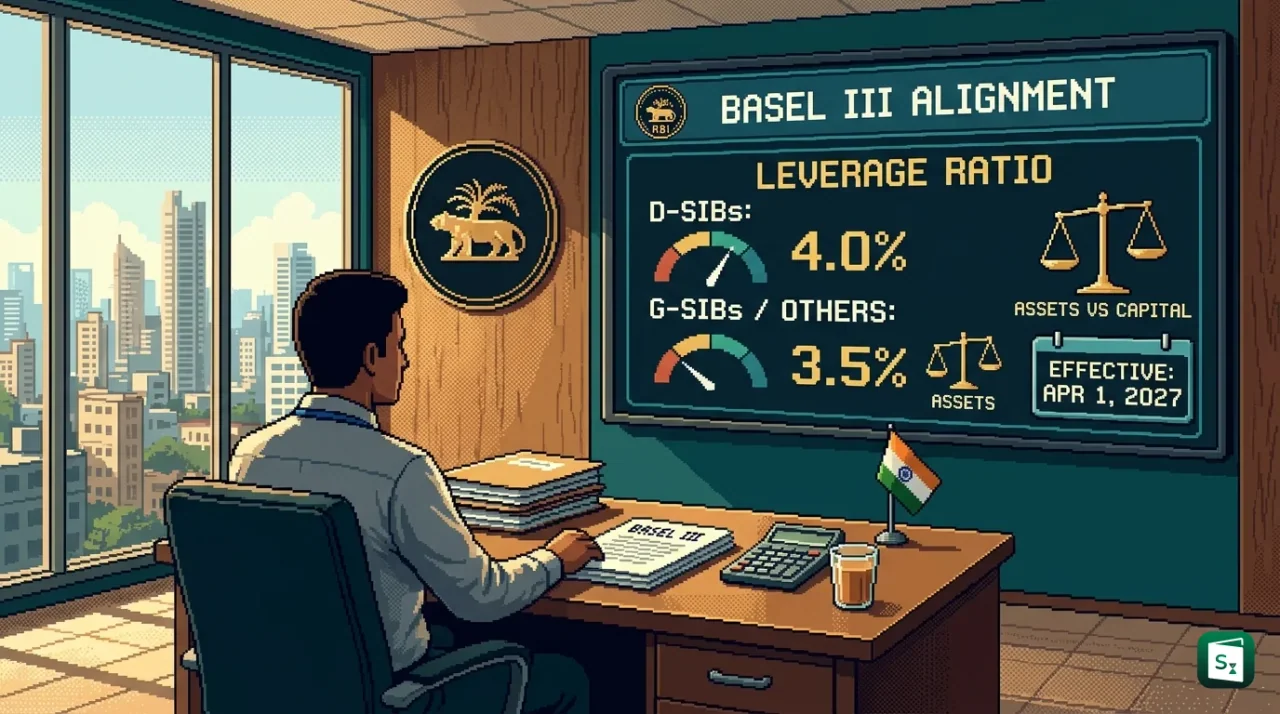
The Reserve Bank of India issued the RBI (Commercial Banks, Prudential Norms on Capital Adequacy) Eleventh Amendment Directions, 2026 on 23 October 2026 to revise the leverage ratio for banks. The revised framework will take effect from 1 April 2027 and aligns India with the Leverage Ratio 2017 Standard of the Basel Committee on Banking Supervision. It sets a clear backstop to bank borrowing at a time when balance sheets are expanding fast.
What Is Leverage Ratio in Banking?
The leverage ratio for banks is a non-risk based capital measure that compares a bank’s Tier 1 capital with its total exposure. The Reserve Bank of India defines it as capital measure divided by exposure measure, expressed as a percentage. It limits total borrowing even when risk weights look low.
The capital measure is the numerator. The Reserve Bank of India uses Tier 1 capital for this purpose. Tier 1 capital is the core capital of a bank and it has two parts, Common Equity Tier 1 (CET1) such as equity shares and retained profits, and Additional Tier 1 (AT1) such as perpetual bonds that absorb losses on a going concern basis. This is the same Tier 1 capital used in the risk based capital framework.
The exposure measure is the denominator. It is the bank’s total exposure, not just loans. The Reserve Bank of India calculates it as the sum of four blocks, on-balance sheet exposures, derivative exposures, securities financing transaction exposures and off-balance sheet items. On-balance sheet assets enter at gross accounting value. Collateral, guarantees and netting of loans against deposits are generally not allowed to reduce the measure.
| Component of Formula | What It Means in Simple Words |
|---|---|
| Leverage ratio = (Capital measure / Exposure measure) x 100 | Percentage of core capital against total exposure |
| Capital measure | Tier 1 capital (CET1 plus AT1) |
| Exposure measure | All assets plus derivatives, repo deals and guarantees given |
A simple example helps. If a bank has ₹8,000 crore of Tier 1 capital and ₹2,00,000 crore of total exposure, its leverage ratio is 4 percent. A lower ratio means higher borrowing against the same capital. In the United States, regulators use a closely related name, the supplementary leverage ratio, for large banks. The idea is identical, core capital divided by total leverage exposure.
What Are Basel Norms and the Basel III Framework?
Basel norms are global banking rules set by the Basel Committee on Banking Supervision to keep banks safe and stable. Basel III is the third set of these rules, introduced in 2010 after the 2008 financial crisis. It tightens capital quality and adds liquidity standards and a leverage ratio backstop.
The Basel Committee on Banking Supervision (BCBS) frames these norms. The committee sits at the Bank for International Settlements (BIS) in Basel, Switzerland and brings together central banks and supervisors from major economies. Its standards are not law by themselves. Each country puts them into its own rules. In India, the Reserve Bank of India (RBI), established in 1935 and headquartered in Mumbai, issues them as capital adequacy directions under Section 35A of the Banking Regulation Act, 1949.
Basel III was introduced in 2010 and was implemented in phases from 2013. It rests on three pillars, minimum capital requirements, supervisory review and market discipline through disclosure. The global minimum leverage ratio under Basel III is 3 percent. In December 2017, the committee finalised the pending reforms, often called the Basel III endgame or the Leverage Ratio 2017 Standard. That 2017 text redefined how exposure is measured for derivatives, repurchase transactions and off-balance sheet commitments. The Reserve Bank of India’s October 2026 directions bring India’s Chapter VII Leverage Ratio framework in line with that 2017 text.
RBI Revised Framework: New 4 Percent and 3.5 Percent Norms From April 2027
The Reserve Bank of India notified the final directions on 23 October 2026 as RBI/2026-27/297. The Reserve Bank of India had placed the draft directions on 7 August 2026 for public comments till 28 August 2026 and examined the feedback before finalising the text. The final directions amend the RBI (Commercial Banks, Prudential Norms on Capital Adequacy) Directions, 2025 and take effect from 1 April 2027.
Leverage Ratio Requirement for D-SIBs, Other Banks and G-SIB Branches
The Reserve Bank of India has kept the minimum levels unchanged but has tightened how they are measured. The revised Paragraph 262 prescribes three clear slabs. The table below captures the new requirement.
| Category of Bank | Minimum Leverage Ratio From 1 April 2027 |
|---|---|
| Domestic Systemically Important Banks (D-SIBs) | 4 percent |
| All other commercial banks | 3.5 percent |
| Branches of Global Systemically Important Banks (G-SIBs) in India | 3.5 percent plus leverage ratio buffer |
Domestic Systemically Important Banks are banks whose failure can disrupt the whole financial system. The Reserve Bank of India first issued the D-SIB framework on 22 July 2014. In the 2025 list released on 2 December 2025, the Reserve Bank of India retained three names, State Bank of India in Bucket 4, HDFC Bank in Bucket 2 and ICICI Bank in Bucket 1. These buckets decide extra Common Equity Tier 1 surcharges of 0.80 percent, 0.40 percent and 0.20 percent of risk weighted assets. The same three banks now face the higher 4 percent leverage ratio.
A branch of a G-SIB in India must maintain 3.5 percent plus the buffer that applies to its parent group. This includes any extra buffer fixed by the home regulator. The buffer must be met with Tier 1 capital.
How the Leverage Ratio Buffer Works for G-SIB Branches
Global norms link the leverage buffer to the risk based G-SIB surcharge. The buffer is set at 50 percent of the parent’s higher loss absorbency requirement. A parent with a 2 percent risk based surcharge will have a 1 percent leverage buffer. A parent with a 1 percent surcharge will have a 0.50 percent buffer.
The Reserve Bank of India will impose capital distribution constraints on a G-SIB branch that fails to meet its buffer. The branch cannot freely pay dividends or bonuses in that situation. The extent of the restriction depends on two positions together, the CET1 risk based ratio and the Tier 1 leverage ratio. A branch that meets both the risk based requirement and the leverage requirement faces no conservation restriction. A branch that misses one requirement follows the conservation standard linked to that shortfall. A branch that misses both follows the higher of the two standards.
For a G-SIB in the first bucket with a 1 percent risk based buffer, the Reserve Bank of India has laid down five slabs. When the CET1 ratio stays between 5.5 percent and 6.375 percent and the leverage ratio stays between 3.5 percent and 3.625 percent, the branch must conserve 100 percent of earnings. The conservation demand falls to 80 percent, 60 percent, 40 percent and finally zero as capital improves above 9 percent CET1 and 4 percent leverage ratio.
How Is the Leverage Ratio Calculated for Banks in India?
The Reserve Bank of India requires banks to meet the minimum leverage ratio at all times. Both capital and exposure are calculated on a quarter end basis. A bank may use daily or monthly averaging only with the prior approval of the Reserve Bank of India and it must then follow that method consistently. The leverage framework follows the same scope of regulatory consolidation as the risk based capital framework.
The total exposure is the sum of four blocks. The table below gives the working logic in plain words.
| Exposure Block | What the Bank Must Include |
|---|---|
| On-balance sheet exposures | All balance sheet assets at gross value, after deducting specific provisions and general provisions that have reduced Tier 1 capital |
| Derivative exposures | Replacement cost plus potential future exposure, multiplied by 1.4, with special rules for written credit derivatives |
| Securities financing transaction exposures | Gross repo and reverse repo assets plus a counterparty risk add-on, with limited netting for same counterparty and same settlement date |
| Off-balance sheet items | Guarantees, letters of credit and undrawn commitments after applying credit conversion factors |
Derivative measurement is the most technical change. Banks that still use the Current Exposure Method (CEM) will follow the older Paragraph 267 treatment. Banks that have moved to the Standardised Approach for Counterparty Credit Risk (SA-CCR) will follow the new Paragraph 267A. Under SA-CCR, exposure equals 1.4 times the sum of replacement cost and potential future exposure. Replacement cost is current market value after recognising eligible cash variation margin exchanged daily. Potential future exposure is an add-on for how the value can move in future. Collateral received does not reduce the exposure. Collateral provided that has reduced balance sheet assets must be added back.
Written credit derivatives get extra attention. A bank that sells protection through a credit default swap must include the effective notional amount of that contract, because the bank carries the credit risk of the reference borrower. The notional can be reduced only by negative fair value already taken out of Tier 1 capital. It can be offset by purchased protection on the same name only when the purchased cover has the same or stricter terms and equal or longer maturity.
Banks must disclose the ratio every quarter on both standalone and consolidated bases. The disclosure uses two Basel templates, LR1 which reconciles published accounting assets with leverage exposure, and LR2 which breaks up on-balance sheet, derivative, repo and off-balance sheet parts and shows the ratio, the minimum and the buffer. Banks must also submit the detailed calculation to the Department of Supervision of the Reserve Bank of India. The Reserve Bank of India may in exceptional conditions temporarily exclude central bank reserves from exposure, but it will then raise the minimum calibration to keep resilience unchanged.
Leverage Ratio vs Capital Adequacy Ratio and CRAR
The Capital Adequacy Ratio (CAR) or Capital to Risk Weighted Assets Ratio (CRAR) is risk based. It compares capital with risk weighted assets, where safe loans get low weights and risky loans get high weights. The leverage ratio is non-risk based. It compares capital with total exposure without weights. The two ratios work as partners. The risk based ratio rewards safe lending. The leverage ratio stops a bank from becoming too large even with assets that look safe.
| Feature | Capital Adequacy Ratio | Leverage Ratio |
|---|---|---|
| Full form | Capital to Risk Weighted Assets Ratio | Tier 1 capital to total exposure |
| Formula | (Tier 1 plus Tier 2 capital / Risk weighted assets) x 100 | (Tier 1 capital / Total exposure) x 100 |
| Risk sensitivity | Yes, weights differ by loan type | No, all exposures count at full value |
| Global minimum under Basel III | 8 percent total capital with 4.5 percent CET1 | 3 percent Tier 1 |
| Minimum in India | 9 percent total capital with 5.5 percent CET1 plus 2.5 percent capital conservation buffer | 4 percent for D-SIBs and 3.5 percent for others |
| Purpose | Covers credit, market and operational risk | Backstop against model error and excessive size |
India keeps higher floors than the global minimum on both ratios. The extra cushion reflects the lessons of past bad loan cycles and the need to protect depositors in a bank dominated financial system. The leverage ratio is therefore not a substitute for CRAR. A bank must meet both ratios at the same time.
Why the Leverage Ratio Is Important and What Lies Ahead
The leverage ratio is important because risk weights can be wrong and models can fail. It caps total size with a simple rule that cannot be gamed easily. It protects depositors during booms when banks expand fast and prevents painful forced asset sales during downturns.
The 2008 global financial crisis showed the gap clearly. Many banks met risk based ratios yet carried very high total borrowing against thin capital. When asset prices fell, these banks had to sell assets at speed and the stress spread across the system. The leverage ratio answers that weakness. It captures items that stay partly outside risk weights, such as derivatives, repurchase deals and guarantees.
For Indian banks, the immediate minimums have not risen. The pressure comes from measurement. Grossing up of derivatives, tighter repo netting and fuller inclusion of off-balance sheet promises can raise the denominator and pull the reported ratio down. Large dealers in foreign exchange derivatives and banks with big undrawn limits will need stronger data systems for SA-CCR, LR1 and LR2 reporting. G-SIB branches in Mumbai and other centres will need to track buffers set abroad and align dividend plans with both CET1 and leverage positions.
The period till 1 April 2027 gives banks time to adjust. The Reserve Bank of India will review quarterly disclosures and supervisory returns during this window. Over time, closer alignment with the 2017 global standard will make Indian ratios more comparable with peers and strengthen confidence in India’s promise of a stable, well capitalised banking system.
Key Takeaways
- The Eleventh Amendment Directions, 2026 were issued on 23 October 2026 and take effect from 1 April 2027.
- The revised framework aligns India with the Leverage Ratio 2017 Standard of the Basel Committee on Banking Supervision under Basel III.
- The minimum leverage ratio is 4 percent for D-SIBs and 3.5 percent for all other banks, while G-SIB branches must hold 3.5 percent plus a leverage buffer.
- The leverage ratio formula is (Tier 1 capital / Total exposure) x 100, where exposure covers on-balance sheet assets, derivatives, repo deals and off-balance sheet items.
- The 2025 D-SIB list names State Bank of India, HDFC Bank and ICICI Bank, with extra CET1 surcharges of 0.80 percent, 0.40 percent and 0.20 percent.
- The global Basel minimum for the leverage ratio is 3 percent, while India applies higher floors of 3.5 percent and 4 percent.