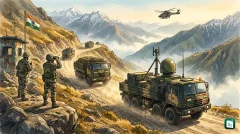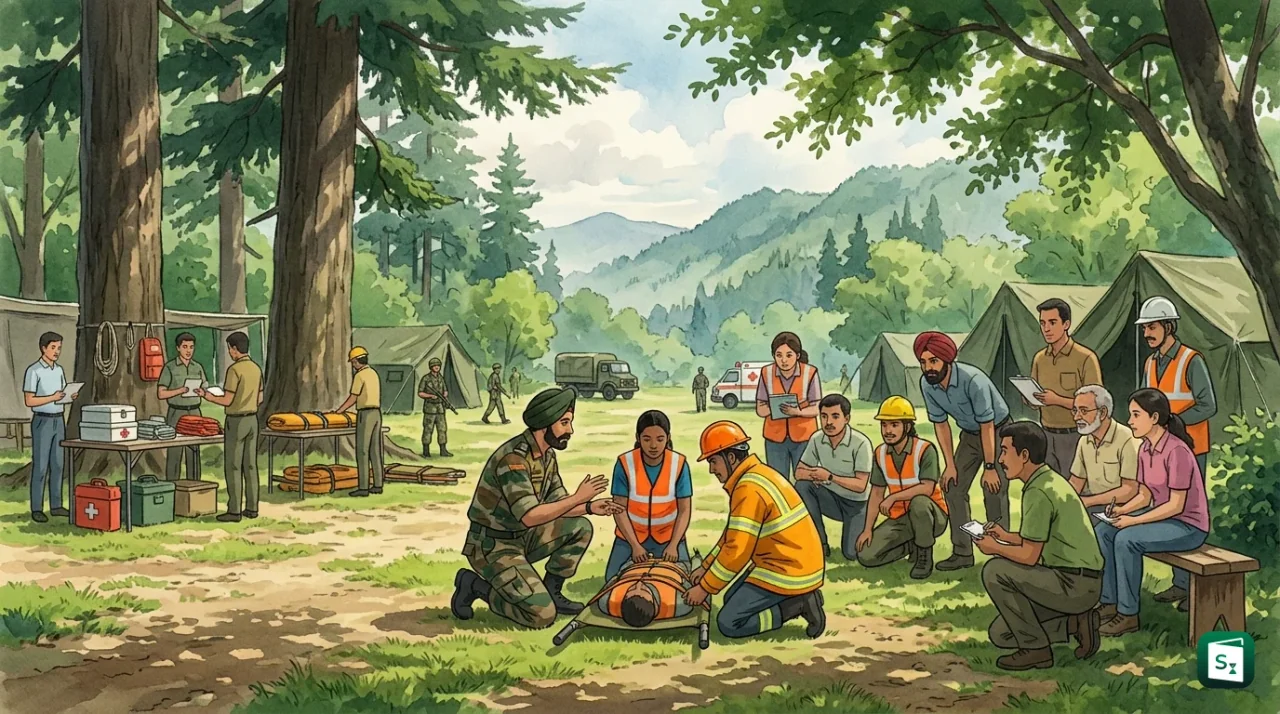
The Ministry of Home Affairs, in coordination with the Indian Army, has launched a first of its kind pilot initiative to build a vibrant Civil Defence network in India. Announced on 23 October 2026, the first phase will give three day specialised training to 600 Civil Defence Master Trainers from 12 States and Union Territories by the second week of November 2026. Each trainer will then train 100 volunteers, creating a 60,000 strong grassroots emergency response force.
What Is Civil Defence?
Civil Defence is a community based voluntary system that protects people, property and essential services during hostile attacks and disasters without taking part in actual combat. The Civil Defence network in India functions under the Ministry of Home Affairs and draws its members from ordinary citizens who are trained to support the police, fire services and disaster response teams during emergencies.
Civil Defence was first set up in India on 24 October 1941. The system grew sharply after the Chinese aggression in 1962 and the conflict with Pakistan in 1965. Parliament passed the Civil Defence Act, 1968 (Act 27 of 1968) on 24 May 1968 to give it a clear legal base. The Act extends to the whole of India. The Civil Defence (Amendment) Act, 2009 added disaster management as an additional role while keeping protection during hostile attack as the core duty.
Civil Defence is organised mainly on a voluntary basis with only a small paid staff. A Civil Defence Volunteer is not a full time government employee. Volunteers receive training, a uniform and a certificate and identity card, and they get duty allowance when called for training or service. Any citizen of India who meets the basic eligibility of age, fitness and residence in the concerned State or Union Territory can apply through the State Civil Defence portal or district office. The current national target is to raise 14.11 lakh volunteers, of whom about 5.38 lakh have been enrolled, with activities spread across 259 categorised towns and 100 multi hazard prone districts.
How Will the Joint Training Initiative Work?
The joint training initiative is led by the Directorate General of Fire Services, Civil Defence and Home Guards (DGFSCDHG) under the Ministry of Home Affairs, in coordination with the Indian Army. The DGFSCDHG was first created as the Directorate General of Civil Defence on 17 November 1962 and took its present name on 26 February 2014. It is headquartered at R. K. Puram, New Delhi. The Directorate will coordinate nominations, curriculum and certification, while the Indian Army will provide instructors and training facilities.
The idea flows from the Prime Minister’s address from the Red Fort on 15 August 2026, where he called for a vibrant Civil Defence network with modern systems and skills to meet emerging security challenges. The Ministry of Home Affairs announced the pilot on 23 October 2026. Training will be held at designated Indian Army training establishments in the participating States and Union Territories.
The model is simple and powerful. The Ministry of Home Affairs will first create a small pool of highly trained Master Trainers. A Master Trainer is a selected Civil Defence member who completes advanced instruction and then teaches the same skills to other volunteers in his or her own district. State governments nominate serving volunteers or wardens for this role based on fitness, service record and leadership ability. There is no separate national examination for the role in this pilot.
| Feature of the First Phase | Detail |
|---|---|
| Total Master Trainers | 600 |
| States and Union Territories covered | 12 |
| Nomination per State or Union Territory | 50 |
| Duration of Army training | 3 days |
| Deadline for completion | Second week of November 2026 |
| Volunteers to be trained by each Master Trainer | 100 |
| Total volunteer strength to be created | 60,000 |
Once the Army completes the three day course, each Master Trainer will return to his or her State and train 100 Civil Defence Volunteers. This cascading method multiplies the impact without moving lakhs of people to Army centres. Based on the results of this pilot, the Ministry of Home Affairs plans to extend the programme to the remaining States and Union Territories in phases.
What Will the Three Day Training Cover?
The Indian Army training focuses on three broad areas that match the threats Indian cities face today. The design reflects lessons from the nationwide civil defence mock drill Operation Abhyaas held on 7 May 2025 across 244 districts, which tested air raid sirens, blackouts, evacuation and rescue coordination.
| Training Area | What Volunteers Will Learn |
|---|---|
| Threat Awareness | Modern and hybrid warfare, drone awareness, air raid threats and warning signals |
| Protection and Emergency Response | Protection of critical infrastructure, fire safety, Chemical Biological Radiological and Nuclear (CBRN) awareness, casualty management, search and rescue |
| Communication and Coordination | Emergency communication, cyber hygiene, digital resilience, civil military coordination and incident command |
Threat Awareness teaches volunteers to recognise new dangers. Hybrid warfare means a mix of conventional attack, cyber attack and disinformation used together. Drone awareness covers small unmanned aircraft that can observe targets or drop payloads. Volunteers learn siren codes, blackout procedure and safe shelter drill.
Protection and Emergency Response builds hands on rescue skills. Critical infrastructure means power stations, water works, ports, hospitals and communication hubs that must keep working during a crisis. CBRN awareness teaches basic protection against chemical, biological, radiological and nuclear hazards, including the use of masks, evacuation distance and decontamination. Casualty management covers first aid, triage and shifting the injured to hospitals. Search and rescue covers rope work, debris clearance and evacuation from high rise buildings.
Communication and Coordination keeps the whole system connected. Emergency communication covers wireless sets, control rooms and clear message passing. Cyber hygiene means safe use of phones and computers during a crisis so that rumours and hacking do not spread panic. Digital resilience means keeping alternative power and communication links ready. Civil military coordination and incident command teach volunteers how to work under a single chain of command along with the Army, police, fire and medical teams.
Which States and Union Territories Are Covered in the First Phase?
The Ministry of Home Affairs has selected 12 States and Union Territories for the pilot. Each region will nominate 50 Master Trainers. The full list is Jammu and Kashmir, Punjab, Rajasthan, Gujarat, Delhi, Assam, Meghalaya, Sikkim, Uttar Pradesh, Kerala, Karnataka and Tamil Nadu.
| Region Group | States and Union Territories | Strategic Logic |
|---|---|---|
| Western border belt | Jammu and Kashmir, Punjab, Rajasthan, Gujarat | Frontline exposure to air, drone and cross border threats and home to vital military and energy assets |
| Northeast and Eastern Himalaya | Assam, Meghalaya, Sikkim | Mountain terrain, heavy rainfall and flood risk, plus sensitive international borders |
| National capital and northern plains | Delhi, Uttar Pradesh | Dense population, central ministries, industrial clusters and transport hubs |
| Southern peninsula | Kerala, Karnataka, Tamil Nadu | Long coastline, major ports, space, defence and information technology centres |
The choice balances security and disaster risk. The four western regions share a border with Pakistan and were part of the extended civil defence exercise Operation Shield in May 2025. Training here sharpens blackout, shelter and evacuation skills where reaction time is shortest. The northeast faces earthquakes, landslides and river floods every year. Real time coordination matters in narrow valleys where roads can be cut off quickly.
Delhi and Uttar Pradesh bring scale. Delhi held drills at 55 locations during Operation Abhyaas, including air raid and building collapse simulations. Uttar Pradesh has the largest population of any State, so trained volunteers there can protect the highest number of people. The three southern States anchor India’s technology and maritime economy. Karnataka hosts defence production and research centres at Bengaluru, Tamil Nadu hosts ports and nuclear and automobile plants, and Kerala hosts ports and petrochemical storage. Protecting these assets keeps supply chains and power systems stable during a crisis.
What Is the Legal and Institutional Framework for Civil Defence in India?
Civil Defence in India comes under the Ministry of Home Affairs. The Ministry handles internal security, border management, management of Central Armed Police Forces and disaster management. Within the Ministry, the DGFSCDHG frames Civil Defence policy, issues guidelines and shares costs with States through grants in aid. Day to day control rests with State governments, which appoint Controllers to command the Civil Defence Corps in each district.
The legal base rests on two laws. The Civil Defence Act, 1968 defines civil defence as any measure, not amounting to actual combat, that protects persons, property, places and things against hostile attack. The Civil Defence Rules and Regulations of 1968 lay down enrolment, training, duties and discipline. The Disaster Management Act, 2005 (Act 53 of 2005), which came into force on 28 July 2006, created the National Disaster Management Authority (NDMA) headed by the Prime Minister, along with State and District Authorities. The 2009 amendment to the Civil Defence Act formally added disaster management before, during and after any disaster as defined in the 2005 law. This is why Civil Defence volunteers now serve in floods, earthquakes, cyclones, fires and epidemics as well as in air raid and blackout drills.
Funding follows a sharing pattern. The central government reimburses part of the approved expenditure on raising and training volunteers. Northeastern States receive a higher share of central support, while other States meet a larger portion from their own budgets.
Civil Defence vs Home Guards
Civil Defence and Home Guards are often named together, but they are two different volunteer forces. Both work under the same Directorate at the national level and often share a combined Directorate in States.
| Point of Difference | Civil Defence | Home Guards |
|---|---|---|
| First raised | 24 October 1941 as Air Raid Precautions | December 1946 to help police control civil disturbance |
| Main law and policy | Civil Defence Act, 1968 | State Home Guards Acts and central guidelines issued after 1962 |
| Core role | Protection during hostile attack and disaster relief | Auxiliary to police for law and order, traffic, elections and essential services |
| Composition | Volunteers enrolled in Corps and Warden Service in categorised towns | Rural and urban wings, plus Border Wing in border States |
| Service nature | Purely voluntary with duty allowance | Voluntary force paid duty allowance, often deployed for longer duties |
In practice the two forces support each other. Home Guards help maintain order around an incident, while Civil Defence teams carry out rescue, first aid, fire control and evacuation. The new Master Trainer programme strengthens both cultures of service by giving them common Army grade standards.
Why Does This Initiative Matter for Disaster Readiness?
The Ministry of Home Affairs initiative links two strengths that usually work apart. The Indian Army brings operational experience in threat assessment, field discipline and rapid movement. The Civil Defence network brings deep local presence, with volunteers who know their own streets, buildings and vulnerable residents. When these two strengths combine, warning reaches faster and rescue starts earlier.
The timing reflects a changing threat picture. Drones, cyber intrusions and hybrid tactics can target power grids, ports, refineries and data centres far from the border. Civil Defence volunteers trained in drone awareness, CBRN basics and cyber hygiene can spot early signs, enforce blackouts correctly and guide people to shelters without panic. Their work protects critical infrastructure in the first golden minutes before specialist forces arrive.
The programme also fills a capacity gap shown during recent national drills. Operation Abhyaas in May 2025 showed that sirens, evacuation and hospital triage work best when citizens already know their roles. A trained volunteer in every ward reduces crowd chaos, keeps roads clear for fire and ambulance services and helps the police hold secure perimeters. With 60,000 newly skilled volunteers, 12 States and Union Territories will gain a ready first responder layer that supports the National Disaster Response Force, State forces, fire services and medical teams under the wider disaster management system built by the Disaster Management Act of 2005.
The Way Forward
The Ministry of Home Affairs will treat the first phase as a pilot. The Directorate General of Fire Services, Civil Defence and Home Guards will track attendance, skill tests and the quality of follow on training by Master Trainers in their home districts. Lessons on language of instruction, equipment needs and refresher intervals will shape the next rollout.
Expansion to the remaining States and Union Territories is planned in phases. The long term goal is a future ready network with common drills, updated manuals and stronger links between Army establishments, district controllers and municipal bodies. If the multiplier holds, every round of 600 Master Trainers can add another 60,000 volunteers, steadily moving India toward its target of a corps present in every vulnerable district.
Key Takeaways
- The Ministry of Home Affairs and Indian Army announced a joint pilot on 23 October 2026 to train 600 Civil Defence Master Trainers by the second week of November 2026.
- The first phase covers 12 States and Union Territories with 50 trainers each, including Jammu and Kashmir, Punjab, Rajasthan, Gujarat, Delhi, Assam, Meghalaya, Sikkim, Uttar Pradesh, Kerala, Karnataka and Tamil Nadu.
- Each Master Trainer will train 100 volunteers, creating a 60,000 strong Civil Defence volunteer network.
- Civil Defence functions under the Ministry of Home Affairs through the Civil Defence Act, 1968 and was first established on 24 October 1941.
- The Civil Defence (Amendment) Act, 2009 added disaster management under the Disaster Management Act, 2005 as an additional role for the Corps.
- The three day Army course covers Threat Awareness, Protection and Emergency Response, and Communication and Coordination, including drone awareness, CBRN basics and cyber hygiene.