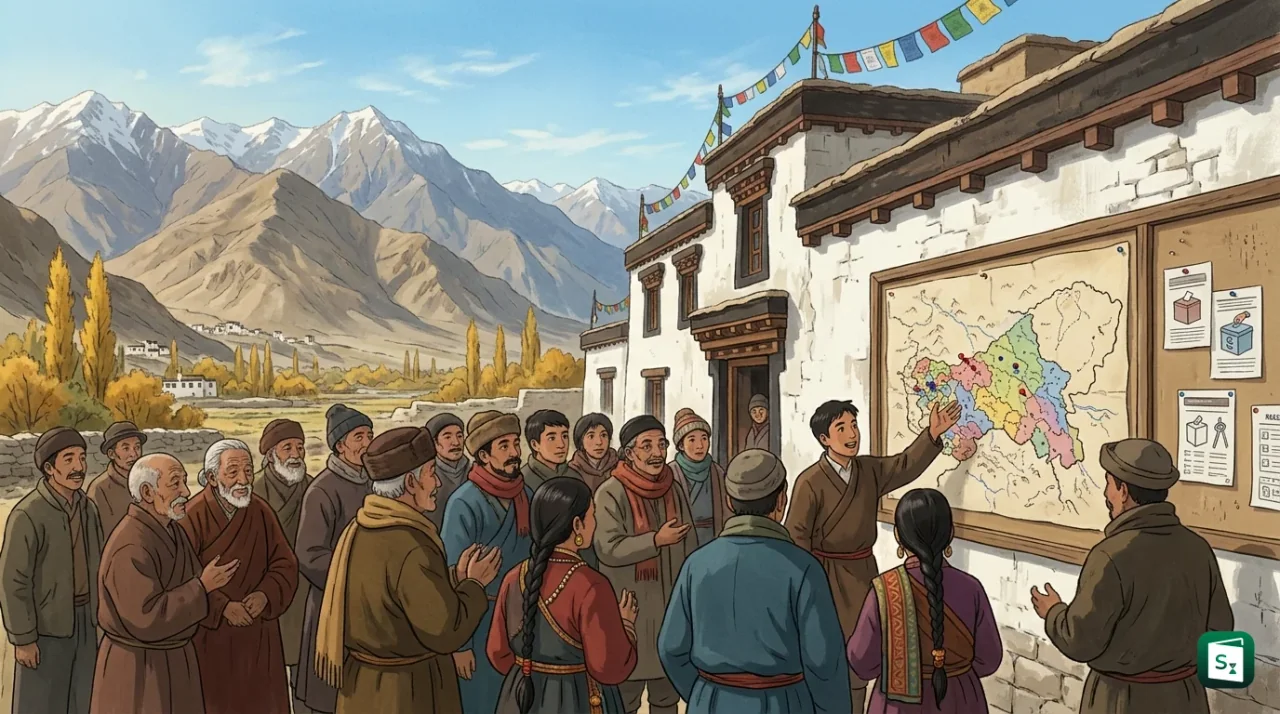
Ladakh Lieutenant Governor Vinai Kumar Saxena notified 100 elected constituencies for the Ladakh Autonomous Hill Development Councils (LAHDCs) on 21 October 2026. The order nearly doubles the earlier strength of 52 seats and spreads them across eight districts, with Leh getting the largest share of 22 seats. The move creates the electoral map for hill councils in every district of the Union Territory for the first time.
What Is LAHDC?
The Ladakh Autonomous Hill Development Council (LAHDC) is an elected local body that governs development at the district level in Ladakh. It prepares district development plans, manages funds for local works, and decides on land use, education, health, agriculture and employment generation within its area. The council works with village panchayats and operates under the overall control of the Union Territory administration.
The demand for such a council rose in Leh in the late 1980s. The Union government and the then Jammu and Kashmir government agreed in October 1993 to give autonomous hill council status to Ladakh. This decision was given legal shape by the Ladakh Autonomous Hill Development Council Act, 1995, and later consolidated in the Ladakh Autonomous Hill Development Councils Act, 1997 (Act No. XXXI of 1997). The 1997 Act received assent on 8 October 1997 and is deemed to have come into force from 1 June 1995.
The council for Leh was formed first. Elections were held on 28 August 1995 and the first meeting took place in Leh on 3 September 1995. The council for Kargil came into being in July 2003. Each of the two older councils had 30 members, with 26 members directly elected from constituencies and up to four members nominated by the government to represent women and minority communities. The council is headed by a Chief Executive Councillor (CEC), who is supported by four Executive Councillors. In protocol and powers, the CEC holds the rank of a Cabinet Minister while Executive Councillors hold the rank of Deputy Ministers. The Deputy Commissioner of the district also functions as the Chief Executive Officer of the council for execution of works and coordination with the district administration.
Is Ladakh a State or a Union Territory?
Ladakh is a Union Territory without a legislature. It was created on 31 October 2019 under the Jammu and Kashmir Reorganisation Act, 2019, after Parliament ended the special status under Article 370 in August 2019. The Union Territory is administered by the President through a Lieutenant Governor, and it sends one member to the Lok Sabha from the Ladakh parliamentary constituency.
Ladakh lies in the far north of India between the Karakoram Range in the north and the Himalaya in the south. It shares borders with China in the east and Pakistan in the west, which gives it high strategic importance. The region is often called a cold desert because of low rainfall, thin air and extreme winter temperatures. It is also described as Moonland for its bare, moonlike landscapes near Lamayuru and as Little Tibet for its shared Buddhist culture and monasteries. Leh is the largest town and the administrative centre.
Before 2019, Ladakh was part of the former state of Jammu and Kashmir and had only two districts, Leh and Kargil. After becoming a Union Territory, the two hill councils in Leh and Kargil continued as the main elected bodies below the UT administration. This is why the expansion of councils to all districts is a major change in local governance.
How Many Constituencies Are There in Ladakh Now?
Ladakh now has 100 elected hill council constituencies spread across eight councils, one for each district. The Lieutenant Governor, Vinai Kumar Saxena, notified the final list on 21 October 2026 under the amended council law. Earlier, Ladakh had only 52 elected seats, with 26 each in Leh and Kargil. The new figure almost doubles local representation.
The district wise division gives the largest shares to the two older districts because of their population and area. Leh will have 22 constituencies, the highest among all districts, followed by Kargil with 21. The newly created districts have smaller shares that match their size. Sankoo will have 13, Changthang will have 10, while Nubra, Sham and Zanskar will have nine each. Drass will have seven, the smallest council.
| District | Number of Elected Constituencies | Earlier Position |
|---|---|---|
| Leh | 22 | 26 (old Leh council) |
| Kargil | 21 | 26 (old Kargil council) |
| Sankoo | 13 | New district, carved from Kargil |
| Changthang | 10 | New district, carved from Leh |
| Nubra | 9 | New district, carved from Leh |
| Sham | 9 | New district, carved from Leh |
| Zanskar | 9 | New district, carved from Kargil |
| Drass | 7 | New district, carved from Kargil |
| Total | 100 | 52 earlier |
The Lieutenant Governor said the increase will improve representation, strengthen grassroots democracy and bring governance closer to remote villages. The State Election Commission of Ladakh has placed the draft delimitation of these constituencies in the public domain and invited objections and suggestions from residents and other stakeholders. This is the normal step before final boundaries are frozen and election rolls are prepared.
The Legal Route: LAHDC Amendment Regulation, 2026
The 100 seats were notified under the Ladakh Autonomous Hill Development Councils (Amendment) Regulation, 2026. The Union Cabinet approved the amendments on 14 October 2026. President Droupadi Murmu promulgated the Regulation on 16 October 2026, and the Lieutenant Governor notified it with effect from 19 October 2026. The administration completed the full process in six days.
The amendment allows a hill council in every district of Ladakh. It replaces the earlier fixed rule of 26 elected seats per council with a flexible range. Under the new law, the administration will fix the number of elected members for each council, with a minimum of seven seats and a maximum of 24 seats. The government can also nominate up to four members from among women and minority communities. These nominated members do not have voting rights in certain decisions, as under the earlier system.
The same legal package cleared the way for reorganisation on the ground. The administration dissolved the old LAHDC Kargil on 21 October 2026 because the territorial limits of Kargil district had changed after new districts were carved out. It also announced panchayat polls in parts of the region for 21 November 2026. Council elections for the new bodies will follow after delimitation is completed by the State Election Commission.
Ladakh’s New District Map: From Two to Eight Districts
Ladakh had only Leh and Kargil districts when it became a Union Territory in 2019. The Union Home Ministry gave in principle approval in August 2024 for five new districts to take administration to remote and border areas. Lieutenant Governor Saxena formally approved their creation on 27 April 2026, and they were inaugurated on 30 April 2026. They were notified through the revenue department with headquarters and village lists.
Three of the five districts were carved from Leh. Nubra has its headquarters at Diskit, Sham at Khaltse, and Changthang at Nyoma. Two were carved from Kargil. Zanskar has its headquarters at Padum, and Drass at Drass. A sixth new district, Sankoo, was notified on 16 October 2026 with headquarters at Sankoo town. Sankoo comprises four tehsils, which are Sankoo, GM Pore, TSG and Taisuru, and was separated from Kargil district. With this, the total number of districts rose to eight.
| New District | Carved From | Headquarters |
|---|---|---|
| Nubra | Leh | Diskit |
| Sham | Leh | Khaltse |
| Changthang | Leh | Nyoma |
| Zanskar | Kargil | Padum |
| Drass | Kargil | Drass |
| Sankoo | Kargil | Sankoo |
Each of these eight districts will now have its own hill council. Earlier, only Leh and Kargil had councils, while the new areas had no direct district level elected body. The notification of 100 constituencies links the new district boundaries to elected representation for the first time.
Why Is Ladakh Demanding Sixth Schedule Protection?
Ladakh groups have demanded inclusion in the Sixth Schedule of the Constitution since it became a Union Territory. The Sixth Schedule, under Articles 244(2) and 275(1), provides autonomous councils with powers to make laws on land, forests, village administration and customary practices in tribal areas. It currently applies to parts of Assam, Meghalaya, Tripura and Mizoram. More than 90 percent of people in Ladakh belong to Scheduled Tribes, and local groups argue that such protection is needed to safeguard land, jobs, language and culture.
Two main platforms lead this demand. The Leh Apex Body (LAB) represents groups in Leh, and the Kargil Democratic Alliance (KDA) represents groups in Kargil. Both seek full statehood for Ladakh along with Sixth Schedule status. Talks with the Ministry of Home Affairs and its High Powered Committee have continued since 2023, with further draft proposals shared in October 2026. The groups have opposed the recent council amendments as unilateral because talks on an elected legislature and constitutional safeguards are still pending. The Centre says the new councils will deepen decentralisation while wider talks continue.
The Way Forward
The immediate next step is delimitation. The State Election Commission will finalise constituency boundaries after studying public objections, update voter lists and announce the poll schedule for the eight councils. Elections to LAHDC Leh were last held in 2020, and the term of that body has already ended, while LAHDC Kargil, elected in October 2023 for a five year term ending in 2028, has been dissolved for reorganisation. New councils will therefore have to be built from fresh mandates.
In the longer term, the success of the 100 seat structure will depend on funds, staff and clear division of powers between the councils and the UT administration. If elections are held on time and councils get real control over local plans, the reform can reduce the sense of distance in far flung valleys such as Changthang, Zanskar and Nubra. A settlement on the larger questions of statehood, legislature and Sixth Schedule protection will decide how much autonomy these local bodies finally enjoy.
Key Takeaways
- Ladakh LG Vinai Kumar Saxena notified 100 elected LAHDC constituencies on 21 October 2026, up from 52 seats.
- Leh gets the highest share with 22 constituencies, followed by Kargil with 21 and Drass with 7.
- The seats were notified under the LAHDC (Amendment) Regulation, 2026, promulgated by President Droupadi Murmu on 16 October 2026 and effective from 19 October 2026.
- Ladakh now has eight districts after five districts were created in April 2026 and Sankoo was added on 16 October 2026.
- The LAHDC Leh was first constituted in 1995 under the LAHDC Act, 1995, while LAHDC Kargil was formed in 2003, each with 26 elected plus 4 nominated members.