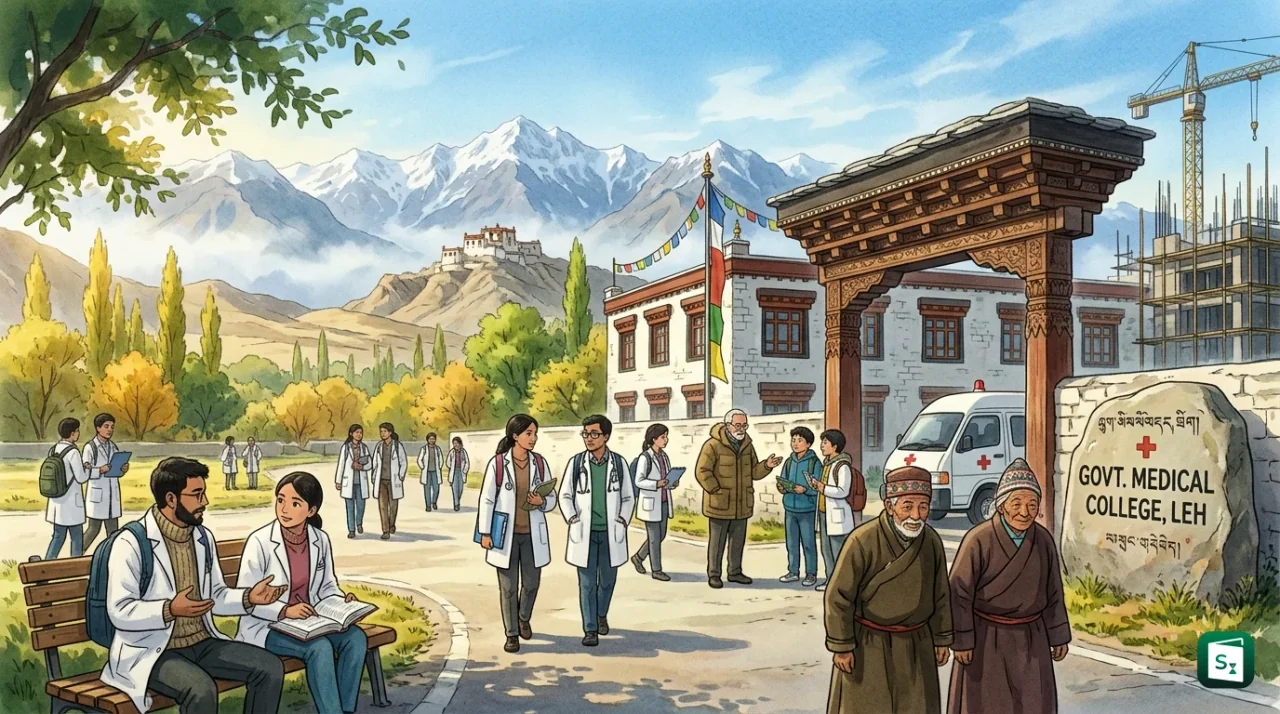
The Ministry of Health and Family Welfare has approved the operationalisation of the first Government Medical College in Ladakh at Stipuk Pharka in Leh from the academic year 2027-28. The approval, conveyed on 13 October 2026, includes a one-time relaxation that lets Ladakh start phased recruitment for 103 sanctioned posts before major construction is complete. The decision ends Ladakh’s long wait for medical education within the territory and brings MBBS training closer to home for Ladakhi students.
What Is the First Government Medical College in Ladakh?
The Government Medical College Ladakh is the first government medical college of the Union Territory, located at Stipuk Pharka in Leh. The Ministry of Health and Family Welfare approved its operationalisation from 2027-28. The college will admit MBBS students and use SNM Hospital for initial clinical training.
GMC is short for Government Medical College, the public institution that offers the MBBS course, which stands for Bachelor of Medicine and Bachelor of Surgery. Admission to this course across India takes place through NEET, which stands for National Eligibility cum Entrance Test. The National Medical Commission (NMC), set up under the NMC Act, 2019, regulates medical education and grants permission for new colleges and seats.
The Health Ministry conveyed its approval in a letter dated 13 October 2026 to the Commissioner-cum-Secretary of the Health and Medical Education Department of Ladakh. The letter permits staggered recruitment for 103 sanctioned regular posts covering faculty and support staff. These posts were sanctioned through a Department of Expenditure note dated 27 November 2024. Recruitment will follow academic needs from 2027-28 onwards, as identified by the Ladakh administration in its communication dated 5 August 2026.
The approval followed the intervention of Ladakh Lieutenant Governor Vinai Kumar Saxena. In a letter dated 13 July 2026 to Union Health Minister J P Nadda (as of October 2026), the Lieutenant Governor sought a one-time relaxation from the rule that bars recruitment before 80 percent of the infrastructure is complete. The Ministry accepted the request after examination by the Department of Expenditure and issued the order with the approval of the competent authority through Under Secretary Anurag Tiwari.
| Approval Element | Detail |
|---|---|
| Institution | Government Medical College Ladakh at Stipuk Pharka, Leh |
| Approving authority | Ministry of Health and Family Welfare |
| Approval letter date | 13 October 2026 |
| Start of operations | Academic year 2027-28 |
| Posts cleared | 103 sanctioned regular posts |
| Mode of hiring | Phased recruitment on regular basis as per recruitment rules |
Is Ladakh a State or Union Territory and Where Is It Located?
Ladakh is a Union Territory without a legislature in northernmost India between the Karakoram and Himalayan ranges. The Ministry of Home Affairs administers Ladakh through the Lieutenant Governor. Leh and Kargil serve as capitals. Ladakh has seven districts after five new districts were notified in April 2026.
Ladakh became a separate Union Territory on 31 October 2019 under the Jammu and Kashmir Reorganisation Act, 2019. Parliament passed the Act in August 2019 after the provisions of Article 370 of the Constitution were changed. Before this change, Ladakh was part of the former state of Jammu and Kashmir as two districts, Leh and Kargil. Ladakh was created as a territory without a legislature, while Jammu and Kashmir was created as a territory with a legislature.
Ladakh lies on a high plateau with an average height above 3,000 metres. It shares borders with China in the east and north and Pakistan in the west. The region sits in the rain shadow of the Himalaya, so it receives very little rainfall. This dry and cold climate gives Ladakh the name of a cold desert. The Indus River, the Nubra Valley and Pangong Tso lake form the most well known geographic features of the region.
In April 2026 the Ladakh administration notified five new districts. This raised the district count from two to seven. Stronger local administration matters for health planning because staff, hospitals and medical seats are distributed district wise.
| District | Headquarters | Carved From |
|---|---|---|
| Leh | Leh | Leh |
| Kargil | Kargil | Kargil |
| Nubra | Diskit | Leh |
| Sham | Khaltse | Leh |
| Changthang | Nyoma | Leh |
| Zanskar | Padum | Kargil |
| Drass | Drass | Kargil |
Local groups continue to seek constitutional safeguards for land, jobs and culture. A central demand is inclusion under the Sixth Schedule of the Constitution, which provides autonomous councils for tribal areas. More than 90 percent of the population in Leh and Kargil belongs to Scheduled Tribes. The National Commission for Scheduled Tribes had recommended Sixth Schedule status for Ladakh in 2019.
How Will GMC Leh Function Before the Permanent Campus Is Ready?
The Government Medical College Ladakh will start in interim facilities and shift to its permanent campus at Stipuk Pharka once construction is complete. The Ladakh administration has identified two newly built structures to serve as the Academic Block and the Students Hostel. This arrangement lets teaching begin in 2027-28 while civil work continues.
Clinical training for the first batch of MBBS students will take place at the Sonam Norbu Memorial (SNM) Hospital in Leh. SNM Hospital is the district hospital of Leh with 200 beds and around 60 experienced doctors. The hospital handles about 1,400 outpatient visits daily and runs emergency services round the clock. Its existing departments give students direct exposure to medicine, surgery, pediatrics and community health from the first year.
SNM Hospital is named after Sonam Norboo, an engineer and administrator remembered as an architect of modern Ladakh. A small primary health centre in Leh was converted into a centrally heated 150 bed hospital in July 1976. The first 50 bed phase opened in December 1980. The hospital has grown since then and has a plan for expansion to 350 beds. Its high altitude services include oxygen supply systems and a hyperbaric chamber, which treats altitude sickness during the tourist season.
The Health Ministry has placed clear terms on this interim model. All interim use must remain temporary. The Ladakh administration must fix reasonable timelines for readiness of the Stipuk Pharka campus and inform the Department of Expenditure when the shift takes place. Permanent facilities must take over all teaching and hostel functions once ready.
| Function | Interim Arrangement | Permanent Plan |
|---|---|---|
| Classroom teaching | New Academic Block building in Leh | Dedicated campus at Stipuk Pharka |
| Student stay | New Hostel building in Leh | Hostel complex at Stipuk Pharka |
| Clinical training | 200 bed SNM Hospital with 60 doctors | Attached teaching hospital at Stipuk Pharka |
Why Does Ladakh Need Its Own Medical College?
Ladakh faces difficult terrain, long winters and thin air at high altitude. Low oxygen levels cause acute mountain sickness, breathing distress and heart strain among residents and visitors. Road links to Srinagar and Manali close for months in winter. Patients who need specialist care must often be flown to Delhi or Chandigarh. A local college that trains doctors in this setting builds a workforce that understands high altitude illness and stays back to serve.
Ladakh has so far had no medical college of its own. Students from the territory depended on seats allotted in colleges outside the region. For the academic year 2026-27, Ladakh received only seven MBBS seats under the Central Pool. The Central Pool is a quota kept by the central government in select colleges for states and territories without enough seats. Seven seats cannot meet the demand from hundreds of NEET qualified students in Ladakh each year.
The project has moved slowly. The college plan dates back to 2019. In March 2023 a parliamentary standing committee noted that no substantial progress had taken place on infrastructure and that the detailed project report was still under examination. The committee asked the administration to remove administrative barriers, speed up construction and start teaching at an existing hospital instead of waiting for a new campus. The present plan to use SNM Hospital for clinical training follows that advice.
A government college in Leh also strengthens public health for the long term. Local graduates are more likely to join district hospitals, community health centres and primary health centres across the seven districts. The territory runs about 340 public health facilities, including district hospitals, community health centres, primary health centres and 269 sub centres. A steady supply of trained doctors will reduce vacancies in remote blocks such as Nubra, Changthang, Zanskar and Drass.
Medical Colleges in India in 2026: The National Expansion Context
The approval for Ladakh forms part of a rapid national rise in medical colleges and MBBS seats. The National Medical Commission revised the seat matrix for 2026-27 to 1,40,664 MBBS seats across 839 medical colleges. This count excludes Institutes of National Importance such as AIIMS. Government colleges account for 447 colleges and 64,121 seats, while private colleges account for 392 colleges and 76,543 seats.
The 2026-27 matrix includes 3,850 seats from 41 newly established colleges. Thirteen of these new colleges are government colleges with 850 seats. The government has stated that the number of medical colleges rose from 387 before 2014 to 846 at present, while MBBS seats rose from 51,348 to 1,39,864 in the same period. A central scheme to link new medical colleges with district referral hospitals has cleared 157 such colleges to correct regional gaps.
Ladakh represents the last mile of this expansion. Most new colleges have come up in larger states such as Karnataka, Tamil Nadu, Rajasthan and Uttar Pradesh. High altitude territories with small populations need a different model with interim hospitals and phased hiring. The one-time relaxation for GMC Ladakh shows how the Health Ministry is adjusting national norms for remote regions so that faculty can join while construction continues.
Key Takeaways
- The first Government Medical College in Ladakh at Stipuk Pharka in Leh will start operations from the academic year 2027-28.
- The Health Ministry letter dated 13 October 2026 allows phased recruitment for 103 sanctioned regular posts before 80 percent infrastructure completion.
- Initial clinical training will take place at the 200 bed Sonam Norbu Memorial Hospital in Leh, supported by about 60 doctors.
- Ladakh became a Union Territory without a legislature on 31 October 2019 and now has seven districts after five new districts were notified in April 2026.
- India has 1,40,664 MBBS seats across 839 medical colleges in 2026-27, including 3,850 seats from 41 new colleges.