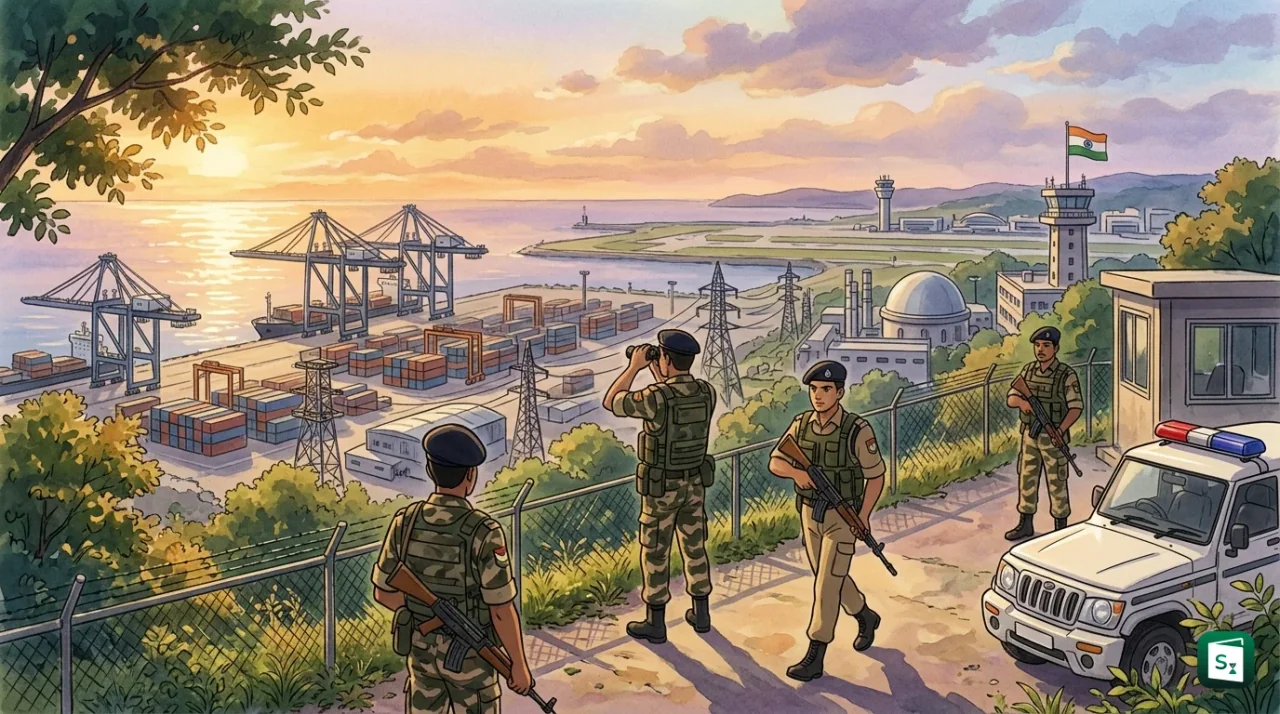
The Central Industrial Security Force (CISF) will shift from territorial control to sector specific functional commands from 1 November 2026. The Ministry of Home Affairs has approved the reorganisation of 8 of the 11 CISF sectors to strengthen security at power plants, coal fields, steel units, oil installations, ports and government buildings. Units from the same industry will now report to the same command, wherever they are located in India.
What Is CISF?
The Central Industrial Security Force (CISF) is a central armed police force under the Ministry of Home Affairs that guards critical public and private installations across India. The full form of CISF is Central Industrial Security Force. It protects airports, power plants, ports, metro systems and strategic establishments.
The CISF was set up under the Central Industrial Security Force Act, 1968. The Act came into force on 10 March 1969 with a strength of about 3,000 personnel. A fire at the Heavy Engineering Corporation plant at Ranchi in 1964 and the recommendation of the Justice Mukherjee Commission formed the background for a dedicated industrial protection force. The first CISF unit was inducted at the Fertilizer Corporation of India plant at Trombay in Maharashtra on 1 November 1969. Parliament made the CISF an armed force of the Union through an amendment on 15 June 1983.
The motto of the CISF is Protection and Security, written in Hindi as Sanrakshan evam Suraksha. The headquarters of the CISF is at Block 13, CGO Complex, Lodhi Road, New Delhi. The force is headed by a Director General, who is an Indian Police Service officer. Praveer Ranjan, an IPS officer of the 1993 AGMUT cadre, took charge as Director General on 30 September 2025 (as of October 2026).
The CISF is a compensatory cost force. This means the establishments it guards pay for its deployment. Its sanctioned strength stood at about 1.88 lakh personnel as on 1 April 2025. The CISF now guards 361 installations, including 70 airports, apart from space and atomic energy units, seaports, steel plants, refineries, mints, heritage monuments and the Delhi Metro. It is the only central armed police force with a full fledged Fire Wing, which covers more than 100 units. After an amendment to the CISF Act in 2009, the CISF can also guard private sector units of national importance.
Which Ministry Controls CISF and Is It Part of the Army?
The CISF functions under the Ministry of Home Affairs and it is not part of the Indian Army. It is a Central Armed Police Force that performs internal security and guarding duties. The CISF works under civil command for policing and protection roles, not for warfare.
The terms paramilitary and Central Armed Police Force often create confusion. The CISF, the Central Reserve Police Force (CRPF), the Border Security Force (BSF), the Indo Tibetan Border Police (ITBP) and the Sashastra Seema Bal (SSB) are Central Armed Police Forces under the Home Ministry. They are distinct from the Army, which functions under the Ministry of Defence and handles external threats. The Home Minister is Amit Shah (as of October 2026).
The job of CISF personnel is static guarding and access control. The CISF secures campuses, controls entry gates, screens baggage, handles fire safety, responds to sabotage threats and manages disaster rescue at the units it guards. CRPF personnel, by contrast, are largely deployed for law and order duties, counter insurgency operations and election security. A comparison helps clarify the roles.
| Feature | CISF | CRPF |
|---|---|---|
| Full form | Central Industrial Security Force | Central Reserve Police Force |
| Parent ministry | Ministry of Home Affairs | Ministry of Home Affairs |
| Primary role | Guarding airports, industries, ports, metro and government buildings | Crowd control, internal security, anti insurgency and election duties |
| Deployment style | Fixed posting at 361 installations | Mobile battalions moved as per need |
| Fire Wing | Has dedicated Fire Wing | No separate Fire Wing |
The official portal for recruitment, results and notices is cisf.gov.in. The recruitment portal cisfrectt.cisf.gov.in handles constable, head constable and Assistant Sub Inspector level intake. Pay and rank follow central government norms, with posts ranging from constable and head constable to Assistant Sub Inspector, Sub Inspector, Assistant Commandant and higher officer ranks led by the Director General.
How Eight Sectors Will Be Reorganised
The CISF Headquarters prepared the plan and the Ministry of Home Affairs gave concurrence. The revised structure was cleared under Director General Praveer Ranjan and will take effect on 1 November 2026. Eight territorial sectors will become functional commands. Three specialised sectors will continue as before.
Under territorial supervision, one regional headquarters controlled all types of units located in its zone. A single office could handle a power plant, a government building and a coal mine together. Under functional supervision, all units of the same industry will report to one sector command across India. A coal mine in Chhattisgarh and a coal mine in Jharkhand will follow the same chain, training module and standard procedure.
The complete change is summarised below.
| Old Territorial Sector With Headquarters | New Functional Sector With Headquarters | Core Units Covered |
|---|---|---|
| National Capital Region Sector, New Delhi | Government Buildings, Museums and Monuments and Mass Rapid Transit System Sector (GBMM and MRTS), New Delhi | Government buildings, museums, monuments and Delhi Metro |
| North Sector, New Delhi | Power-I Sector, New Delhi | Thermal, hydro and power transmission units in northern region |
| North Eastern Sector-II, Kolkata | Power-II Sector, Kolkata | Power units in eastern and north eastern region |
| Eastern Sector, Ranchi | Coal Sector, Ranchi | Coal fields and coal handling plants |
| Central Sector, Bhilai | Steel Sector, Bhilai | Steel plants and associated units |
| North Eastern Sector, Guwahati | Petroleum and Natural Gas Sector, Guwahati | Refineries, oil fields and gas installations |
| Western Sector, Mumbai | West Coast Port Sector, Mumbai | Seaports on the western coast |
| Southern Sector, Chennai | East Coast Port Sector, Chennai | Seaports on the eastern coast |
Three functional arrangements will continue without change. These are the Department of Atomic Energy and Department of Space Sector at Bengaluru, Airport Sector-I at New Delhi and Airport Sector-II at Bengaluru. The CISF adopted functional control for aviation and for atomic energy and space units over the past 25 years. The force found that specialised supervision improved training, helped frame sector specific standard operating procedures and allowed better use of technical staff. The present reform extends that experience to energy, industry and ports.
Why Ports Get Two Dedicated Coastal Commands
India has around 250 large and small seaports. The CISF at present guards 13 major ports, including Jawaharlal Nehru Port in Maharashtra and Mundra Port in Gujarat. Out of the total ports, about 77 handle export import cargo. These are called EXIM ports and include 12 major ports and around 65 non major ports. Security standards at many non major ports were not uniform. The government wanted one professional agency to set common rules.
The CISF was designated as a Recognised Security Organisation (RSO) for port facilities under the International Ship and Port Facility Security (ISPS) Code. The ISPS Code is an international framework for detecting threats to ships and ports engaged in global trade. It was adopted by the International Maritime Organization (IMO) in December 2002 and entered into force on 1 July 2004. It forms part of Chapter XI-2 of the International Convention for the Safety of Life at Sea (SOLAS). In India, the Directorate General of Shipping is the designated authority for implementing the Code.
As RSO, the CISF will prepare security assessments and standard security plans for ports, conduct audits and train stakeholders. Core tasks such as access control, CCTV watch, perimeter security, seafront patrolling and quick reaction cover will remain with trained CISF teams. Non core tasks such as traffic handling may be done by state police or licensed private agencies, but those personnel will be trained and certified by the CISF. A hybrid model of CISF plus state or private staff is therefore planned for many ports.
The new West Coast Port Sector at Mumbai and East Coast Port Sector at Chennai will anchor this work. Each coastal command will develop port specific expertise, keep common procedures for both coasts and coordinate daily with port authorities, customs and shipping lines. The reform also links with the proposed Bureau of Port Security under Section 13 of the Merchant Shipping Act, 2025. The Bureau will function under the Ministry of Ports, Shipping and Waterways on the lines of the Bureau of Civil Aviation Security. It will oversee regulation while the CISF acts as the field security expert.
Why the Functional Model Matters for Critical Infrastructure
Different industries face different risks. A power transmission station needs protection against grid sabotage. A refinery needs fire control and hazardous chemical drills. A museum needs crowd and artefact safety. A port needs seafront watch and container screening. A coal field needs vast open area patrolling. One territorial officer cannot master all these threats together. A sector command can.
The CISF says the new system will improve operational oversight and build sector specific skills. Officers posted to the Coal Sector will learn mining hazards in depth. Officers in the Power Sectors will understand plant shutdown procedures. Training schools can run focused courses. Equipment can be standardised. The force can also speak to one nodal ministry for each sector, such as the power, coal, steel, petroleum and ports ministries, instead of routing files through several regional offices. This shortens response time during strikes, accidents or intelligence alerts.
The change comes as the mandate of the CISF is widening beyond factories. The CISF took over full security of Parliament House after the 13 December 2023 breach in the Lok Sabha chamber. It guards the Delhi Metro network across Delhi, Haryana and Uttar Pradesh with 100 percent frisking and baggage checks. It has been given security duties at high security correctional facilities in Jammu and Kashmir. It has been named the nodal agency for aerial security of critical infrastructure, which includes counter drone tasks.
To meet these threats, the CISF has set up a drone and anti drone training centre at Behror in Rajasthan. The Home Ministry has approved a Remote Pilot Training Organisation for drone operation. Under its modernisation plan for 2026 to 2030, the CISF has listed 76 items worth ₹819 crore, including drone solutions, an integrated cyber security lab, a dedicated data centre and a zero trust network. Cyber commandos are being trained with premier institutions to protect control systems of power and oil units from hacking and hostile unmanned systems.
Key Takeaways
- The Ministry of Home Affairs approved the CISF restructuring effective 1 November 2026, converting 8 of 11 sectors into functional commands.
- The NCR Sector becomes the GBMM and MRTS Sector at New Delhi, while the North Sector and North Eastern Sector-II become Power-I at New Delhi and Power-II at Kolkata.
- The Eastern Sector at Ranchi becomes the Coal Sector, the Central Sector at Bhilai becomes the Steel Sector and the North Eastern Sector at Guwahati becomes the Petroleum and Natural Gas Sector.
- The Western Sector at Mumbai and the Southern Sector at Chennai become the West Coast Port Sector and the East Coast Port Sector to guard ports.
- The CISF was set up under the CISF Act, 1968 on 10 March 1969, is headquartered at CGO Complex, Lodhi Road, New Delhi, and follows the motto Protection and Security.
- The CISF is the Recognised Security Organisation under the ISPS Code, adopted by the IMO in 2002 and in force from 1 July 2004 under the SOLAS Convention.