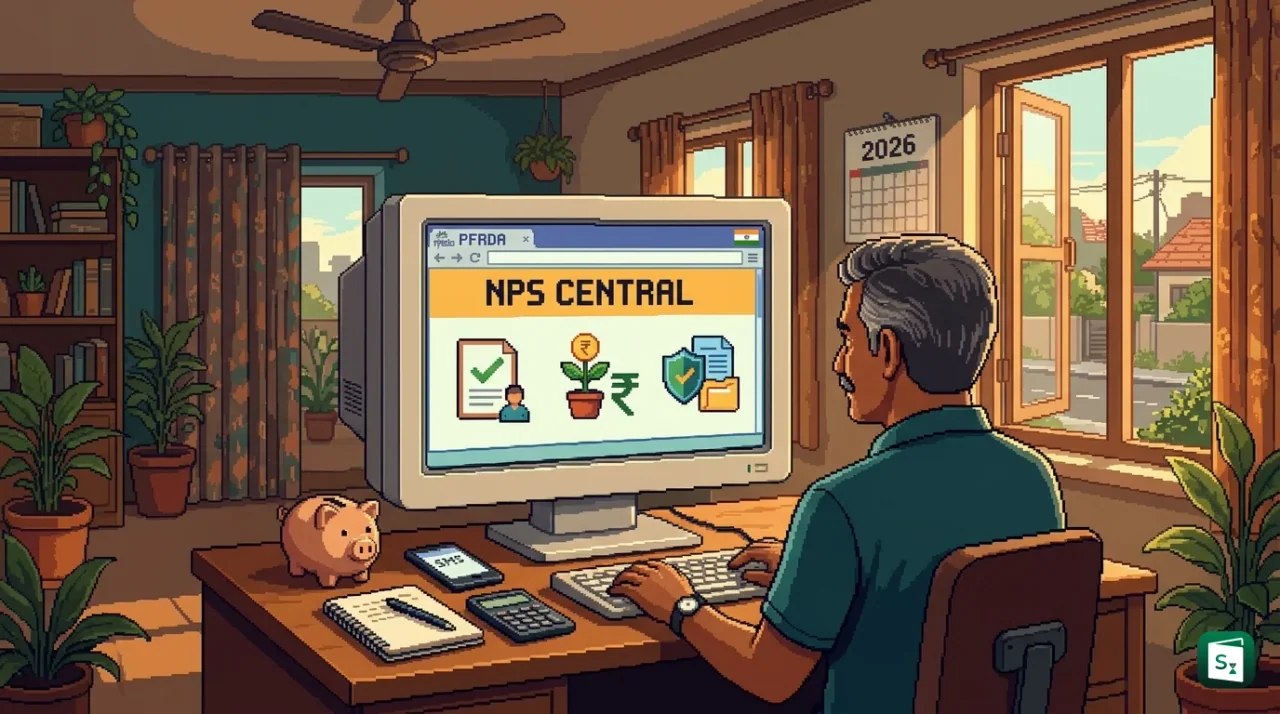
The Pension Fund Regulatory and Development Authority (PFRDA) launched NPS Central on 1 October 2026, on the occasion of NPS Diwas, to let National Pension System subscribers enrol, invest and manage accounts through one interface. The platform, available at www.npscentral.in, brings the three Central Recordkeeping Agencies onto a single dashboard. It removes the need to visit separate CRA portals for everyday pension tasks.
What Is NPS Central?
NPS Central is a unified digital platform launched by the Pension Fund Regulatory and Development Authority to provide single-window access to all National Pension System services. The platform integrates the three Central Recordkeeping Agencies, Pension Funds and Points of Presence into one common interface at www.npscentral.in.
The platform was launched on 1 October 2026 on NPS Diwas, and its rollout was announced by PFRDA on 19 October 2026. PFRDA developed the concept, while the three Central Recordkeeping Agencies jointly built and now manage the portal. These agencies are Protean eGov Technologies (earlier NSDL e-Governance), KFin Technologies Ltd and Computer Age Management Services Ltd (CAMS).
Before this launch, a subscriber serviced by one CRA had to use that CRA portal for statements, contributions and service requests. A subscriber with accounts across different CRAs had to use multiple logins. NPS Central replaces that fragmented setup with a consolidated dashboard that shows holdings across all three CRAs in one view.
The portal will also connect with other parts of the NPS ecosystem through application programming interfaces. This means banks, Points of Presence and other digital touchpoints can offer the same unified NPS services through their own websites and apps, instead of redirecting users to separate systems.
How to Log in and Use NPS Central?
NPS login on NPS Central does not require the subscriber to remember the Permanent Retirement Account Number (PRAN). Existing subscribers can log in with their registered mobile number and date of birth, verified through a one-time password (OTP). PRAN is the unique 12-digit number issued to every NPS subscriber and maintained in the CRA database.
Once logged in, the subscriber gets a single dashboard to view NPS accounts and investment portfolios held across Protean, KFin and CAMS. The dashboard supports contributions to existing schemes, tracking of contribution status across payment modes, and download of the Statement of Transaction and holdings. Subscribers can review scheme features, past returns and charges before choosing a new investment option.
Profile maintenance is also centralised. Subscribers can update personal details such as mobile number, email and address, and they can raise or track grievances through the Pension Sahayak portal linked on NPS Central. These functions earlier required separate visits to individual CRA websites, call centres or physical service points.
For first-time users, NPS Central offers AI-assisted onboarding with zero onboarding charge, subject to applicable terms. Identity verification can be completed through Central KYC (CKYC) or DigiLocker, and an AI-enabled assistant answers queries during the process. The applicant can compare pension funds, check performance, select a Pension Fund, and on successful registration receives an electronic PRAN, called e-PRAN, with immediate access to basic account services.
What Is the National Pension System?
The National Pension System (NPS) is a market-linked, defined contribution retirement savings scheme regulated by PFRDA. Subscribers contribute regularly during their working life, the money is invested in market instruments by registered Pension Funds, and the accumulated corpus provides pension income after the age of 60.
The scheme began on 1 January 2004 for new central government recruits (except the armed forces), replacing the earlier defined benefit pension. PFRDA extended NPS to all citizens on a voluntary basis on 1 May 2009. Any Indian citizen aged 18 to 70 years can join, including Non-Resident Indians and Overseas Citizens of India for Tier 1, though Tier 2 has separate eligibility conditions.
On joining, the Central Recordkeeping Agency generates a PRAN for the subscriber and maintains all records of contributions, investments, switches and withdrawals. NPS is portable across jobs and locations, which means a change of employer or city does not require a new account. Ten Pension Funds currently manage investments under PFRDA investment guidelines, while Axis Bank acts as Trustee Bank and Deutsche Bank acts as custodian of securities.
At exit on superannuation, at least 40% of the corpus must be used to buy an annuity, which is a regular monthly pension paid by an insurance company called an Annuity Service Provider. The remaining amount up to 60% can be taken as a lump sum. If the total corpus is less than ₹5 lakh at normal exit, the entire amount can be paid as a lump sum without mandatory annuitisation.
Tier 1 and Tier 2 Accounts at a Glance
NPS offers two accounts with different rules on withdrawal and tax. Tier 1 is the core pension account, while Tier 2 is an optional savings account linked to an active Tier 1.
| Feature | Tier 1 Account | Tier 2 Account |
|---|---|---|
| Nature | Individual pension account, default account | Optional investment account, needs active Tier 1 |
| Minimum to open | ₹500 | ₹1,000 |
| Minimum yearly contribution | ₹1,000 | ₹250 |
| Withdrawal | Restricted, only as per PFRDA exit and withdrawal rules | Free withdrawal at any time |
| Tax benefit on contribution | Available under Section 80CCD | Not available |
| Eligibility | Citizens aged 18 to 70, including NRIs and OCIs | Only resident subscribers with active Tier 1 |
Partial withdrawal from Tier 1 is allowed after three years for specific needs such as illness, disability, education or marriage of children, purchase of house, or starting a venture. A subscriber can take up to 25% of own contributions and can do so a maximum of three times in the full tenure. Tier 2 has no such limit and also permits a one-way switch of funds from Tier 2 to Tier 1.
Who Runs the NPS Architecture?
What is PFRDA? The Pension Fund Regulatory and Development Authority (PFRDA) is the statutory regulator for the pension sector in India. PFRDA regulates the National Pension System, the Atal Pension Yojana and the Unified Pension Scheme option, and it protects subscriber interests while promoting old-age income security.
PFRDA was first set up as an interim body on 23 August 2003. It became a statutory authority under the PFRDA Act, 2013, which was passed on 19 September 2013 and brought into force on 1 February 2014. The head office of PFRDA is at Nauroji Nagar in New Delhi, and it functions under the Department of Financial Services in the Ministry of Finance. The Chairperson of PFRDA is Sivasubramanian Ramann (as of October 2026), and the Authority consists of a Chairperson, three whole-time members and three part-time members.
NPS works on an unbundled model in which each task is handled by a separate intermediary to keep costs low and avoid single-point failure. The Central Recordkeeping Agency keeps records, issues PRAN and provides customer service. The Pension Fund invests the contributions. The Point of Presence, which includes banks and financial institutions, distributes NPS and collects forms and contributions. The NPS Trust, constituted by PFRDA, holds subscriber assets and oversees operations, while the Trustee Bank handles fund collection and reconciliation.
| Intermediary | Core Role |
|---|---|
| Central Recordkeeping Agencies (CRAs) | Recordkeeping, PRAN issuance, statements, customer service |
| Pension Funds | Investment of contributions as per PFRDA guidelines |
| Points of Presence (PoPs) | Registration, contribution collection and subscriber servicing |
| NPS Trust | Safeguarding of pension assets on behalf of subscribers |
| Trustee Bank and Custodian | Banking, fund flow management and securities custody |
| Annuity Service Providers | Payment of monthly pension through annuity plans |
The three CRAs now joined on NPS Central each bring large-scale registry experience. Protean eGov Technologies (formerly NSDL e-Governance) was the first CRA for NPS. KFin Technologies, operational as a CRA since 2017, services more than 100 million investor accounts across mutual funds and corporate registries. CAMS, granted a CRA certificate in March 2021, is the largest registrar for mutual funds and operates service centres across 271 locations.
What Services Are Available Now and What Is Planned Next?
NPS Central already allows subscribers to contribute to existing schemes and explore new schemes. The current live services include comparison of scheme features, returns and charges, profile updates, download of account statements, and tracking of contributions made through different modes. Grievance filing through the Pension Sahayak link is also live.
New subscribers can complete full digital enrollment, compare Pension Funds and receive e-PRAN. The portal also facilitates registration for NPS Swasthya, which combines a dedicated investment corpus with a super top-up health insurance arrangement. Under NPS Swasthya, the minimum initial contribution includes at least ₹1,000 to the investment account plus the first-year insurance premium, and subscribers can withdraw up to 25% of own contributions for eligible medical costs.
PFRDA has said the platform will grow in phases. The next set of services will include change of investment choice and Pension Fund, loan against NPS, systematic investment plan mandates, onboarding and maintenance of NPS Vatsalya accounts for minors, corporate onboarding, re-KYC, and services for Tier 2 accounts. API specifications for integration with ecosystem partners are being published on the NPS Central website, so that banks and Points of Presence can embed these services in their own channels.
How Is NPS Taxed and How Does It Compare With UPS?
Is NPS tax free? NPS contributions get tax deduction, growth remains tax deferred, and much of the maturity amount is tax exempt. Under Section 80CCD(1), an employee can claim deduction up to 10% of salary within the ₹1.5 lakh limit under Section 80CCE. An extra deduction up to ₹50,000 is available under Section 80CCD(1B) for Tier 1 self-contribution.
Employer contribution gets a separate deduction under Section 80CCD(2). For central government employees, this covers up to 14% of basic pay plus dearness allowance. The same employer deduction is also available under the new tax regime, while the employee deductions under 80CCD(1) and 80CCD(1B) apply mainly under the old regime. On exit, up to 60% of the corpus taken as lump sum is exempt under Section 10(12A), and the amount used to buy annuity is exempt at that stage under Section 10(12B). Pension received monthly from the annuity is taxed as salary income in the year of receipt.
NPS pension itself is market linked, so the final monthly amount depends on contributions, fund returns and the annuity rate at retirement. The NPS calculator hosted on CRA and PFRDA websites helps estimate this by using contribution amount, expected return, age and annuity share. NPS does not declare a fixed interest rate like a small savings scheme, because returns follow equity, corporate debt and government securities markets.
The Unified Pension Scheme (UPS), operational from 1 April 2025, is an option under NPS for central government employees seeking assured payouts. UPS promises 50% of average basic pay of the last 12 months as monthly pension after 25 years of qualifying service, and a minimum ₹10,000 per month after 10 years of service. Both employee and government contribute 10% of basic pay plus dearness allowance to the individual corpus, while the government adds 8.5% to a pooled corpus for the guarantee. Tax benefits available to NPS under Section 80CCD and Section 10 now apply to UPS on a mutatis mutandis basis.
What Are NPS Swasthya and NPS Vatsalya?
NPS Swasthya links retirement saving with health cover. It pairs an NPS investment account with a super top-up health insurance policy managed through a Health Benefit Administrator. NPS Central provides a direct registration path for this product, which extends the pension platform into healthcare support for subscribers and their families.
NPS Vatsalya is the NPS variant for minors, launched in 2024 to allow parents and guardians to start pension saving for children. The account is opened in the name of the minor and converts into a regular NPS account when the child becomes a major. NPS Central is expected to add onboarding and maintenance services for NPS Vatsalya accounts in its next phase, along with an NPS Vatsalya calculator to project long-term growth for small early contributions.
Key Takeaways
- NPS Central was launched on 1 October 2026 on NPS Diwas and is accessible at www.npscentral.in.
- The portal is jointly built and managed by three CRAs: Protean eGov Technologies, KFin Technologies Ltd and CAMS.
- Existing users can log in with registered mobile number and date of birth with OTP, without remembering PRAN.
- PFRDA became a statutory regulator under the PFRDA Act, 2013 and is headquartered in New Delhi.
- NPS started on 1 January 2004 for central government staff and opened to all citizens on 1 May 2009.
- At normal exit, a minimum of 40% of the corpus must buy an annuity, while up to 60% can be taken as tax-exempt lump sum.