Eminent painter and former Rajya Sabha member Jogen Chowdhury died in Kolkata on the morning of 25 October 2026 at the age of 87. Doctors at Ruby General Hospital said he had battled a rare blood cancer for over a year and was placed on ventilator support a day before his death. Widely known as Jogendranath Chowdhury in official records, he was both a defining figure of contemporary Indian art and a Trinamool Congress parliamentarian from West Bengal.
When and How Did Jogen Chowdhury Die?
Jogen Chowdhury died at 10.15 am on 25 October 2026 at Ruby General Hospital on the E.M. Bypass in Kolkata. He was 87 and had suffered from myeloproliferative neoplasm, a rare blood cancer, for about 14 months while receiving chemotherapy for the disease.
The hospital said Chowdhury was admitted on 16 October 2026 in critical condition with a urinary tract infection. His condition worsened due to sepsis, which is a severe reaction of the body to infection, along with other age related ailments. Doctors placed him on ventilator support on 24 October with the consent of his family. He did not recover.
His death led to tributes from public leaders in West Bengal. Chief Minister Suvendu Adhikari (as of October 2026) said his work had brought international honour to Bengal and his passing left an irreparable void in the intellectual and artistic life of the state. Former Chief Minister Mamata Banerjee, who had brought him into parliamentary life, described him as a pride of Bengal and India and an inspiration for artists.
Who Was Jogen Chowdhury?
Jogen Chowdhury was a contemporary Indian painter famous for his ink, watercolour and pastel drawings of the human figure. He was also a teacher, curator, institution builder and a former Rajya Sabha member from West Bengal representing the All India Trinamool Congress (AITC) from 2014 to 2020.
Born in undivided Bengal and trained in Kolkata and Paris, he lived and worked mainly between Kolkata and Santiniketan. Over a career of more than six decades, he shaped modern Indian art through his teaching at Kala Bhavana, his long tenure at Rashtrapati Bhavan and his distinctive line based style. The table below traces the key milestones of his life.
| Year | Milestone |
|---|---|
| 1939 | Born in Daharpara, Faridpur, now in Bangladesh |
| 1955 to 1960 | Studied painting at Government College of Art and Craft, Kolkata |
| 1965 to 1967 | Studied in Paris on French government scholarship |
| 1972 to 1987 | Served as Keeper of Art at Rashtrapati Bhavan, New Delhi |
| 1987 onwards | Joined Kala Bhavana, Visva-Bharati, Santiniketan as professor |
| 2014 to 2020 | Served as Rajya Sabha member from West Bengal |
| 2026 | Died in Kolkata at age 87 |
Early Life, Partition and Education in Kolkata and Paris
Jogen Chowdhury was born on 15 February 1939 in Daharpara village in Faridpur district. The area was then part of undivided Bengal under British rule and is now in Bangladesh. Some official records mention 16 February or 19 February 1939, but February 1939 in Faridpur is common to all accounts.
His father, Pramathanath Chowdhury, was a landlord who painted scenes from Hindu mythology and sculpted deities. His mother practised alpona, the traditional Bengali art of painting decorative patterns on floors and walls with rice paste during festivals and rituals. The young Jogen first carved figures and drew on walls at home.
Partition changed his life. Just before 1947, he moved with his father to Calcutta, now Kolkata. The rest of the family joined them in 1948. They first stayed in a relative quarter and later in Saheednagar Colony in Dhakuria. Memories of village creepers, tendrils, migration and refugee life stayed with him. They later appeared in his art as longing, loss and resilience.
In 1955, at age 16, he joined the Government College of Art and Craft in Kolkata and graduated in 1960 with a focus on painting. He learned from the legacy of Bengal School masters such as Abanindranath Tagore, Nandalal Bose, Benode Behari Mukherjee, Ramkinkar Baij and Jamini Roy. After graduation, he taught at Howrah Zilla School and then worked as a textile designer for the Handloom Board.
In 1965, he received a French government scholarship and moved to Paris. There he studied fresco and mosaic at the Ecole Nationale Superieure des Beaux-Arts, the National School of Fine Arts of France, and learned printmaking at Atelier 17, the famous print workshop run by William Hayter. Visits to museums, churches and galleries exposed him to European modernism. He won the Prix de la Jeune Peinture, the Young Painting Prize, in Paris in 1966. He also spent five months in London before returning to India in early 1968.
Distinctive Art Style and Major Themes
Jogen Chowdhury developed his individual style after returning from Paris. He did not copy Western methods. He did not repeat old Indian traditions either. He built a language rooted in personal experience and the present.
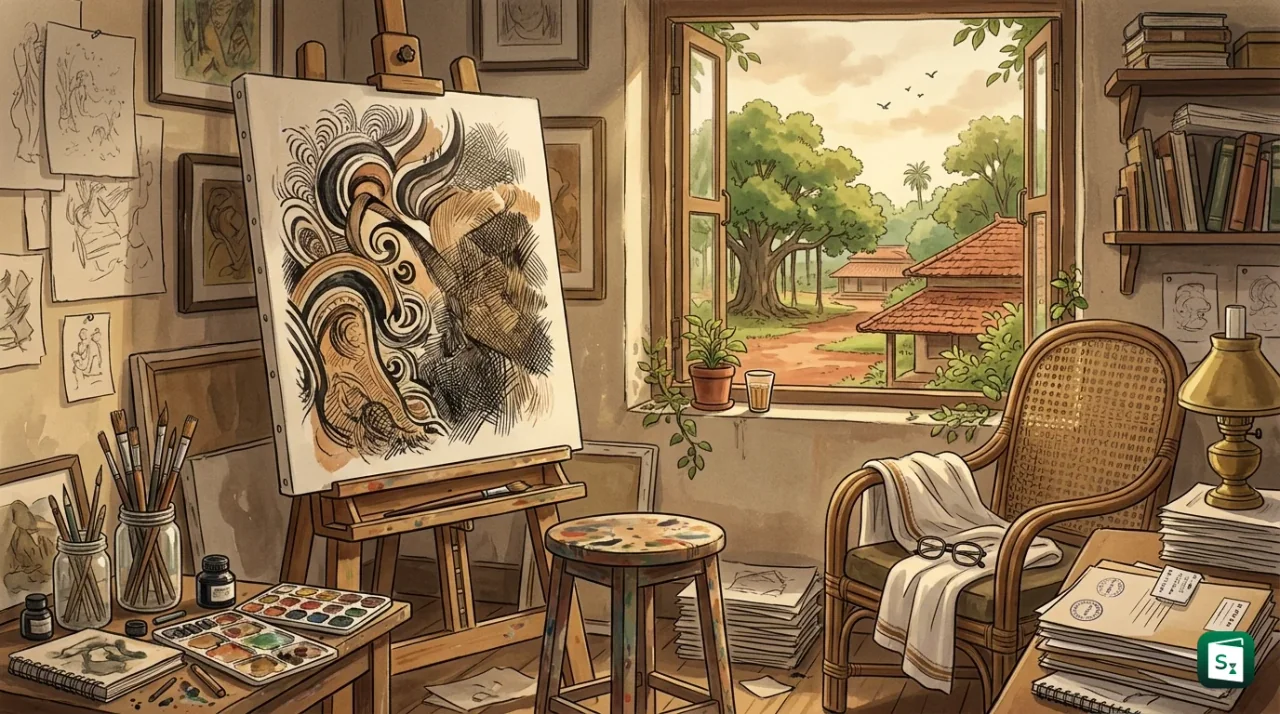
His best known tools were simple. Black ink, watercolour and pastel on paper. His mark was a flowing, unbroken line with fine cross hatching, which means closely drawn crisscross lines that create shade and volume. He often placed a single figure against an empty background.
His figures are easy to recognise. They are elongated, heavy, flaccid and sometimes contorted. Eyes, hands and limbs are slightly distorted. Critics read this distortion as a comment on social decay, inequality, violence and political satire. Yet his work also carries warmth, sensuality and hope. In his own words, he wanted his paintings to be like sunlight in darkness.
Human beings remained his central subject. Men, women, gods, lovers, common people and political figures all appear in his drawings. Early ink series such as Reminiscences of a Dream recalled his childhood in East Bengal with plants, animals and dream like forms. Later works such as Noti Binodini, Sundari, Life 1, Life 2, Tiger in the Moonlit Night and Ganapati explored body, memory and myth. He also painted in oils, created portraits and designed backdrops and installations for Durga Puja in Kolkata in his later years.
He participated in landmark shows such as Pictorial Space in 1977 and Place for People in 1981. His work was shown at the Sao Paulo Biennale, the Havana Biennale, exhibitions in France, Singapore, Amsterdam and Berlin, and at major Indian galleries. In 2012, the National Gallery of Modern Art (NGMA) in New Delhi, the premier state run museum of modern art established in 1954, honoured him with a solo retrospective.
Keeper of Art at Rashtrapati Bhavan and Professor at Santiniketan
Chowdhury combined studio practice with institution building throughout his life. After his return from Paris, he worked as a textile designer at the Weavers Service Centre in Chennai, then called Madras. There he met artists such as K. C. S. Paniker and joined the Calcutta Painters Group in 1970. The group sought a free Indian idiom away from both the Bengal School and Western modernism.
In 1972, he moved to New Delhi as Curator and Keeper of Art at Rashtrapati Bhavan, the official residence of the President of India. He held the post for 15 years until 1987. He looked after the art collection of the presidential estate and shaped its gallery. In 1975, he co founded Gallery 26 and the Artists Forum in Delhi with other leading painters. In 1981, he co launched the art journal Art Today.
In 1987, he joined Kala Bhavana at Visva-Bharati University in Santiniketan as professor of painting. Kala Bhavana is the fine arts faculty of Visva-Bharati, founded by Nobel laureate Rabindranath Tagore in 1919. Visva-Bharati itself, located in Birbhum district of West Bengal, became a central university by an Act of Parliament in 1951 and is recognised as an Institution of National Importance. Its early teachers included Nandalal Bose, Benode Behari Mukherjee and Ramkinkar Baij.
Chowdhury later served as Principal of Kala Bhavana and finally as Professor Emeritus. Students remember him as a warm teacher who encouraged young artists to find their own line. He also served on juries and advisory bodies, including the advisory committee of NGMA and juries for Triennale India and the Singapore Biennale.
Rajya Sabha Tenure and Public Role
Jogen Chowdhury entered Parliament late in life. The Rajya Sabha, or Council of States, is the Upper House of Indian Parliament. Its members serve for six years, with one third retiring every two years. West Bengal elects 16 members to the House through its state legislators.
Backed by Mamata Banerjee, Chowdhury was elected on an AITC ticket from West Bengal and served from 3 April 2014 to 2 April 2020. He has said he was hesitant at first because politics could disturb his art, but he accepted after a long conversation with Banerjee because he cared deeply about people and the country.
In the House, he sat mostly in the back rows and observed. He sketched fellow members during debates and breaks. He drew Manmohan Singh, Sitaram Yechury, Ghulam Nabi Azad, Rajnath Singh, Smriti Irani, Javed Akhtar, P. J. Kurien, D. Raja and many others. He found Singh an easy subject because he sat still. He planned to publish the collection as a Rajya Sabha Diary with sketches, prose and poetry. The project, like the earlier sketchbooks of artist MP M. F. Husain, would have been a rare visual record of Parliament.
As a parliamentarian, he also raised issues affecting artists, including taxation on artworks such as Goods and Services Tax. In August 2015, he became the first Artist in Residence at Rashtrapati Bhavan under the In Residence scheme for writers and artists. It marked a return to the institution where he had worked as a young curator.
Awards and Recognition
Chowdhury received honours in India and abroad across five decades. The table below lists his major awards.
| Year | Award and Conferring Body |
|---|---|
| 1966 | Prix de la Jeune Peinture, Paris |
| 1986 | Honour at 2nd Biennale of Havana, Cuba |
| 1995 | Honourable Mention, International Print Biennale, Bhopal |
| 2001 | Kalidas Samman for plastic arts by Government of Madhya Pradesh |
| 2010 | Honorary D.Litt. by Rabindra Bharati University, Kolkata |
| 2012 | Banga Bibhushan, one of the highest civilian honours of West Bengal |
| 2016 | Zainul Samman by University of Dhaka, Bangladesh |
The Kalidas Samman, named after the classical Sanskrit poet Kalidasa, was instituted by Madhya Pradesh in 1980 for excellence in classical music, dance, theatre and plastic arts. Plastic arts is the official term for visual arts such as painting and sculpture.
The Banga Bibhushan, which means Ornament of Bengal, is the highest civilian honour instituted by the Government of West Bengal. It was conceived in 2011 to recognise outstanding service in fields such as art, literature, music, cinema, public life and industry. The state government conferred it on Chowdhury in 2012.
His work is held in major public collections, including NGMA. Retrospectives in Santiniketan, New Delhi and Mumbai in the 2010s and 2020s drew large audiences and renewed interest in drawing as a serious medium.
Key Takeaways
- Jogen Chowdhury died on 25 October 2026 in Kolkata at age 87 after a long battle with rare blood cancer.
- He was born in February 1939 in Faridpur, now in Bangladesh, and migrated to Kolkata during Partition.
- He studied at the Government College of Art and Craft, Kolkata and at the Ecole des Beaux-Arts, Paris on a French scholarship.
- He served as Keeper of Art at Rashtrapati Bhavan from 1972 to 1987 and as professor at Kala Bhavana, Visva-Bharati, Santiniketan from 1987.
- He was a Rajya Sabha member from West Bengal on an AITC ticket from 3 April 2014 to 2 April 2020.
- He received the Kalidas Samman in 2001 and the Banga Bibhushan in 2012 for his contribution to art.