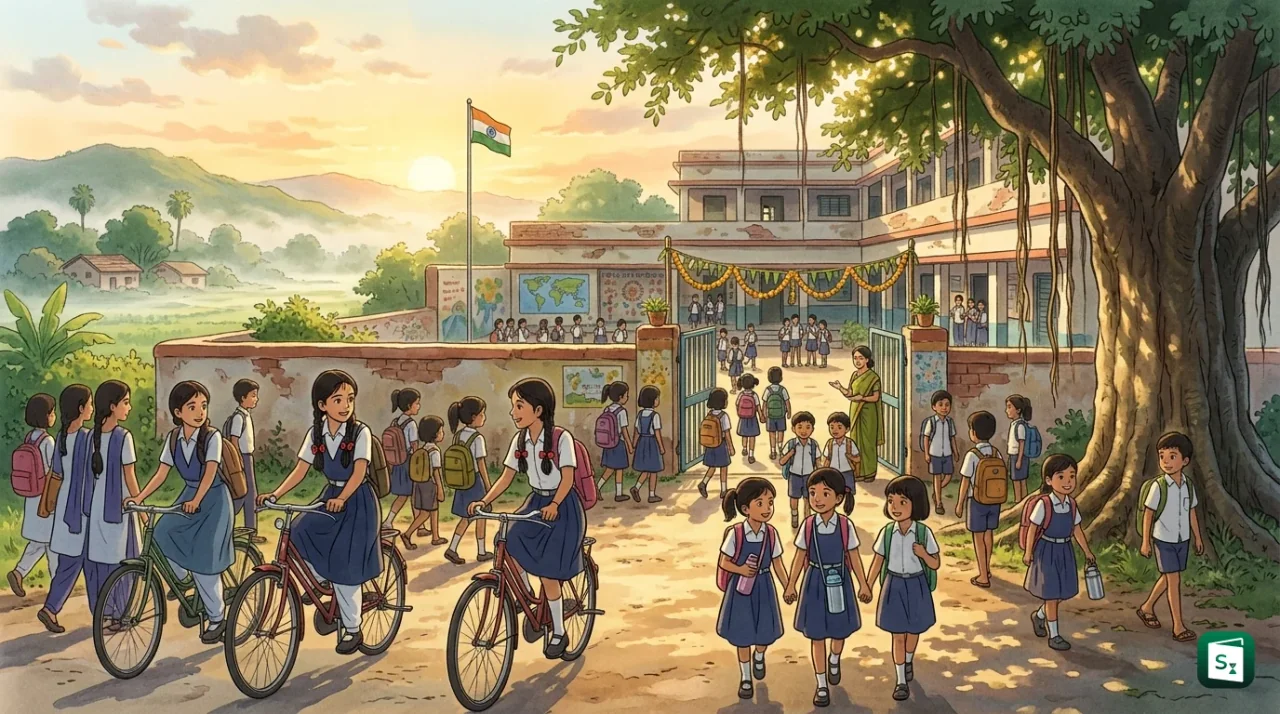
UNESCO released its 2026 Global Education Monitoring (GEM) Gender Report titled Gender equity in access to education to mark the International Day of the Girl Child on 11 October 2026. The report finds that the world has reached gender parity in school enrolment from pre-primary through upper secondary level by 2024. Yet it warns that completion, poverty, location and early marriage still keep millions of girls from finishing school.
What Is the 2026 GEM Gender Report?
The Global Education Monitoring (GEM) Report is an editorially independent report hosted and published by the United Nations Educational, Scientific and Cultural Organization (UNESCO). UNESCO is headquartered in Paris and works with 194 Member States to advance cooperation in education, science, culture and communication. The GEM Report was set up in 2002. It first tracked the Education for All goals. After the World Education Forum held in Incheon in 2015, 160 governments gave it a fresh mandate to monitor progress towards Sustainable Development Goal 4 (SDG 4), which calls for inclusive and equitable quality education for all by 2030.
The 2026 edition is the first in a three part Countdown to 2030 series. This first report focuses on access and equity. Later editions will cover quality and learning. The Gender Report titled Gender equity in access to education accompanies the main 2026 GEM Report titled Access and equity: Countdown to 2030. A separate Africa edition was prepared with the Forum for African Women Educationalists (FAWE).
UNESCO launched the Gender Report in Paris on 9 October 2026 at an event held to mark the International Day of the Girl Child. The United Nations General Assembly declared 11 October as the International Day of the Girl Child on 19 December 2011, and the day has been observed every year since 2012. The 2026 theme was End child marriage and invest in girls rights. The same Paris event also hosted the award ceremony for the 2026 UNESCO Prize for Girls and Women’s Education. The Prize was established in 2015 with funding from China. It is given each year to two laureates, who receive $50,000 each. The 2026 laureates were projects from Morocco and Peru.
The report uses three simple measures. Enrolment counts who enters school. Completion counts who finishes a level. The gender parity index divides the girls value by the boys value. A value of 1 means parity. UNESCO treats the range of 0.97 to 1.03 as parity. A value below 0.97 favours boys. A value above 1.03 favours girls.
Enrolment Parity: What the Numbers Show
The Gender Report states that gender parity in enrolment has been reached at the global level from pre-primary through upper secondary education by 2024. In other words, as many girls as boys are now enrolled in school worldwide at these levels. This is a major shift from 2000.
Between 2000 and 2024, the share of countries with fewer than nine girls enrolled for every ten boys fell sharply. In primary education, the share dropped from 15% to 2%. In upper secondary education, it fell from 18% to 5%. More children are also staying long enough to finish primary school. About 88% now complete primary education, 78% finish lower secondary and 61% reach upper secondary completion.
Tertiary education shows the opposite pattern. Girls were already ahead of boys in 2000, both in enrolment and graduation. The gap has widened since then. There are now only 88 young men enrolled for every 100 young women on average at the tertiary level.
Global parity hides a different picture on out of school children. Of an estimated 273 million out of school children, adolescents and youth in 2024, 140 million were boys and 133 million were girls. For more than 15 years, more boys than girls have been out of school globally. Boys are more likely to start late and repeat grades. In lower secondary education in 2024, 11% of boys were at least two years older than expected for their grade, compared with 8% of girls. In Africa, the gap was far wider, with 37% of boys and 23% of girls over age for their grade.
| Level | Key global finding in 2026 Gender Report |
|---|---|
| Pre-primary to upper secondary | Gender parity in enrolment achieved by 2024 |
| Primary enrolment | Countries with fewer than 9 girls per 10 boys fell from 15% in 2000 to 2% in 2024 |
| Upper secondary enrolment | Such countries fell from 18% in 2000 to 5% in 2024 |
| Tertiary enrolment | 88 men enrolled for every 100 women, gap favouring women since 2000 |
| Out of school children in 2024 | 273 million in total, including 140 million boys and 133 million girls |
Child Marriage and Early Pregnancy Remain the Biggest Barriers
Enrolment parity does not mean equal chances to finish school. The report identifies child marriage and early pregnancy as the main forces pushing adolescent girls out of secondary classrooms. Girls face stronger pressure to leave education as they grow older because of marriage, pregnancy or care work.
Globally, the share of girls married before age 18 fell from 25% in 2000 to 18% in 2025. The average hides sharp regional gaps. The rate remains at 25% in Central and Southern Asia and 31% in sub-Saharan Africa. About one in every three seconds, a girl is married before adulthood. An estimated 650 million women and girls alive today were married before age 18.
Pregnancy compounds the break. In sub-Saharan Africa, about 6 million pregnant girls and young mothers aged 10 to 19 were out of school in 2024. Fewer than 5% of pregnant and parenting girls in the region return to school after giving birth. A girl may have the legal right to return. In practice she may lack transport, childcare, safe water and sanitation in school, or face stigma and the risk of violence on the way to school.
Legal protection remains thin. In 2026, 58% of countries guaranteed the right to education without discrimination based on sex or gender in their legal framework. Only 35% explicitly protected the education rights of pregnant and parenting girls. Some countries have changed course. The Central African Republic, Tanzania, Cameroon, Sao Tome and Principe, Sierra Leone and Togo have ended bans that once stopped married, pregnant and parenting girls from staying in school. Recent data show that nine in ten Eastern and Southern African countries surveyed now have policies that allow pregnant and parenting adolescents to continue or resume education.
Hidden Gaps Within Countries: Wealth, Location and India’s Rural Divide
National averages can mask deep divides inside a country. The report uses data from the World Inequality Database on Education (WIDE) to show how location and wealth combine with gender to shape results. Where a girl lives and how much her family earns often matter more than national parity figures.
In Angola, there is near parity among the richest households. Among the poorest households, only 30 girls complete upper secondary education for every 100 boys. In India, parity in upper secondary completion has been reached in urban areas. In rural areas, only 59 girls complete upper secondary education for every 100 boys. Similar patterns appear across western Africa, where more than half of the 50 most unequal countries in 2000 had still not made enough progress by 2024.
These gaps reflect practical barriers. Distance matters. In Pakistan, girls who travelled 45 to 60 minutes to school were 15 percentage points less likely to be in education than girls who lived within 15 minutes. Safety and facilities matter too. In Burkina Faso, building girl friendly schools with water, sanitation and secure classrooms raised enrolment by 19 percentage points, with larger gains for girls. In Mozambique, training staff to act against gender based violence and encouraging girls to report incidents reduced violence and raised enrolment.
India’s case underlines why disaggregation matters. National enrolment gains coexist with a rural completion gap and strong links between schooling and marriage age. Girls with no schooling face far higher rates of marriage before 18 than girls with secondary or higher education. Poverty sharpens the risk. Programmes such as free lunches in disadvantaged rural communities have shown nearly twice as large an effect on primary enrolment for girls as for boys, because costs beyond fees weigh more heavily on poor families.
Which Countries Closed Gender Gaps the Fastest?
The report shows that large gaps can close within a generation when policies stay consistent. It highlights several country trajectories from its Countdown to 2030 case studies.
Nepal closed a 33 percentage point gap in lower secondary completion between girls and boys between 1990 and 2024. Cambodia turned a 22 point disadvantage for girls in primary completion in 1981 into an 11 point advantage for girls by 2024. Saudi Arabia cut its tertiary enrolment gender gap by three quarters between 2006 and 2022. Costa Rica narrowed an upper secondary completion gap that favoured girls from 12 to 7 points between the periods 2011 to 2017 and 2018 to 2024.
Africa has also narrowed exclusion. Between 2000 and 2024, the out of school rate for girls in Africa fell from 47% to 28%. The gap between girls and boys narrowed from eight percentage points to around one point. Africa reached gender parity in primary enrolment in 2021 and is close to parity in lower secondary. Gaps remain higher up. In 2024, Africa had 93 girls for every 100 boys enrolled in upper secondary and 94 women for every 100 men in tertiary education. Regional differences are wide. Northern Africa enrols more girls than boys at upper secondary age, while Central Africa records 79 girls per 100 boys and Eastern Africa records 71 girls per 100 boys.
| Country | Change recorded |
|---|---|
| Nepal | 33 point lower secondary completion gap closed between 1990 and 2024 |
| Cambodia | 22 point deficit for girls in primary completion in 1981 became 11 point lead by 2024 |
| Saudi Arabia | Tertiary enrolment gender gap cut by three quarters between 2006 and 2022 |
| Costa Rica | Upper secondary completion gap favouring girls narrowed from 12 to 7 points in early 2020s |
What Policies Can Close the Remaining Gaps?
The 2026 Gender Report states that no single reform can fix access to education. Financial, social and school level barriers act together, so governments need to combine measures and track who is furthest behind by gender, wealth and location.
Making schooling free and compulsory works best when both parts move together. Evidence from 14 African countries found that making lower secondary education free and compulsory increased attainment by 1.6 years for girls and 1.4 years for boys, compared with making it free alone. The Africa edition also reports a 14 percentage point rise in girls secondary completion after such moves.
Targeted help with costs beyond fees matters. A subsidy programme in rural China that covered tuition, textbooks and living expenses raised poor girls enrolment by seven percentage points. In Mali, the national safety net programme Jigisemejiri doubled enrolment among girls of upper secondary age. Free meals, transport support, hostel places and textbook aid reduce the daily costs that push poor girls out first.
Safe and nearby schools form the next layer. Accessible buildings, secure transport, separate sanitation, clean water and protection from violence raise attendance. Flexible and second chance routes that lead to recognised certificates help married girls, young mothers and older learners return. UNESCO points to its programme Our Rights, Our Lives, Our Future, which works with education ministries in 35 countries to expand comprehensive sexuality education. In Afghanistan, where an estimated 2.4 million girls and women remain deprived of their right to education, UNESCO supports community based classes, literacy and skills training and psychosocial support.
Monitoring must also improve. The report asks governments to publish participation and completion data split by gender, wealth, location and age, including delayed completion. This matters because boys repeat more and girls drop out later for marriage or care reasons. Without age wise data, completion figures can mislead.
Key Takeaways
- The 2026 GEM Gender Report titled Gender equity in access to education was launched in Paris on 9 October 2026 to mark the International Day of the Girl Child on 11 October.
- Global gender parity in enrolment was achieved from pre-primary through upper secondary by 2024, with countries having fewer than 9 girls per 10 boys falling from 15% to 2% in primary and 18% to 5% in upper secondary between 2000 and 2024.
- In tertiary education, 88 men are enrolled for every 100 women, a gap favouring women that has widened since 2000.
- The share of girls married before 18 fell from 25% in 2000 to 18% in 2025, but remains at 25% in Central and Southern Asia and 31% in sub-Saharan Africa.
- In India, parity in upper secondary completion is reached in urban areas, but only 59 girls per 100 boys complete the level in rural areas, while in Angola only 30 girls per 100 boys complete it among the poorest households.
- The GEM Report, set up in 2002 and hosted by UNESCO in Paris, received its mandate to monitor SDG 4 from 160 governments at the 2015 World Education Forum in Incheon.