Ladakh has become India’s first 100 percent organic Union Territory, with Lieutenant Governor Vinai Kumar Saxena making the declaration on 25 October 2026. The declaration follows a complete ban on the procurement, sale and use of chemical and synthetic fertilizers across Leh and Kargil. It turns the high altitude cold desert into a national model for chemical free farming in a fragile Himalayan ecosystem.
What Is Organic Farming and How Is It Done?
Organic farming is a method of cultivation that avoids chemical and synthetic fertilizers, chemical pesticides and genetically modified seeds. The method relies on natural inputs and soil friendly practices to grow crops while protecting soil health, water quality and biodiversity over the long term.
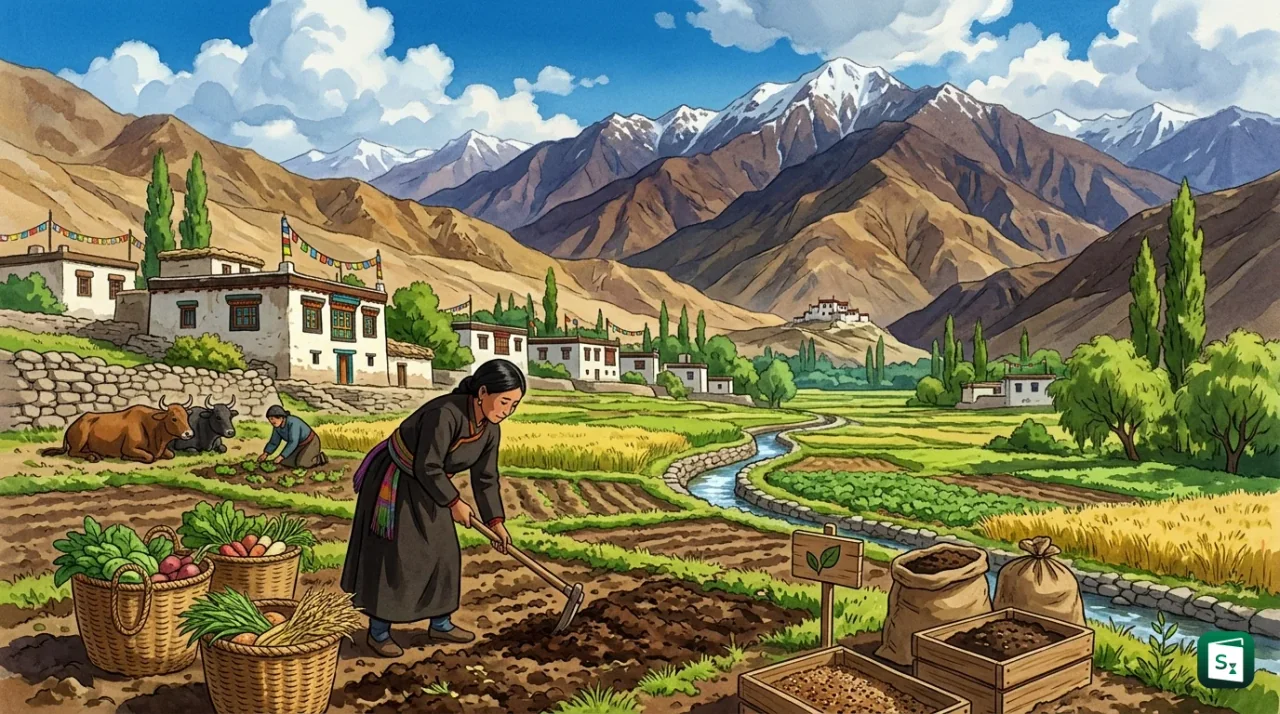
In India, organic farming is also called jaivik kheti. Farmers use farmyard manure, compost, vermicompost, green manure and biofertilizers to feed the soil. They manage pests with neem based preparations, trap crops and friendly insects instead of chemical sprays. They also rotate crops, use animal waste and crop residue, and protect local seeds to keep the farm self reliant.
Two public systems certify organic produce in India. The National Programme for Organic Production (NPOP) provides third party certification for exports and premium domestic markets. The NPOP was launched in 2001 and is implemented by the Agricultural and Processed Food Products Export Development Authority (APEDA) under the Ministry of Commerce and Industry. The Participatory Guarantee System for India (PGS-India) supports local verification among small farmers for the domestic market. Certified farms can use the India Organic logo after a conversion period of two to three years.
India holds a strong position in this sector. India ranks second in the world in organic agricultural land and first in the number of organic producers as per global assessments. During 2024-25, about 3.96 million hectares were under NPOP certification, including land under conversion, apart from wild collection area. Madhya Pradesh and Maharashtra account for the largest certified areas. The Ladakh declaration adds a unique high mountain model to this national base.
Where Is Ladakh Located and Is It a State or Union Territory?
Ladakh is located in the northernmost part of India in the western Himalaya, between the Karakoram Range in the north and the Great Himalayas in the south. Ladakh shares borders with China in the east and Pakistan in the west. Leh is its largest city and administrative centre.
Ladakh is a Union Territory, not a state. The Union Territory of Ladakh was formed on 31 October 2019 under the Jammu and Kashmir Reorganisation Act, 2019, after Parliament reorganised the former state of Jammu and Kashmir. The reorganisation followed the abrogation of Article 370 of the Constitution.
The Union Territory comprises two districts, Leh and Kargil. Leh is largely Buddhist and Kargil is largely Muslim. Ladakh covers 59,196 square kilometres, with Leh accounting for about 45,110 square kilometres and Kargil for about 14,086 square kilometres. It is the largest Union Territory by area. The region sits at an average altitude of more than 3,000 metres above sea level, with settlements spread across narrow river valleys of the Indus, Nubra, Shyok and Suru rivers.
Farming in Ladakh reflects this geography. The cropping season lasts only four to five months because of long and harsh winters. Farmers grow barley, wheat, peas and mustard in small irrigated plots. Horticulture centres on apricot in Kargil and sea buckthorn in Leh. Ladakh ranks first in India in apricot production, with about 1,674 hectares producing nearly 9,834 metric tonnes in Kargil district.
How Ladakh Became India’s First Organic Union Territory
Lieutenant Governor Vinai Kumar Saxena declared Ladakh as India’s first 100 percent organic Union Territory on 25 October 2026. The announcement recognised the work of farmers in Leh and Kargil and the sustained push by the Union Territory administration for chemical free cultivation. The Lieutenant Governor said the shift protects the Himalayan ecosystem, improves soil health and creates better market opportunities for local produce.
The declaration followed a decisive legal step taken three months earlier. On 13 July 2026, the Agriculture Department of Ladakh issued Order No. 50-LA (Agri)/UTL of 2026. The order imposed a complete prohibition on the procurement, distribution, sale, marketing and use of chemical and synthetic fertilizers for agriculture in Ladakh with immediate effect. The order stated that the ban aims to safeguard organic certification, protect soil and water resources, promote sustainable practices and build Ladakh as a model organic region.
The ban carries strict enforcement. Any violation attracts a minimum penalty of ₹10,000. Farmers and farm units must now use only on farm and off farm organic inputs such as compost, farmyard manure and biofertilizers. The order was issued on the directions of the Lieutenant Governor, in line with the national call for natural and chemical free farming.
The move did not come from a single order. Ladakh already had low use of chemical inputs because of its remote location, traditional practices and short season. The administration built on this natural advantage through training, input supply and village level certification over several years. In July 2026, the Lieutenant Governor awarded organic certification to 102 villages across Kargil, Dras, Zanskar and Sham, taking the total number of certified organic villages to 207. Three months later, the administration extended the claim to full Union Territory coverage.
What Is the Mission Organic Development Initiative?
The Mission Organic Development Initiative (MODI) is the umbrella programme behind Ladakh’s organic transition. The Ladakh administration launched the mission in 2020 with the goal of converting all 666 villages of the Union Territory into certified organic zones. The mission carries a budget of about ₹500 crore for inputs, training, infrastructure and marketing.
The mission works through the Agriculture and Horticulture Departments along with the Ladakh Autonomous Hill Development Councils of Leh and Kargil. Field teams supply quality seeds, compost units, biofertilizer units and greenhouses. About ₹50 crore is set aside for value chain development such as collection, grading, packaging and branding. About ₹125.54 crore supports protected cultivation, mainly subsidised greenhouses that extend the short summer season. Ladakh now has about 11,000 greenhouses, which allow vegetables to grow even in freezing months.
Village certification follows national norms. Organic certified villages in Ladakh are promoted under the Paramparagat Krishi Vikas Yojana (PKVY), which is part of the National Mission on Sustainable Agriculture. The PKVY uses a cluster approach, where groups of farmers adopt common standards, maintain records and face joint inspection. Certification agencies verify that no prohibited chemicals are used for the required conversion period. In September 2025, the then administration distributed organic certificates to village headmen from Tar, Igoo, Kairy, Khaltse and Takmachik, showing how certification moves village by village.
The model suits Ladakh. Small landholdings, livestock based manure and limited past use of chemicals reduce the cost of conversion. The challenge now is steady supply of quality organic inputs, pest control in a cold climate and honest monitoring across remote valleys.
Ladakh vs Sikkim: Two Models of Organic Transition
Sikkim is called India’s first organic state because the state converted its entire farmland of about 75,000 hectares to certified organic cultivation and banned the sale of chemical fertilizers and pesticides. The process began in 2003 under Chief Minister Pawan Chamling and was completed in December 2015. Prime Minister Narendra Modi formally declared Sikkim fully organic in January 2016.
The Sikkim model earned global recognition. The UN Food and Agriculture Organization (FAO), headquartered in Rome and founded in 1945, gave Sikkim the Future Policy Gold Award in 2018 for its leadership in agroecology. Tourism in the state rose sharply after the declaration, and Sikkim produce gained access to export certification through APEDA. The Sikkim Organic Mission and state certification agencies enforced standards under NPOP guidelines.
Ladakh follows a similar path but in tougher conditions. The table below compares the two transitions.
| Feature | Ladakh | Sikkim |
|---|---|---|
| Status | First 100 percent organic Union Territory, declared on 25 October 2026 | First fully organic state, declared in January 2016 |
| Mission start | Mission Organic Development Initiative in 2020 | Sikkim Organic Mission in 2003 |
| Area approach | 666 villages across Leh and Kargil, cold desert at more than 3,000 metres | About 75,000 hectares across four districts in the eastern Himalaya |
| Legal tool | Order of 13 July 2026 banning chemical fertilizers, with ₹10,000 minimum fine | State ban on sale of chemical fertilizers and pesticides from 2003 onward |
| Time taken | About six years from mission to declaration | About 13 years from mission to declaration |
| Key crops | Barley, wheat, peas, apricot, sea buckthorn | Cardamom, ginger, turmeric, buckwheat, mandarin orange |
The comparison shows an important lesson. Sikkim proved that a full state can go organic with long term political continuity and certification support. Ladakh proves that a high altitude desert with a four month season and two remote districts can achieve the same result with a focused mission, input support and a strict ban.
Why Organic Farming Is Important for Ladakh
Organic farming protects Ladakh’s most fragile assets, its soil and water. The region depends on glacial melt and the Indus river system for irrigation. Chemical residues drain quickly through thin mountain soils into streams and fields. By stopping synthetic fertilizers and pesticides, Ladakh reduces pollution of drinking water, keeps soil microbes alive and slows desertification in an area that receives very low rainfall.
The health and income gains are direct. Farmers spend less on costly chemical inputs that must be trucked over high passes from the plains. Organic manure from livestock, kitchen waste and crop residue costs little and is locally available. Certified organic apricots, apples, barley, peas, sea buckthorn juice and herbal products fetch premium prices in Delhi, Chandigarh and export markets. Better branding under the India Organic logo can raise household incomes without expanding farmland.
How Organic Farming Differs From Natural and Conventional Farming
Readers often mix organic farming with natural farming and conventional farming. The three systems use soil and inputs in different ways.
| System | Main inputs | Certification | Cost and yield pattern |
|---|---|---|---|
| Conventional farming | Chemical fertilizers and chemical pesticides, high yielding seeds | No organic certification needed | High short term yield, high input cost, risk of soil decline |
| Organic farming | Compost, farmyard manure, biofertilizers, approved biopesticides | Third party certification under NPOP or local PGS-India needed | Moderate yield, premium price, export access after conversion period |
| Natural farming | On farm preparations such as Jeevamrit and Beejamrit, minimal outside input, no tillage emphasis | No formal NPOP certification in most cases | Very low cost, suited to small farms, depends on local knowledge |
Ladakh has chosen the certified organic path rather than uncertified natural farming. Certification allows Ladakh’s apricot oil, dried apricots, sea buckthorn pulp and barley flour to enter organised retail and export chains where buyers demand proof.
The Way Forward
The declaration is the start of a harder task, keeping Ladakh organic year after year. The administration will need to ensure a steady supply of quality compost, vermicompost and biofertilizers before each sowing season. In March 2026, the administration arranged advance supply of organic fertilizers for villages, and this practice will need to continue.
Market linkage will decide success. Ladakh needs more testing labs, cold stores, grading centres and transport support so that perishable apricots and vegetables reach markets without loss. A common Ladakh Organic brand, clear traceability and regular inspection will build buyer trust. Training for farmers on soil health, pest management and greenhouse use will reduce the temptation to return to chemicals if yields dip in the first years.
If these links hold, Ladakh can combine clean farming with eco tourism, homestays and food processing. The model will then offer a practical guide for other hill and dryland regions that face water stress and high input costs.
Key Takeaways
- Ladakh was declared India’s first 100 percent organic Union Territory on 25 October 2026 by Lt Governor Vinai Kumar Saxena.
- The declaration followed Order No. 50-LA (Agri)/UTL of 2026 dated 13 July 2026, which bans procurement, sale and use of chemical fertilizers with a minimum fine of ₹10,000.
- The transition was driven by the Mission Organic Development Initiative (MODI), launched in 2020 to certify all 666 villages, with 207 villages certified before October 2026.
- The National Programme for Organic Production (NPOP), launched in 2001 and run by APEDA, provides third party certification and the India Organic logo.
- Sikkim remains India’s first fully organic state, declared in January 2016 after converting about 75,000 hectares from 2003, and won the FAO Future Policy Gold Award in 2018.
- Ladakh was formed as a Union Territory on 31 October 2019 under the Jammu and Kashmir Reorganisation Act, 2019, comprising Leh and Kargil districts across 59,196 square kilometres.