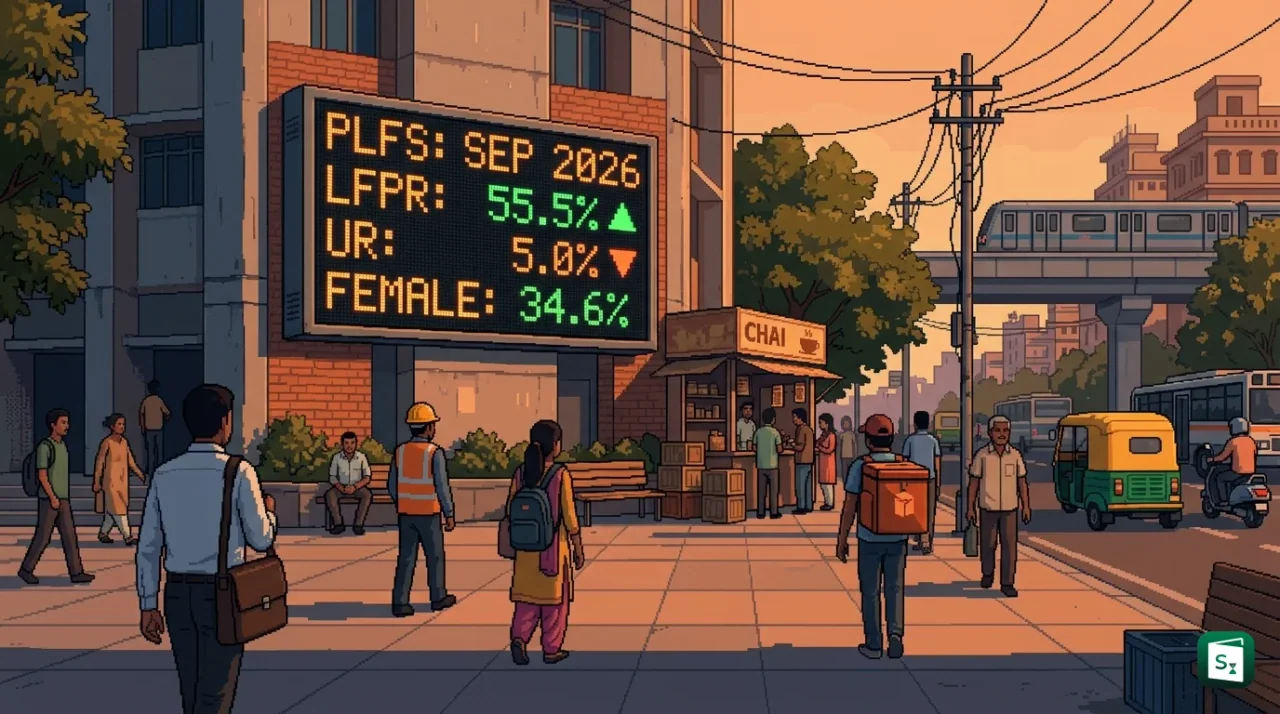
The National Statistical Office released the 18th Monthly Bulletin of the Periodic Labour Force Survey for September 2026 on 15 October 2026. The bulletin places the overall Labour Force Participation Rate at 55.5% and the overall Unemployment Rate at 5.0% for persons aged 15 years and above. Urban participation improved during the month while rural female unemployment fell to its lowest level in 2026.
What Is the Periodic Labour Force Survey?
The Periodic Labour Force Survey (PLFS) is India’s main national survey that measures jobs and joblessness. The National Statistical Office (NSO) under the Ministry of Statistics and Programme Implementation (MOSPI) conducts it to estimate participation, employment and unemployment across rural and urban India.
The NSO launched the PLFS in April 2017 to provide frequent labour data. The survey has two central aims. It estimates key employment indicators at short intervals, and it measures employment conditions in both rural and urban areas every year. The first annual PLFS report appeared in 2019, and quarterly bulletins for urban areas followed soon after.
The NSO revamped the survey design in January 2025 to meet the demand for faster data. The redesigned PLFS now gives monthly estimates for the whole country and quarterly estimates for both rural and urban areas. Monthly results appear as Monthly Bulletins that report all India figures using the Current Weekly Status approach.
The September 2026 release is the 18th Monthly Bulletin in this new series. The series began with the April 2025 bulletin, and bulletins for April 2025 to August 2026 are already published. For September 2026, the NSO surveyed 3,70,513 persons, including 2,11,333 persons in rural areas and 1,59,180 persons in urban areas.
What Is LFPR, WPR and Unemployment Rate in India?
The Labour Force Participation Rate (LFPR), Worker Population Ratio (WPR) and Unemployment Rate (UR) are India’s three core labour market indicators. LFPR shows the share of people in the workforce, WPR shows the share who are employed, and UR shows the share of the workforce without work.
LFPR means the percentage of persons in the labour force in the total population. The labour force includes people who are working and people who are seeking or available for work. The formula is simple. Divide the number of persons in the labour force by the total population and multiply by 100.
WPR means the percentage of employed persons in the total population. The NSO calculates it by dividing the number of employed persons by the total population and multiplying by 100. A higher WPR signals that a larger share of people actually holds jobs.
UR means the percentage of unemployed persons within the labour force. The NSO divides the number of unemployed persons by the number of persons in the labour force and multiplies by 100. This rate therefore focuses only on people who are part of the workforce, not the entire population.
| Indicator | What It Measures | Formula in Words |
|---|---|---|
| LFPR | Share of population in labour force | Labour force divided by total population multiplied by 100 |
| WPR | Share of population employed | Employed persons divided by total population multiplied by 100 |
| UR | Share of labour force unemployed | Unemployed persons divided by labour force multiplied by 100 |
How Is Unemployment Rate Calculated in India?
The NSO calculates India’s unemployment rate using the Current Weekly Status approach for monthly bulletins. Under this method, survey teams record a person’s activity during the seven days before the survey date. A person without work but seeking or available for work during that week counts as unemployed.
The PLFS also uses the Usual Status approach for annual reports. Usual Status looks at a person’s main activity over the 365 days before the survey. Monthly bulletins, including the September 2026 bulletin, use only the Current Weekly Status method and cover persons aged 15 years and above.
Key Findings of the September 2026 Monthly Bulletin
The September 2026 bulletin presents a picture of stability with slow yearly gains. The overall LFPR for persons aged 15 years and above stood at 55.5% in September 2026. The figure was almost unchanged from 55.6% in August 2026. Over one year, it rose by 0.2 percentage points from 55.3% in September 2025.
Rural participation stayed higher than urban participation. Rural LFPR was 58.0% in September 2026 against 58.2% in August 2026. The rural rate increased by 0.6 percentage points from 57.4% a year earlier. Urban LFPR moved in the opposite direction during the month. The urban rate rose by 0.3 percentage points from 50.4% in August 2026 to 50.7% in September 2026. Compared with 50.9% in September 2025, urban LFPR was lower by 0.2 percentage points.
| Area | September 2026 | August 2026 | September 2025 | Yearly Change |
|---|---|---|---|---|
| All India LFPR | 55.5% | 55.6% | 55.3% | Up 0.2 points |
| Rural LFPR | 58.0% | 58.2% | 57.4% | Up 0.6 points |
| Urban LFPR | 50.7% | 50.4% | 50.9% | Down 0.2 points |
The pattern shows two clear trends. Rural areas continue to hold a larger share of people in the workforce. Urban areas recorded the only month on month improvement in September, which lifted the national figure and kept it broadly stable.
Female Labour Force Participation in India
Female participation remains the most watched part of India’s jobs data. The overall female LFPR for women aged 15 years and above stood at 34.6% in September 2026. The figure was slightly lower than 34.8% in August 2026. Over one year, it rose by 0.5 percentage points from 34.1% in September 2025.
Urban women drove the monthly momentum. Urban female LFPR rose by 0.5 percentage points from 25.4% in August 2026 to 25.9% in September 2026. The NSO noted that this was the highest urban female rate since October 2025. Compared with 26.1% in September 2025, the urban female rate stayed broadly stable around 26%.
Rural women continue to participate at much higher levels than urban women. Rural female LFPR was 38.9% in September 2026 against 39.4% in August 2026. On a yearly basis, rural female LFPR increased by 1.0 percentage point from 37.9% in September 2025. This rural gain explains most of the yearly rise in the national female rate.
The gap between rural and urban female participation remains wide. Nearly 39 out of every 100 rural women aged 15 and above are in the labour force. In cities, the figure is about 26 out of every 100 women. The September data therefore shows steady long term progress for women, with cities providing the latest push.
Unemployment Rate in India: Current Trends
The unemployment rate in India for persons aged 15 years and above stood at 5.0% in September 2026. The rate was unchanged from August 2026. It declined by 0.2 percentage points from 5.2% in September 2025.
Rural joblessness stayed much lower than urban joblessness. Rural UR was 4.2% in September 2026 against 4.1% in August 2026. Over one year, rural UR fell by 0.4 percentage points from 4.6%. Urban UR edged up from 6.8% in August 2026 to 6.9% in September 2026. Compared with 6.8% in September 2025, urban joblessness stayed broadly stable.
| Area | September 2026 | August 2026 | September 2025 |
|---|---|---|---|
| All India UR | 5.0% | 5.0% | 5.2% |
| Rural UR | 4.2% | 4.1% | 4.6% |
| Urban UR | 6.9% | 6.8% | 6.8% |
Gender trends show yearly improvement for both men and women. Overall male UR held steady at 4.9% in September 2026, continuing the stable or falling trend seen since June 2026. Urban male UR eased from 6.1% to 6.0% during the month. Overall female UR was 5.2% against 5.1% in August 2026. Rural female UR stood at 3.9%, the lowest level recorded in 2026. Urban female UR rose from 8.9% to 9.2%.
Year on year, overall male UR fell by 0.2 percentage points and overall female UR fell by 0.3 percentage points. In rural areas, male UR dropped from 4.7% to 4.4%, while female UR dropped from 4.3% to 3.9%.
Worker Population Ratio and Employment Conditions
The Worker Population Ratio (WPR) captures the employment side of the labour market. The overall WPR for persons aged 15 years and above stood at 52.7% in September 2026. The figure was broadly stable against 52.8% in August 2026. Over one year, it increased by 0.3 percentage points from 52.4% in September 2025.
Urban employment strengthened across genders. Urban WPR reached 47.2%, its highest level since October 2025. Urban male WPR rose from 70.7% to 71.0% during the month. Urban female WPR rose from 23.2% to 23.5%. Rural WPR eased from 55.8% to 55.5% over the same period.
Yearly data shows rural areas leading job growth. Rural WPR rose by 0.7 percentage points from 54.8% to 55.5%. Urban WPR stayed broadly stable around 47%. At the national level, male WPR rose by 0.4 percentage points to 73.6%. Female WPR rose by 0.5 percentage points to 32.8%.
Why the September 2026 Data Matters
The September bulletin matters because it confirms three steady shifts in the labour market. First, work participation keeps rising on a yearly basis even when monthly numbers stay flat. LFPR rose by 0.2 points and WPR rose by 0.3 points over the year. The rise in both indicators together suggests that more people entered the workforce and found work.
Second, cities show fresh energy. Urban LFPR, urban female LFPR and urban WPR all improved in September. Urban female participation touched its highest point in nearly a year. Urban male unemployment also eased. This urban recovery balances the slight monthly dip in rural participation.
Third, rural women remain central to employment gains. Rural female LFPR grew by a full point over the year, and rural female unemployment dropped to 3.9%. These two moves together point to wider work access for rural women, a trend that shapes income security in farming and allied households.
Key Takeaways
- The 18th PLFS Monthly Bulletin for September 2026 was released by the National Statistical Office on 15 October 2026.
- Overall Labour Force Participation Rate stood at 55.5% in September 2026, up 0.2 points from September 2025.
- Overall Unemployment Rate stayed at 5.0% in September 2026, down 0.2 points from 5.2% a year earlier.
- Overall Female LFPR reached 34.6%, with rural female LFPR at 38.9% and urban female LFPR at 25.9%, the highest urban level since October 2025.
- Overall Worker Population Ratio rose to 52.7%, while urban WPR touched 47.2%, its highest level since October 2025.
- The PLFS was launched in April 2017 and revamped in January 2025 to provide monthly national estimates using the Current Weekly Status method.