The West Bengal Cabinet approved the Bhagini Nivedita Scheme on 5 October 2026, clearing a ₹50,000 package for unmarried women pursuing undergraduate education in government and government-aided colleges. The scheme, first announced in the state’s 2026-27 Budget with an allocation of ₹1,000 crore, will begin payments in January 2027. It replaces the ₹25,000 one-time Kanyashree K2 grant and doubles the state’s support for a girl’s move from school into college.
What Is the Bhagini Nivedita Scheme?
The Bhagini Nivedita Scheme is a West Bengal government programme that pays ₹50,000 to unmarried women during a three-year undergraduate degree. The money is released in three annual instalments: ₹17,000 in the first year, ₹17,000 in the second and ₹16,000 in the third.
Chief Minister Suvendu Adhikari announced the Cabinet decision at the state secretariat, Nabanna, in Kolkata. The first instalment is expected to be credited in January 2027, which means students who entered college in the 2026-27 academic session will be among the first beneficiaries.
| Year of study | Instalment | Amount |
|---|---|---|
| First year | First | ₹17,000 |
| Second year | Second | ₹17,000 |
| Third year | Third | ₹16,000 |
| Total | Three instalments | ₹50,000 |
The payment is not a lump sum handed over at admission. Each instalment is linked to the student’s continuation in the course, so the design works as a retention tool rather than a simple admission incentive.
Unlike a merit scholarship, the scheme does not appear to require a minimum percentage of marks, at least in the announcements made so far. The Cabinet has cleared the principle and the payment structure. The application form, the portal and the detailed eligibility rules are yet to be notified.
Who Is Eligible for the ₹50,000 Assistance?
The scheme is open to women who are unmarried and enrolled in the first year of an undergraduate degree at a government or government-aided college in West Bengal. The government has not yet fixed an age limit, a family income ceiling or a minimum marks requirement.
Unmarried status is the central condition. A woman who marries while pursuing the degree may lose the remaining instalments, although the formal rules are still awaited. The institution must be a government or government-aided college, which leaves out private and self-financed colleges. The scheme is also designed for undergraduate study, with postgraduate students covered separately under the Kanyashree K3 component.
West Bengal does not issue a single standard “unmarried certificate” for all purposes. In the Kanyashree model, a student’s unmarried status was established through a self-declaration or affidavit, countersigned by the head of the institution or a designated certifying authority. A similar declaration is likely to be part of the Bhagini Nivedita process.
Students should keep a small set of documents ready: Aadhaar, a bank account in their own name, Class 12 marksheet, college admission receipt or identity card, and proof of residence in West Bengal. The final list will be published only through the official notification, and any private website demanding a fee for registration should be treated with caution.
The absence of an announced income ceiling is significant. Kanyashree was restricted to families earning up to ₹1.2 lakh a year, with waivers for orphans, students with disabilities and children in juvenile justice homes. If the new scheme is open to all unmarried women in government and aided colleges, it becomes a broad entitlement rather than a targeted anti-poverty transfer. That choice will shape both its reach and its annual bill.
Why West Bengal Introduced the Scheme
West Bengal’s problem is not simply one of girls not enrolling in college. It is one of girls dropping out before they finish, and of early marriage cutting short their education altogether.
Ministry of Education estimates put the state’s secondary school dropout rate at 17.8 per cent in 2023-24, well above the national average. The transition from school to college is the point where many families reassess the cost of educating a daughter. A grant paid across three years directly attacks that calculation.
| Indicator | West Bengal | India |
|---|---|---|
| Female literacy, Census 2011 | 70.54% | 65.46% |
| Women marrying before 18, SRS 2024 | 6.3% | 2.1% |
| Women aged 15-19 who are mothers or pregnant, NFHS-6 | 16.6% | 6.7% |
West Bengal has the highest share of underage marriages among the major states. The Sample Registration System data for 2024 show that 6.3 per cent of women marrying in the state were below 18, against 2.1 per cent nationally. The latest National Family Health Survey, NFHS-6 for 2023-24, found that 16.6 per cent of girls aged 15-19 were already mothers or pregnant, nearly two and a half times the national figure.
The state is not starting from zero on female education. Female literacy was already above the national average in 2011, and AISHE 2023-24 shows female enrolment in higher education in West Bengal at 12.5 lakh, higher than male enrolment of 12 lakh. The gap is in completion, not in the first step through the gate.
At the national level, the higher education Gross Enrolment Ratio, which measures the share of people aged 18 to 23 enrolled in higher education, rose to 30.0 in 2023-24 from 23.7 in 2014-15. Female GER stood at 31.2, with a Gender Parity Index of 1.08. The National Education Policy 2020 aims to push the overall GER to 50 per cent by 2035, a target that cannot be met if women leave college after the first year.
From Kanyashree to Kanya Ratna: The Scheme Being Replaced
Kanyashree Prakalpa is West Bengal’s conditional cash transfer scheme launched on 1 October 2013 to keep adolescent girls in school and delay marriage. It won the first prize in the Asia-Pacific group at the United Nations Public Service Awards in 2017 and has covered more than one crore girls.
The scheme was built by the Department of Women Development and Social Welfare, with technical support from UNICEF. Its original design had two parts. K1 was an annual scholarship for unmarried girls aged 13 to 18 who remained enrolled in school, initially ₹500 and later ₹1,000 a year. K2 was a one-time grant of ₹25,000 for unmarried girls aged 18 to 19 who were still studying. A third component, Kanyashree K3, later added support for women pursuing postgraduate degrees.
The scheme also came with an income test. Benefits went to families earning up to ₹1.2 lakh a year, with the ceiling waived for orphans, girls with disabilities of 40 per cent or more, and girls living in juvenile justice homes. Payments were made directly into bank accounts held in the girl’s name, which turned the programme into a tool of financial inclusion as well.
In August 2026, the state renamed Kanyashree as Kanya Ratna and doubled the annual school grant from ₹1,000 to ₹2,000 from the 2027 academic year. The K2 grant of ₹25,000 has now been replaced by the Bhagini Nivedita Scheme’s ₹50,000 spread over three years of college.
| Component | Earlier provision | Position as of October 2026 |
|---|---|---|
| Annual school grant | ₹1,000 a year, ages 13 to 18 | Renamed Kanya Ratna; raised to ₹2,000 from 2027 |
| One-time college grant | ₹25,000 at age 18 to 19 | Replaced by Bhagini Nivedita’s ₹50,000 over three years |
| Postgraduate support | Kanyashree K3 scholarship | Continues |
The change shifts the centre of gravity of the state’s girl-child welfare package. School-stage support now runs through Kanya Ratna, while the largest single payment has moved to the college stage through Bhagini Nivedita.
The renaming is part of a wider pattern. The state has also renamed Lakshmir Bhandar as Annapurna Yojana, Sabuj Sathi as Sarathi and Yuva Sathi as Yuva Shakti, while retaining the basic benefit structure of these programmes.
Who Was Sister Nivedita?
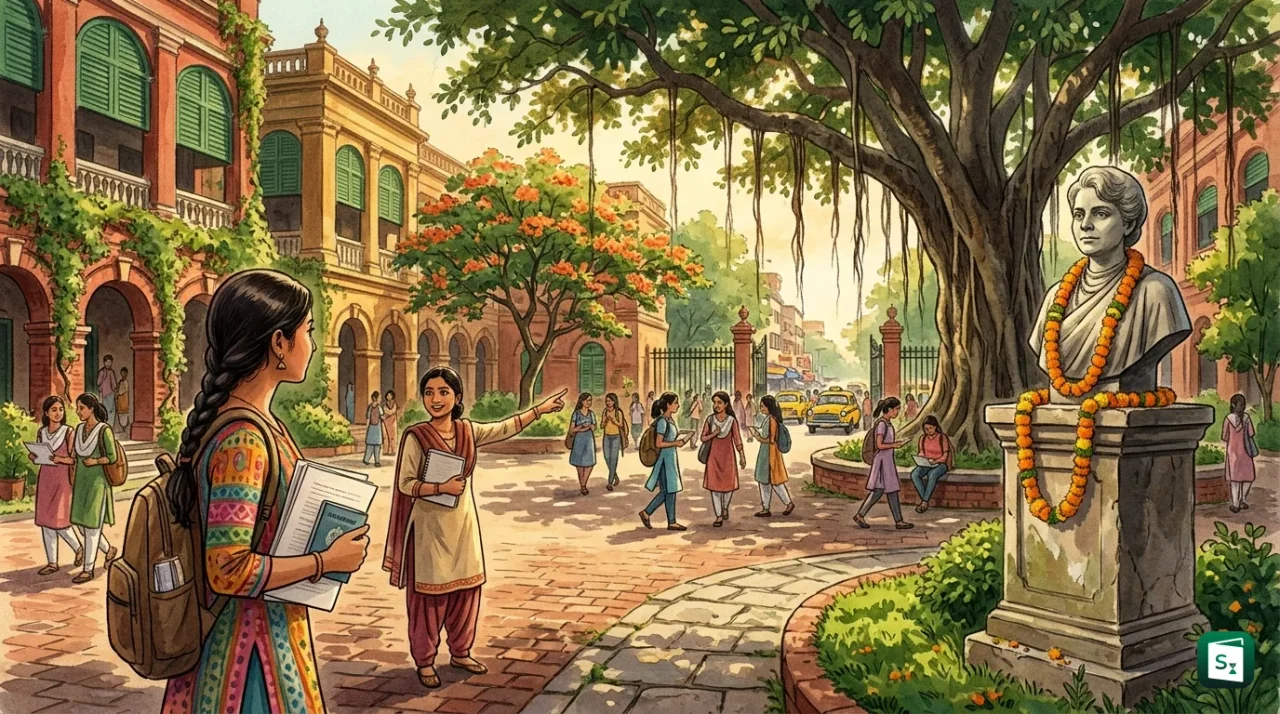
Sister Nivedita was the Irish-born disciple of Swami Vivekananda, born Margaret Elizabeth Noble in 1867. She came to Kolkata in 1898, opened a girls’ school in Bagbazar and spent the rest of her life promoting women’s education and Indian nationalism.
Margaret Elizabeth Noble was born on 28 October 1867 in Dungannon, County Tyrone, in present-day Northern Ireland. Her father, Samuel Richmond Noble, was a clergyman, and the family moved to England after his early death. She began teaching at 17, worked in schools across England, and by 1892 had opened her own school in Wimbledon.
She met Swami Vivekananda in London in November 1895. His call to work for Indian women persuaded her to travel to India, where she arrived in January 1898. Vivekananda initiated her into brahmacharya on 25 March 1898 and gave her the name Nivedita, meaning “the dedicated one”.
On 13 November 1898, she opened a girls’ school at 16 Bosepara Lane in Bagbazar, north Kolkata. At a time when orthodox families were reluctant to send daughters to school, and more so to a school run by a foreign woman, she began with a handful of students of different ages. The school taught history, geography, natural science, sewing and handicrafts, and later became a base for a wider order of women monastics.
Nivedita nursed patients during the plague epidemic in Kolkata in 1899 and organised relief during the famine and floods in East Bengal in 1906. She supported the physicist Jagadish Chandra Bose, helping raise funds for his research and for the Bose Institute. After the Partition of Bengal in 1905, she joined the Swadeshi movement, wrote on Indian art and crafts, and designed a flag bearing the vajra, or thunderbolt, which was presented to the Indian National Congress in 1906.
She died in Darjeeling on 13 October 1911, aged 43. Her birth anniversary on 28 October is observed in West Bengal, and her work is carried forward by the Ramakrishna Sarada Mission and Sri Sarada Math.
The scheme’s name should not be confused with similarly named institutions. Sister Nivedita University in Kolkata is a private university, and Bhagini Nivedita College is a college under the University of Delhi. Neither has any role in the West Bengal scheme.
What Else the Cabinet Approved
The Bhagini Nivedita Scheme was one of several decisions taken at the same Cabinet meeting. The others deal with government recruitment and hostel support for students from Scheduled Castes and Scheduled Tribes.
The Cabinet cleared recruitment to 14,454 government posts across departments including forests, fire services, prisons, and home and hill affairs. The West Bengal Public Service Commission and the West Bengal Police Recruitment Board will conduct the examinations and complete the process within six to eight months. The Chief Minister linked the decision to the government’s target of providing one lakh jobs in the state.
The monthly remuneration of Karmabandhus, the part-time support staff engaged by the land and land revenue department, was raised from ₹5,000 to ₹8,000, effective October 2026. The monthly food allowance for Scheduled Caste and Scheduled Tribe students living in government hostels was increased from ₹1,800 to ₹3,300.
| Decision | Change |
|---|---|
| Bhagini Nivedita Scheme | ₹50,000 over three years for unmarried women in undergraduate courses |
| Government recruitment | 14,454 posts to be filled within six to eight months |
| Karmabandhu remuneration | ₹5,000 to ₹8,000 a month from October 2026 |
| Hostel food allowance for SC and ST students | ₹1,800 to ₹3,300 a month |
How It Compares With Other States
West Bengal is not the only state using cash transfers to keep young women in education and away from early marriage. Assam’s Mukhya Mantri Nijut Moina Aasoni, launched in 2024, is the closest comparison.
| Feature | Bhagini Nivedita Scheme, West Bengal | Nijut Moina, Assam |
|---|---|---|
| Benefit | ₹50,000 over three years | ₹1,000 a month in Class 11, ₹1,250 in degree first year, ₹2,500 in postgraduate first year |
| Duration | Three annual instalments | Ten months a year, with a break in June and July |
| Institutions covered | Government and government-aided colleges | Government and venture institutions |
| Marital condition | Unmarried women | Married girls excluded, except in postgraduate and B.Ed courses |
| Private colleges | Not covered in the announcement | Excluded |
| Income condition | Not announced | No income limit, but daughters of ministers, MPs and MLAs are excluded |
The two schemes share an important design choice: both pay year after year rather than in a single lump sum, and both exclude private institutions. The differences are in the size of the monthly flow and in the political conditions attached. Assam also bars the children of elected representatives, a rule West Bengal has not announced.
For a student, the practical difference is timing. Nijut Moina provides a monthly stipend that helps with bus fares, books and hostel costs through the term. Bhagini Nivedita pays in larger annual blocks, which may be better suited to clearing admission-related and examination-related expenses but offers less steady support through the year.
Implementation Challenges and the Way Forward
The scheme’s success will depend less on the size of the cheque and more on how quickly the administrative machinery is put in place. As of October 2026, the government has not named the nodal department, opened an application portal or issued the formal guidelines. With the first payment due in January 2027, the window for notification, verification and bank seeding is short.
The first open question is fiscal. The Budget has set aside ₹1,000 crore, but if every unmarried woman in a government or aided college qualifies, the outgo will depend on enrolment and on how many students remain unmarried through the course. The second is the treatment of marriage during the degree. The unmarried condition is meant to delay marriage, but it also means a student who marries in her second year may lose support at the very point when household expenses rise. The guidelines need a clear rule on mid-course changes. The third is the exclusion of private and self-financed colleges, where a large number of West Bengal students study. That exclusion limits the scheme’s reach, though it also keeps costs within the Budget estimate.
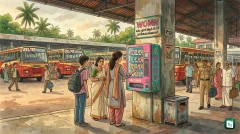
There is a wider point about access versus completion. A cash transfer can keep a student enrolled, but it cannot by itself fix the quality of teaching, the availability of hostels, or the safety of travel to distant colleges. The state’s parallel plans for six new girls’ colleges, a girls’ hostel in every district and sanitary vending machines in government institutions address some of these gaps.
The immediate test is administrative. The government must publish the application process well before January 2027, link it to the college admission system, and track whether beneficiaries actually complete three years. If the first cohort receives all three instalments, the scheme will have done something Kanyashree’s one-time grant could not: it will have paid for persistence, not just enrolment.
Key Takeaways
- The West Bengal Cabinet approved the Bhagini Nivedita Scheme on 5 October 2026 to give ₹50,000 to unmarried women pursuing undergraduate education.
- The amount is paid in three instalments of ₹17,000 in the first year, ₹17,000 in the second and ₹16,000 in the third, with the first payment due in January 2027.
- Beneficiaries must be unmarried and enrolled in a government or government-aided college in West Bengal; the application process and detailed eligibility rules are yet to be notified.
- The scheme replaces the Kanyashree K2 one-time grant of ₹25,000 and is backed by an allocation of ₹1,000 crore in the 2026-27 state Budget.
- Kanyashree, launched on 1 October 2013, was renamed Kanya Ratna in August 2026, with its annual school grant doubled from ₹1,000 to ₹2,000 from 2027.
- The scheme is named after Sister Nivedita, born Margaret Elizabeth Noble on 28 October 1867, who opened a girls’ school in Bagbazar, Kolkata, in 1898 and died in Darjeeling on 13 October 1911.
- The same Cabinet meeting cleared recruitment to 14,454 government posts and raised the monthly food allowance for SC and ST hostel students from ₹1,800 to ₹3,300.