The Reserve Bank of India has opened a dedicated foreign exchange window to meet the entire daily dollar requirement of Indian Oil Corporation, Hindustan Petroleum Corporation and Bharat Petroleum Corporation from October 12, 2026. In the same package, the central bank cut the threshold for rupee derivative positions without proof of underlying exposure from $100 million to $5 million and raised the daily minimum Cash Reserve Ratio maintenance for banks from 90% to 99%. The measures respond to a rupee that came within a whisker of its record low while crude oil stayed above $100 a barrel.
What Did the RBI Announce?
The RBI announced a special dollar window for three state-owned oil marketing companies, tighter rules for rupee-linked foreign exchange derivatives and a higher daily floor for CRR maintenance. The measures took effect between October 12 and October 16, 2026.
The three actions came through separate notifications rather than a single monetary policy resolution. The CRR change was notified on October 9, while the foreign exchange measures and the oil company window were announced on October 10.
| Measure | Key change | Effective date | Immediate purpose |
|---|---|---|---|
| Special dollar window | RBI sells US dollars to IOCL, HPCL and BPCL through designated banks for their entire daily requirement | October 12, 2026, until further notice | Remove large oil import bids from the spot market |
| Forex derivative rules | Threshold for positions without proof of underlying exposure cut from $100 million to $5 million; rebooking of cancelled contracts barred; 20% risk reserve on large hedges | October 10 and 12, 2026 | Curb one-sided bets against the rupee |
| CRR daily maintenance | Minimum daily CRR raised from 90% to 99% of the prescribed requirement; CRR rate left unchanged at 3% | Fortnight beginning October 16, 2026 | Keep a tighter grip on surplus banking liquidity |
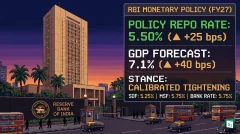
The backdrop was a sharp turn in the macroeconomic environment. The RBI’s Monetary Policy Committee raised the repo rate by 25 basis points to 5.50% on October 7, 2026, its first increase since February 2023, and changed its stance from neutral to calibrated tightening. Brent crude had moved above $100 a barrel after the re-escalation of the West Asia conflict, and the rupee was trading close to its all-time low.
Each measure works on a different channel. The dollar window removes a predictable chunk of demand from the spot market. The derivative rules make it more expensive to take a large rupee position without a genuine trade or payment to hedge. The CRR change does not withdraw fresh money from the system, but it reduces the room banks have to run down their cash balances on individual days.
Why Is the RBI Selling Dollars Directly to Oil Marketing Companies?
The RBI is selling dollars directly to IOCL, HPCL and BPCL so that their large, predictable crude oil payments do not hit the spot foreign exchange market. This reduces daily pressure on the rupee and lowers the companies’ cost of buying dollars.
Indian Oil Corporation Limited, Hindustan Petroleum Corporation Limited and Bharat Petroleum Corporation Limited are government-controlled refiners and fuel retailers. They buy crude oil from overseas suppliers in US dollars and sell petrol, diesel and cooking gas in India for rupees. That business model creates a steady need to convert rupees into dollars.
The three companies together need an estimated $300 million to $400 million every day, or roughly $10 billion to $12 billion a month, to pay for crude imports. India imports close to 90% of its crude oil, so this demand does not disappear when the rupee weakens. It only becomes more expensive.
Under the facility, the RBI sells US dollars to the three companies through designated banks. The companies pay in rupees and receive dollars for their import payments. The central bank has not disclosed the pricing formula or the exact volume it expects to supply.
How the Special Window Works
The window covers the entire daily dollar requirement of the three public sector companies, not a fixed share of it. It began on October 12, 2026 and will continue until further notice. Only IOCL, HPCL and BPCL are eligible.
The operating logic is simple. When three large buyers enter the spot market on the same day, their bids can push up the dollar’s price and weaken the rupee. Routing the same demand through a dedicated window keeps those lumpy orders away from the market. Analysts estimate that avoiding even a 5 to 15 paise increase in the cost of each dollar can save a substantial amount at these volumes.
The window does not remove currency risk for the companies. The cost of hedging dollar payments through forward contracts was around an annualised 4% forward premium in October 2026. What the window changes is the mechanics of buying dollars, not the underlying exposure to crude prices or exchange rates.
The 2013 Precedent and What Is Different
The RBI used a similar facility during the 2013 taper tantrum, when the rupee crashed to a record low of ₹68.85 per dollar on August 28, 2013. On the same day, the central bank opened a special window for the same three oil marketing companies. That facility was a sell/buy swap: the RBI supplied dollars immediately and bought them back later. The companies drew about $12 billion, and the window was tapered as the market stabilised.
The 2026 facility is an outright sale, not a swap. The RBI sells the dollars and does not contract to buy them back. This means the foreign exchange reserves fall by the amount sold, with no future reverse flow from the oil companies. A swap would have deferred the pressure to a later date; an outright sale absorbs it now.
The earlier episode also included a window during the 2008 global financial crisis, which shows that the RBI treats this tool as a temporary circuit breaker rather than a permanent subsidy.
How Large Is India’s Oil-Linked Dollar Demand?
India’s crude oil import bill reached $90.6 billion in April to September 2026, up 46% from a year earlier. Because the country imports close to 90% of its crude, every rise in oil prices adds directly to dollar demand and pressure on the rupee.
The increase came almost entirely from prices, not volumes. India imported 100.7 million tonnes of crude in April to August 2026, marginally below the 101.1 million tonnes bought in the same period a year earlier. Yet the import bill for those five months jumped 48% to $74.8 billion.
| Indicator | Latest reading | Period |
|---|---|---|
| Crude oil import bill | $90.6 billion, up 46% year on year | April to September 2026 |
| Crude import volume | 100.7 million tonnes | April to August 2026 |
| Brent crude price | Above $100 a barrel | October 2026 |
| Indian crude basket | $108.91 a barrel | September 8, 2026 |
| Daily dollar need of the three PSU OMCs | $300 million to $400 million | October 2026 |
Higher crude prices hurt India through several connected channels. A larger import bill widens the trade deficit, which feeds into the current account deficit. A wider deficit, in turn, increases demand for dollars and weakens the rupee. A weaker rupee makes the next round of oil imports even more expensive in rupee terms, which adds to imported inflation.
Economists estimated that if crude stayed above $90 a barrel for much of the second half of 2026-27, India’s current account deficit could widen to about 1.7% of GDP, or roughly $71 billion. The rupee had already lost more than 7% against the dollar in 2026 before the RBI’s October measures.
The pressure also shows up on the books of the oil marketing companies. With retail fuel prices held steady, state-owned retailers were losing about ₹5 per litre on petrol and ₹23 per litre on diesel in September 2026, with under-recoveries of around ₹200 per cylinder on domestic LPG. Those losses limit how much the companies can absorb without government support.
This is why the RBI’s window matters beyond the foreign exchange market. Oil demand is inelastic in the short run: India cannot stop importing crude because the rupee is weak. By supplying dollars directly, the central bank prevents a known, recurring buyer from amplifying every bout of rupee weakness.
What Changes in the Rupee Forex Derivatives Market?
Authorised dealer banks can now allow rupee-linked foreign exchange derivative positions without proof of underlying exposure only up to $5 million, down from $100 million. The RBI has also barred rebooking of cancelled contracts and imposed a 20% cash reserve on large hedges.
A currency derivative is a contract whose value depends on the exchange rate. Exporters and importers use these contracts to lock in a rate for a future payment. The “underlying exposure” is the actual trade, loan or payment that the contract is meant to protect against.
Authorised dealers are banks and other entities licensed under the Foreign Exchange Management Act, 1999 to deal in foreign exchange. They are the gatekeepers for every hedging transaction that a company undertakes.
The RBI’s October 10 directions made four changes to this market. First, the threshold for taking a position without establishing underlying exposure fell from $100 million to $5 million across all authorised dealers. The same limit applies to exchange-traded currency derivatives across all recognised stock exchanges taken together. Second, authorised dealers cannot permit a user to rebook a cancelled rupee derivative contract, whether deliverable or non-deliverable. Third, dealers must obtain a written undertaking that the same exposure has not been hedged with another dealer. Fourth, large contracts now attract the Foreign Exchange Risk Reserve.
The rebooking ban closes a familiar loop. A company could cancel a forward contract when the rupee moved in its favour, book a profit, and then re-enter at a better rate. That practice turned hedging into a directional bet. Rollovers at maturity are still allowed, so genuine hedgers are not blocked from extending cover.
The Foreign Exchange Risk Reserve Explained
The Foreign Exchange Risk Reserve (FERR) applies to rupee-linked derivative contracts where a user is buying foreign currency against the rupee to hedge a current account transaction, and the notional value exceeds $2 million. The authorised dealer must park 20% of the rupee equivalent of the notional amount in cash with the RBI.
The reserve does not earn interest. It must be maintained daily on a gross basis for each qualifying contract, starting the working day after the contract is signed and continuing until a day after it ends. It sits alongside the bank’s CRR obligation and cannot be counted towards high-quality liquid assets under the liquidity coverage ratio framework.
| Rule | Position before October 2026 | Position after the new directions |
|---|---|---|
| Over-the-counter derivative without underlying exposure | Up to $100 million | Up to $5 million |
| Exchange-traded currency derivative without underlying exposure | Up to $100 million across exchanges | Up to $5 million across exchanges |
| Rebooking a cancelled rupee contract | Permitted in specified cases | Barred after cancellation with any dealer |
| Documentation | Standard know-your-customer checks | Written undertaking that the exposure is not hedged elsewhere |
| Reserve on large current account hedges | None | 20% of rupee notional above $2 million |
The reserve is not retrospective. Contracts signed before October 10, 2026 do not attract it, but a rolled-over contract is treated as a fresh contract and does attract the reserve if it meets the conditions. On October 12, the RBI extended the requirement to authorised dealers hedging their own assets and liabilities where they buy foreign currency against the rupee. Market-making and proprietary positions are outside this extension.
The arithmetic is straightforward. A contract with a notional value of $10 million at a contracted rate of ₹95 per dollar has a rupee notional of ₹95 crore. The FERR on it works out to ₹19 crore.
The design resembles the reserve requirements that China has used on forward dollar sales during periods of yuan weakness. The aim is to make a one-way bet on the rupee expensive for the party taking it.
What the Reserve Means for Banks and Importers
For banks, the FERR locks up cash that would otherwise be used for lending or trading. Several banks asked the RBI to replace the cash requirement with a fee, arguing that a 20% cash reserve raises the cost of offering hedges. The RBI has not changed the basic structure.
For importers, the immediate effect is a higher cost of currency protection. A company that wants to fix the rupee cost of a future dollar payment may pay more for the same forward contract. The impact is largest for firms with big dollar payables, such as crude oil, machinery and component importers.
The RBI issued detailed FAQs on October 15, 2026 after the initial directions disturbed forward market pricing. The clarifications exempted hedges of interest on external commercial borrowings, coupons on resident debt instruments held by non-residents, and dividends payable to non-resident investors, because those payments arise from capital account transactions. Contracts where a user sells foreign currency against the rupee are also outside the reserve.
Why Did the RBI Raise Daily CRR Maintenance to 99%?
The RBI raised the minimum daily CRR maintenance from 90% to 99% of the prescribed requirement to keep a tighter grip on surplus banking liquidity. The CRR rate itself remains 3% of net demand and time liabilities; only the daily floor has changed.
The Cash Reserve Ratio is the share of a bank’s net demand and time liabilities that it must hold as cash with the RBI. It earns no interest, so every rupee parked as CRR is a rupee that cannot be lent. The current CRR of 3% followed a 100 basis point cut in four equal tranches between September and November 2025, when the RBI reduced it from 4% to 3%.
The daily maintenance rule works alongside the fortnightly average. Before the change, a scheduled bank had to keep at least 90% of its required CRR on any given day, while the average across the reporting fortnight had to be at least 100%. This gave treasuries room to hold 90% on some days and 110% on others, as long as the average worked out.
From the fortnight beginning October 16, 2026, the daily floor rose to 99%. Banks can no longer run down their CRR balances on individual days by the same margin. The total CRR requirement has not increased, but the flexibility to manage it has almost disappeared.
| Feature | Cash Reserve Ratio | Statutory Liquidity Ratio |
|---|---|---|
| What banks hold | Cash with the RBI | Cash, gold or approved government securities |
| Statutory basis | Section 42(1), RBI Act, 1934 | Section 24, Banking Regulation Act, 1949 |
| Current rate | 3% of NDTL | 18% of NDTL |
| Interest earned | None | Interest-bearing securities |
| Main purpose | Monetary and liquidity control | Solvency and liquidity buffer |
The trigger was a persistent liquidity surplus of about ₹4 lakh crore in the banking system. The RBI had been absorbing this surplus through variable rate reverse repo auctions and open market sales of government securities. Those operations had not fully drained the excess. Raising the daily CRR floor forces banks to keep more cash with the central bank through the fortnight, which reduces the funds available for overnight lending.
The change also matters for the definition of a reporting fortnight. The Banking Laws (Amendment) Act, 2025 changed the fortnight from the Saturday-to-second-following-Friday cycle to the periods from the 1st to the 15th and the 16th to the last day of each month. The new definition took effect on December 15, 2025, which is why the CRR notification refers to the fortnight beginning October 16.
Bankers described the move as mainly an operational tightening. Most large banks already maintain balances close to the required level, so the immediate impact on aggregate liquidity is smaller than a headline CRR hike would suggest. The signal, however, is clear: the RBI wants less day-to-day slack in the system while it manages inflation and the currency.
How Have the Rupee and Forex Reserves Moved?
The rupee strengthened about 2% in the week to October 16, 2026, closing near ₹94.92 per dollar after nearing its record low. Foreign exchange reserves fell to $726.03 billion as the RBI sold dollars and valuation losses added to the decline.
The rupee vs dollar rate is simply the price of one US dollar in Indian rupees. A higher number means the rupee has weakened, because it takes more rupees to buy the same dollar.
The currency’s slide had been relentless for most of the year. The rupee hit its record low of ₹96.98 per dollar on May 20, 2026. It came close to that level again in early October, touching 96.96 during intraday trade, and closed at 96.78 on October 7 despite the RBI’s rate hike.
The October 10 package changed the mood. The rupee gained for six consecutive sessions and closed at ₹94.92 on October 16, its best weekly performance in seven months. It ended at ₹94.925 on October 19, nearly flat, as a slump in domestic equity markets and importer demand for dollars offset the earlier gains. Even after the recovery, the rupee was still down more than 6% against the dollar in 2026.
| Indicator | Latest level | Date or period |
|---|---|---|
| Rupee | ₹94.92 per dollar | October 16, 2026 |
| Record low | ₹96.98 per dollar | May 20, 2026 |
| Forex reserves | $726.03 billion | Week ended October 9, 2026 |
| Peak forex reserves | $785.71 billion | Week ended September 4, 2026 |
| Repo rate | 5.50% | Effective October 7, 2026 |
| CPI inflation | 4.8% | August 2026 |
| FY27 inflation projection | 5.2% | October 2026 policy |
The reserves story is closely tied to the currency defence. Reserves peaked at $785.71 billion in the week ended September 4, helped by a special concessional swap facility for foreign currency non-resident bank deposits. Banks mobilised nearly $133 billion through that route. Reserves then fell by almost $60 billion from the peak, reaching $726.03 billion by October 9, as the RBI sold dollars and global asset values moved.
RBI Governor Sanjay Malhotra (as of October 2026) said the rupee may be undervalued rather than overvalued. One measure he cited was the Real Effective Exchange Rate, which compares the rupee with a basket of trading partner currencies after adjusting for inflation. A REER above 100 suggests overvaluation. India’s REER stood at 88.92 in August 2026, which supports the view that the rupee was not expensive in real terms.
A large reserve buffer gives the RBI room to intervene. It does not remove the underlying causes of rupee weakness: a high oil import bill, foreign portfolio outflows, high US bond yields and a strong dollar. The October package bought time and calmed the market. It did not change those fundamentals.
What Does the Package Mean for Banks, Importers and the Economy?
The package raises the cost of hedging dollars, shifts oil-related demand away from the spot market and leaves banks with less daily liquidity flexibility. It supports the rupee in the short term, but it also imposes costs on banks and importers.
For banks, the most direct burden is the Foreign Exchange Risk Reserve. Cash parked with the RBI under this head earns no interest and cannot be used for lending. A bank with a large book of rupee derivative contracts therefore has to set aside more capital for the same business. Some banks have argued that a fee would be a more efficient way to achieve the same goal, but the RBI has retained the cash reserve design.
For importers, the cost of buying protection against a weaker rupee may rise. Companies with large dollar payments, such as crude oil, machinery and components, are the most exposed. The threshold changes also narrow the space for taking a view on the currency without a genuine transaction to back it. A small importer with a contract below $2 million is outside the FERR, but it still operates in a market where banks are pricing in the new reserve.
For the three public sector oil companies, the window lowers transaction costs and removes the risk of their own large orders pushing the rupee lower. It does not protect them from crude price risk or from losses on retail fuel sales. The facility is a currency supply arrangement, not a subsidy on petroleum.
For the wider economy, the immediate gain is a calmer currency and slightly lower imported inflation pressure. The cost is a drawdown in reserves. The rupee’s recovery also reduces the risk of a sharp pass-through from oil prices into food and transport costs, which matters because the RBI expects CPI inflation to average 5.2% in 2026-27.
The Risks and Limits
The window covers only the three public sector oil marketing companies. Private refiners such as Reliance Industries and Nayara Energy still buy dollars in the market, so a portion of India’s oil-related demand remains. The RBI has chosen the PSUs because they form the largest single block of predictable demand and are under government control.
The FERR carries its own risks. If hedging becomes too expensive onshore, some activity could move to offshore non-deliverable forwards, where the RBI’s reserve does not apply. The undertaking requirement, which asks users to confirm that the same exposure is not hedged with another dealer, is meant to prevent exactly this kind of regulatory arbitrage.
The CRR change is the mildest of the three measures. It does not alter the CRR rate or the average balance required over the fortnight. Its main effect is to remove the operational cushion that banks used to manage day-to-day cash flows. That can push overnight money market rates closer to the repo rate, but it will not drain liquidity on the scale of a CRR hike.
The common limitation is that none of these tools can offset a sustained oil shock. If crude stays above $100 a barrel, India’s import bill will remain high, the current account deficit will stay under pressure, and the RBI will have to keep intervening. The package manages the symptoms of rupee weakness. It does not cure them.
The Way Forward
The RBI has said the special window will remain in place until further notice. How long it lasts will depend on crude prices, the pace of foreign capital flows and the behaviour of the rupee. A sustained fall in Brent below $90 a barrel would reduce the daily dollar demand that the window is designed to absorb.
The next signal will come from the forward market. If hedging costs stabilise and the forward premium does not spike, the FERR will have achieved its purpose without freezing genuine trade hedges. If banks continue to complain about the cash lock-up, the RBI may adjust the design while keeping the deterrent effect.
Foreign exchange reserves are the third variable to watch. The buffer of about $726 billion is comfortable by historical standards, but weekly declines of $8 billion to $19 billion cannot continue indefinitely. The RBI will want the rupee to stabilise before the reserve drawdown becomes a concern in itself.
On the fiscal side, the government faces a familiar trade-off. Holding retail fuel prices down protects consumers and inflation, but it adds to the losses of the oil marketing companies and can require compensation from the Budget. Letting prices rise would ease the companies’ burden but add to headline inflation at a time when the RBI is already projecting 5.2% for the year.
The broader lesson is that India’s currency management now relies on a mix of intervention, regulation and targeted supply windows. The RBI has shown it is willing to use its balance sheet and its rule-making powers together. The test is whether the calm lasts once the initial squeeze on speculative positions fades.
Key Takeaways
- The RBI opened a special dollar window on October 10, 2026, effective October 12, for IOCL, HPCL and BPCL, selling US dollars through designated banks until further notice.
- The three public sector oil marketing companies need an estimated $300 million to $400 million daily, or $10 billion to $12 billion a month, for crude oil imports.
- The RBI cut the threshold for rupee-linked forex derivative positions without underlying exposure from $100 million to $5 million across authorised dealers and recognised stock exchanges.
- The Foreign Exchange Risk Reserve requires banks to keep 20% of the rupee notional value of eligible contracts above $2 million in cash with the RBI, earning no interest.
- The RBI raised the minimum daily CRR maintenance from 90% to 99% from the fortnight beginning October 16, 2026, while leaving the CRR rate at 3% of NDTL.
- The rupee strengthened about 2% to ₹94.92 per dollar by October 16, 2026, after nearing its record low of ₹96.98 in May.
- India’s forex reserves fell to $726.03 billion in the week ended October 9, 2026, down from a peak of $785.71 billion in September.
- In 2013, the RBI used a sell/buy swap window for the same three oil companies; the 2026 facility is an outright sale of dollars.