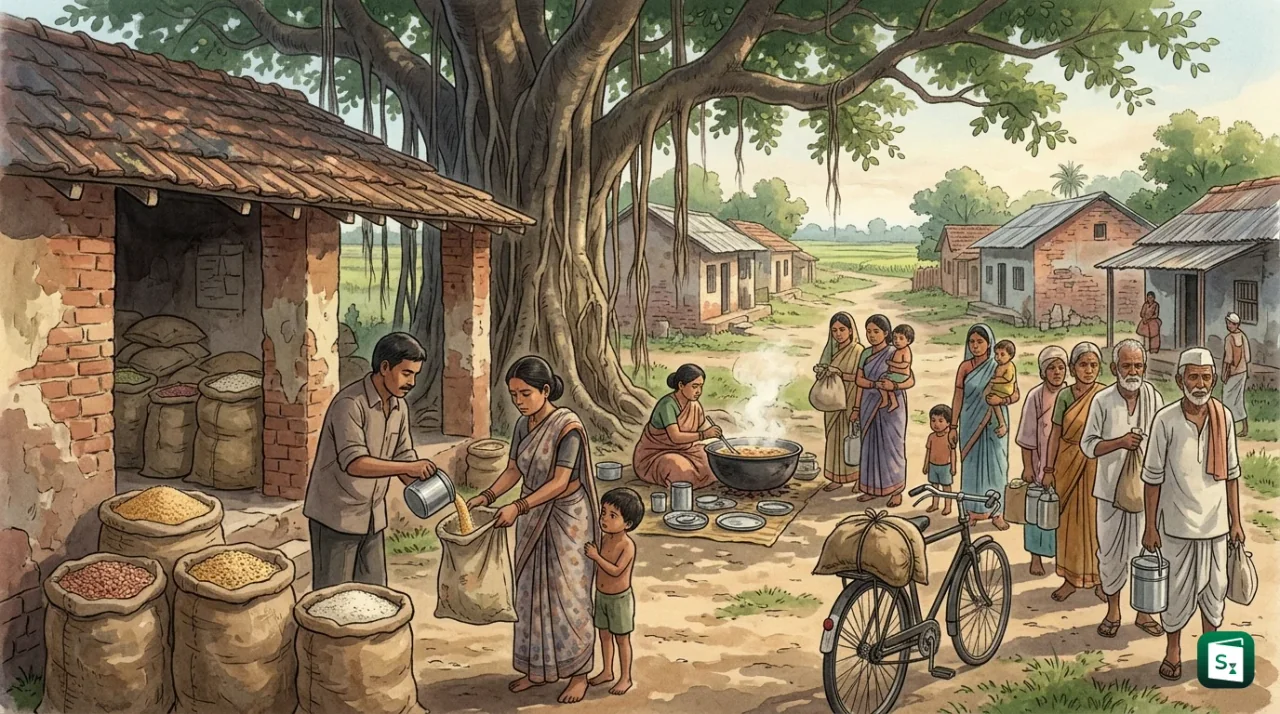
The Global Hunger Index 2026 ranks India 100th among 122 countries with a score of 24.1, placing the country in the serious hunger category. India shares this rank with Ethiopia. Released on 14 October 2026, two days before World Food Day, the report is themed No Security Without Food Security and warns that global hunger is rising again.
What Is the Global Hunger Index?
The Global Hunger Index (GHI) is a peer reviewed annual report that measures and tracks hunger at global, regional and national levels. The GHI combines calorie deficiency, child malnutrition and child deaths into a single score on a 100 point scale where zero means no hunger and 100 means the worst hunger.
The GHI started in 2006. For the 2026 edition, the GHI assessed data for 136 countries and calculated scores and ranks for 122 countries with sufficient data. The remaining countries had missing data and were not ranked. The reference period for the 2026 scores is largely 2021 to 2025, with undernourishment data for 2023 to 2025.
The GHI classifies every score into five severity levels. This scale helps readers understand what a number like 24.1 actually means.
| GHI Score | Severity Level | Meaning in Simple Words |
|---|---|---|
| 9.9 or less | Low | Hunger levels are under control |
| 10.0 to 19.9 | Moderate | Noticeable hunger and malnutrition remain |
| 20.0 to 34.9 | Serious | Widespread hunger and child malnutrition |
| 35.0 to 49.9 | Alarming | Very high hunger and health risk |
| 50.0 or more | Extremely alarming | Grave hunger emergency |
Who Publishes the Global Hunger Index?
The Global Hunger Index 2026 is jointly published by Welthungerhilfe (WHH), the Institute for International Law of Peace and Armed Conflict (IFHV) at Ruhr University Bochum, and the Swiss organisation Helvetas. The full report and country data are available on the official portal globalhungerindex.org.
Welthungerhilfe is a Germany based private aid organisation headquartered in Bonn. It works on food security, rural development and emergency aid in many countries. The IFHV is a research institute based in Bochum, Germany, that studies peace, conflict and humanitarian law. Helvetas is a Swiss development organisation headquartered in Zurich that works on food, water and livelihoods. In earlier years, the Irish organisation Concern Worldwide was also a co publisher of the index.
The publishers describe the GHI as a tool to draw attention to areas where more action and funds are needed to end hunger. The index also supports monitoring of the global goal to end hunger, which is Sustainable Development Goal 2 (Zero Hunger).
How Global Hunger Index Is Calculated?
The Global Hunger Index score is calculated from four component indicators that together show calorie shortage and child undernutrition. The GHI gives one third weight to undernourishment, one third weight to child mortality, one sixth weight to child stunting and one sixth weight to child wasting.
Undernourishment is the share of the population with insufficient calorie intake. Data for this indicator comes from the Food and Agriculture Organization (FAO), which is headquartered in Rome, Italy and was established in 1945. Child stunting means low height for age in children below five years. It reflects long term or chronic undernutrition. Child wasting means low weight for height in children below five years. It reflects short term or acute undernutrition. Data for stunting and wasting come from the World Health Organization (WHO), UNICEF and the World Bank joint estimates. Child mortality is the share of children who die before the age of five. It reflects the deadly mix of poor nutrition and weak health care. Data for this indicator comes from the United Nations child mortality estimates.
A lower score is better. A country with adequate food, healthy children and very few child deaths gets a score near zero. The GHI report cautions that scores from one annual edition cannot be directly compared with printed scores from older editions. This is because UN agencies revise past data every year. The 2026 report therefore provides fresh values for 2000, 2006, 2012, 2018 and 2026 calculated with the same method. Only these values should be used to study change over time.
India Rank 100 and Score 24.1 in Global Hunger Index 2026
The Global Hunger Index 2026 places India 100th among 122 countries with a GHI score of 24.1. The score falls in the serious category. India shares the 100th rank with Ethiopia, which also scored 24.1. India remains in the serious band, where it has stayed since 2012.
The India country profile shows progress on calorie intake and child survival alongside continued stress on child nutrition. The four indicator values for India used in the 2026 calculation point to one clear pattern. Fewer people go hungry for calories than before, but too many young children remain undernourished.
| Indicator for India | Value in 2026 Report | What It Shows |
|---|---|---|
| Undernourishment | 9.8% of population | Share of people with too few calories |
| Child stunting | 29.3% of children under five | Low height for age, sign of chronic undernutrition |
| Child wasting | 19.0% of children under five | Low weight for height, sign of acute undernutrition |
| Child mortality | 2.7% of children under five | Share of children dying before age five |
Child stunting in India has fallen from 50.0% in 2000 to 29.3% in 2026, a drop of 20.7 percentage points. Undernourishment has declined from around 18% in 2000 to 9.8% now. Child mortality has also improved sharply over the same period. Child wasting, however, stays close to 19%, which is among the highest rates recorded in the world. Wasting is now the sharpest driver of concern for India, since it reflects recent weight loss from poor diet, infection or lack of care.
India scores worse than the world average and the regional average. The global GHI score is 18.1, which falls in the moderate category. The South Asia score is 23.5, which falls in the serious category. India at 24.1 sits slightly above both levels.
Which Country Ranks First in Global Hunger Index?
No single country holds the first rank alone in the Global Hunger Index 2026. A group of 24 countries with scores below 5.0 share ranks 1 to 24 collectively. These countries have very low hunger levels and are not ordered separately within the group.
The 2026 report names Armenia, Belarus, Bulgaria, Chile, Costa Rica and Croatia among these 24 top performers. China also figures in this low hunger group. These countries have scores below 5.0, which places them in the low category. Just after this group, Moldova is ranked 25th with a score of 5.0 and Mongolia is ranked 26th.
At the other end, Somalia is ranked last at 122nd with a score of 47.0, which falls in the alarming category. Somalia has faced prolonged conflict, drought and funding cuts for relief work. The Democratic Republic of the Congo is ranked 121st with a score of 39.5 and Chad is ranked 120th with a score of 38.0. Sudan, Burundi, South Sudan and Yemen could not be fully ranked in 2026 because of missing data, but the report flags them as areas of grave concern and gives Sudan a provisional alarming range.
The 2026 picture shows a clear global divide. Hunger has worsened in 32 countries since 2018. The world as a whole has slipped from 17.6 in 2018 to 18.1 in 2026. In three of the four global indicators, namely undernourishment, child stunting and child wasting, conditions have worsened. Only child mortality has shown a small improvement. The report warns that 57 countries are unlikely to reach even the low hunger level by 2030, the deadline for the Sustainable Development Goals.
Previous Year Benchmark and Year on Year Comparison
The Global Hunger Index 2026 cannot be read against the printed ranks of earlier editions. The GHI team recalculates past scores each year when UN agencies update their data. Valid comparison is possible only with the revised series given inside the 2026 report itself.
For India, that revised series shows steady long term improvement followed by slower recent gains.
| Reference Year in 2026 Report | India GHI Score |
|---|---|
| 2000 | 38.1 |
| 2006 | 37.0 |
| 2012 | 28.8 |
| 2018 | 25.8 |
| 2026 | 24.1 |
The fall from 38.1 to 24.1 marks a gain of 14 points over 26 years. The pace of improvement was fastest between 2006 and 2012. Since 2018, the score has improved by only 1.7 points. The rank reflects this slowdown. India was ranked 102nd among 123 countries in the 2025 report and now stands 100th among 122 countries in the 2026 report. The small upward move comes partly from a smaller country count and shared ranks, not from a sharp drop in hunger.
The global trend has turned less favourable. The world score improved from 2000 to 2018 but then worsened to 18.1 in 2026. South Asia as a region has largely stalled. The report links the reversal to conflict, climate shocks, economic stress and high food prices. It estimates that 218 million people in South Asia, including Iran, were undernourished during 2023 to 2025.
Global Hunger Index 2026: India and Neighbouring Countries
The Global Hunger Index 2026 places India behind several neighbours but ahead of Pakistan and Afghanistan. South Asia as a whole stays in the serious category with a score of 23.5. The comparison shows that hunger in the region is shaped by local conditions such as farm output, food prices, health services and exposure to floods, droughts and conflict.
| Country | Rank in 2026 | GHI Score | Severity |
|---|---|---|---|
| Sri Lanka | 53 | 10.2 | Moderate |
| Nepal | 72 | 14.5 | Moderate |
| Myanmar | 72 | 14.5 | Moderate |
| Bangladesh | 84 | 19.2 | Moderate |
| India | 100 | 24.1 | Serious |
| Ethiopia | 100 | 24.1 | Serious |
| Pakistan | 106 | 25.5 | Serious |
| Afghanistan | 108 | 28.6 | Serious |
Sri Lanka, Nepal and Bangladesh fall in the moderate band. Pakistan and Afghanistan fall in the serious band with scores higher than India. The report notes that conditions in Pakistan and Afghanistan have worsened since 2018, driven by economic instability, high food inflation and climate linked disasters. Nepal has done notably better on stunting reduction, while Bangladesh has kept both undernourishment and child mortality lower than India despite similar income challenges.
What Does No Security Without Food Security Mean?
The theme of the Global Hunger Index 2026 is No Security Without Food Security. The Global Hunger Index 2026 argues that food insecurity and instability feed each other in both directions. Conflict, climate shocks and price spikes damage farms, markets and supply chains. At the same time, empty grain stores and high food prices deepen public anger, migration and unrest.
The report points to recent pressure points such as the war in Ukraine, fighting in Sudan and Gaza, and the escalation linked to the United States, Israel and Iran since early 2026. These events have raised fuel, fertiliser and food costs far beyond the battle zones. The report also notes that global food aid funding has fallen for the third year in a row and is expected to fall again in 2026.
To break this cycle, the GHI recommends four practical shifts. It asks governments to treat food and nutrition security as a core part of national security and crisis planning, with dedicated funds and early warning systems. It calls for stronger local food systems that can survive droughts and floods. It seeks protection for farmers, markets and relief workers during conflicts. It also urges better data collection in crisis zones such as Burundi, South Sudan, Sudan and Yemen, where hunger is hardest to measure.
For India, the message connects directly to domestic policy. Programmes such as the Public Distribution System, the PM POSHAN scheme for school meals, the Integrated Child Development Services for young children and mothers, and the PM Garib Kalyan Anna Yojana for free food grains shape calorie access for crores of families. The GHI values suggest that calorie support has helped cut undernourishment to 9.8%, while child feeding, clean water, sanitation and health checkups need sharper focus to cut wasting and stunting further.
Key Takeaways
- The Global Hunger Index 2026, themed No Security Without Food Security, was released on 14 October 2026.
- India ranks 100th among 122 countries with a score of 24.1, placing it in the serious category, jointly with Ethiopia.
- The GHI is jointly published by Welthungerhilfe, IFHV and Helvetas and is calculated from undernourishment, child stunting, child wasting and child mortality.
- 24 countries with scores below 5.0 share ranks 1 to 24, while Moldova ranks 25th and Mongolia ranks 26th.
- Somalia ranks 122nd with a score of 47.0, making it the lowest ranked country in the 2026 index.
- India records 9.8% undernourishment, 29.3% child stunting, 19.0% child wasting and 2.7% child mortality in the 2026 report.