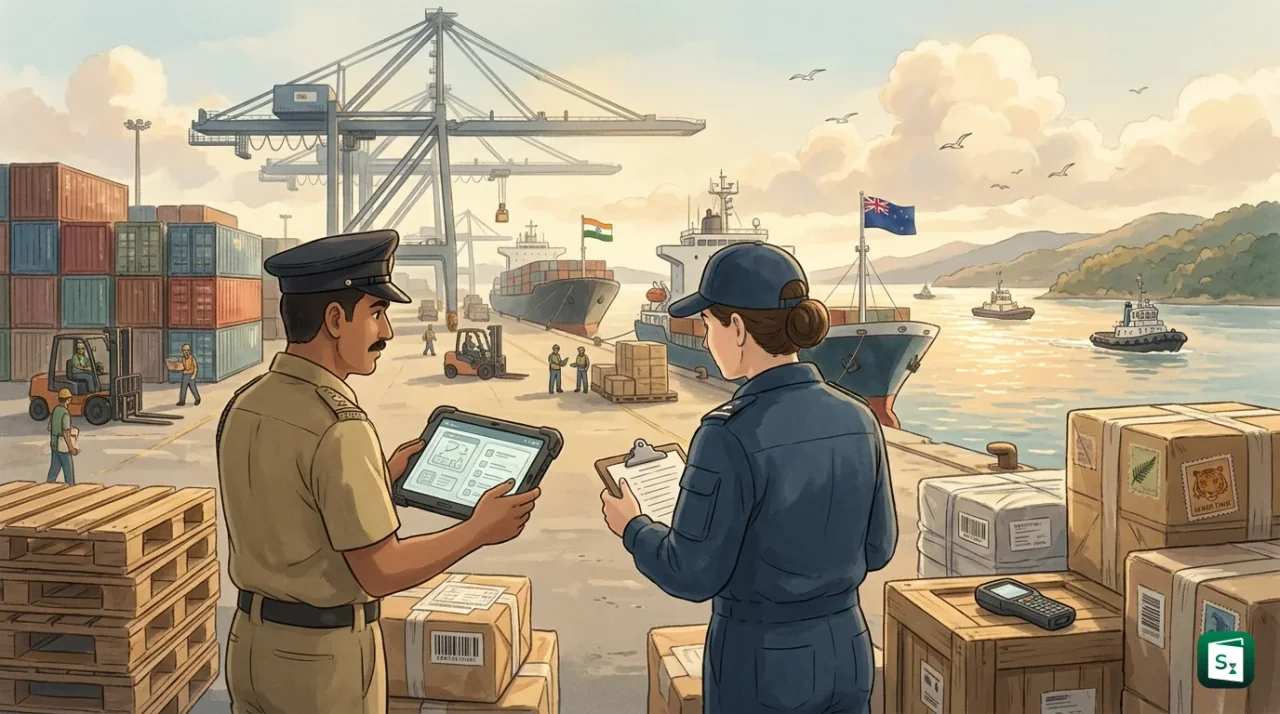
India’s customs administration and New Zealand’s customs service signed a Memorandum of Cooperation (MoC) on Electronic Origin Data Exchange on 19 October 2026 in the goods trade segment. The arrangement will allow the two countries to share origin information electronically in advance. It was signed under the India New Zealand Free Trade Agreement (FTA), which entered into force on 20 October 2026.
What Is a Free Trade Agreement?
A Free Trade Agreement (FTA) is a pact between two or more countries to reduce or remove barriers on trade between them. These barriers mainly include customs duties, import quotas and restrictive rules. The goal is to make goods and services cheaper, increase market access and encourage investment.
A standard FTA works through tariff cuts agreed in schedules, rules to decide which goods qualify for those cuts, and procedures for customs clearance and dispute settlement. In customs practice, the phrase what is FTA in customs simply refers to this preferential system. Only goods that meet the agreed rules of origin can claim the lower duty. The importer proves this by submitting a proof of origin at the time of clearance.
India New Zealand Free Trade Agreement: Overview and Core Mandate
The India New Zealand Free Trade Agreement is a bilateral pact to liberalise trade in goods and services, promote investment and improve cooperation on standards, customs and mobility. India and New Zealand announced negotiations on 16 March 2025 and concluded them on 22 December 2025 after five formal rounds. The FTA was signed on 27 April 2026 at Bharat Mandapam in New Delhi by Commerce and Industry Minister Piyush Goyal and New Zealand Trade and Investment Minister Todd McClay.
New Zealand completed its domestic ratification in September 2026. Both governments formally ratified the pact on 21 September 2026. The agreement entered into force on 20 October 2026. From that date, eligible exporters and importers can claim tariff preferences, provided their goods meet the origin and documentation conditions.
The core trade bargain is broad. New Zealand will provide 100% duty free access for all Indian exports on all tariff lines from entry into force. This removes peak duties of up to 10% that earlier applied to Indian ceramics, carpets, textiles, apparel, leather, footwear, automobiles and auto parts. India has offered liberalisation on 70.03% of tariff lines, covering about 95% of bilateral trade value. Duties on 30% of tariff lines were removed immediately, covering items such as wood, wool, sheep meat and raw hides. Duties on 35.6% of lines will be phased out over 3, 5, 7 and 10 years.
India has kept 29.97% of tariff lines in the exclusion list to protect sensitive farm and industrial interests. The excluded items include dairy products such as milk, cream, whey, yoghurt and cheese, several animal products, onions, chickpeas (chana), peas, corn, almonds, sugar, fats and oils, arms and ammunition, and copper and aluminium products. The FTA package also includes a $20 billion investment commitment over 15 years, cooperation on agricultural productivity, fast track pharma access, services openings in 118 sectors, and mobility pathways for students, STEM graduates and skilled workers.
The New Memorandum of Cooperation on Electronic Origin Data Exchange
The Central Board of Indirect Taxes and Customs (CBIC) of India and the New Zealand Customs Service (NZCS) signed the MoC concerning Electronic Origin Data Exchange of Trade in Goods on 19 October 2026. CBIC is the apex body under the Department of Revenue in the Ministry of Finance. It frames policy for customs duty, central excise and Goods and Services Tax administration and controls customs houses and field formations across India. NZCS is New Zealand’s national customs administration.
CBIC Chairman Vivek Chaturvedi and NZCS Comptroller and Chief Executive Christine Stevenson signed the document. The signing took place one day before the FTA entered into force. The MoC does not create new requirements for exporters or importers. It sets up the government to government channel to exchange and verify origin information.
The stated aims are direct. Advance electronic exchange will improve operational efficiency, reduce information gaps and give traders greater certainty. It will help customs manage risk better, allow faster clearance of genuine goods and ensure that FTA tariff benefits reach eligible firms quickly. Indian customs has committed to release regular goods within 48 hours and to try to release perishable goods within 24 hours. While a full electronic system is being built, the MoC also supports interim verification arrangements between the two customs authorities.
How Electronic Origin Data Exchange and Certification Work
The Electronic Origin Data Exchange System (EODES) is a secure channel through which the exporting country shares origin certificate data with the importing country before the goods arrive. The importing customs can then match the claim made by the importer with the data sent by the partner. This reduces paper checks, detects false claims and speeds up clearance.
Chapter 3 of the India New Zealand FTA lays down the rules of origin and requires an electronic system for exchange of information on Certificates of Origin from entry into force. It also requires the parties to set up, within 12 months from entry into force, a similar system for other proofs of origin. The launch of self declarations through origin declarations will depend on that verification system being ready.
Certificate of Origin, Proof of Origin and Origin Declaration
A Certificate of Origin is a document that certifies that goods in a shipment were made, grown or substantially transformed in a specific country. What is origin certificate in trade means the same idea. It is the main evidence used to claim a lower FTA duty. A proof of origin is the wider legal term in the FTA. It covers both a Certificate of Origin issued by an authorised body and an origin declaration made by an approved exporter or status holder.
Under the India New Zealand FTA, a claim for preferential tariff must be based on a valid proof of origin. It must be in English, carry a unique certification number, state that the good is originating, remain valid for 12 months from issue, and cover a single import consignment. The FTA provides templates for these forms in Annex 3B and Annex 3C, along with product specific rules in Annex 3A that decide whether a product has undergone enough processing in the partner country.
Who Issues the Certificate and How to Get It
Certificate of origin is issued by authorised issuing bodies notified by each government. In India, certificates are filed and issued through the common digital platform run by the Directorate General of Foreign Trade (DGFT), which functions under the Ministry of Commerce and Industry in New Delhi. The platform, now upgraded as eCoO 2.0 on Trade Connect (trade.gov.in), connects more than 125 issuing agencies, including national and regional chambers of commerce and the Export Inspection Council, and processes over 7,000 certificates daily.
Exporters apply online using their Importer Exporter Code (IEC), upload invoices and cost details, and obtain a digitally signed certificate with a QR code for verification. The system handles both preferential certificates for FTAs and non preferential certificates for general purposes. For exporters asking how to get origin certificate for New Zealand, the practical steps are to check the product specific rule for the item, obtain the correct preferential certificate from the DGFT platform or an authorised agency, and hand the proof of origin to the importer for presentation to New Zealand Customs. Indian status holders and New Zealand approved exporters can also use origin declarations once the electronic system for those declarations is in place.
| Document Type | Issued By | Used When |
|---|---|---|
| Preferential Certificate of Origin | DGFT authorised agencies in India, designated authority in New Zealand | To claim lower duty under the India New Zealand FTA |
| Non Preferential Certificate of Origin | Chambers of commerce and Export Inspection Agencies via eCoO 2.0 | For general proof of origin, trade finance or buyer requirement without FTA benefit |
| Origin Declaration | Status holder in India, approved exporter in New Zealand | Self certification option, subject to electronic verification system |
India New Zealand Trade Profile and FTA Impact
India New Zealand goods and services trade remains small compared with its potential. New Zealand data places two way total trade at about NZ$3.95 billion annually. In the year ended June 2026, New Zealand exported NZ$2.22 billion in goods and services to India, including NZ$921 million in goods and NZ$1.3 billion in services. India was New Zealand’s 21st largest goods export market and 5th largest services export market in that period.
India’s official data places bilateral merchandise trade at about $1.3 billion in 2024-25, with a 49% growth in that year. Indian merchandise exports have grown about 130% over ten years from 2015-16 to 2024-25. Exports to New Zealand stood at about $711 million, led by aviation fuel, textiles, pharmaceuticals and machinery. Imports from New Zealand were about $587 million, led by wood and wood products, coal, aluminium, wool, apples and kiwifruit. Services trade is broadly balanced, with Indian exports of about $634 million and imports of about $611 million, leaving a small surplus of $23 million for India.
India is New Zealand’s second largest trading partner in Oceania, but only its 9th or 10th largest export market overall, accounting for about 1.8% of New Zealand’s exports. The Indian diaspora of about 3,00,000 people, close to 5% of New Zealand’s population, acts as a strong people link. For India, the FTA gives labour intensive sectors such as textiles, apparel, leather, footwear, gems and jewellery, engineering goods and processed foods zero duty access from day one. For New Zealand, key gains include forestry, sheep meat, wool, coal, fish and seafood with duties phased out over seven years, and wine duties cut by 66% to 83% over ten years. Faster origin verification under the MoC will help small firms and first time exporters use these openings without long customs delays.
India’s Expanding FTA Network in Context
India FTA with how many countries is a common question because the network has grown fast in recent years. India has signed 17 Free Trade Agreements, including comprehensive partnership agreements. Of these, 16 are in force (as of August 2026). The India New Zealand FTA signed on 27 April 2026 was under ratification until its entry into force on 20 October 2026.
Seven of these 17 pacts were signed in the last five years with Mauritius, the United Arab Emirates, Australia, the European Free Trade Association (EFTA) covering Iceland, Liechtenstein, Norway and Switzerland, the United Kingdom, Oman and New Zealand. Negotiations with the European Union were concluded on 27 January 2026. India and the United States announced a framework for an interim trade agreement on 7 February 2026, with talks continuing.
| Agreement | Signed | Status |
|---|---|---|
| India Mauritius CECPA | 22 February 2021 | In force from 1 April 2021 |
| India UAE CEPA | 18 February 2022 | In force from 1 May 2022 |
| India Australia ECTA | 2 April 2022 | In force from 29 December 2022 |
| India EFTA TEPA | 10 March 2024 | In force from 1 October 2025 |
| India UK CETA | 24 July 2025 | In force from 15 July 2026 |
| India Oman CEPA | 18 December 2025 | In force from 1 June 2026 |
| India New Zealand FTA | 27 April 2026 | In force from 20 October 2026 |
The MoC model fits a wider shift toward paperless trade. India already exchanges origin data electronically with several partners and runs all preferential certificates through the DGFT digital platform. Similar electronic verification reduces misuse of tariff cuts, a concern flagged in past reviews of FTAs with ASEAN, Korea and Japan. For businesses, the lesson is clear. Tariff cuts alone do not raise exports. Simple proof, quick verification and predictable clearance decide whether small exporters actually use the FTA.
Key Takeaways
- The MoC on Electronic Origin Data Exchange was signed on 19 October 2026 by CBIC and the New Zealand Customs Service.
- The India New Zealand FTA was signed on 27 April 2026 and entered into force on 20 October 2026.
- New Zealand offers 100% duty free access for all Indian exports, while India liberalised 70.03% of tariff lines.
- A Certificate of Origin is issued through the DGFT eCoO 2.0 platform and remains valid for 12 months under the FTA.
- India has signed 17 FTAs, of which 16 were in force before the New Zealand pact became operational, with recent pacts including UAE, Australia, EFTA, UK and Oman.