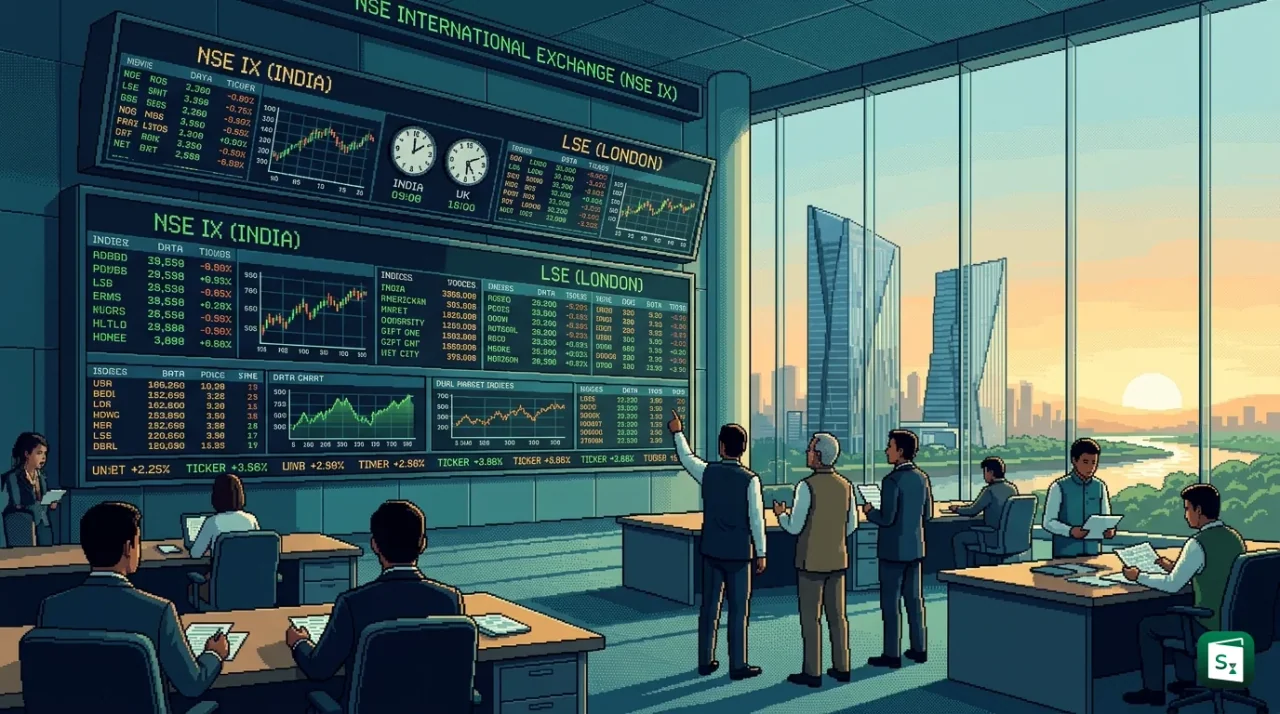
NSE IFSC Limited, which operates the NSE International Exchange (NSE IX) at GIFT City, signed a Memorandum of Understanding with London Stock Exchange plc (LSE) on 13 October 2026 to explore joint work on listings, trading and new financial products. The framework covers dual and cross listings across equity, fixed income and exchange traded funds, along with trading connectivity and derivatives linked to FTSE Russell indices. It connects London, one of the world’s oldest capital markets, with GIFT IFSC, India’s international financial gateway, at a time when the India UK trade agreement is pushing closer financial ties.
What Is NSE IX?
NSE International Exchange (NSE IX) is India’s international multi asset stock exchange located at GIFT City in Gandhinagar, Gujarat. NSE IX is a wholly owned subsidiary of the National Stock Exchange of India (NSE) and has operated since 5 June 2017 under the oversight of the International Financial Services Centres Authority (IFSCA).
NSE IX functions as an IFSC exchange. This means it operates inside a Special Economic Zone that is treated as a foreign territory for exchange control purposes. All trading and settlement on NSE IX happen in foreign currency, mainly in US dollars, and not in Indian rupees. The exchange keeps longer trading hours than domestic Indian exchanges so that its sessions overlap with markets in Asia, Europe and the United States.
The product range is wide. NSE IX offers Indian single stock derivatives, index derivatives, currency derivatives, commodity derivatives, depository receipts and global stocks. On the primary market side, it allows listing of equity shares, depository receipts, debt securities, green and sustainable bonds, Real Estate Investment Trusts, Infrastructure Investment Trusts and Special Purpose Acquisition Companies under IFSCA listing rules. NSE IX holds a dominant share of trading activity in GIFT IFSC, reported at more than 99.7 percent (as of October 2026).
Two features set NSE IX apart for global investors. First, NSE IX has received exemption relief from the US Commodity Futures Trading Commission and class relief from the US Securities and Exchange Commission, which allows customers from the United States to trade its derivative contracts. Second, NSE IX operates Global Access and unsponsored depository receipt platforms such as NSE IX Receipts, which let Indian investors access US listed stocks in fractional units with settlement guarantee through its clearing corporation, NSE IFSC Clearing Corporation.
What Is the London Stock Exchange?
London Stock Exchange plc (LSE) is the main stock exchange of the United Kingdom, based in London. LSE is operated by the London Stock Exchange Group (LSEG) and provides listing, trading, clearing and market data services for equities, fixed income and exchange traded funds.
LSE traces its roots to 1801, when the first regulated exchange was created in London. Its history goes back further to coffee house trading in the late 1600s. The modern LSEG was formed in October 2007 through the merger of London Stock Exchange with Borsa Italiana, the Milan stock exchange. LSE became a listed public company on its own market in 2001.
LSEG is today a global markets infrastructure group. It holds a majority stake in LCH, a leading clearing house, and owns FTSE Russell, the index business formed in 2015 by combining FTSE Group and Russell Indexes. FTSE Russell calculates well known benchmarks such as the FTSE 100, FTSE 250 and FTSE All Share indices. In 2021, LSEG completed the acquisition of Refinitiv, the financial data provider, which expanded its role in market data and analytics.
For Indian readers, two practical reference points matter. LSE trading normally runs from 8 am to 4.30 pm London time, which translates to 12.30 pm to 9 pm Indian Standard Time during UK winter clock settings. Its main equity benchmarks are tracked globally through index funds and ETFs, which is why any cross listing of ETFs between London and GIFT City draws close investor attention.
What Does the NSE IX LSE MoU Cover?
The NSE IX LSE agreement was announced at GIFT IFSC in Gandhinagar on 13 October 2026. NSE IFSC Limited and London Stock Exchange plc signed the document to create a broad framework for joint exploration. The framework does not by itself create new listings or live trading links. Each idea will need product design, issuer interest and regulatory clearance before launch.
The leaders who announced the pact set the tone for the next steps. V Balasubramaniam, Managing Director and Chief Executive Officer of NSE IX, linked the pact to closer capital market ties between London and India. Dame Julia Hoggett, Chief Executive Officer of London Stock Exchange plc, said the signing continues sustained work to connect two large capital markets for the benefit of companies and investors.
The table below summarises the areas listed for joint exploration.
| Area of Cooperation | What the Two Exchanges Will Explore |
|---|---|
| Dual and cross listings | Listing of equity shares, fixed income securities and ETFs on both markets to widen issuer and investor choice |
| Trading in existing products | Allowing investors to access products already listed on the other exchange through agreed channels |
| New derivatives | Developing derivatives to be listed on NSE IX using FTSE Russell indices as the underlying reference |
| Joint equity indices | Creating new equity indices together that can support index funds, ETFs and derivatives |
| Trading connectivity | Building cross border links to allow smoother two way order flow and better liquidity |
| Market data distribution | Sharing and distributing price and reference data to support trading and research |
The derivatives idea is central. If NSE IX lists contracts linked to FTSE Russell benchmarks, global investors familiar with those benchmarks could hedge or take exposure through GIFT City in US dollars. Joint indices could work in a similar way by forming the base for future ETFs or futures contracts.
What Is Dual Listing and Cross Border Listing?
Dual listing means a company lists its securities on two different stock exchanges to reach more investors and improve liquidity. Cross border listing means the second listing happens in a different country, so the company must meet the listing rules of both the home and the foreign exchange.
In practice, the two phrases are often used in a similar sense. A strict dual listed company structure involves two separate companies operating as one group with listings in two places. A cross listing is simpler. The same company seeks an additional listing abroad while remaining a single legal entity. Many large firms follow this route. Examples include non US firms that list in New York alongside their home market through ordinary shares or American Depository Receipts.
A cross listing is different from merely allowing a foreign share to be traded by arrangement. In a true cross listing, the company is formally registered with the second exchange and must file documents, follow disclosure standards and arrange settlement across jurisdictions. Shares are usually not freely interchangeable on the same day because a re registration process moves the outstanding balance from one jurisdiction to the other.
For the NSE IX LSE framework, this distinction matters. NSE IX operates under IFSCA listing regulations, while LSE operates under UK rules supervised by the Financial Conduct Authority. Any dual or cross listing will therefore need aligned prospectus standards, clearing arrangements and tax clarity before issuers can raise capital in both centres.
GIFT Nifty, Global Access and Market Link Context
GIFT Nifty is the best known product linked to NSE IX. GIFT Nifty refers to futures contracts based on NSE Nifty indices that trade at GIFT City in US dollars for almost all hours of the day. The contracts earlier traded in Singapore and now operate through the NSE IX SGX GIFT Connect, which became fully operational in 2023 and was inaugurated by the Prime Minister of India. The Connect channels Singapore trading interest into GIFT City and helps price discovery for Indian equities continue after domestic market hours.
This background explains why search interest around GIFT Nifty live prices stays very high. Traders watch overnight GIFT Nifty moves as an early signal for the next day opening of NSE in Mumbai. NSE IX offers extended sessions that cover Asian, European and US hours, so global events during the Indian night are reflected in GIFT Nifty futures before Indian cash markets open.
NSE IX Global Access is the second pillar to understand. Global Access is a platform that allows Indian investors to trade in international stocks through IFSC registered brokers. Investors open a trading and demat account with an authorised IFSC intermediary, complete know your customer checks and fund the account within the Liberalised Remittance Scheme limit of $250,000 per person per financial year. Orders are placed on the NSE IX system and settled in US dollars with guarantee from the IFSC clearing corporation. This route is distinct from buying a foreign mutual fund, where the investor buys units at net asset value and the fund manager decides the portfolio.
India has two IFSC exchanges at GIFT City. The table below places them in context.
| Exchange | Promoter and Location | Key Features |
|---|---|---|
| NSE IX | Wholly owned by NSE, operating at GIFT City since 2017 | Multi asset derivatives, debt listings, Global Access, GIFT Nifty through SGX Connect, clearing by NSE IFSC Clearing Corporation |
| India INX | Promoted by BSE, operating at GIFT City since 2017 | Equity derivatives, debt listings, Global Access for foreign stocks, clearing by India ICC |
| NSE domestic | NSE in Mumbai and regulated by SEBI | Rupee settled equities and derivatives for domestic hours |
The NSE IX LSE pact could add a London leg to this structure. If LSE listed ETFs tracking the FTSE 100 or FTSE All World indices are cross listed on NSE IX, Indian investors could buy and sell them during extended hours on an exchange platform instead of routing only through fund houses. No product list or launch date has been announced. Regulatory approvals, issuer participation and market making arrangements will decide the timeline.
Why the Pact Matters for India and the UK
The NSE IX LSE understanding did not emerge in isolation. NSE IX has said the seeds of the collaboration lie in the India UK Comprehensive Economic and Trade Agreement (CETA). CETA was signed on 24 July 2025 at Chequers in the United Kingdom and entered into force on 15 July 2026. The agreement gives zero duty access for nearly 99 percent of Indian exports to the UK and contains wide commitments on services, professional mobility, digital trade and investment. Prime Minister Narendra Modi has underlined that GIFT City should interact more closely with the UK financial ecosystem under this partnership.
The financial dialogue track reinforces the same direction. The Fourth India UK Financial Markets Dialogue took place in London on 29 September 2026, led by the Indian Ministry of Finance and HM Treasury with participation from SEBI, the Reserve Bank of India, IFSCA, the Pension Fund Regulatory and Development Authority, the Insurance Regulatory and Development Authority of India, the Bank of England and the Financial Conduct Authority. The joint statement discussed cross border equity and bond listings through GIFT IFSC and stronger capital market connectivity. The two sides also work through the India UK Financial Partnership and the Vision 2035 roadmap for long term cooperation.
For India, the gains centre on GIFT IFSC. The International Financial Services Centres Authority (IFSCA) was established on 27 April 2020 under the IFSCA Act, 2019 and is headquartered at GIFT City, Gandhinagar. IFSCA acts as a unified regulator inside the IFSC and exercises powers that RBI, SEBI, the Insurance Regulatory and Development Authority of India and the Pension Fund Regulatory and Development Authority hold outside the zone. A working link with London would help GIFT City attract foreign issuers, improve liquidity in IFSC listed products and give Indian companies a clearer path to global capital without leaving the Indian regulatory perimeter.
For the UK, the pact offers closer access to one of the fastest growing large economies. London investors could gain simpler exposure to India linked derivatives, debt and sustainable finance products listed in GIFT City. Data cooperation and joint indices would also support LSEG index and data businesses. In a period when global exchanges compete for listings and trading volumes, a two way bridge spreads issuance and trading across both time zones.
The Way Forward
The MoU is exploratory, so the next steps will decide its value. The two exchanges will first identify priority products where issuer demand is strongest, most likely ETFs and fixed income securities, followed by FTSE Russell linked derivatives. Each product will then need rule alignment on listing documents, settlement calendars, holiday schedules and clearing guarantees.
Regulatory coordination will be critical. NSE IX operates under IFSCA rules, while LSE products fall under UK regulation. The Financial Markets Dialogue and the Economic and Financial Dialogue provide the forum to resolve issues on investor protection, taxation of cross listed income and repatriation of funds through the Liberalised Remittance Scheme channel.
Market readiness will also matter. Cross listings succeed only when market makers provide continuous buy and sell quotes, data feeds reach brokers on time and custody arrangements handle corporate actions smoothly. If those blocks fall into place, the framework could move from paper to live trading links, joint indices and shared data products over the coming quarters.
Key Takeaways
- NSE IFSC Limited (NSE IX) signed an MoU with London Stock Exchange plc on 13 October 2026 at GIFT City to explore cross border listings and trading links.
- NSE IX has operated at GIFT City since 5 June 2017 as a wholly owned subsidiary of NSE under IFSCA oversight with trading and settlement in US dollars.
- The MoU covers dual listings of equity, fixed income and ETFs, FTSE Russell linked derivatives, joint indices, trading connectivity and market data sharing.
- LSE traces its regulated history to 1801 and is operated by LSEG, formed in 2007, which owns FTSE Russell and acquired Refinitiv in 2021.
- The pact builds on CETA, signed on 24 July 2025 and in force from 15 July 2026, and the Fourth India UK Financial Markets Dialogue held on 29 September 2026.