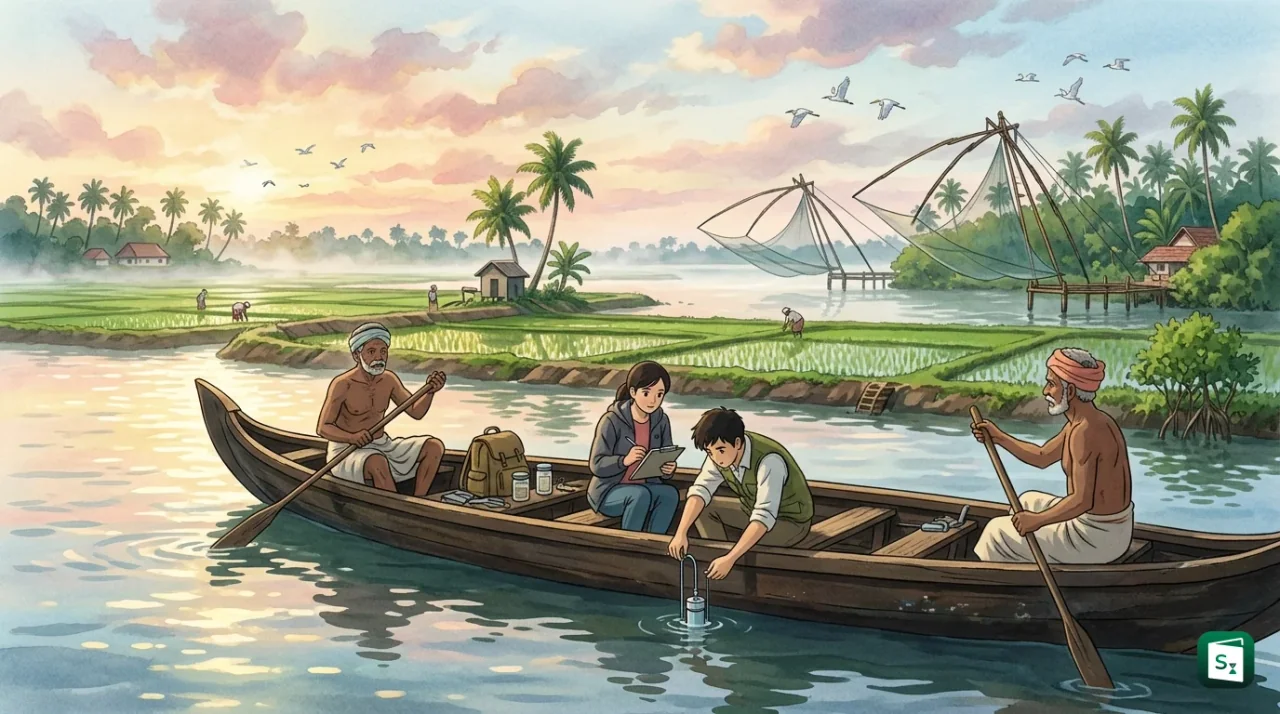
B Madhusoodana Kurup, renowned fisheries scientist and founding Vice-Chancellor of the Kerala University of Fisheries and Ocean Studies (KUFOS), passed away on 18 October 2026 in Kochi at the age of 71. Kurup built KUFOS into India’s first dedicated fisheries and ocean studies university and documented aquatic life from Kerala’s inland waters to the deep sea. His death came just days before the scheduled 30 October release of his co-authored book on the Vembanad Kole wetlands.
B Madhusoodana Kurup: Fisheries Scientist and Institution Builder
B Madhusoodana Kurup was born on 28 November 1954 and trained as a fisheries researcher, teacher and university administrator. A fisheries scientist studies fish, other aquatic life and the systems used to conserve, farm and harvest them. Kurup spent more than four decades in this field and became known for linking laboratory taxonomy with real problems of lakes, coasts and fishing communities.
Kurup completed postdoctoral research at Wageningen University in the Netherlands. He then served for over eighteen years as Director and Professor at the School of Industrial Fisheries of the Cochin University of Science and Technology (CUSAT) in Kochi. CUSAT is a public university owned by the Government of Kerala and headquartered at Kochi. During this long tenure, Kurup guided 22 doctoral scholars and shaped a generation of fisheries teachers and researchers.
Kurup died on 18 October 2026 while undergoing treatment at a private hospital in Kochi. The funeral took place on the same day at his residence, Jeyam House, at Paruthichuvadu in Nettoor, Kochi. He is survived by his wife, son and daughter.
What Is KUFOS?
The Kerala University of Fisheries and Ocean Studies (KUFOS) is an autonomous public university established on 20 November 2010 to teach and research fisheries, aquaculture and ocean science. KUFOS is funded by the Government of Kerala, governed by the KUFOS Act of 2010 and headquartered at Panangad in Kochi.
KUFOS is India’s first university created only for fisheries and ocean studies. The Kerala Legislative Assembly passed the law for the university in 2010, and the Government of Kerala issued the formation notification on 28 January 2011 as Act 5 of 2011. KUFOS functions under the state Ministry of Fisheries. This administrative link is important because fisheries is a state subject with strong local livelihood stakes.
The university was formed by separating two units from the Kerala Agricultural University. Under an order dated 10 May 2011, the College of Fisheries at Panangad and the Fisheries Station at Puthuvype became part of KUFOS with effect from 1 April 2011. The College of Fisheries at Panangad was already one of the nineteen fisheries colleges in the country. The main campus sits about 12 km from Kochi city in Ernakulam district.
KUFOS is a government institution, not a private college. It is approved by the University Grants Commission (UGC), accredited by the Indian Council of Agricultural Research (ICAR) and cleared by the All India Council for Technical Education (AICTE) for its technology programmes. KUFOS became the first university in Kerala to earn an A grade from the National Assessment and Accreditation Council (NAAC) in its first accreditation cycle. Kurup, as founding Vice-Chancellor, laid down its academic departments, research stations and administrative rules in its formative years.
Scientific Contributions and Leadership Roles
Kurup published more than 250 research papers and edited 11 books. His taxonomic work led to the discovery of eight new freshwater fish species from the Western Ghats, one of the world’s richest biodiversity hotspots. Taxonomy is the science of identifying, naming and classifying living organisms. Such discoveries matter because correct identification is the first step in conservation and fisheries management.
His field studies covered a wide range. Kurup documented aquatic biodiversity from the inland waters of Kerala, including Vembanad Lake, to depths of about 1,000 metres in India’s Exclusive Economic Zone (EEZ). The EEZ is the sea area up to 200 nautical miles from the coast where India has special rights over marine resources. This inland to deep sea arc gave his work unusual breadth.
Kurup also led large applied projects. He headed the Kuttanad Water Balance Study under the Indo-Dutch Cooperation Programme. The study examined floods, salinity and water flows in Kuttanad, the low-lying rice bowl around Vembanad Lake. He contributed to the Indo-Vietnam South-South Cooperation Programme, the Ashtamudi Management Plan and the World Bank supported India Eco-Development Project. Ashtamudi Lake in Kollam district is another major estuarine lake of Kerala and a Ramsar site designated in 2002.
Kurup held several national and state positions that shaped policy and research direction.
| Institution or Body | Role Held by Kurup |
|---|---|
| KUFOS, Panangad Kochi | Founding Vice-Chancellor |
| Shri Venkateshwara University, Gajraula in Uttar Pradesh | Vice-Chancellor |
| Rajiv Gandhi Centre for Aquaculture under the Marine Products Export Development Authority (MPEDA) | Chairman of Scientific Advisory Committee |
| ICAR Central Institute of Brackishwater Aquaculture (CIBA), Chennai | Chairman of Research Advisory Committee |
| Kerala Coastal Zone Management Authority | Member |
| Kerala Fisheries Minister | Adviser |
The Marine Products Export Development Authority (MPEDA), established in 1972 and headquartered in Kochi, promotes marine exports. The Central Institute of Brackishwater Aquaculture, headquartered in Chennai, works on shrimp and brackishwater farming under the Indian Council of Agricultural Research (ICAR). ICAR, set up in 1928 and headquartered in New Delhi, guides farm research across India. Through these posts, Kurup influenced aquaculture standards, coastal regulation and training of young scientists.
The Final Book on Vembanad Kole Wetlands
Kurup co-authored the book Exploring the Legacy of Fishing and Farming Below Sea Level: Vembanad Kole Wetlands of Southern India with Dr Sileesh Mullasseri. The book was scheduled for release on 30 October, just twelve days after Kurup’s death on 18 October 2026. Vembanad Lake and its conservation remained especially close to his heart through his final years.
The title captures the central theme. Fishing and farming below sea level means growing paddy and catching fish on land that sits lower than the level of the sea. Farmers first build earthen walls, called bunds, around shallow plots. They then pump out water to create dry fields for a season. After harvest, water is allowed back for fish and prawn culture. The Vembanad Kole region of Kerala is one of the very few places in the world where this system still supports large numbers of people.
The book places this local practice in a larger story of ecology, livelihood and heritage. It explains how reclaimed wetlands feed families, shelter birds and fish, and face pressure from reclamation, pollution and saltwater entry. For readers, the book serves as a bridge between Kurup’s scientific papers and the lived knowledge of farmers and fishers around the lake.
Vembanad Kole Wetlands: Geography Behind the Book
The Vembanad Kole wetland complex is the largest brackish, humid tropical wetland ecosystem on India’s southwest coast. Brackish water is a mix of fresh river water and salty sea water. The system stretches in a low strip along the Malabar coast and supports paddy, fish, prawns, birds and backwater tourism. Understanding its map and functioning is essential to grasp why Kurup devoted his last book to it.
Vembanad Lake Is Located in Which State and Districts?
Vembanad Lake is located in the state of Kerala. The lake spreads across Alappuzha, Kottayam and Ernakulam districts, stretching about 96.5 km from Alappuzha in the south to Kochi and further north as part of the wider wetland chain.
Vembanad is the longest lake in India and the largest lake in Kerala. The lake proper covers about 204 to 230 sq km, while the full Vembanad Kol wetland system covers 2,033.02 sq km. The wider system runs from Alappuzha in the south to Azheekkode in the north. The lake is known by different local names. People call it Punnamada Kayal near Alappuzha and Kochi Kayal near Kochi.
Ten rivers feed the system. The main feeders include the Meenachil, Manimala, Pamba, Achankoil and Muvattupuzha. These rivers rise in the Western Ghats, flow west and meet the Lakshadweep Sea through the Kochi bar mouth. The lake has two clear parts. The southern part near Kuttanad is fresh water dominant, while the northern part near Kochi is salt water dominant. The Thanneermukkom regulator, built across the lake between Thanneermukkom and Vechur, blocks tidal salt water to protect paddy. Islands such as Pathiramanal, Perumbalam and Pallippuram lie inside the lake. Kumarakom Bird Sanctuary on its bank is a major waterfowl habitat.
Vembanad Kol was designated a Wetland of International Importance under the Ramsar Convention on 19 August 2002. The Ramsar Convention, adopted in the Iranian city of Ramsar in 1971, lists wetlands that need global conservation. India joined the convention in 1982 and has more than 90 Ramsar sites (as of October 2026). Vembanad supports finfish, shellfish and one of the country’s largest wintering waterfowl populations.
What Are the Kole Wetlands and Below Sea Level Farming?
The Kole wetlands are low-lying paddy and fish fields that form the northern part of the Vembanad Kol system. Kole lands lie mainly in Thrissur and Malappuram districts of central Kerala. About 13,000 to 13,632 hectares of Kole land stretch between the Kechery and Karuvannur rivers. The word Kole means bumper yield in Malayalam. The name reflects very high paddy output in a good season.
Most Kole plots sit 0.5 to 2.5 metres below mean sea level. Farmers build temporary earthen bunds around each plot, pump out water and grow paddy from December to May. This dry season crop is followed by fish and prawn culture when salinity rises. Kole wetlands contribute about 40 percent of the rice grown in the combined Thrissur and Malappuram area. The Enamavu lock, built in 1956 to 1957, regulates salt water entry into these fields. Bird surveys have recorded about 250 species in the remaining Kole tracts.
South of Kole lies Kuttanad, the delta of the Pamba, Manimala and Achankoil rivers around Vembanad Lake. Kuttanad covers about 900 sq km across Alappuzha, Pathanamthitta and Kottayam districts. Farmers reclaimed nearly 50,000 hectares from the lake and marshes over the past two centuries. These reclaimed blocks are called padasekharams. Fields sit 1.2 to 3 metres below sea level. In 2013, the Food and Agriculture Organization (FAO) recognised the Kuttanad Below Sea Level Farming System as a Globally Important Agricultural Heritage System (GIAHS). FAO, founded in 1945 and headquartered in Rome in Italy, gives this tag to farming systems of global cultural and ecological value. Kuttanad is the only system in India that practices rice cultivation below sea level.
Key Takeaways
- B Madhusoodana Kurup, founding Vice-Chancellor of KUFOS, passed away on 18 October 2026 in Kochi at the age of 71.
- KUFOS, established on 20 November 2010 under the KUFOS Act of 2010, is India’s first fisheries and ocean studies university headquartered at Panangad, Kochi.
- Kurup discovered eight new freshwater fish species from the Western Ghats and authored more than 250 research papers and 11 edited books.
- His final book, Exploring the Legacy of Fishing and Farming Below Sea Level, co-authored with Dr Sileesh Mullasseri, was scheduled for release on 30 October 2026.
- Vembanad Lake in Kerala, spanning Alappuzha, Kottayam and Ernakulam, is the longest lake in India at 96.5 km and part of the Vembanad Kol Ramsar site designated on 19 August 2002.
- The Kuttanad Below Sea Level Farming System was recognised by the FAO as a Globally Important Agricultural Heritage System in 2013.