Vummidi Ethiraj, the Chennai jeweller who helped craft the historic Sengol presented to Jawaharlal Nehru on the eve of Independence in 1947, passed away in Chennai on 21 October 2026 at the age of 99. Born on 25 November 1926, he was the patriarch of the family behind the 125-year-old Vummidi Bangaru Jewellers. The same five-foot gold-plated silver sceptre now stands beside the Speaker’s chair in the new Parliament House.
What Is Sengol?
The Sengol is a five-foot gold-plated silver sceptre topped with a seated Nandi, the sacred bull linked with justice. The word comes from the Tamil term Semmai, which means righteousness or just rule. The sceptre stands for ethical governance and was handed to Jawaharlal Nehru in 1947 to mark the transfer of power.
In Tamil, Sengol literally denotes a sceptre carried as a sign of kingly authority. In Hindi and English it is described as a rajadanda, or a sacred sceptre of rule. The core idea stays the same across languages. The holder of the Sengol is reminded that power must be exercised with fairness and moral duty.
The tradition traces back to the Chola dynasty, which ruled large parts of south India between the 9th and 13th centuries. Chola records and Tamil texts like the Tirukkural describe the handing of the Sengol during coronation as a pledge of just rule. The unbending staff showed that law must stay straight. The watching Nandi showed that justice must stay alert.
Who Was Vummidi Ethiraj?
Vummidi Ethiraj was a master jeweller from Chennai who kept alive a family craft tradition for more than eight decades. He was born on 25 November 1926 and passed away on 21 October 2026, a month short of his 100th birthday. At the time of Independence he was only about 20 years old and worked in the family workshop where the Sengol took shape.
The President of India Droupadi Murmu, Vice President C. P. Radhakrishnan (as of October 2026) and Prime Minister Narendra Modi condoled his death. The Prime Minister recalled meeting Ethiraj in 2023 and described the Sengol as a timeless symbol of civilisational heritage and rightful governance. Ethiraj is survived by his three children, Vijaya Bharathi, Uday Kumar Vummidi and Vijayendren Vummidi. His wife Sumitra Vummidi had passed away earlier.
Ethiraj was the patriarch of the Vummidi family, which owns Vummidi Bangaru Jewellers (VBJ). He saw the Sengol move through three phases in his own lifetime. He watched its making in 1947, its long stay in a museum, and its return to public honour in the new Parliament building in 2023.
The 1947 Transfer Ritual and the Thiruvavaduthurai Adheenam
Who gave the Sengol to Jawaharlal Nehru in 1947? The Sengol was presented to Nehru by priests of the Thiruvavaduthurai Adheenam, a Saivite monastery in present day Tamil Nadu. The monastery, which is more than 500 years old, commissioned the sceptre and sent its deputy high priest to Delhi for the ceremony on the night of 14 August 1947.
The sequence of events is closely tied to the final days of British rule. When the last Viceroy Lord Mountbatten asked how the transfer of power would be marked, Nehru is said to have consulted C. Rajagopalachari, who later became the last Governor-General of India. Rajagopalachari pointed to the Chola practice where a high priest hands the Sengol to a new king to bless a just reign.
On that night, the Adheenam representatives first handed the Sengol with holy water sprinkled from Thanjavur and sacred ash applied on the forehead. Religious songs were sung by an Oduvar, a temple singer, while nagaswaram music was played by noted musician Rajarathnam Pillai. The priests then handed the sceptre to Nehru shortly before his famous Tryst with Destiny speech in the Constituent Assembly. The ritual framed Independence as a civilisational transfer of responsibility guided by dharma, or righteous conduct.
Material Craft and Design Specifications of the Sengol
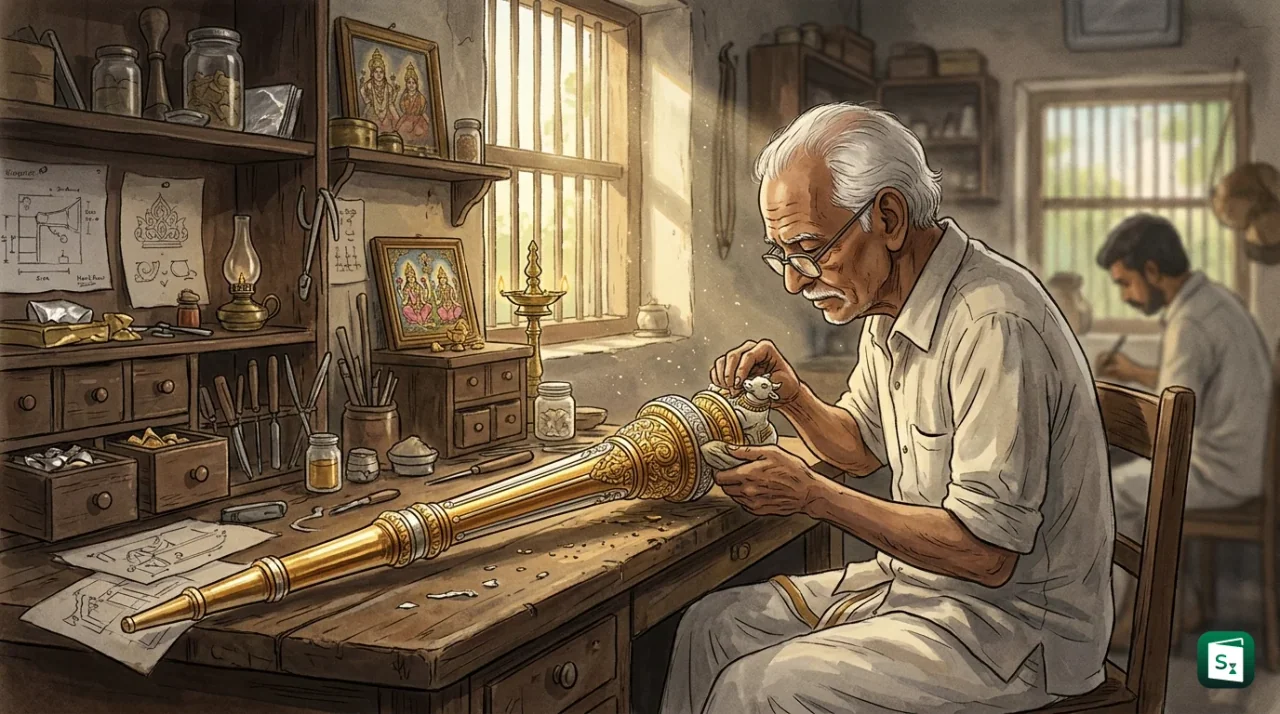
Who made the Sengol? The Sengol was designed and manufactured by Vummidi Bangaru Chetty and Sons in Madras, as Chennai was then called. The work was done at the family shop in Parry’s Corner. Ethiraj, then a young craftsman, was part of that effort along with senior goldsmiths of the house.
The Sengol is a masterpiece of south Indian metalwork. It measures about five feet (1.5 metres) in length, with rich carving from top to bottom. The outer body is made of silver plated with gold and encases a wooden staff inside. The diameter is about three inches at the top and tapers to about one inch at the bottom. At that time the value of the materials was reported at about ₹15,000.
| Feature | Detail |
|---|---|
| Length | About 5 feet or 1.5 metres |
| Material | Silver body with gold plating, wooden core inside |
| Finial | Seated Nandi bull on top, symbol of justice and watchfulness |
| Shaft | Carved shaft with Chola style motifs |
| Made by | Vummidi Bangaru Chetty and Sons, Madras, in 1947 |
| Commissioned by | Thiruvavaduthurai Adheenam |
At the top sits the seated Nandi, the vehicle of Lord Shiva. Nandi is treated as the witness to just action. The Ministry of Culture describes the Sengol as sanctified by the seers of the Adheenam and handcrafted by Vummidi Bangaru Chetty, carrying both spiritual blessing and skilled workmanship.
From Allahabad Museum to Sengol in New Parliament
Where was the Sengol kept before it came to Parliament? After 1947 the historic Sengol was preserved in the Allahabad Museum in Prayagraj, Uttar Pradesh. For many years it remained out of wide public view. Its rediscovery followed a letter to the Prime Minister’s Office citing a Tamil magazine article and photographs of the 1947 ceremony.
On 28 May 2023 Prime Minister Narendra Modi installed the same 1947 Sengol in the new Parliament House. The Sengol was placed in a glass case beside the Speaker’s chair in the Lok Sabha chamber, with the Nandi facing the east-west direction. Before the installation, Adheenam priests handed the Sengol to the Prime Minister after prayers.
The government presented the Sengol as a national symbol of the Amrit Kaal, the period leading to 100 years of Independence in 2047. The message was direct. People chosen to serve must govern with fairness and remember the pledge taken in 1947. In May 2023 the Vummidi family, including Ethiraj, was felicitated at the Prime Minister’s residence along with the Adheenam priests.
Vummidi Bangaru Jewellers: A Chennai Institution Since 1900
Vummidi Bangaru Jewellers, popularly known as VBJ, is one of Chennai’s oldest jewellery houses. The founder Vummidi Bangaru Chetty hailed from Gudiyatham near Vellore on the present Tamil Nadu and Andhra Pradesh border. He started by selling diamonds in villages like Pallikonda and opened a shop on Govindappa Naicken Street in Chennai in 1900. That beginning makes the house more than 125 years old.
The shop was later known as Vummidi Bangaru Chetty and Sons and shifted to Anna Salai, opposite the American Consulate near Anna Flyover. The business was renamed Vummidi Bangaru Jewellers in 1980. Today the fourth generation of the family leads the firm, with strong work in diamonds, silverware and handcrafted jewellery. The making of the 1947 Sengol remains its most historic commission, ordered because of the family’s repute for purity and fine work.
Key Takeaways
- Vummidi Ethiraj passed away in Chennai on 21 October 2026 at the age of 99.
- The historic Sengol is a five-foot gold-plated silver sceptre topped with a seated Nandi.
- The Sengol was crafted in 1947 by Vummidi Bangaru Chetty and Sons in Madras and presented to Jawaharlal Nehru on 14 August 1947.
- The Sengol was commissioned by the Thiruvavaduthurai Adheenam and draws on the Chola tradition of just rule.
- The word Sengol comes from Tamil Semmai, meaning righteousness, and the sceptre is now installed beside the Speaker’s chair in the Lok Sabha in the new Parliament House since 28 May 2023.