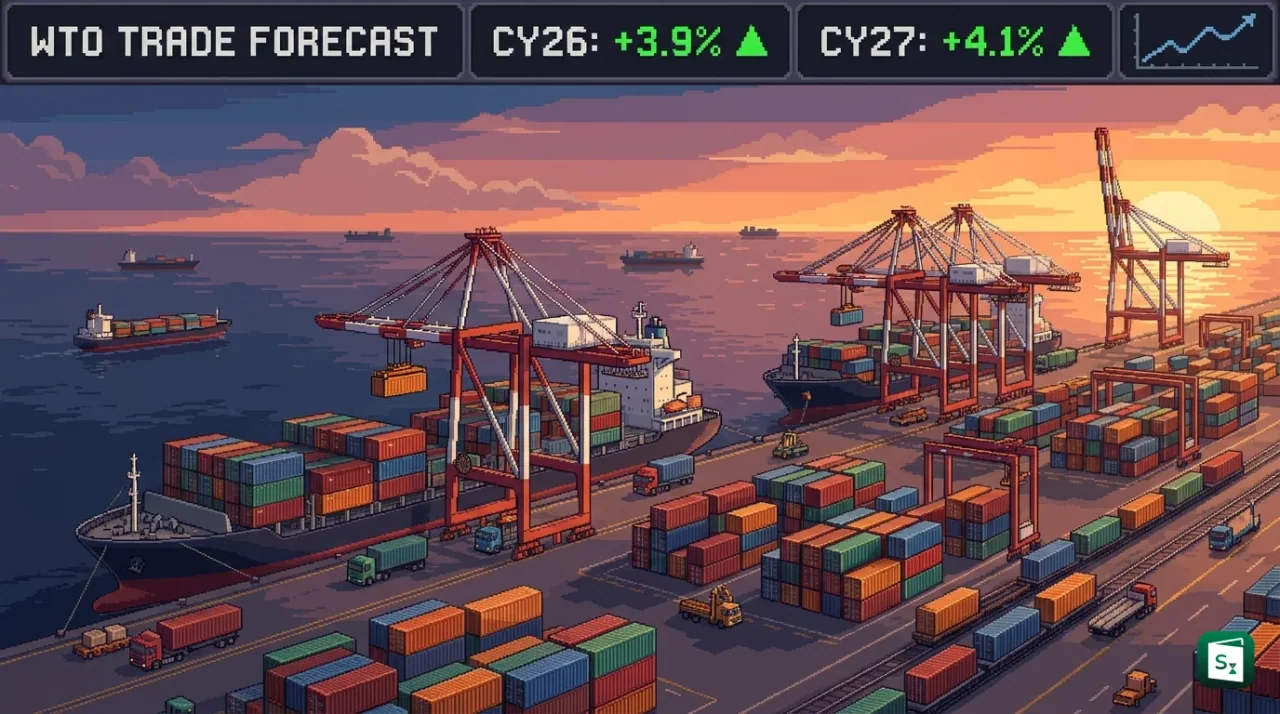
The World Trade Organization released its Global Trade Outlook and Statistics Update on 8 October 2026 with a sharply higher forecast for goods trade. The WTO now expects world merchandise trade volume to grow by 3.9 percent in 2026, up from 1.9 percent projected in March, and by 4.1 percent in 2027. The upgrade rests on two opposite forces: a powerful boom in trade in AI related goods and proven supply chain resilience despite the Middle East conflict.
What Is the WTO and What Does the October 2026 Outlook Cover?
The World Trade Organization (WTO) is the international body that sets the global rules of trade between nations. Its core job is to ensure that trade flows as smoothly, predictably and freely as possible, with a level playing field for all members. The WTO performs this role by administering trade agreements, providing a forum for negotiations, settling trade disputes, monitoring members trade policies and supporting developing economies through training and technical help.
The WTO came into being on 1 January 1995 under the Marrakesh Agreement, which concluded the Uruguay Round negotiations (1986 to 1994). It succeeded the General Agreement on Tariffs and Trade (GATT), which had governed much of world trade on a provisional basis from 1948 to 1994. GATT focused mainly on reducing tariffs on goods. The WTO widened the system to cover services through the General Agreement on Trade in Services (GATS), intellectual property through the TRIPS Agreement, and stronger dispute settlement.
The WTO is headquartered in Geneva, Switzerland. The WTO has 166 members accounting for around 98 percent of world trade (as of October 2026). India has been a member since the founding in 1995, as it was also a contracting party to GATT. The WTO is not a United Nations agency. It is an independent organization, though it cooperates closely with the UN system and other bodies such as the World Bank and the International Monetary Fund.
The Director General of the WTO (as of October 2026) is Dr Ngozi Okonjo-Iweala of Nigeria. She is the seventh Director General and the first woman and first African to hold the post. She took office on 1 March 2021 and began her second four year term on 1 September 2025. The WTO takes all major decisions by consensus among members. Ministers meet at least once every two years in the Ministerial Conference, the highest decision making body, while ambassadors meet regularly in Geneva in the General Council.
The Global Trade Outlook and Statistics is the WTO Secretariat’s flagship forecast publication. It is normally released twice a year, in March or April and in October, along with the WTO’s quarterly and annual trade statistics. The October 2026 update presents revised forecasts for world trade in 2026 and 2027, with breakdowns of merchandise and commercial services trade by sector and region. The October 2026 edition was released on 8 October 2026 and includes a special analytical chapter on trade in AI enabling goods.
Revised Forecasts for Merchandise Trade and Global GDP
The WTO measures merchandise trade in volume terms. Volume strips out price changes, so it shows the real quantity of goods crossing borders. The October 2026 update revises this volume forecast sharply upward for goods, downward for services for 2026, and upward for both in 2027.
WTO economists now expect world merchandise trade volume to increase by 3.9 percent in 2026 and 4.1 percent in 2027. The 2026 figure is more than double the 1.9 percent baseline projected in the March 2026 report. The 2027 figure is also higher than the 2.6 percent projected in March. In 2025, merchandise trade volume had grown by 4.6 percent, well above earlier expectations, while in value terms merchandise trade reached $26.26 trillion (up 7 percent) and commercial services trade reached $9.56 trillion (up 8 percent).
Global gross domestic product (GDP) growth, which measures the total value of goods and services produced in an economy, is projected at 2.6 percent in 2026 and 2.9 percent in 2027 at market exchange rates. Combined goods and services trade volume is expected to grow by 3.7 percent in 2026 and 4.7 percent in 2027. The numbers point to trade growing faster than output, the normal pattern when supply chains function well and investment demand is strong.
| Indicator | 2026 forecast (October 2026) | 2026 forecast (March 2026) | 2027 forecast (October 2026) |
|---|---|---|---|
| Merchandise trade volume | 3.9 percent | 1.9 percent | 4.1 percent |
| Commercial services trade volume | 3.3 percent | 4.8 percent | 6.4 percent |
| Global GDP growth | 2.6 percent | baseline near 2.6 percent | 2.9 percent |
| Goods and services trade combined | 3.7 percent | not separately given | 4.7 percent |
Merchandise trade already grew by 3.5 percent in the first half of 2026, beating expectations. That strong start gave WTO economists the confidence to lift the full year forecast. The 2027 projection assumes a timely easing of the Middle East conflict. If energy prices stay high and transport routes remain disrupted, goods growth could cool and services recovery could be delayed.
Why Did the WTO Raise the 2026 Merchandise Trade Forecast?
The WTO cites two clear reasons for the upgrade. First, global supply chains adapted to the Middle East conflict faster than expected. Second, investment in artificial intelligence created a surge in demand for specific traded goods that more than offset war related losses.
The Middle East conflict, which intensified after February 2026, hit energy and fertilizer markets directly. In the first half of 2026, crude oil exports from the Middle East fell by roughly 24 percent and liquefied natural gas (LNG) exports fell by 47 percent. LNG is natural gas cooled to liquid form for shipping. Yet other suppliers raised shipments. As a result, the fall in total global exports was limited to about 6 percent for crude oil and just 1 percent for LNG. Fertilizer markets also adjusted despite severe disruption, and global container throughput remained resilient with growth of 3.9 percent year on year through July.
The bigger surprise was AI. Strong spending on semiconductors, servers, data centres and digital infrastructure lifted imports of AI enabling goods. These are physical inputs needed to build and run AI systems, such as chips, servers, storage devices and network equipment. The WTO finds that these goods accounted for 47 percent of global merchandise trade growth in the first half of 2026. Trade in these products rose by 67 percent year on year, accelerating from already rapid growth of 16 percent in value in 2024 and 31 percent in 2025. Global AI infrastructure spending is projected to rise by at least 30 percent in 2026, with market estimates pointing to further capital expenditure growth of 10 to 20 percent in 2027. The WTO notes that AI related trade has moved in two years from a small part of goods trade to one of its main drivers.
Commercial Services Trade Slows While Digital Services Hold Up
The WTO lowered its outlook for services even as it raised the outlook for goods. Commercial services cover transport, travel, finance, computer services and other intangible trade. Unlike goods, services were hit directly by the conflict because the Middle East acts as a major global hub for air transport and travel.
Commercial services trade grew by 14 percent year on year in value terms in the first quarter of 2026 and 10 percent in the second quarter. Growth slowed in the second quarter as transport and travel services weakened. The WTO now expects commercial services trade volume to grow by only 3.3 percent in 2026, down from 4.8 percent in the March forecast, before rebounding to 6.4 percent in 2027 if the conflict eases.
Other services held firm. Digitally delivered services such as computer services and financial services exports stayed resilient and continued to support overall services growth. On the regional side, Europe is expected to record the fastest growth in services exports in 2026 at 4.6 percent, followed by Asia at 4.0 percent and Africa at 3.1 percent. The WTO notes that Europe is expected to account for more than half of global services export growth in 2026, helping to offset weaker contributions from Asia, North America and the Middle East.
Uneven Regional Picture and Risks to the Outlook
The WTO stresses that resilience was not uniform. Goods trade held up, but services and some regions felt the conflict much more deeply. The gains from AI demand were also concentrated in a few production hubs.
On the export side, the new forecast predicts the strongest 2026 trade volume growth in Asia at 9.9 percent, followed by North America at 5.7 percent, Africa at 5.6 percent and South America at 3.4 percent. Export performance is expected to stay weak in Europe at minus 0.1 percent and to contract sharply in the Middle East at minus 17.2 percent. Asian economies were already the main engine of goods growth, contributing a large share of volume expansion through strong electronics and machinery exports.
Two risks dominate the outlook. The Middle East conflict is expected to weigh on trade through higher energy prices and disruptions to transport routes, including shipping through key sea lanes. If the conflict persists, services recovery in 2027 could be delayed and goods growth could lose momentum as AI related growth slows from a higher base after two strong years. WTO Director General Ngozi Okonjo-Iweala described the numbers as trade resilience in action, while cautioning that vulnerabilities remain and stronger cooperation in the multilateral trading system would leave the global economy better equipped for future shocks.
How the WTO Works: Principles, Functions and WTO Versus GATT
The WTO works on a few simple principles. The most favoured nation (MFN) principle means a member must treat all other members equally on tariffs and market access. If India cuts a tariff for one WTO member, it must extend the same rate to all members unless an exception applies. The national treatment principle means imported goods and services must be treated no less favourably than domestic ones once they enter the market. Other principles include promoting fair competition, predictability through binding tariff commitments, and special treatment for developing and least developed countries.
The WTO performs six core functions. It administers trade agreements, hosts negotiations for further liberalisation, settles disputes between members, reviews members trade policies for transparency, provides training and technical assistance, and cooperates with other international organisations. In recent analysis, WTO economists estimated that about 72 percent of world trade is now conducted on MFN terms, after fluctuations in 2025 linked to policy shifts.
Many readers ask why the WTO replaced GATT and whether the WTO is still relevant. GATT was a provisional treaty focused mainly on goods. It had no permanent organisation, weak dispute settlement and limited coverage of services, farm trade and intellectual property. The WTO, created as a full organisation, added binding dispute settlement, regular Trade Policy Reviews, and wider agreements such as the Agreement on Agriculture, the Agreement on Fisheries Subsidies, the Trade Facilitation Agreement and the TRIPS Agreement on intellectual property. The WTO remains central because its 166 members still account for almost all world trade, and its monitoring helped keep trade visible during shocks such as the pandemic and the current energy disruption.
| Feature | GATT (1948 to 1994) | WTO (since 1995) |
|---|---|---|
| Legal status | Provisional agreement, no permanent body | Permanent organisation under Marrakesh Agreement |
| Coverage | Mainly goods and tariffs | Goods, services, agriculture, intellectual property, subsidies |
| Dispute settlement | Weak, easy to block rulings | Binding panel and appeal process with timelines |
| Decision making | Contracting parties, ad hoc rounds | Members by consensus, regular Ministerial Conference and General Council |
| Transparency | Limited review | Regular Trade Policy Reviews and notification system |
Significance for India and World Trade
The October 2026 outlook matters for India because India links goods and services trade closely. India is an original WTO member and a large trader in both merchandise and computer related services. India’s eighth Trade Policy Review took place on 21 and 23 July 2026 in Geneva. The review noted that India’s combined merchandise and services exports had reached a record $863.1 billion in 2025 to 2026, and that digitally delivered services had grown by about 17.3 percent a year between 2021 and 2025, with a surplus of more than $200 billion in 2025. India also deposited its acceptance of the WTO Agreement on Fisheries Subsidies during the review week.
For the world, the report shows that trade can adapt to energy shocks when other suppliers step in and shipping stays fluid. Container traffic growth and small declines in total oil and gas exports point to that flexibility. For India, steady energy supply and stable freight rates affect import costs and export competitiveness, while resilient demand for electronics, semiconductors and servers supports India’s electronics manufacturing and digital services exports. The weaker 2026 outlook for transport and travel services is a caution for tourism and logistics earnings. A rebound to 6.4 percent services growth in 2027, if the conflict eases, would help services exporters more broadly.
Key Takeaways
- The Global Trade Outlook and Statistics Update: October 2026 was released on 8 October 2026 and raised world merchandise trade volume growth to 3.9 percent for 2026 from 1.9 percent in March.
- The WTO projects merchandise trade growth at 4.1 percent for 2027 and global GDP growth at 2.6 percent in 2026 and 2.9 percent in 2027.
- Commercial services trade volume is expected to grow by only 3.3 percent in 2026, down from 4.8 percent, before rebounding to 6.4 percent in 2027.
- AI enabling goods accounted for 47 percent of merchandise trade growth in the first half of 2026, with trade in these goods up 67 percent year on year.
- The World Trade Organization, established on 1 January 1995 and headquartered in Geneva, has 166 members and is led by Director General Ngozi Okonjo-Iweala (as of October 2026).