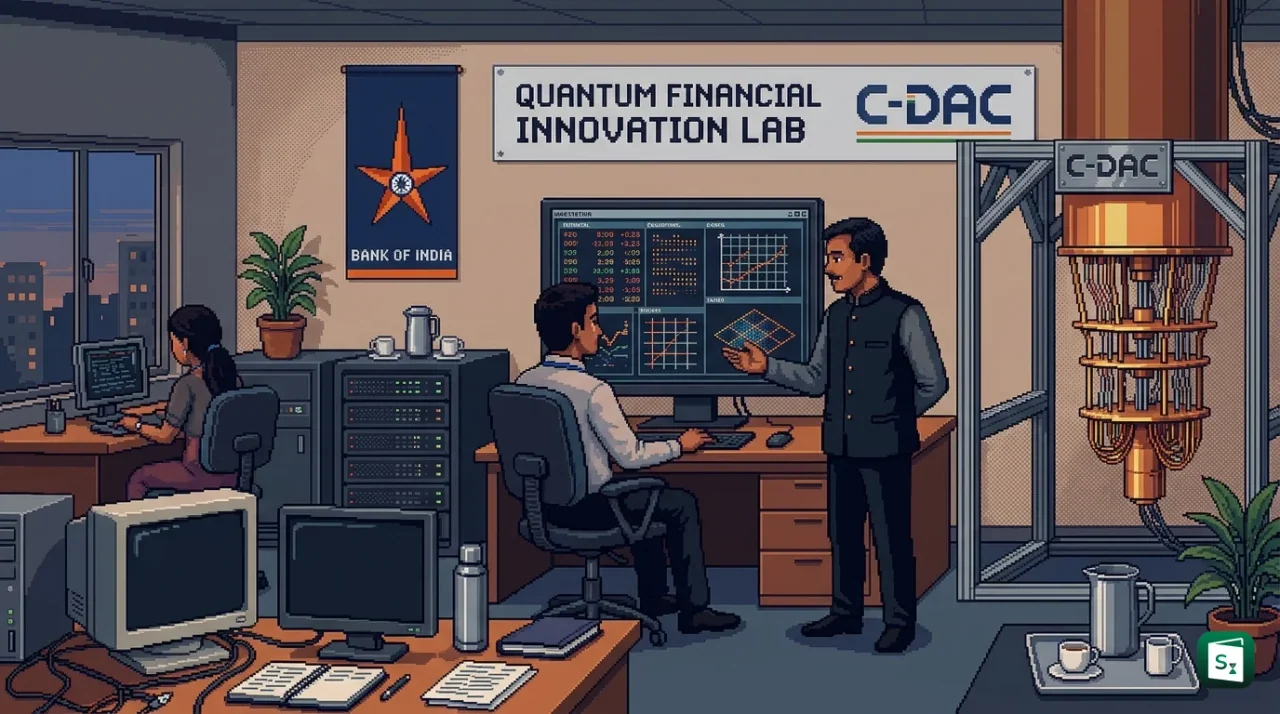
The Centre for Development of Advanced Computing (C-DAC) and Bank of India signed a Memorandum of Understanding (MoU) on 22 October 2026 to jointly explore quantum technologies for banking. The pact aims to build a Quantum Ecosystem for Financial Innovation that prepares banking systems for both the power and the security risks of quantum computing. It also covers joint work on artificial intelligence (AI), blockchain and high performance computing for financial services.
What Is C-DAC?
The Centre for Development of Advanced Computing (C-DAC) is the premier research organisation of the Ministry of Electronics and Information Technology (MeitY) for electronics and information technology. Established in March 1988 and headquartered in Pune, C-DAC builds supercomputers, AI systems, cybersecurity tools and quantum technologies.
C-DAC is a government body. It functions as an autonomous scientific society under MeitY. C-DAC is neither a private company nor a commercial public sector undertaking. It is a public research institution that develops indigenous technology for national use.
The origin of C-DAC explains its mandate. In the late 1980s, the United States denied India the import of supercomputers. The government set up C-DAC in 1988 to build indigenous supercomputers. Its first machine, PARAM 8000, was completed in 1991 and proved that India could build world class computing systems despite technology denial.
Since then C-DAC has expanded far beyond supercomputers. It works on high performance computing, multilingual computing, health informatics, strategic electronics, cybersecurity and quantum computing. It runs the National Supercomputing Mission jointly with the Indian Institute of Science (IISc), Bengaluru. The mission has deployed systems like PARAM Rudra and AIRAWAT-PSAI across research institutions. C-DAC also runs well known postgraduate diploma courses through its education and training network, with centres in Pune, Mumbai, Bengaluru, Chennai, Hyderabad, Noida, Mohali, Thiruvananthapuram and other cities. The Director General of C-DAC is E. Magesh (as of October 2026).
What Is Quantum Computing and How Does It Work?
Quantum computing is a new method of computing that uses the laws of quantum mechanics to process information in ways ordinary computers cannot match. It uses quantum bits that can represent many possibilities at once to solve complex optimisation, simulation and cryptography problems far faster than classical systems for select tasks.
An ordinary computer uses bits. Each bit is either 0 or 1. A quantum computer uses quantum bits, called qubits. Because of two properties named superposition and entanglement, qubits can hold many combinations of values at the same time. Superposition means a qubit can be partly 0 and partly 1 together. Entanglement links two qubits so that a change in one instantly affects the other.
This design lets quantum systems test many possible answers in parallel. For banks, that ability matters in three tasks. Quantum methods can improve portfolio optimisation, speed up risk assessment and strengthen fraud pattern detection. At the same time, powerful quantum machines could break widely used public key encryption that protects internet banking, mobile payments and digital signatures. That double nature, huge opportunity plus serious security risk, is called quantum banking risk and promise in simple terms.
Two related terms appear often in this pact. Quantum inspired technology uses quantum style logic on ordinary computers to get faster results without a real quantum machine. Quantum safe technology, also called post quantum cryptography, means new encryption methods that even a future quantum computer cannot easily break. The C-DAC and Bank of India pact will explore both paths.
What Exactly Did C-DAC and Bank of India Agree To Do?
The Centre for Development of Advanced Computing and Bank of India signed the Memorandum of Understanding on 22 October 2026 in New Delhi. The Ministry of Electronics and Information Technology announced the pact on 23 October 2026. C-DAC Mumbai Executive Director Aditya Kumar Sinha and Bank of India Chief General Manager for IT and Chief Information Officer Satyendra Singh exchanged the document. MeitY Secretary S. Krishnan, C-DAC Director General E. Magesh, Bank of India Executive Director Rajiv Mishra and MeitY Joint Secretary Sudeep Shrivastava were present.
The MoU creates a framework, not a purchase order. It sets rules for joint research, pilot projects, technology demonstrations and staff training. The teams will first list priority banking problems, then build proofs of concept in secure sandbox test environments, then compare the new methods with existing systems before deciding on wider use.
| Element of the Pact | Detail |
|---|---|
| Signing date | 22 October 2026 |
| Announcing ministry | Ministry of Electronics and Information Technology (MeitY) |
| C-DAC side | Expertise in high performance computing, quantum technologies, AI, blockchain and cybersecurity |
| Bank of India side | Banking domain knowledge, nationwide branch network and high volume technology environment |
| Work method | Identify use cases, build pilots in sandboxes, benchmark against current systems, prepare roadmaps |
| Other technologies covered | AI, blockchain and emerging digital tools for financial services |
| Skill component | Joint training and capacity building in quantum computing, quantum security, AI and blockchain |
Quantum Ecosystem for Financial Innovation: Key Focus Areas
The central goal of the MoU is to build a Quantum Ecosystem for Financial Innovation. The phrase means a shared system of research labs, testing platforms, skilled people and banking test cases that helps India move from laboratory quantum research to working banking solutions. It prepares banks for new opportunities while building defence against future quantum attacks on encryption.
On the quantum side, the partners will study quantum inspired optimisation for credit decisions, quantum safe encryption for data protection, and secure models for data sharing between banks and partners. MeitY Secretary S. Krishnan stressed the need for a quantum resilient financial ecosystem at a time of rising cybersecurity threats. Bank of India Executive Director Rajiv Mishra said quantum tools could reshape both security and complex financial decision making, so the bank wants to test them in a structured way before adoption.
Beyond quantum, the pact lists practical AI and blockchain uses that are closer to rollout. These include intelligent document processing, customer and employee assistance tools, fraud analysis, credit and financial analytics, digital identity, smart contracts and secure data sharing. These tools can cut paperwork, spot suspicious transactions faster and make loan appraisal more accurate. All pilots will be judged on technical feasibility, cost and security benefit before any decision on full scale use.
National Quantum Mission Linkage
The National Quantum Mission (NQM) is the umbrella policy that gives this bank level MoU its national importance. The Union Cabinet approved the National Quantum Mission on 19 April 2023 with a total outlay of ₹6,003.65 crore for eight years from 2023-24 to 2030-31. The Department of Science and Technology (DST) implements the mission. It aims to seed indigenous capability in quantum computing, quantum communication, quantum sensing and quantum materials, and to build startups and skilled manpower around them.
The mission works through four Thematic Hubs set up in 2024-25 as Section 8 nonprofit companies in leading institutes. Each hub anchors research, startups and shared labs in its vertical.
| Thematic Hub | Host Institute | Focus |
|---|---|---|
| Quantum Computing | Indian Institute of Science (IISc), Bengaluru | 20 to 50 qubits in 3 years, 50 to 100 qubits in 5 years, 50 to 1,000 qubits in 8 years |
| Quantum Communication | IIT Madras with C-DOT, New Delhi | Satellite based secure links over 2,000 km, intercity quantum key distribution over 2,000 km |
| Quantum Sensing and Metrology | IIT Bombay | Atomic clocks, magnetometers for timing, navigation and communications |
| Quantum Materials and Devices | IIT Delhi | Superconductors, single photon sources, topological materials for devices |
The C-DAC and Bank of India pact connects this science mission to real financial use. C-DAC already works on quantum hardware access, simulators and security tools. Banks provide large live data environments where algorithms for risk, settlement and fraud can be tested. This bridge from lab to market is exactly what the mission wants. It reduces dependence on foreign proprietary solutions and supports self reliance in critical financial infrastructure.
Bank of India Profile: Why This Partnership Matters
Bank of India is one of India’s major public sector banks. Businessmen from Mumbai founded Bank of India on 7 September 1906. The government nationalised Bank of India in July 1969 along with 13 other major banks. The bank is headquartered in Bandra Kurla Complex, Mumbai, and its tagline is Relationship Beyond Banking. The government holds a majority stake in the bank, and the bank operates more than 5,000 branches and more than 8,000 automated teller machines across India, with overseas branches including London and Paris.
The scale of Bank of India makes it a useful test bed. A public bank that handles crores of retail transactions, corporate loans and government payments produces the high volume data needed to test quantum inspired models. Bank of India also has a record of early technology adoption. It opened a fully computerised branch with automated teller machine service at Mahalaxmi in Mumbai in 1989, and it was a founder member of SWIFT in India for secure interbank messaging.
For Bank of India, the tie up brings access to indigenous research without dependence on a single foreign vendor. For C-DAC, it brings a live banking environment to validate tools for encryption, fraud analytics and credit modelling. This two way gain explains why MeitY presented the pact as a model for public sector digital collaboration.
RBI Q-SAFE Panel and the Push for Quantum Secure Banking
The Reserve Bank of India (RBI) set up an expert committee for a Quantum Secure and Adaptive Financial Ecosystem, called Q-SAFE, on 25 May 2026. The RBI is India’s central bank, established in 1935 under the Reserve Bank of India Act, 1934 and headquartered in Mumbai. The Q-SAFE panel shows that the regulator sees quantum risk as a system level issue, not a problem for one bank alone.
The eight member committee is convened by Anil Prabhakar, professor of electrical engineering at IIT Madras. Members include officials from DST, MeitY, the Data Security Council of India, State Bank of India, the National Payments Corporation of India (NPCI) and a former IBM Quantum India head, with the RBI FinTech Department providing secretarial support. The panel must submit its report within six months of its first meeting.
The terms of reference explain the urgency. The committee will map the cryptographic inventory of the financial sector through a Cryptography Bill of Materials (CBOM), test crypto agility, identify systems most vulnerable to quantum attacks, study global rules, assess industry readiness for quantum safe tools, and recommend a roadmap to make Indian finance quantum secure. The C-DAC and Bank of India pilots fit directly into this agenda. Results from sandbox tests on quantum safe virtual private networks, post quantum certificates and hybrid encryption can feed into national standards.
Significance for Digital Banking in India
India now has one of the largest digital payment systems in the world, anchored by the Unified Payments Interface (UPI) run by NPCI and a fast growing net banking and mobile banking base. For banks, two gains stand out.
First, security. Most online banking still relies on public key encryption. A future large quantum machine could in theory break those keys and forge signatures, putting mobile banking sessions, card payments and even central bank digital currency wallets at risk. Moving early to quantum safe methods, larger symmetric keys like AES-256, hybrid virtual private networks and quantum key distribution on critical links, protects long life financial data from harvest now and decrypt later attacks.
Second, performance. Quantum inspired optimisation can improve loan portfolio design, macroeconomic modelling and real time fraud scoring. Combined with AI and high performance computing, banks can process larger data sets with better accuracy and lower cost. The challenge is talent. Few bank staff understand quantum security today. The joint training programmes under this MoU aim to create that talent pool inside the financial sector, so technology adoption does not stall for lack of skills.
Key Takeaways
- C-DAC and Bank of India signed an MoU on 22 October 2026 to build a Quantum Ecosystem for Financial Innovation.
- C-DAC, established in March 1988 and headquartered in Pune, is the research society of MeitY.
- The National Quantum Mission, approved on 19 April 2023 with ₹6,003.65 crore till 2030-31, is implemented by DST through four Thematic Hubs.
- The RBI Q-SAFE committee, set up on 25 May 2026, will recommend a roadmap for quantum secure finance in India.
- Bank of India, founded on 7 September 1906 and nationalised in 1969, is headquartered in Mumbai.