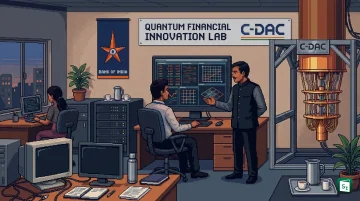
The Centre for Development of Advanced Computing (C-DAC) has signed an MoU with the Bank of India (BOI) to collaborate on quantum financial innovation and drive the adoption of emerging technologies in the banking sector.
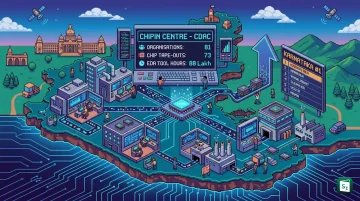
According to a dataset released by the Ministry of Electronics and Information Technology (MeitY), Karnataka has emerged as the leading state in semiconductor support under the ChipIN Centre initiative.
The state recorded the highest engagement under the initiative, featuring 81 organisations, 73 chip tape-outs, and 88 lakh hours of Electronic Design Automation (EDA) tool usage. The ChipIN Centre initiative was launched by MeitY in 2023 and is established at the Centre for Development of Advanced Computing (C-DAC).
PM Narendra Modi has inaugurated ‘Param Pragya’, an AI-enabled high-performance supercomputing facility at the Sonipat (Haryana) campus of the IIT Delhi. The inauguration took place during the 57th convocation of IIT Delhi, where he attended as the Chief Guest.
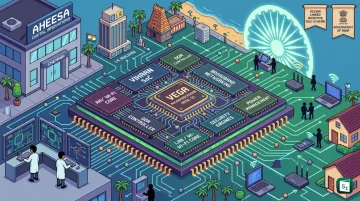
Chennai-based Aheesa Digital Innovations, a fabless semiconductor startup, has achieved first-pass silicon success with ‘VIHAAN’, the first domestically designed broadband networking System-on-Chip (SoC) in India.
The development of ‘VIHAAN’ is supported under the Design Linked Incentive (DLI) scheme of the central government. It is built using the indigenous 64-bit VEGA microprocessor developed by the Centre for Development of Advanced Computing (C-DAC), offering a royalty-free RISC-V architecture.
The Centre for Development of Advanced Computing (C-DAC) under the Ministry of Electronics and Information Technology (MeitY) has signed an umbrella MoU with the Geological Survey of India (GSI) to strengthen collaboration in the fields of geoscience, mineral exploration, and disaster management.
The Odisha government has signed a tripartite agreement with Digital Bharat Nidhi (DBN) under the Department of Telecommunications (DoT) and Bharat Sanchar Nigam Ltd (BSNL) to implement the amended BharatNet programme in the state. The project has an outlay of ₹3,384.8 crore.
Additionally, the state government has also signed an MoU with the Centre for Development of Advanced Computing (C-DAC) to collaborate in the field of emerging technologies.
The Ministry of Electronics and Information Technology (MeitY), in collaboration with the Drone Federation India (DFI), has launched the second edition of the 'National Innovation Challenge for Drone Application and Research' (NIDAR 2.0, 2026-27) at Electronics Niketan, New Delhi, in a hybrid mode.
The challenge is conducted under the 'SwaYaan' initiative, which was approved by MeitY in 2022 with a total financial outlay of ₹89.87 crore over a five-year period.
The 67th edition of the TOP500 Supercomputer Rankings was released at the International Supercomputing (ISC) High Performance 2026 conference in Hamburg, Germany. China's 'LineShine' has emerged as the world's most powerful supercomputer, displacing the USA's 'El Capitan' from the top spot.
They are followed by 'Frontier' (USA), 'Aurora' (USA), and 'Jupiter' (Germany). The USA leads the list as the most represented country, with 161 systems featured.
India is ranked 16th globally, with 7 supercomputers included in the list, namely 'PARAM Siddhi-AI', 'Pratyush', 'Mihir', 'Aditya', 'SahasraT', 'Arka', and 'Param Bramha'. India's most powerful supercomputer, 'Shakti Cloud', secured the 32nd position on the list with a performance of 84.31 petaflops.
The Broadcast Engineering Consultants India Ltd (BECIL) has signed an MoU with the Centre for Development of Advanced Computing (C-DAC) to collaborate in the fields of advanced technologies, digital transformation, and capacity building. The partnership focuses on joint project implementation, consultancy, and technical support, including the development of solutions in emerging technologies.