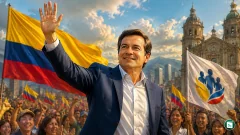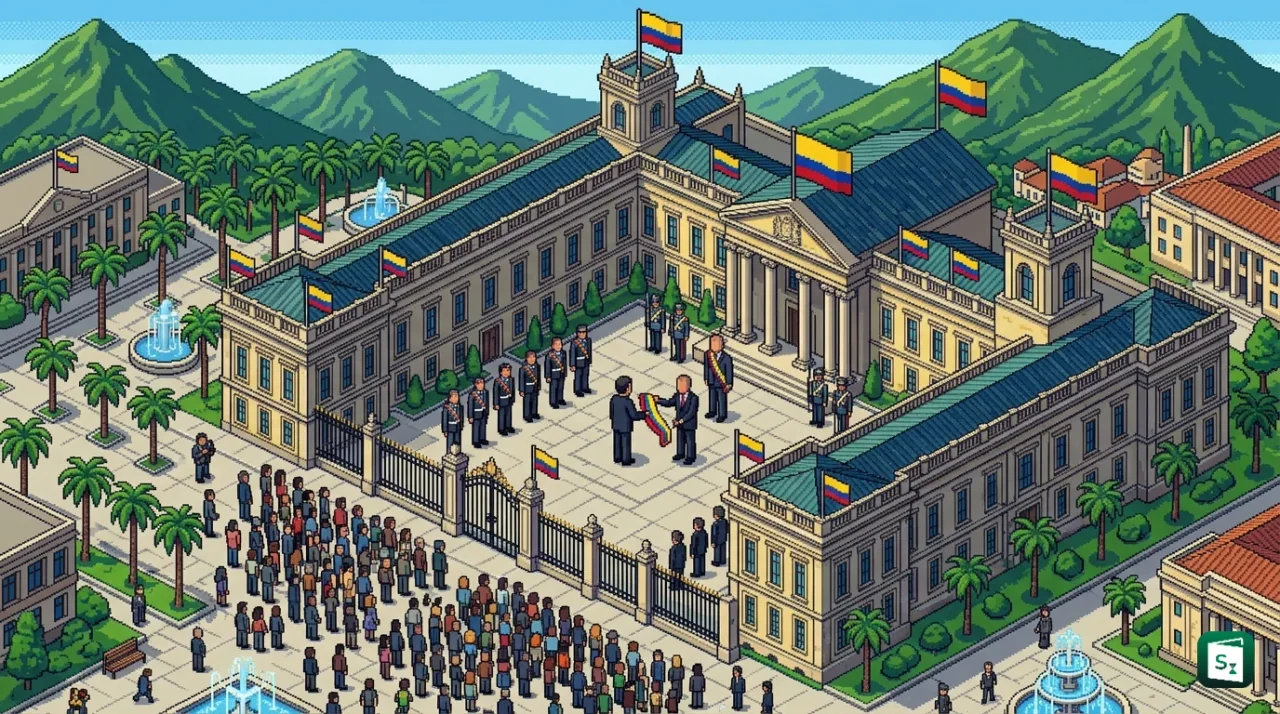
Conservative lawyer and businessman Abelardo de la Espriella was sworn in as the President of Colombia on 7 August 2026, succeeding Gustavo Petro and ending four years of leftist government in the South American nation. He takes office after winning a razor-thin run-off election against Iván Cepeda, a close ally of Petro, on 21 June 2026. The inauguration marks a sharp swing to the right in Colombia and extends a wave of conservative victories across Latin America.
Who Is Abelardo de la Espriella?
Abelardo Gabriel de la Espriella Otero, born in Bogotá on 31 July 1978 and raised in the coastal city of Montería, is a criminal defence lawyer and businessman who had never held public office before his election. He studied law at Sergio Arboleda University, completed his degree at Del Rosario University, and earned a master’s in law from Nebrija University in Spain in 2012. He holds Colombian, American and Italian citizenship, having received US citizenship in 2023 after living in Miami for over a decade.
Known to supporters as “El Tigre”, or the Tiger, de la Espriella built his fortune as a lawyer representing high-profile clients. He founded the Defenders of the Homeland (Defensores de la Patria) movement in 2024 and ran as a self-funded political outsider. His running mate is José Manuel Restrepo, an economist who served as finance minister under Colombia’s previous conservative government and brings technical credibility to the ticket.
How He Won the 2026 Election
Incumbent president Gustavo Petro was constitutionally barred from seeking a second term under Colombia’s single-term rule. He backed his left-wing ally, Senator Iván Cepeda of the ruling Historic Pact coalition, as his successor. Colombia’s constitution limits presidents to a single four-year term, so the 2026 contest was always going to produce a new head of state.
In the first round on 31 May 2026, de la Espriella finished first with 43.74 percent of the vote, ahead of Cepeda’s 40.91 percent. Because neither candidate crossed the 50 percent mark, the election moved to a run-off on 21 June 2026, where de la Espriella won with 49.66 percent against Cepeda’s 48.70 percent, a margin of roughly 251,000 votes out of about 39.3 million cast. This was the smallest margin of victory in Colombian presidential history. His 12.96 million votes made him the most-voted presidential candidate in the country’s history, and the run-off saw record turnout of about 63.6 percent.
The electoral authority confirmed the result on 25 June 2026. Cepeda conceded after the final count, but Petro initially refused to accept the outcome, alleging without evidence that the vote tallies had been manipulated. International observers and Colombia’s electoral authorities dismissed the fraud claims, and Petro later said he would respect the result.
A Break With Tradition in Cali
De la Espriella chose to hold his swearing-in ceremony not in the capital, Bogotá, but in Cali, a volatile city in the country’s southwest that has long suffered from the conflict between the state and armed groups. The venue, a university auditorium before Congress, was the first time in Colombian history that a presidential inauguration was hosted by Cali. The choice was widely read as a signal of his hard-line approach to security.
The ceremony took place under a heavily reinforced security operation. Authorities deployed about 11,000 law enforcement personnel in and around Cali, set up vehicle checkpoints to screen for explosives, and used an anti-drone system following a string of terrorist threats and a thwarted bomb attack in the preceding days. Attendance included Spain’s King Felipe VI, acting US Attorney General Todd Blanche, FIFA President Gianni Infantino, and several Latin American conservative leaders including Argentina’s Javier Milei and Chile’s José Antonio Kast.
Citing the city’s location at the heart of Colombia’s armed conflict, de la Espriella travelled to a nearby military battalion after the ceremony to address the troops directly, framing the visit as a message of support for the armed forces and a warning to illegal armed groups. He has declared that dissident groups must surrender or be treated as military targets.
Security and the Peace Process
Colombia’s Long Armed Conflict
Colombia has been entangled in an internal armed conflict for more than six decades. Left-wing guerrilla groups, right-wing paramilitary militias and drug cartels have fought the state and each other over territory, political power and the profits of the drug trade. The Revolutionary Armed Forces of Colombia (FARC) began its insurgency in 1964, while the National Liberation Army (ELN), founded in the 1960s, remains active today. The conflict has killed more than 260,000 people and displaced millions.
The 2016 Peace Agreement and Its Fallout
In 2016, the government of President Juan Manuel Santos signed a landmark peace agreement with the FARC after years of negotiations in Havana, Cuba. The deal ended the armed conflict with the group, which disarmed and transformed into a political party. However, a minority of FARC fighters rejected the agreement and remain active as dissident factions, and the peace process did not cover the ELN or the Clan del Golfo drug cartel. These groups dispute control over the drug trafficking and illegal mining economies, and their ranks have reportedly grown since the deal was signed.
End of “Total Peace”
Gustavo Petro’s flagship policy was “Total Peace”, an attempt to simultaneously negotiate with all the major armed groups. De la Espriella has called this approach a failure and vowed to abandon it. He has said the option of dialogue is exhausted and promised an all-out war against what he calls “narco-terrorism”, including bombing cocaine laboratories, building private mega-prisons modelled on El Salvador’s system, and cutting off peace talks. Within days of taking office, his government launched its first military offensives against dissident FARC factions, and he has signalled that he wants to dismantle the special peace tribunal set up under the 2016 agreement.
Economic Agenda and Fiscal Pressures
De la Espriella has promised to shrink the state and revive Colombia’s economy. He campaigned on cutting government spending by up to 40 percent, a programme inspired by the budget-slashing reforms of Argentina’s Javier Milei. His “integral state reform” plan includes eliminating entire ministries and could affect an estimated 700,000 government employees and contractors. He has also pledged to revive the country’s oil and gas sector and restore the state energy company Ecopetrol, reversing Petro’s push to move away from fossil fuels.
These plans come as Colombia faces serious fiscal stress. The budget deficit roughly doubled under Petro’s administration, and the new government must present a credible strategy to bring it down, respect the fiscal rule and retain investor confidence. Vice President Restrepo, with his record as a former finance minister, is expected to be the anchor of the economic team. De la Espriella has also promised lower taxes, deregulation and support for business, drawing sharp criticism from human rights groups over the social impact of the proposed cuts.
Foreign Policy and the Regional Rightward Shift
Closer Ties With the United States
De la Espriella is a self-described admirer of US President Donald Trump, who personally endorsed his campaign. Colombia and the US had a turbulent relationship under Petro, including disputes over deportation flights and US accusations against the outgoing government. The new president has promised a realignment with Washington and welcomed the US State Department’s plan to provide $1 billion in security assistance to his administration, pending approval from the US Congress.
The Shield of the Americas
De la Espriella has pledged to make Colombia a member of the Shield of the Americas, a US-backed military and political coalition against drug trafficking launched by the Trump administration at a summit in March 2026. The initiative, also known as the Americas Counter Cartel Coalition, groups right-leaning governments to coordinate intelligence sharing and military operations against cartels. Colombia, long the linchpin of US anti-narcotics strategy in the region, had refused to join while Petro was in power.
Relations With Israel, Cuba and Nicaragua
In a break with Petro’s policies, de la Espriella plans to restore diplomatic relations with Israel, which Colombia suspended over the Gaza war. He has also said he wants to open a Colombian embassy in Jerusalem. At the same time, he intends to sever diplomatic ties with Cuba and Nicaragua, which he has branded as “tyrannies”.
A Continent Moving Right
De la Espriella’s victory is part of a broader shift across Latin America. Since early 2025, at least seven right-wing or conservative leaders have been elected in the region, including Argentina’s Javier Milei, Chile’s José Antonio Kast and Peru’s Keiko Fujimori. Analysts see de la Espriella’s win as consolidating a regional bloc of conservative governments and further shrinking the influence of left-wing administrations, which had risen during the earlier “pink tide”.
Challenges Ahead for the New Government
De la Espriella takes office in a deeply polarised country. He faces a fragmented Congress where his party lacks a majority, so passing structural reforms will require building coalitions with other parties. The defeated opposition retains a large following, and protests broke out in Cali, Bogotá and Barranquilla on inauguration day.
The security situation is equally fraught. His hard-line approach has raised fears among human rights groups that heavy-handed operations could lead to abuses, while outgoing president Petro has threatened fierce opposition, urging his supporters to mobilise. On the economic front, the promised deep spending cuts face resistance from unions and from regions that depend on state programmes.
Within days of the inauguration, western Colombia was struck by a 7.4-magnitude earthquake, the strongest recorded in the country this century, killing more than 100 people and damaging around 1,600 buildings. De la Espriella declared a state of national disaster and personally took charge of the emergency response, making disaster management an immediate test of his new administration. His performance in this crisis, and in the security and fiscal battles ahead, will define the early years of his presidency.
Key Takeaways
- Abelardo de la Espriella was sworn in as the President of Colombia on 7 August 2026, succeeding Gustavo Petro.
- He defeated Iván Cepeda in the run-off on 21 June 2026 with 49.66 percent of the vote against 48.70 percent, the smallest margin in Colombian presidential history.
- De la Espriella, nicknamed “El Tigre”, is a conservative lawyer and businessman who founded the Defenders of the Homeland movement in 2024 and had never held public office before.
- Colombia’s constitution allows presidents a single four-year term, which barred Gustavo Petro, the country’s first leftist president (2022 to 2026), from seeking re-election.
- De la Espriella has promised to abandon Petro’s “Total Peace” policy, cut government spending by up to 40 percent, and join the US-backed Shield of the Americas coalition against drug trafficking.
- The 2016 peace agreement between Colombia and the FARC was signed under President Juan Manuel Santos and formally ended a conflict that had killed more than 260,000 people.