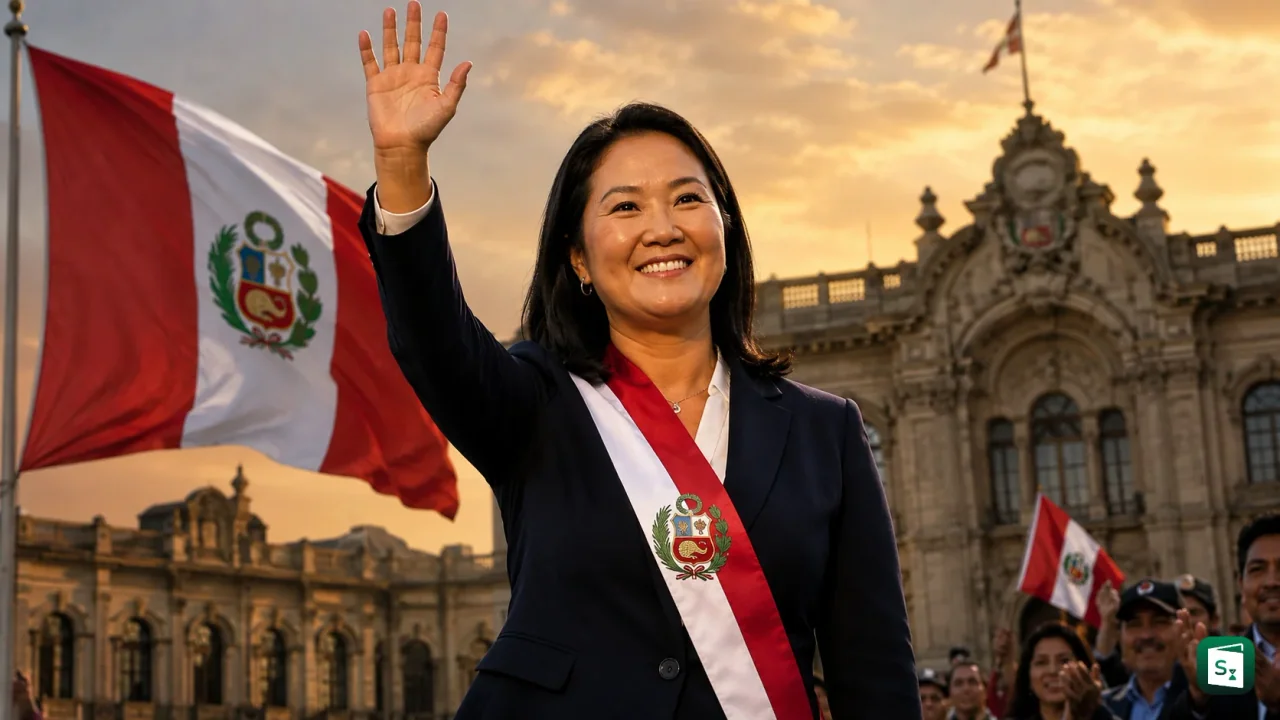
Keiko Fujimori, the 51-year-old leader of the conservative Popular Force party, has been declared the winner of Peru’s 2026 presidential election after a bitterly contested runoff. She defeated left-wing candidate Roberto Sanchez by the slimmest margin in the country’s recent history, securing 50.13% of the vote against his 49.87%. Fujimori will take office on July 28 as Peru’s first elected woman president and the 10th president of the republic, succeeding interim President Jose Maria Balcazar.
The 2026 Presidential Election: A Knife-Edge Contest
Peru held the first round of its general election on April 12-13, 2026, with a record 36 presidential candidates on the ballot. Keiko Fujimori emerged with 17.18% of the vote, while Roberto Sanchez of the left-wing Together for Peru coalition finished second with 12.0%. Since no candidate crossed the 50% threshold, a runoff was scheduled for June 7.
What followed was one of the closest presidential runoffs in Latin American history. For most of the vote count, Sanchez held a narrow lead, boosted by strong support from Peru’s rural southern regions. But as the remaining tally sheets from Lima, the northern coastal departments, and overseas voters were processed, Fujimori overtook him. The final count gave Fujimori 9,223,396 votes (50.13%) against Sanchez’s 9,173,755 votes (49.87%), a margin of just 49,641 votes out of more than 18.4 million valid ballots cast.
Sanchez refused to concede, alleging irregularities in the overseas vote count and filing complaints with electoral authorities. However, the National Jury of Elections (JNE), Peru’s highest electoral tribunal, rejected his challenges. Domestic and international observer missions, including those from the European Union and the Organization of American States, reported no evidence of systematic fraud. On July 3, 2026, the JNE formally proclaimed Fujimori as president-elect for the 2026-2031 term, alongside her vice presidents Luis Galarreta and Miguel Angel Torres.
Who Is Keiko Fujimori?
Born on May 25, 1975 in Lima, Keiko Sofia Fujimori Higuchi is the eldest daughter of Alberto Fujimori, who served as Peru’s president from 1990 to 2000. Her political journey is deeply intertwined with her father’s controversial legacy.
In 1994, at the age of 19, she became the First Lady of Peru after her mother, Susana Higuchi, was removed from the role during the couple’s highly publicized separation. She served in this ceremonial position until her father’s government collapsed in 2000. During these years, she headed charitable foundations providing healthcare for underprivileged children.
Fujimori studied business administration in the United States, earning a Bachelor’s degree from Boston University in 1997 and an MBA from Columbia University in 2008. She returned to Peru after her father’s arrest in Chile in 2005 and entered electoral politics. In the 2006 congressional elections, she won a seat in Peru’s Congress representing Lima with a record 602,869 votes, the highest ever received by a single candidate in the country’s history.
She founded what is now the Popular Force (Fuerza Popular) party and has led it since 2010. Fujimori ran for president three times before 2026, losing each time in closely fought runoffs to Ollanta Humala in 2011, Pedro Pablo Kuczynski in 2016, and Pedro Castillo in 2021. Her political career has also been marked by legal challenges; she was detained for over a year in 2018-2020 on money laundering charges related to the Odebrecht corruption scandal, though the case was eventually dismissed.
The Fujimori Legacy: Understanding Fujimorismo
Keiko Fujimori is the standard-bearer of Fujimorismo, a right-wing populist political movement founded by her father. Alberto Fujimori came to power in 1990 during one of Peru’s darkest periods, with hyperinflation reaching 7,650% and the Maoist guerrilla group Shining Path (Sendero Luminoso) waging a brutal insurgency across the country.
His government achieved two defining successes. First, he implemented drastic neoliberal economic reforms known as the “Fujishock”, which tamed hyperinflation, stabilized the economy, and attracted foreign investment. These policies, enshrined in the 1993 Constitution, laid the foundation for Peru’s subsequent two decades of strong economic growth. Second, his military campaign crippled the Shining Path, capturing its leader Abimael Guzman in 1992 and drastically reducing terrorist violence.
However, these achievements came at a severe cost. In April 1992, Fujimori carried out a “self-coup” (autogolpe), dissolving Congress and suspending the judiciary with military backing. His government was later found to have committed widespread human rights violations, including the Barrios Altos and La Cantuta massacres and the forced sterilization of thousands of indigenous women. Alberto Fujimori was convicted in 2009 of crimes against humanity and sentenced to 25 years in prison. He died in September 2024 after being released on humanitarian grounds.
Fujimorismo as a movement combines strong executive authority, free-market economics, social conservatism, and a hardline stance on crime and security. For its supporters, it represents order and prosperity. For its critics, it symbolizes authoritarianism and democratic backsliding. Keiko Fujimori has navigated this legacy carefully, at times distancing herself from her father’s abuses while more recently embracing his record as a campaign asset.
Peru’s Decade of Political Turmoil
Fujimori inherits a country that has experienced extraordinary political instability. Peru has had nine presidents in ten years, with multiple impeachments, resignations, and constitutional crises marking the period since 2016.
The slide began when the Popular Force-led Congress used broadly worded impeachment provisions in the 1993 Constitution to remove successive presidents. Pedro Pablo Kuczynski resigned in 2018 facing impeachment. Martin Vizcarra was removed by Congress in 2020. In December 2022, President Pedro Castillo attempted a self-coup by dissolving Congress, was immediately impeached and arrested. His vice president, Dina Boluarte, succeeded him but faced massive protests that left dozens dead. Boluarte herself was removed by Congress in October 2025 on grounds of “permanent moral incapacity.” Her successor, Congress President Jose Jeri, lasted only months before he too was removed. Jose Maria Balcazar became interim president in February 2026, serving until the election of a new government.
This institutional instability has severely eroded public trust in political institutions. The 2022-2023 protests shook the country’s social fabric, and surging crime, extortion, and organized crime became the dominant campaign issues. Peru’s Congress, dominated by opposition parties, also restored a bicameral legislature (a Senate and a Chamber of Deputies) in the 2026 elections, reversing the 2018 referendum where voters had chosen to keep a unicameral system. Analysts have warned that Congress under Fujimori’s Popular Force has systematically weakened judicial independence and the rule of law, with some describing Peru as being in a process of democratic backsliding.
Challenges Ahead for the New President
Fujimori takes office facing a complex set of challenges. The most pressing is crime and public security. Extortion, homicides, and organized crime have surged dramatically in recent years, and this was the single biggest concern for voters in the election. She campaigned on a “heavy hand” approach to law and order, promising to restore security through tougher policing and stricter sentencing.
The second challenge is governing a deeply divided country. The razor-thin margin of victory reflects a Peru split roughly in half, between the Fujimori-supporting coast and northern departments and the left-leaning southern highlands. Sanchez has refused to recognize her victory, and his supporters have taken to the streets. Healing this political divide will be a major test of her leadership.
Third, Fujimori must manage a fragmented Congress. Although her Popular Force party emerged as the largest bloc in both the Chamber of Deputies (41 of 130 seats) and the Senate (22 of 60 seats), it does not hold a majority. She will need to build coalitions to pass legislation, a task made harder by Peru’s history of executive-legislative gridlock.
On the economic front, Fujimori’s victory was welcomed by markets. Her commitment to Peru’s free-market economic model, continuity with the policies that delivered decades of growth, and the appointment of experienced technocrats are expected to boost investor confidence. Peru is a major global producer of copper, gold, and silver. Stabilizing the political environment is critical for maintaining investment in the mining sector, which drives a significant portion of the country’s export earnings.
Her win also strengthens the rightward political shift across Latin America. Conservative leaders including Argentina’s Javier Milei, Chile’s Jose Antonio Kast, and El Salvador’s Nayib Bukele have congratulated her. The United States, through Secretary of State Marco Rubio, signaled a desire to deepen cooperation on security, investment, and trade.
Key Takeaways
- Keiko Fujimori was declared winner of Peru’s 2026 presidential election on July 3, 2026, after winning the June 7 runoff with 50.13% of the vote.
- She will be sworn in on July 28, 2026, becoming Peru’s first elected woman president and the 10th president of the republic.
- Fujimori defeated left-wing candidate Roberto Sanchez by just 49,641 votes out of over 18.4 million cast, one of the closest elections in Peru’s history.
- She is the daughter of former president Alberto Fujimori, who governed from 1990 to 2000, and is the leader of the Fujimorismo movement under the Popular Force (Fuerza Popular) party.
- This was her fourth consecutive presidential bid, having lost previous runoffs in 2011, 2016, and 2021.
- Peru has had nine presidents in ten years, reflecting a deep political instability driven by executive-legislative conflicts under the 1993 Constitution.
- Her victory continues a rightward shift in Latin America, with conservative leaders across the region welcoming the result.