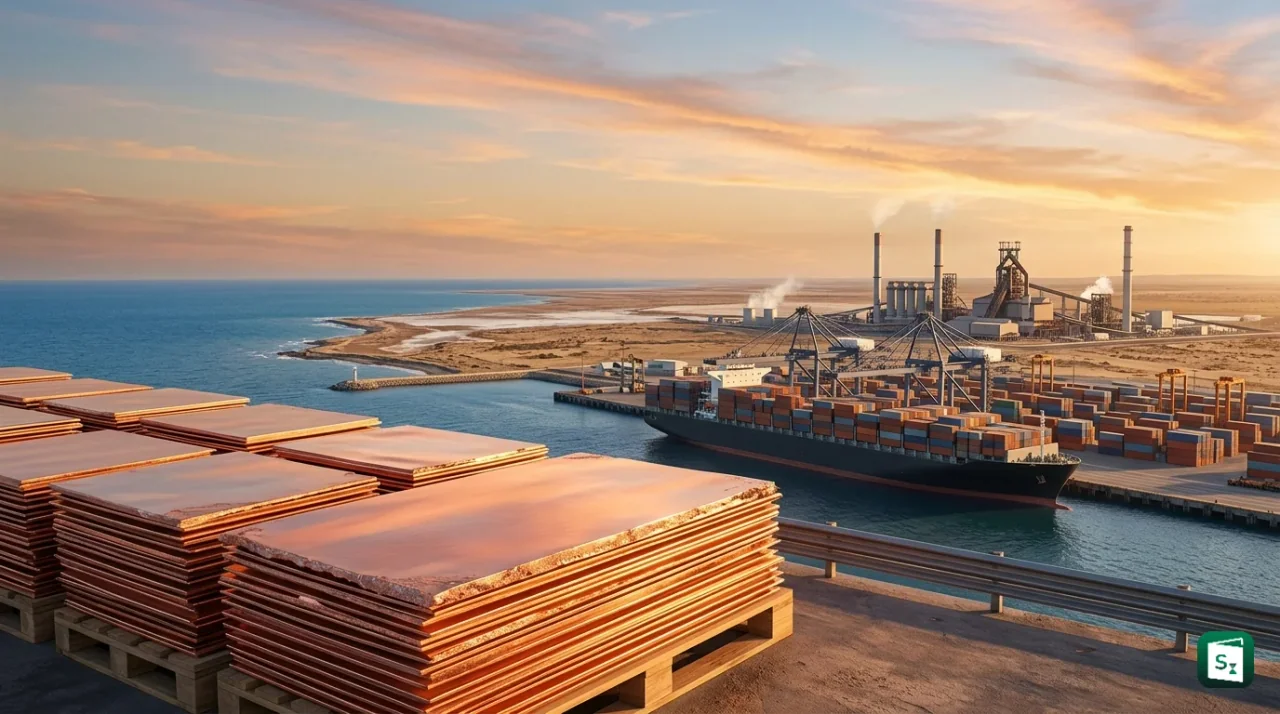
Kutch Copper Ltd (KCL), a wholly owned subsidiary of Adani Enterprises Ltd (AEL), has secured the London Metal Exchange (LME) certification for its Adani Copper brand of Grade A cathodes. The certification, effective from July 10, 2026, makes Adani Copper an LME Good Delivery brand, allowing it to be delivered against LME copper futures contracts. This milestone places the Adani Group among the world’s leading copper producers and strengthens India’s position in the global refined copper supply chain.
What Is the London Metal Exchange?
The London Metal Exchange (LME) is the world’s largest and oldest market for trading industrial metals, founded in 1877 and headquartered in London. It is owned by Hong Kong Exchanges and Clearing Limited (HKEX), which acquired it in 2012. The LME handles the majority of global non-ferrous metal futures trading, including copper, aluminium, zinc, lead, nickel, and tin.
The LME serves a critical function in the global metals industry. It provides a platform for price discovery, where producers, consumers, and traders can determine the benchmark price of metals. The LME Official Settlement Price, determined at the close of each trading day, is used as the reference price in commercial contracts worldwide. The exchange also allows participants to hedge against price volatility and offers a market of last resort through its physical delivery mechanism.
For a metal brand to be listed on the LME, it must go through a rigorous multi-stage approval process. Producers must meet strict specifications covering chemical composition, shape, and weight, along with responsible sourcing requirements aligned with the OECD Due Diligence Guidance. The application process involves independent sampling and assaying by LME-approved testers, ISO certifications (including ISO 9001, ISO 14001, and ISO 45001), and review by the LME Copper Committee. Only about 435 brands across nine metals were listed on the LME as of early 2024, making it a highly exclusive club.
What LME Certification Means for Adani Copper
The LME certification elevates Adani Copper from a domestically recognized product to a globally tradeable commodity. As an LME Good Delivery brand, Adani Copper cathodes can now be stored in LME-approved warehouses worldwide and placed on warrant, which is an electronic document representing ownership. This allows the metal to be used as highly liquid collateral for financing, giving buyers and sellers greater confidence in its quality and marketability.
The certification validates that Adani Copper meets the Grade A standard, which requires a minimum purity of 99.99% copper. This is the highest specification for copper cathodes traded on the LME and is essential for use in electrical applications, including power cables, transformers, and renewable energy systems. The approval also confirms that Kutch Copper complies with the LME’s responsible sourcing protocols, including the OECD Due Diligence Guidance for conflict-free supply chains, and holds the necessary environmental and safety management certifications.
Kutch Copper applied for LME registration in August 2025, and the approval process took nearly a year, reflecting the thoroughness of the LME’s evaluation. The certification also expands the LME’s deliverable base by adding a major new production hub in India, deepening the geographic diversity and liquidity of the global copper market.
Kutch Copper’s Mundra Smelter
Kutch Copper operates a greenfield copper smelter at Mundra in the Kutch district of Gujarat. The facility represents a total investment of approximately $1.2 billion in its first phase and is described as one of the world’s largest single-location custom copper smelting complexes. A custom smelter processes copper concentrate purchased from third-party mining companies rather than from captive mines.
Phase I and Expansion Plans
The smelter was commissioned in March 2024, when the company dispatched its maiden batch of copper cathodes to customers. Phase I has an installed capacity of 500,000 tonnes per annum (MTPA). The second phase, expected to be completed by FY29 (March 2029), will add another 500,000 tonnes, taking the total capacity to 1 million tonnes per annum. The expansion is expected to cost an additional $700-800 million, bringing the total project investment to around $2 billion.
Byproducts
Apart from copper cathodes, the smelter produces several valuable byproducts:
| Byproduct | Quantity (per annum) |
|---|---|
| Gold | ~25 tonnes |
| Silver | ~250 tonnes |
| Sulphuric Acid | ~1.5 million tonnes |
| Phosphoric Acid | ~250,000 tonnes |
These byproducts add significant revenue streams and are crucial for industries such as fertilizers and chemicals.
Employment and Technology
The facility is designed with advanced process automation, modern technology, and sustainability-led design principles. It is expected to create 2,000 direct jobs and 5,000 indirect employment opportunities. Kutch Copper has also joined the International Copper Association (ICA), reflecting its commitment to industry standards and sustainable practices.
India’s Copper Story: From Importer to Self-Reliance
India’s copper industry has undergone a dramatic transformation over the past decade. The country was a net exporter of refined copper until FY18, but the landscape changed after the May 2018 closure of Vedanta’s Sterlite Copper plant in Tuticorin, Tamil Nadu, which had a capacity of 400,000 tonnes per annum and accounted for roughly 40% of the country’s smelting capacity. The shutdown turned India into a net importer of refined copper starting FY19.
Rising Demand
India’s copper demand has been growing rapidly, driven by infrastructure investments, power sector expansion, renewable energy, electric vehicles, and consumer durables. According to the International Copper Association (ICA) India, the country’s copper demand grew by 9.3% to 1.88 million tonnes in FY25 from 1.72 million tonnes in FY24. The ICA estimates that India needs approximately 500,000 tonnes of additional refined copper capacity every five years to keep pace with demand.
Domestic Supply Picture
Major copper producers in India include:
| Producer | Installed Capacity | Details |
|---|---|---|
| Hindalco Industries | ~500,000 tonnes | India’s largest copper producer; also expanding |
| Vedanta (Sterlite) | 400,000 tonnes (shut) | Plant in Tuticorin closed since 2018 |
| Hindustan Copper | ~90,000 tonnes | Public sector undertaking; mining and smelting |
| Kutch Copper (Adani) | 500,000 tonnes (Phase I) | New entrant; expanding to 1 MTPA |
India imported 238,080 tonnes of refined copper in 2025, down 18% from a year earlier, as domestic production from Kutch Copper and Hindalco narrowed the supply gap. In FY26, India’s primary copper production surged by 25% year-on-year, driven mainly by Kutch Copper’s ramp-up.
Self-Reliance on the Horizon
By mid-2026, industry leaders indicated that India could end its dependence on imported refined copper within the year. Hindalco’s Managing Director Satish Pai stated that new smelting capacity and recycling initiatives were expected to make the country self-sufficient in refined copper. However, India is expected to remain dependent on imported copper concentrate, the raw material for smelting, as domestic ore reserves are limited. Hindalco has secured about 85% of its concentrate requirements through long-term contracts, while Kutch Copper sources concentrate from Latin America, Australia, and Africa, including a supply agreement with Chilean state-owned miner Codelco.
Significance of the Milestone
The LME certification of Adani Copper carries implications across multiple dimensions.
For Kutch Copper and the Adani Group
The certification establishes the Adani Group as a credible player in the global metals industry, breaking into a sector traditionally dominated by Hindalco and Vedanta in India. It enhances the bankability of Kutch Copper’s output, as LME-listed metal can be used as collateral for financing at more favourable terms. The certification also opens up new export markets, particularly in regions where buyers mandate LME-certified copper for quality assurance.
For India
The milestone reinforces India’s growing stature in global metals markets. With Kutch Copper’s Phase I capacity of 500,000 tonnes and plans to double it, India is on track to not only meet its own demand but also emerge as a significant exporter of refined copper. This is particularly important given copper’s critical role in the global energy transition. Copper is essential for electric vehicles, solar panels, wind turbines, battery storage, and power transmission infrastructure. Securing a reliable domestic supply of high-quality copper reduces India’s vulnerability to global price shocks and supply chain disruptions.
For the Global Copper Market
The LME benefits from adding a major new production hub in India. The certification increases the geographic diversity of the LME’s deliverable base, enhances market liquidity, and provides participants with more options for physical delivery. As global copper demand rises with the energy transition, new supply sources from credible producers are vital for market stability.
Key Takeaways
- Kutch Copper Ltd (KCL), a wholly owned subsidiary of Adani Enterprises Ltd (AEL), secured London Metal Exchange (LME) certification for its Adani Copper Grade A cathodes, effective from July 10, 2026.
- The certification makes Adani Copper an LME Good Delivery brand, requiring a minimum purity of 99.99% and compliance with OECD Due Diligence Guidance for responsible sourcing.
- The LME, founded in 1877 and headquartered in London, is the world’s largest market for industrial metals and is owned by Hong Kong Exchanges and Clearing Limited (HKEX).
- Kutch Copper’s Mundra smelter in Gujarat, built at a cost of $1.2 billion, has a Phase I capacity of 500,000 tonnes per annum and is one of the world’s largest single-location custom copper smelting complexes.
- India turned into a net importer of refined copper after the May 2018 closure of Vedanta’s Sterlite Copper plant in Tuticorin, but is now moving towards self-sufficiency with new domestic capacity.
- India’s copper demand grew 9.3% to 1.88 million tonnes in FY25, and the country needs 500,000 tonnes of additional capacity every five years, according to the International Copper Association (ICA).