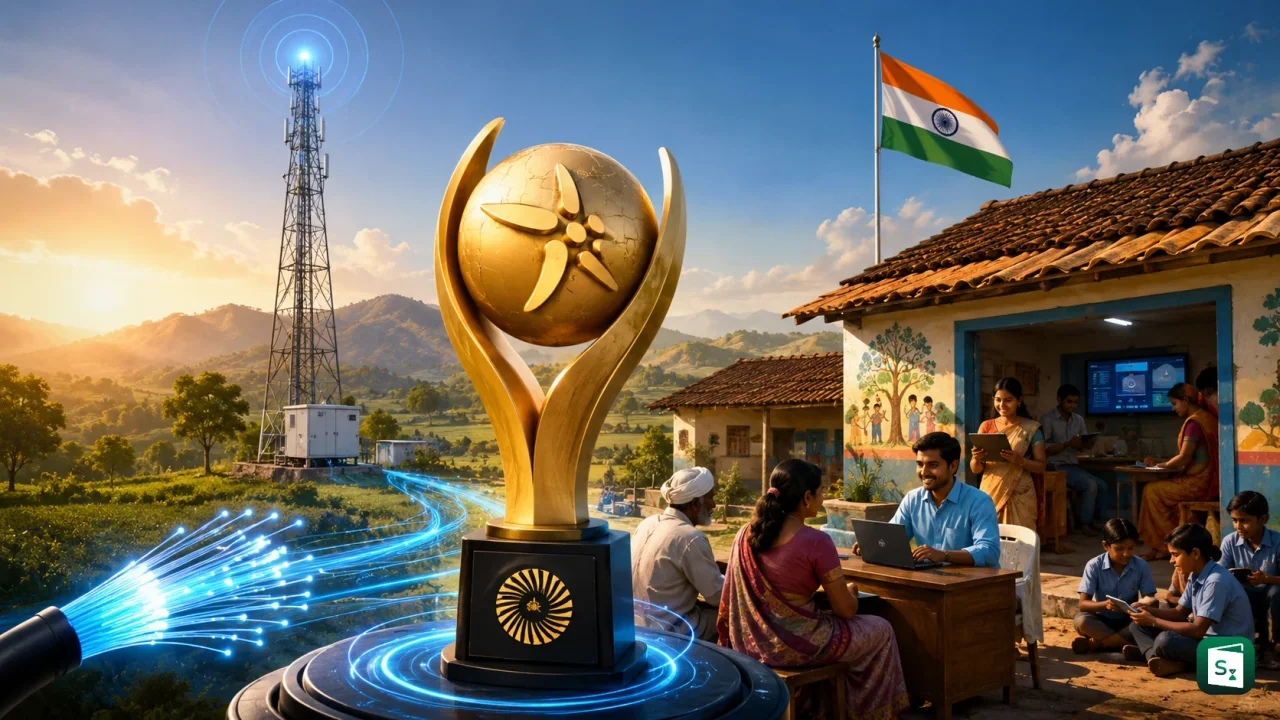
The Department of Telecommunications (DoT) has won the global top honour at the WSIS Prizes 2026 for its Samriddh Gram initiative, an integrated phygital service delivery model powered by BharatNet. The award, presented during the WSIS Forum 2026 in Geneva, recognised the project under Action Line C6 for creating an enabling environment that delivers healthcare, education, banking and e-governance services to rural India. The win places India’s digital public infrastructure model on a global pedestal alongside the world’s most innovative ICT for development projects.
What Are the WSIS Prizes?
The World Summit on the Information Society (WSIS) is a United Nations process that began in two phases: the first in Geneva (2003) and the second in Tunis (2005) . It was created to build a people-centric, inclusive and development-oriented information society where everyone can create, access and share information.
The WSIS Prizes were launched in 2012 as an annual global contest to identify and reward outstanding projects that use information and communication technologies (ICTs) to advance sustainable development. They are an integral part of the WSIS Stocktaking process, which is coordinated by the International Telecommunication Union (ITU) as mandated by the UN General Assembly since 2004.
The ITU is the oldest specialised agency of the United Nations. It was founded on 17 May 1865 as the International Telegraph Union and is headquartered in Geneva, Switzerland. The ITU manages global radio spectrum and satellite orbits, develops technical standards and works to improve ICT access worldwide. Its current Secretary-General is Doreen Bogdan-Martin, the first woman to lead the organisation.
The WSIS Prizes have 18 award categories, each aligned with one of the 11 WSIS Action Lines defined in the Geneva Plan of Action. Action Line C6 (Enabling Environment) focuses on creating policy, regulatory and institutional frameworks that foster ICT growth and digital inclusion. Projects are evaluated through a multi-stage process: technical screening, worldwide public voting and final assessment by the WSIS Expert Committee. In 2026, more than 2.2 million votes were cast globally. Each category selects 5 Champion Projects, from which one Global Winner is chosen.
The Samriddh Gram Initiative
Samriddh Gram: Integrated Phygital Service Delivery Model Enabled by BharatNet is a flagship rural digital transformation initiative of the Department of Telecommunications (DoT) . The Department of Telecommunications was established in 1985 and functions under the Ministry of Communications, headed by Union Minister Jyotiraditya Scindia. It is headquartered at Sanchar Bhawan, New Delhi.
The initiative was launched as a pilot project under the Telecom Technology Development Fund (TTDF) . Four villages were selected for the pilot: Ari and Umri in Madhya Pradesh’s Guna district, Narakoduru in Andhra Pradesh’s Guntur district, and Chaurawala in Uttar Pradesh. The first Samriddhi Kendra was inaugurated by Union Minister Jyotiraditya Scindia at Umri village in March 2026.
At the heart of Samriddh Gram are Samriddhi Kendras, which are one-stop village-level service hubs. Each Kendra combines reliable telecom connectivity with digital platforms and assisted in-person support to deliver services across multiple sectors under one roof. The word “phygital” reflects this blend of physical and digital service delivery.
How Samriddhi Kendras Deliver Integrated Services
Each Samriddhi Kendra functions as a single-window facility offering a comprehensive range of services. In healthcare, residents can access teleconsultations with doctors, Health ATMs for basic diagnostics and emergency care coordination. The education vertical provides smart classrooms, AR and VR based learning tools and digital skill development programmes aligned with government skilling schemes.
For agriculture, the Kendras offer IoT based soil testing, drone support for crop monitoring and smart irrigation guidance. Financial inclusion is addressed through digital banking services and Banking Correspondent facilities that allow cash transactions and account management without travelling to a bank branch. Citizens can also access e-governance services, including documentation assistance, certificate applications and grievance redressal.
The Kendras support e-commerce through integration with the Open Network for Digital Commerce (ONDC) , helping local entrepreneurs and self-help groups sell products on digital marketplaces. Connectivity is delivered through BharatNet fibre to the home (FTTH) broadband and public Wi-Fi hotspots under the PM-WANI framework. The model includes a sustainability mechanism through service delivery revenues, community participation, digital entrepreneurship and convergence with various government programmes.
BharatNet: The World’s Largest Rural Broadband Project
BharatNet is the backbone of the Samriddh Gram initiative. Originally launched in 2011 as the National Optical Fibre Network (NOFN) , it was renamed BharatNet in 2015 . The project is one of the world’s largest rural broadband connectivity programmes, implemented by the Department of Telecommunications with the goal of connecting all Gram Panchayats (GPs) in the country with high-speed broadband.
The project has been executed in phases. Phase I involved connecting GPs through existing optical fibre cables. Phase II adopted an optimal mix of media including optical fibre cable, radio and satellite to reach remote and hilly areas. As of early 2026, more than 2.15 lakh Gram Panchayats across all states and union territories have been made service-ready under BharatNet.
The project was initially implemented by Bharat Broadband Network Limited (BBNL) , a special purpose vehicle under DoT. It has now been merged with the Universal Service Obligation Fund (USOF) for streamlined implementation. BharatNet has enabled digital services ranging from telemedicine and online education to digital payments and e-governance in villages, and the Samriddh Gram initiative builds directly on this infrastructure to convert connectivity into measurable socio-economic outcomes.
Why the WSIS Recognition Matters for India
Among the 18 award categories of the WSIS Prizes 2026, only two projects from India were selected as Champion Projects. Samriddh Gram was the only Indian initiative to go on and win the Global Winner title in its category. The recognition is significant because it validates India’s approach to Digital Public Infrastructure (DPI) as a scalable model for developing nations facing similar challenges of rural connectivity and service delivery.
Union Minister Jyotiraditya Scindia described the achievement as a proud moment for the nation and a testament to the Prime Minister’s vision of a digitally empowered India. He noted that the award reinforces India’s leadership in DPI and shows that solutions designed for India’s unique demographic and geographic challenges can have global relevance.
The win also highlights the shift in India’s telecom policy from providing connectivity alone to building integrated digital service ecosystems. Samriddh Gram demonstrates how last-mile telecom infrastructure, when combined with local facilitation and community participation, can generate tangible improvements in health, education, livelihoods and governance outcomes for rural citizens.
Key Takeaways
- The Department of Telecommunications (DoT) won the WSIS Prizes 2026 Global Winner title under Action Line C6 (Enabling Environment) for its Samriddh Gram project.
- The award was presented during the WSIS Forum 2026 held in Geneva, organised by the International Telecommunication Union (ITU) .
- The ITU, headquartered in Geneva, was founded on 17 May 1865 and is the oldest specialised agency of the United Nations.
- Samriddh Gram is a phygital service delivery model that combines physical Samriddhi Kendras with digital platforms, powered by the BharatNet broadband network.
- BharatNet has made more than 2.15 lakh Gram Panchayats service-ready, making it one of the world’s largest rural broadband initiatives.
- The pilot project is being implemented in four villages: Ari and Umri (Madhya Pradesh) , Narakoduru (Andhra Pradesh) and Chaurawala (Uttar Pradesh) .