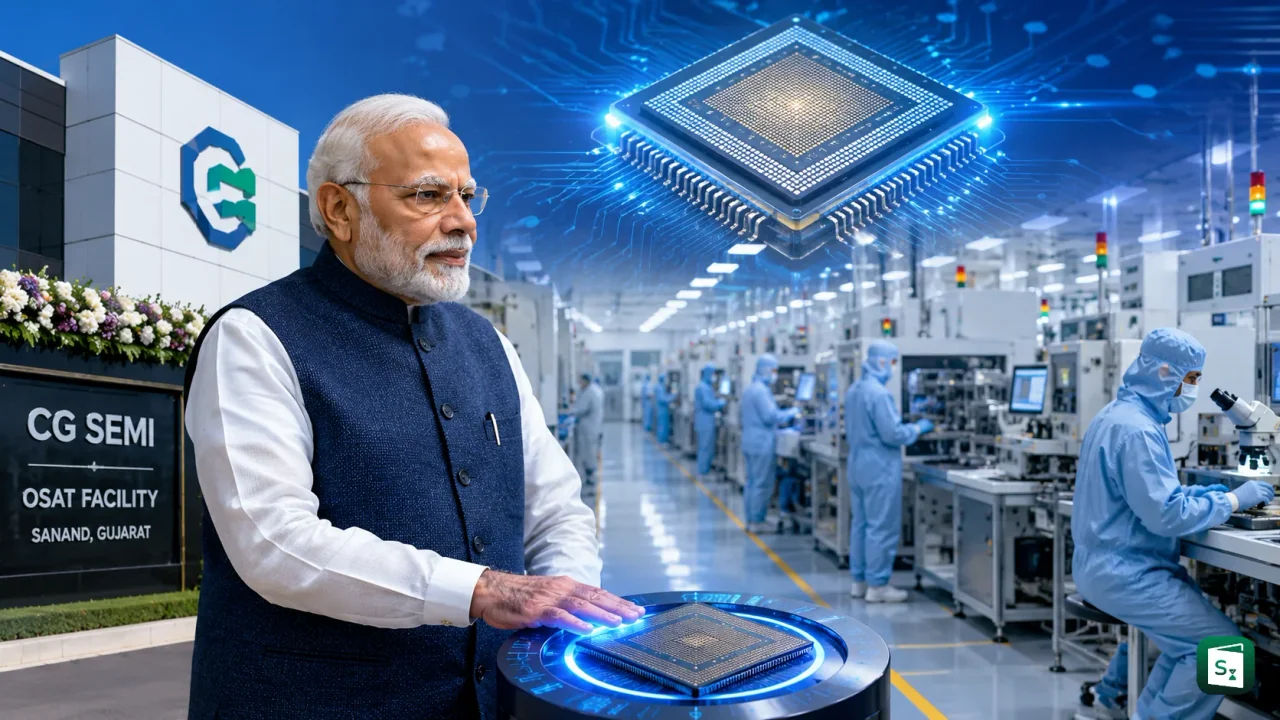
Prime Minister Narendra Modi inaugurated the CG Semi Outsourced Semiconductor Assembly and Test (OSAT) facility in Sanand, Gujarat on 4 July 2026, marking the start of commercial chip production at India’s third operational semiconductor plant. The facility, built with an investment of over ₹7,500 crore, is a joint venture between Murugappa Group firm CG Power, Japan’s Renesas Electronics, and Thailand’s Stars Microelectronics. This milestone places India firmly on the global semiconductor map, with the plant set to produce 200 million chips annually initially, with a target of scaling up to 5 billion chips per year.
What Is an OSAT Facility?
An Outsourced Semiconductor Assembly and Test (OSAT) facility is a specialised plant that handles the back-end processes of semiconductor manufacturing. After chips are fabricated on silicon wafers at a foundry, they are sent to an OSAT facility where they are assembled into packages, tested for functionality and reliability, and prepared for shipment to customers. In simple terms, while a fabrication plant creates the microscopic circuitry on a wafer, an OSAT plant cuts, packages, and tests each individual chip to ensure it works as designed.
The CG Semi facility provides end-to-end services including wafer sorting, chip assembly, packaging, functional testing, failure analysis, test programme development, and logistics support. The plant handles both traditional packages such as Quad Flat No-Lead (QFN) and Quad Flat Package (QFP), as well as advanced packages including Flip Chip Ball Grid Array (FC BGA) and Flip Chip Scale Package (FC CSP). These serve a wide range of industries from automotive and consumer electronics to industrial equipment and 5G telecommunications.
CG Semi and Its Global Partnership
The CG Semi joint venture was approved by the Union Cabinet on 29 February 2024 under India’s semiconductor scheme. CG Power and Industrial Solutions Limited, a Murugappa Group company with nearly 86 years of manufacturing experience, holds 92.3% equity in the venture. Renesas Electronics Corporation, headquartered in Tokyo, Japan, holds about 6.8% and provides advanced semiconductor technology and expertise. Stars Microelectronics, a Thailand-based OSAT provider, holds around 0.9% and contributes technology for legacy packages along with training and enablement.
The project was planned with a total investment of ₹7,600 crore over five years, financed through a mix of government subsidies, equity, and bank borrowings. The facility has been set up in two phases. The G1 facility, which was inaugurated, will operate at a peak capacity of approximately 0.5 million units per day. A second facility, G2, located about 3 km away, is under construction and expected to be completed by the end of 2026.
Prime Minister Modi had laid the foundation stone of the plant in 2024, and the pilot line was inaugurated by Union Electronics and IT Minister Ashwini Vaishnaw in August 2025, when test chip production began. The facility is currently undergoing ISO 9001 and IATF 16949 certification, which are international standards for quality management and automotive industry quality management respectively.
India’s Semiconductor Footprint: A Rapidly Expanding Ecosystem
The CG Semi OSAT facility is the third semiconductor plant in India to begin commercial production, reflecting the pace at which the government’s semiconductor push is yielding results. The first was Micron Technology’s Assembly, Testing, Marking, and Packaging (ATMP) facility, also in Sanand, which began volume production in February 2026. The second was Kaynes Semicon’s OSAT facility in Sanand, inaugurated on 31 March 2026.
Beyond these operational plants, several major projects are under construction:
| Project | Location | Investment | Type | Status |
|---|---|---|---|---|
| Tata Electronics-PSMC | Dholera, Gujarat | ~₹91,000 crore | Wafer Fabrication Fab | Under construction |
| Micron Technology | Sanand, Gujarat | ₹22,516 crore | ATMP (Memory) | Operational |
| CG Semi | Sanand, Gujarat | ₹7,600 crore | OSAT | Operational |
| Kaynes Semicon | Sanand, Gujarat | ₹3,300 crore | OSAT | Operational |
| Tata Electronics | Jagiroad, Assam | - | OSAT | Operational |
| HCL-Foxconn JV | Jewar, Uttar Pradesh | - | OSAT | Under construction |
In total, 10 semiconductor projects have been approved under the India Semiconductor Mission as of 2026, with a cumulative investment of around ₹1.60 lakh crore spread across six states.
Speaking at the inauguration, Union Minister Ashwini Vaishnaw said the chips manufactured at the Sanand facility will be used in cars, scooters, and various industrial applications. Notably, chips made at this plant will be exported to Japan, America, and Europe, signalling India’s emergence as an exporter of semiconductor products rather than just a consumer.
Sanand: India’s First Chip Packaging Cluster
Sanand, once known primarily as an automobile and electronics manufacturing hub, has transformed into India’s first semiconductor chip packaging cluster. The town now hosts three of the country’s operational semiconductor plants. The concentration of multiple OSAT and ATMP facilities in one geographical area creates significant ecosystem advantages, including shared infrastructure, a pooled talent pool, and supply chain efficiencies.
Prime Minister Modi described the facility’s diverse workforce as a “Mini India”, with engineers and professionals from various states working under one roof. This human capital dimension is critical, as the semiconductor industry is expected to generate substantial direct and indirect employment. The Micron facility alone is projected to create over 5,000 direct jobs and an additional 15,000 community jobs.
Gujarat currently hosts four of the ten semiconductor projects approved under the national programme. The state has also established the SAMARTH (Silicon and Advanced Semiconductor Manufacturing Research and Training) Hub at IIT Gandhinagar with a ₹190 crore investment, aiming to train 10,000 individuals over five years in semiconductor research, workforce development, and industry-oriented training.
India Semiconductor Mission: From ISM 1.0 to ISM 2.0
The India Semiconductor Mission (ISM) was launched in December 2021 by the Union Cabinet with an initial outlay of ₹76,000 crore to build a comprehensive domestic semiconductor and display manufacturing ecosystem. The mission is implemented as an Independent Business Division within Digital India Corporation under the Ministry of Electronics and Information Technology (MeitY).
ISM provides fiscal support of up to 50% of capital expenditure for setting up semiconductor fabs, ATMP, and OSAT facilities. It also offers a Design Linked Incentive (DLI) scheme with a ₹1,000 crore outlay to support Indian semiconductor design startups. Over 40 startups have been onboarded under the DLI scheme by 2026.
Building on the success of ISM 1.0, the Union Budget 2026-27 announced ISM 2.0, shifting focus from assembly and testing towards creating a comprehensive, self-reliant semiconductor value chain. ISM 2.0 targets the domestic manufacturing of semiconductor equipment and specialised materials, development of full-stack Indian intellectual property, and strengthening of supply chains. An outlay of ₹1,000 crore was provisioned for ISM 2.0 in FY 2026-27, and subsequent reports indicated a total outlay of ₹1.25 lakh crore being cleared for the next phase.
Significance of the CG Semi OSAT Facility
The inauguration carries multiple layers of significance beyond the immediate milestone. First, it demonstrates India’s ability to execute large-scale high-technology manufacturing projects within tight timelines, from cabinet approval in February 2024 to commercial production in July 2026. Second, the facility’s export orientation, with chips destined for Japan, the US, and Europe, marks a shift from India being a net importer of semiconductors to becoming a participant in global semiconductor supply chains.
Third, the plant strengthens India’s position in the global “China Plus One” strategy, where multinational companies are diversifying their supply chains beyond China. India is positioning itself as a reliable alternate destination for semiconductor assembly and testing, leveraging its large engineering talent pool and policy support.
At the inauguration, PM Modi placed the event in the broader context of India’s electronics revolution. India has become the world’s second-largest mobile phone manufacturer and second-largest mobile phone exporter. Total electronics production has increased by nearly seven times compared to 2014, while electronics exports have grown by nearly eleven times. The Prime Minister described the semiconductor journey as a natural progression: first products, then components, and now semiconductors, building the entire electronics value chain within India as the roadmap to Viksit Bharat and the next phase of Make in India.
Key Takeaways
- The CG Semi OSAT facility in Sanand, Gujarat is a joint venture between CG Power (Murugappa Group), Japan’s Renesas Electronics, and Thailand’s Stars Microelectronics with a total investment of over ₹7,500 crore.
- The facility is India’s third operational semiconductor plant and will produce 200 million chips annually, with a target of scaling to 5 billion chips per year.
- The Union Cabinet approved the project on 29 February 2024 under the India Semiconductor Mission. The pilot line was inaugurated in August 2025, and commercial production began in July 2026.
- CG Power holds 92.3% equity in the joint venture, Renesas holds 6.8%, and Stars Microelectronics holds 0.9%.
- The India Semiconductor Mission (ISM) was launched in December 2021 with a ₹76,000 crore outlay, implemented by Digital India Corporation under MeitY. ISM 2.0 was announced in Budget 2026-27.
- Sanand is emerging as India’s first chip packaging cluster, hosting three operational semiconductor plants, with a fourth wafer fabrication fab under construction in nearby Dholera.