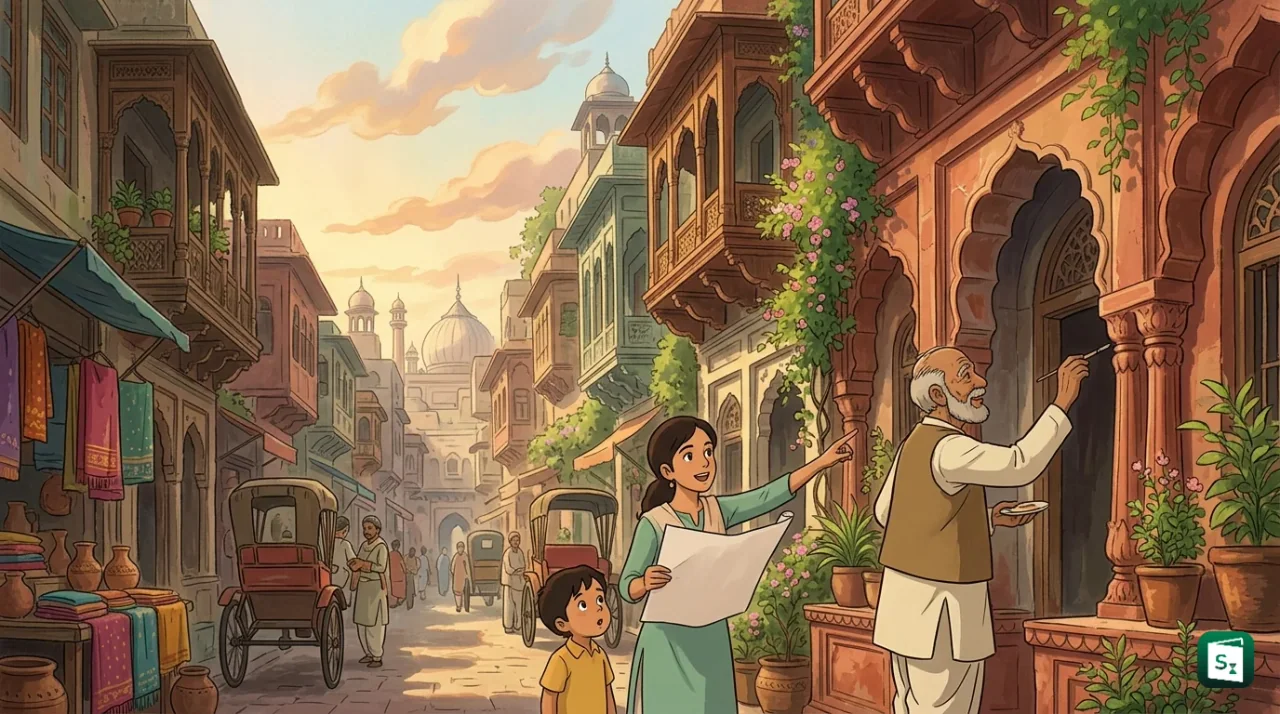
The Delhi government has renamed the Shahjahanabad Redevelopment Corporation (SRDC) as the Indraprastha Virasat Punarvikas Nigam (IVPN), signalling a renewed push to restore the historic, cultural and architectural heritage of Old Delhi. Chief Minister Rekha Gupta, who chaired the corporation’s Annual General Meeting on July 9, 2026, directed officials to prioritise the redevelopment of Chandni Chowk and other key precincts in the Walled City. The rebranding replaces the Mughal-era reference of Shahjahanabad with Indraprastha, the name of the ancient city that, according to the Mahabharata, served as the capital of the Pandavas.
What Was the Shahjahanabad Redevelopment Corporation?
The Shahjahanabad Redevelopment Corporation (SRDC) was set up on May 1, 2008 by the Delhi government as a special purpose vehicle to coordinate the conservation, restoration and infrastructure upgradation of Old Delhi. It was registered as a company limited by shares under Section 25 of the Companies Act, 1956 (now Section 8 of the Companies Act, 2013), making it a not-for-profit entity. The corporation brought together multiple agencies including the Municipal Corporation of Delhi, the Public Works Department and the Tourism Department under one umbrella.
SRDC’s mandate covered the protection of built and natural heritage in the National Capital Territory, including architecturally significant buildings, historical landmarks, living monuments, and sites of socio-cultural value. It was also tasked with preparing redevelopment plans, improving civic services such as water supply, sewerage and electricity, and promoting heritage tourism in the Walled City.
Despite its ambitious charter, SRDC struggled with challenges on the ground. Overlapping jurisdictions among multiple agencies, limited enforcement powers, delays in removing encroachments, and poor coordination plagued its functioning. Several projects remained stalled or incomplete, leaving Old Delhi saddled with illegal parking, tangled overhead cables, poor drainage, and a shortage of public amenities.
Why the Name Was Changed
The decision to rename the corporation was first approved at the 38th board meeting of SRDC on March 13, 2026, chaired by Chief Minister Rekha Gupta. The board shortlisted names and finalised the change, after which the proposal was sent for registration with the Registrar of Companies. Several delegations had earlier approached the Chief Minister requesting a name change, arguing that the corporation’s identity should reflect a broader civilisational heritage rather than a specific Mughal-era reference.
The new name Indraprastha Virasat Punarvikas Nigam combines three elements. Indraprastha refers to the legendary capital of the Pandavas from the Mahabharata, believed to have been located in the Delhi area. Archaeological excavations at Purana Qila have unearthed Painted Grey Ware pottery dating back to around 1200 BCE, suggesting habitation in the region from that period. Virasat means heritage, and Punarvikas means redevelopment. Together, the name signals a shift towards an integrated approach that balances heritage conservation with modern urban development.
The renaming also carries political and cultural significance. While Shahjahanabad was built by Mughal emperor Shah Jahan in 1648 as his capital, Indraprastha evokes a much older lineage that predates the Mughal and even the Sultanate periods. This aligns with the current government’s emphasis on reclaiming and celebrating India’s ancient civilisational heritage.
Old Delhi: A Heritage Treasure
Old Delhi, also known as the Walled City or Shahjahanabad, is one of the capital’s oldest continuously inhabited areas and a repository of layered history. The city was founded by Shah Jahan in 1648 when he moved the Mughal capital from Agra to Delhi. It was designed as a fortified city with 14 gates, a central axis running through Chandni Chowk, and a canal that once ran through its main thoroughfare.
The area covers approximately 7.12 square kilometres and contains an extraordinary concentration of heritage assets:
| Category | Number |
|---|---|
| UNESCO World Heritage Sites | 1 (Red Fort) |
| Nationally protected monuments (ASI) | 10 |
| State-protected monuments | 10 |
| Locally protected heritage sites | More than 700 |
Some of the most prominent landmarks include the Red Fort, Jama Masjid (India’s largest mosque), Fatehpuri Masjid, Khari Baoli (Asia’s largest spice market), Gurudwara Sis Ganj Sahib, and the historic Town Hall on Chandni Chowk. The area also contains the haveli of Mirza Ghalib, the legendary Urdu poet, and the tomb of Razia Sultana, Delhi’s only female medieval ruler.
Lakhs of people visit Old Delhi daily for shopping, business, religious purposes and tourism. However, the area suffers from severe infrastructure pressure. Narrow lanes, illegal encroachments, inadequate parking, poor solid waste management, and deteriorating heritage buildings are among the pressing problems that the IVPN is expected to address.
The Redevelopment Blueprint
At the AGM of the newly renamed IVPN, chaired by Chief Minister Rekha Gupta and attended by Urban Development Minister Ashish Sood (Vice Chairman) and Managing Director Sandeep Kumar, several priority projects were outlined.
Chandni Chowk redevelopment has been identified as the top priority. The CM directed officials to improve public amenities, develop organised parking facilities, and create better access for pedestrians and tourists. A dedicated control room will be set up in the market to provide information, guidance and assistance to visitors.
The historic Town Hall, a colonial-era civic building on Chandni Chowk that once served as the headquarters of the Municipal Corporation of Delhi, will be redeveloped as a heritage tourist destination. The CM directed that a major entry and exit point be created from the Chandni Chowk side to make the building more accessible.
Other specific projects include:
- Integrated development of the Hanuman Temple at Yamuna Bazaar and the surrounding area
- Beautification and redevelopment of the Jama Masjid area
- Comprehensive plan for Shyama Prasad Mukherjee Marg in front of Old Delhi Railway Station
Development work worth approximately ₹160 crore is already underway on 28 roads in Old Delhi, covering road repairs, beautification of public spaces, sanitation improvements, and cleanliness drives. A phased plan is being prepared to move overhead electricity wires underground.
The CM emphasised that heritage conservation and modern development must go hand in hand. Historians, conservation experts, architects and other domain specialists will be involved in planning and execution to ensure sensitivity towards the area’s historical character. The interests of local traders and shopkeepers will also be safeguarded.
Key Takeaways
- The Delhi government renamed the Shahjahanabad Redevelopment Corporation (SRDC) as Indraprastha Virasat Punarvikas Nigam (IVPN) on July 9, 2026.
- SRDC was established on May 1, 2008 as a not-for-profit company under Section 25 of the Companies Act, 1956 (now Section 8 of the Companies Act, 2013).
- Old Delhi (Shahjahanabad) was founded by Mughal emperor Shah Jahan in 1648 and covers approximately 7.12 square kilometres.
- The Walled City contains 1 UNESCO World Heritage Site (Red Fort), 10 nationally protected monuments, 10 state-protected monuments, and over 700 locally protected heritage sites.
- Development works worth ₹160 crore are underway on 28 roads in Old Delhi as part of the revival plan.
- The renaming from Shahjahanabad to Indraprastha draws from the Mahabharata-era name of the ancient Pandava capital, with archaeological evidence at Purana Qila suggesting habitation dating back to 1200 BCE.