The Delhi Cabinet on June 29, 2026 approved the Delhi Electric Vehicle (EV) Policy 2026, a four-year roadmap to transform the national capital into a zero-emission mobility hub. With a total financial outlay of 15,000 crore, the policy will take effect from July 1, 2026 and remain in force until March 31, 2030. Chief Minister Rekha Gupta described it as the most ambitious state-level EV push in the country, combining purchase subsidies, tax waivers, scrappage incentives, and legally binding phase-out dates for fossil fuel vehicle registrations.
What Is the Delhi EV Policy 2026?
The Delhi EV Policy 2026, also referred to as EV Policy 2.0, is the successor to Delhi’s first electric vehicle policy launched in August 2020. The earlier policy was originally designed for a three-year term ending in August 2023 and was extended multiple times. Under that framework, Delhi registered over 4.65 lakh electric vehicles, and EV penetration crossed nearly 20% of new vehicle sales by late 2023, making Delhi one of the leading adopters of electric mobility among Indian states.
The new policy builds on this foundation with a sharper focus on retiring older polluting vehicles and creating binding mandates rather than relying solely on voluntary incentives. The government has allocated 7,000 crore for promotional initiatives and transitioning legacy fleets, and another 8,000 crore for charging infrastructure and direct buyer subsidies.
The urgency behind the policy stems from Delhi’s persistent air quality crisis. According to the Commission for Air Quality Management (CAQM), vehicular emissions contribute 23% of Delhi’s PM2.5 pollution during winter months, making transport the single largest source. Two-wheelers alone account for 67% of the city’s total vehicle stock, while commercial fleets contribute 33% of transport-related emissions. The policy targets 95% electric vehicle registrations among all new vehicles by 2027.
The policy draws its legal basis from Article 21 of the Constitution, which guarantees the right to life including the right to clean air, and from directives of the Supreme Court in the M.C. Mehta Vs. Union of India case.
Tax Waivers and Financial Incentives
The policy introduces a multi-layered incentive structure designed to lower the upfront cost of EV ownership across vehicle categories.
100% Road Tax Exemption for Electric Cars
All pure battery electric vehicles registered in Delhi will receive a 100% exemption from road tax and registration fees. For electric cars, this benefit applies to vehicles with an ex-showroom price of up to 30 lakh. Luxury EVs priced above this threshold are not eligible for any tax concession.
Road tax and registration charges in Delhi typically account for 8% to 12% of a vehicle’s on-road price. A full waiver translates into savings of 1.5 lakh to 2.5 lakh on a mid-range electric car, making the policy one of the most financially attractive state-level EV incentive frameworks in the country.
Strong hybrid vehicles, which combine an internal combustion engine with an electric motor, were initially proposed for a 50% road tax exemption in the draft policy released in April 2026. However, the final approved policy excludes hybrid vehicles from any subsidies or tax benefits, channelling all public funds exclusively toward zero-emission battery electric vehicles.
Direct Benefit Transfer Subsidies
Purchase incentives for electric two-wheelers and three-wheelers follow a step-down structure to encourage early adoption. All subsidies are credited directly to buyers’ bank accounts through the Direct Benefit Transfer (DBT) mechanism via a dedicated online portal managed by the Transport Department.
| Vehicle Category | Year 1 Subsidy | Year 2 Subsidy | Year 3 Subsidy |
|---|---|---|---|
| Electric Two-Wheelers | 30,000 | 20,000 | 10,000 |
| Electric Three-Wheelers | 50,000 | 40,000 | 30,000 |
| N1 Goods Vehicles (up to 3.5 tonnes) | Up to 1,00,000 | 75,000 | 50,000 |
Scrappage Incentives for Older Vehicles
A defining feature of the Delhi EV Policy 2026 is its emphasis on retiring older, more polluting vehicles through scrappage-linked incentives. Owners who scrap a BS-IV or older vehicle and replace it with an electric model are eligible for additional financial benefits on top of the purchase subsidies.
| Vehicle Category | Scrappage Incentive | Conditions |
|---|---|---|
| Four-Wheelers (Cars) | 1,00,000 | First 1 lakh applicants; car must be priced up to 30 lakh; scrapping within 6 months of Certificate of Deposit |
| N1 Commercial Trucks | 50,000 | Standard terms |
| Three-Wheelers | 25,000 | Standard terms |
| Two-Wheelers | 10,000 | Standard terms |
The scrappage incentive for four-wheelers is capped at the first 1 lakh applicants and requires the vehicle owner to scrap the old vehicle within six months of obtaining a Certificate of Deposit. This provision is designed to create an immediate, measurable reduction in the number of BS-IV and older vehicles on Delhi’s roads, which are among the highest contributors to transport emissions.
Phasing Out Combustion Engines: Registration Deadlines
The policy introduces legally binding cut-off dates for new registrations of internal combustion engine vehicles in two key segments. These mandates are the most aggressive regulatory measure in any Indian state EV policy to date.
From January 1, 2027, only electric three-wheelers will be eligible for new registration in Delhi. This marks a major shift in a city where CNG autorickshaws have dominated for years. The three-wheeler segment, which includes passenger autos and goods carriers, is a significant source of urban emissions due to high daily usage and older engine technology.
From April 1, 2028, the registration of new petrol and CNG two-wheelers will cease entirely. Only electric two-wheelers will be permitted for fresh registration after this date. This is a landmark step given that two-wheelers make up nearly 67% of Delhi’s total registered vehicle fleet of over 1.2 crore vehicles.
Charging Infrastructure Expansion
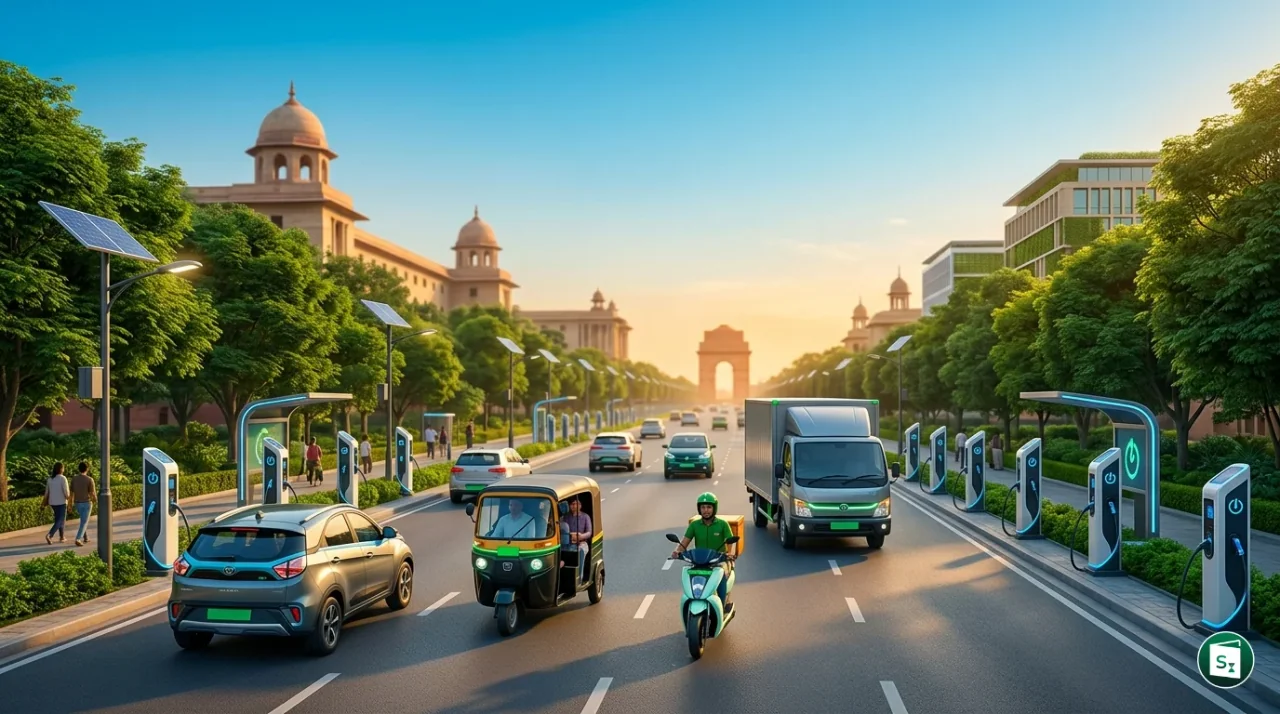
Recognising that charging availability is the single biggest barrier to mass EV adoption, the policy sets ambitious targets for public charging infrastructure. The government plans to deploy over 30,000 public charging points across the capital, with land already identified and allocated for this rollout.
This represents a massive scale-up from Delhi’s existing network. According to the Bureau of Energy Efficiency, Delhi had approximately 1,951 public charging stations as of April 2025. By early 2026, this number had grown to about 5,000 public charging points and some battery swapping stations. The new target is nearly six times the current count.
The policy also introduces supportive measures for charging infrastructure, including concessional land in public parking areas for private charging operators, subsidised electricity tariffs for EV charging, and mandates for EV-ready infrastructure in new buildings. New constructions must reserve 20% of parking spaces with power conduits for future charger installation.
Fleet Electrification Mandates
The policy does not stop at individual buyers. It imposes phased electrification targets on commercial and institutional fleet operators, recognising that these high-utilisation vehicles contribute disproportionately to emissions.
School buses and commercial fleet operators in Delhi must ensure that at least 10% of their fleet is electric within two years, 20% by the third year, and 30% by March 31, 2030. All newly leased or hired vehicles for government departments must be electric within 12 months of the policy’s notification.
In a first-of-its-kind provision for heavy commercial vehicles, the first 1,000 heavy-duty N2 electric trucks (weighing between 3.5 and 12 tonnes) will receive a 10-year exemption from city peak hour No Entry restrictions. This exemption is designed to encourage logistics operators to transition to electric trucks, which currently face severe operational disadvantages due to daytime movement bans in the capital.
Key Takeaways
- The Delhi Cabinet approved the Delhi EV Policy 2026 on June 29, 2026, effective from July 1, 2026 to March 31, 2030, with a total outlay of 15,000 crore.
- A 100% exemption on road tax and registration fees applies to electric cars priced up to 30 lakh (ex-showroom). Luxury EVs above this limit and hybrid vehicles are excluded from all benefits.
- Purchase subsidies are delivered through Direct Benefit Transfer (DBT): 30,000 for two-wheelers and 50,000 for three-wheelers in Year 1, stepping down annually.
- Scrappage incentives of up to 1 lakh for four-wheelers, 50,000 for N1 trucks, 25,000 for three-wheelers, and 10,000 for two-wheelers are offered for replacing BS-IV and older vehicles with EVs.
- Only electric three-wheelers will be registered from January 1, 2027, and only electric two-wheelers from April 1, 2028, marking legally binding phase-outs of internal combustion engine registrations.
- The policy targets deployment of over 30,000 public charging points and mandates 30% fleet electrification for commercial and school operators by March 2030.